Page 422 of 574
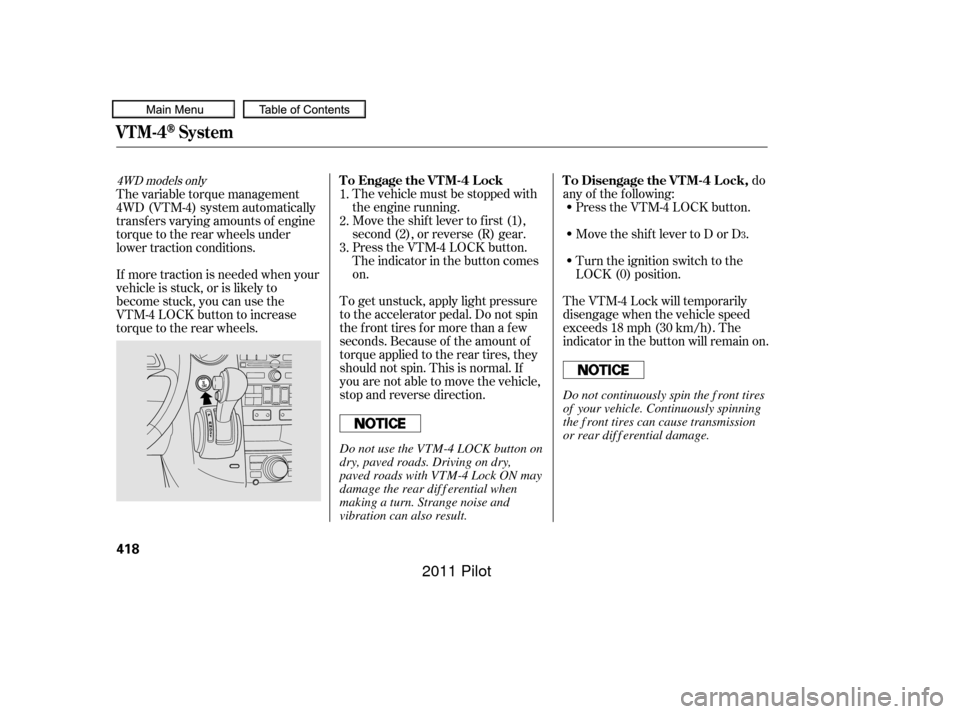
The vehicle must be stopped with
the engine running.do
any of the f ollowing: Press the VTM-4 LOCK button.
Move the shift lever to D or D .
Move the shift lever to first (1),
second (2), or reverse (R) gear.
Turn the ignition switch to the
LOCK (0) position.
Press the VTM-4 LOCK button.
The indicator in the button comes
on.
The VTM-4 Lock will temporarily
disengage when the vehicle speed
exceeds 18 mph (30 km/h). The
indicator in the button will remain on.
To get unstuck, apply light pressure
to the accelerator pedal. Do not spin
the f ront tires f or more than a f ew
seconds. Because of the amount of
torque applied to the rear tires, they
should not spin. This is normal. If
you are not able to move the vehicle,
stop and reverse direction.
If more traction is needed when your
vehicle is stuck, or is likely to
become stuck, you can use the
VTM-4 LOCK button to increase
torque to the rear wheels. The variable torque management
4WD (VTM-4) system automatically
transf ers varying amounts of engine
torque to the rear wheels under
lower traction conditions.
1.
2.
3.
3
4WD models onlyTo Engage the VTM-4 Lock To Disengage the VTM-4 Lock,
VTM-4System
418
Do not continuously spin the f ront tires
of your vehicle. Continuously spinning
the f ront tires can cause transmission
or rear dif f erential damage.
Do not use the VTM-4 LOCK button on
dry, paved roads. Driving on dry,
paved roads with VTM-4 Lock ON may
damage the rear dif f erential when
making a turn. Strange noise and
vibration can also result.
10/01/26 19:35:36 31SZA620_423
2011 Pilot
Page 429 of 574
CONT INUED
To see the inf lation pressures of all
f our tires, press the SEL/RESET
button. The display changes as
shown above.Each tire pressure is shown in PSI
(U.S. models) or in kPa (Canadian
models).
Each tire has its own pressure
sensor. If the air pressure of a tire
becomes signif icantly low, the
sensor in that tire immediately sends
a signal that causes the low tire
pressure/TPMS indicator in the
instrument panel to come on. If this
happens, you will see which tire is
losing pressure on the multi-
inf ormation display along with a
‘‘CHECK TIRE PRESSURE’’
message.
Tire Pressure Monitoring System (TPMS)
Driving
425
U.S. models
Canadian models
10/01/26 19:36:52 31SZA620_430
2011 Pilot
Page 432 of 574

Constant application of the brakes
when going down a long hill builds
up heat and reduces their ef f ective-
ness. Use the engine to assist the
brakes by taking your f oot of f the
accelerator and downshif ting to a
lower gear.
Check the brakes after driving
through deep water. Apply the
brakes moderately to see if they f eel
normal. If not, apply them gently and
f requently until they do. Be extra
cautious in your driving.
Your vehicle is equipped with disc
brakes at all f our wheels. A power
assist helps reduce the ef f ort needed
on the brake pedal. The emergency
brake assist system increases the
stopping f orce when you depress the
brake pedal hard in an emergency
situation. The anti-lock brake system
(ABS) helps you retain steering
control when braking very hard.
Resting your f oot on the pedal keeps
the brakes applied lightly, builds up
heat, reduces their ef f ectiveness and
reduces brake pad lif e. In addition,
f uel economy can be reduced. It also
keeps your brake lights on all the
time, conf using drivers behind you.As required by the FCC:
This device complies with Part 15 of theFCC rules. Operation is subject to thef ollowing two conditions: (1) This devicemay not cause harmf ul interf erence, and(2) this device must accept anyinterf erence received, includinginterf erence that may cause undesiredoperation.
This device complies with IndustryCanada Standard RSS-210.Operation is subject to the f ollowing twoconditions: (1) this device may not causeinterf erence, and (2) this device mustaccept any interf erence that may causeundesired operation of the device.
Changes or modif ications not expressly
approved by the party responsible f orcompliance could void the user’sauthority to operate the equipment.Braking System
Tire Pressure Monitoring System (TPMS), Braking System
428
10/01/26 19:37:21 31SZA620_433
2011 Pilot
Page 440 of 574
Thebestwaytoconfirmthatall
loads are within limits is to check
them at a public scale. For public
scales in your area, check your local
phone book, or contact your trailer
dealer or rental agency for
assistance.
To help ensure a saf e drive to a scale,
or if you cannot get to a public scale,
we recommend that you estimate
your total trailer weight and tongue
load as described next.Add the weight of your trailer (as
quoted by the manuf acturer) with
everything in or on the trailer. Then
check the tables on page to
make sure you do not exceed the
limit f or your conditions.
The maximum allowable weight of
the f ully loaded vehicle and trailer
with the proper hitch is:
The GCWR must be reduced 2
percent f or every 1,000 f eet (305
meters) of elevation. 438
4WD models:
2WD models:
Estimating Loads
Gross Combined Weight Rating
(GCWR):To Estimate the Total Trailer Weight
Towing a Trailer
436
9,579 lbs (4,345 kg)
8,466 lbs (3,840 kg)
10/01/26 19:38:50 31SZA620_441
2011 Pilot
Page 441 of 574
Estimated
tongue load is:
150 lbs (68 kg)
250 lbs (114 kg)
350 lbs (159 kg)
Park the vehicle on level ground.
Measure and record the distance
from the ground to the bottom of
the trailer hitch.
Connect the f ully loaded trailer to
the hitch.
Measure again f rom the ground to
the same spot on the bottom of the
hitch.
Subtract the second measurement
from the first measurement, then
refer to the following table. Estimated
tongue load is:
150 lbs (68 kg)
250 lbs (114 kg)
350 lbs (159 kg)
450 lbs (205 kg)
If thedifferenceismorethan1¾
inch, you have too much load on the
tongue. Redistribute the load or
remove cargo as needed. If the
dif f erence is:
5/8’’
11/4’’
13/4’’ If the
dif f erence is:
5/8’’
11/4’’
13/4’’
21/4’’
If thedifferenceismorethan2¼
inch, you have too much load on the
tongue. Redistribute the load or
remove cargo as needed.
1.
2.
3.
4.
5.
2WD models
4WD models
Towing a Trailer
To Estimate the Tongue Load
Driving
437
10/01/26 19:39:04 31SZA620_442
2011 Pilot
Page 442 of 574

�Î�Î�Î
�Î �Î�Î
�µ�µ
�Î
�Î�Î
T owing is Not Recommended
Number of
Occupants 2
3
4
5
6
7
8 Maximum T otal T railer Weight
Maximum T ongue Load
T owing is Not Recommended
Number of
Occupants 2
3
4
5
6
7
8 Maximum T otal T railer Weight
Maximum T ongue Load
2WD models
4WD models
Towing a Trailer
438
Total Trailer Weight and Tongue Load Limits:
3,500 lbs (1,588 kg)
3,300 lbs (1,497 kg)
3,100 lbs (1,406 kg)
3,000 lbs (1,361 kg)
2,800 lbs (1,270 kg)
2,000 lbs (907 kg) 350 lbs (159 kg)
300 lbs (136 kg)
230 lbs (104 kg)
200 lbs (91 kg)
150 lbs (68 kg)
100 lbs (45 kg)
4,500 lbs (2,041 kg)
4,300 lbs (1,950 kg)
4,100 lbs (1,860 kg)
4,000 lbs (1,814 kg)
3,800 lbs (1,724 kg)
2,000 lbs (907 kg) 450 lbs (204 kg)
400 lbs (181 kg)
330 lbs (150 kg)
270 lbs (122 kg)
190 lbs (86 kg)
100 lbs (45 kg)
The corresponding weight limits assume occupants fill seats from the front of the vehicle to the back, each occupant weighs 150 lbs (68
kg), and each has 15 lbs (7 kg) of cargo in the cargo area. Any additional weight, including cargo or accessories, reduces the maximum
trailer weight and maximum tongue load. Never exceed the gross axle weight ratings (see page ).
Recommended tongue load should be 5 10% of the total trailer weight for boat trailers, and 8 15% of the total trailer weight for all other
trailers. 435
10/01/26 19:39:15 31SZA620_443
2011 Pilot
Page 444 of 574
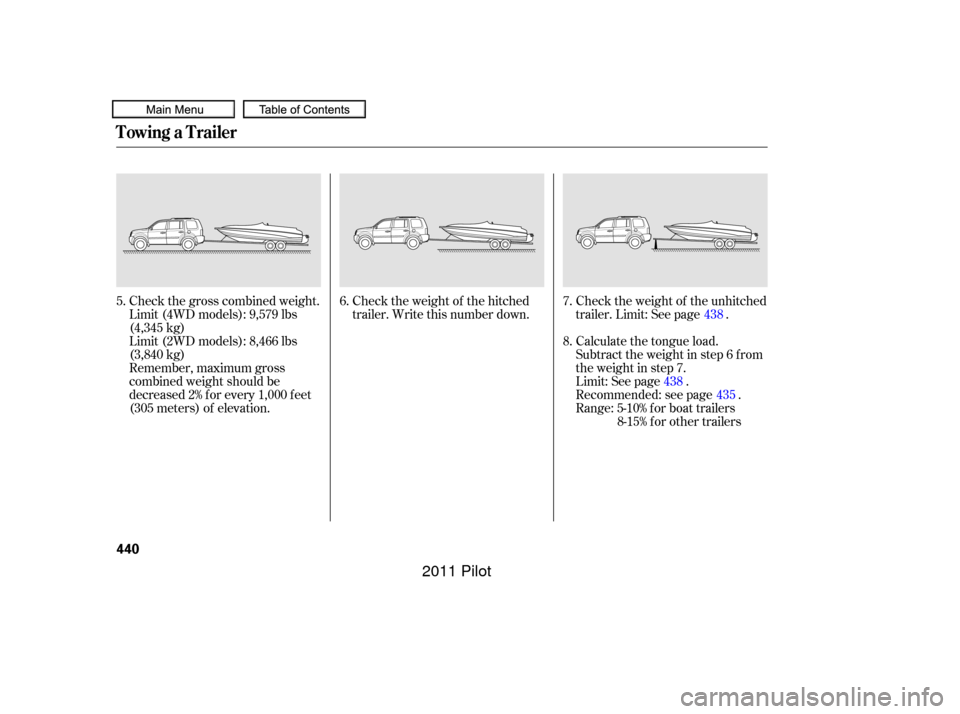
Calculate the tongue load.
Subtract the weight in step 6 f rom
the weight in step 7.
Limit: See page .
Recommended: see page .
Range: 5-10% f or boat trailers8-15% f or other trailers
Check the weight of the unhitched
trailer. Limit: See page .
Check the weight of the hitched
trailer. Write this number down.
Check the gross combined weight.
Limit (4WD models): 9,579 lbs
(4,345 kg)
Limit (2WD models): 8,466 lbs
(3,840 kg)
Remember, maximum gross
combined weight should be
decreased 2% f or every 1,000 f eet
(305 meters) of elevation. 7.
8.
6.
5.
438
438 435
Towing a Trailer
440
10/01/26 19:39:34 31SZA620_445
2011 Pilot
Page 448 of 574

The 7-pin trailer connector is needed
f or the trailer lights. To connect the
connector:Make sure the connector and the
socketarefreeof dirt,moisture,
or other f oreign material.
Open the socket lid by pulling it up.
Your vehicle has a class 3 trailer
hitch as standard equipment.
We recommend that you have your
dealer install a Honda wiring harness
and converter. This harness has
been designed f or your vehicle.
If you use a non-Honda trailer
lighting harness and converter, you
can get the connector and pins that
mate with the connector in your
vehicle f rom your dealer.
Since lighting and wiring vary with
trailer type and brand, you should
also have a qualif ied mechanic install
a suitable connector between the
vehicleandthetrailer.
The jumper harness and trailer
brakefusearestoredintheglove
box.
Also see page f or trailer-related
inf ormation.1.
2.
441
On Touring models
Towing a Trailer
Connect ing t he T railer Connect orsTowing Equipment
444
TRAILER HITCH 7-PIN TRAILER CONNECTOR
LID
7-PIN TRAILER CONNECTOR SOCKET
RETAINING
TAB
RETAINING
TAB
7-PIN TRAILER
CONNECTOR
10/01/26 19:40:24 31SZA620_449
2011 Pilot