Page 279 of 369

This section explains why it is
important to keep your vehicle well
maintained and how to f ollow basic
maintenance saf ety precautions.
This section also includes
instructions on how to read the
Maintenance Minder messages on
the information display, and
instructions f or simple maintenance
tasks you may want to take care of
yourself .
If you have the skills and tools to
perf orm more complex maintenance
tasks on your vehicle, you may want
to purchase the service manual. See
page f or inf ormation on how to
obtain a copy, or see your dealer.U.S. Vehicles:
......................
Maintenance Saf ety . 276
.................
Maintenance Minder . 277
..............................
Fluid Locations . 284
........................
Adding Engine Oil . 285
.........
Changing the Oil and Filter . 286
..............................
Engine Coolant . 288
....................
Windshield Washers . 290
........................
Transmission Fluid .291
Continuously Variable ............
Transmission (CVT) . 291
....................................
Brake Fluid . 292
.............................................
Lights . 293
................................
Roof Antenna . 298
................
Cleaning the Seat Belts . 299
.....................................
Floor Mats . 299
..................
DustandPollenFilter .300
.................................
Wiper Blades . 300
...........................................
Wheels . 303
...............................................
Tires . 303
......
Checking the 12 Volt Battery . 308
.............................
Vehicle Storage . 309
..................................
Interior Care . 310
355
Maintenance
Maintenance, replacement, or
repair of emissions control
devices and systems may be done
by any automotive repair
establishment or individual using
parts that are ‘‘certif ied’’ to EPA
standards.
Maint enance
275
TM
Main Menu
Page 280 of 369
To eliminate potential hazards, read
the instructions bef ore you begin,
and make sure you have the tools
and skills required.To clean parts, use a commercially
available degreaser or parts
cleaner, not gasoline.
To reduce the possibility of f ire or
explosion, keep cigarettes, sparks,
and flames away from the battery
and all f uel-related parts.
Make sure your vehicle is parked
on level ground, the parking brake
is set, and the engine is of f .
Some of the most important saf ety
precautions are given here. However,
we cannot warn you of every
conceivable hazard that can arise in
perf orming maintenance. Only you
can decide whether or not you
should perf orm a given task.Do
not run the engine unless
instructed to do so. Let the
engine and exhaust system cool
down bef ore touching any parts.
Wear eye protection and
protective clothing when working
with the battery or compressed air.
All service items not detailed in this
section should be perf ormed by a
certif ied technician or qualif ied
mechanic.
Be sure there is
adequate ventilation whenever you
operate the engine.
Maintenance Saf ety
Important Saf ety Precautions Injury f rom moving parts.
Burns f rom hot parts.
Carbon Monoxide poison f rom
engine exhaust.
Potential Vehicle Hazards
276 Failure to properly follow
maintenance instructions and
precautions can cause you to
be seriously hurt or killed.
Always follow the procedures
and precautions in this owner’smanual.
Improperly maintaining this
vehicle, or failing to correct a
problem before driving can
cause a crash in which you can
be seriously hurt or killed.
Always follow the inspection
and maintenance
recommendations and
schedules in this owner’smanual.
Main Menu
Page 286 of 369

�µ�µ�µ
�µ
�µ �µ
�Ì Youshouldcheckthefollowing
items at the specif ied intervals. If
you are unsure of how to perf orm
any check, turn to the appropriate
page listed.
Engine oil level Check every
time you fill the fuel tank. See
page .
Engine coolant level Check the
radiator reserve tank every time
youfillthefueltank.Seepage .
Automatic transmission Check
the f luid level monthly. See page .
Brakes Check the f luid level
monthly. See page .
Tires Check the tire pressure
monthly. Examine the tread f or
wear and foreign objects. See page . Lights Check the operation of
the headlights, parking lights,
taillights, high-mount brake light,
turn signals, brake lights, and
license plate light monthly. See
page .
According to state and federal
regulations, f ailure to perf orm
maintenance on the items marked
with will not void your emissions
warranties. However, all
maintenance services should be
perf ormed in accordance with the
intervals indicated by the
inf ormation display.
U.S. Vehicles:
245246
291
303 293
292
Maintenance Minder
Owner’s Maintenance Checks
282
TM
Main Menu
Page 287 of 369

�Î �Î
�Ì �Ì
�Ì
�Î
Maintenance Minder
283
:
TM
See information on maintenance and emissions warranty on page .
If the message ‘‘SERVICE’’ does not appear more than 12 months after the
display is reset, change the engine oil every year.
Independent of the maintenance messages on the information display,
replace the brake fluid every 3 years.
Adjust the valves during services A, B, 1, 2, or 3 only if they are noisy.
Inspect idle speed every 160,000 miles (256,000 km).
NOTE:
282
: Maintenance Main Items
Replace engine oil
Replace engine oil and oil filter
Inspect front and rear brakes
Check parking brake adjustment
Inspect these items: Tie rod ends, steering gear box, and boots
Suspension components
Driveshaft boots
Brake hoses and lines (including ABS/VSA)
All fluid levels and condition of fluids
Exhaust system
Fuel lines and connections Maintenance Sub Items
Rotate tires
Replace air cleaner element
If you drive in dusty conditions, replace every 15,000
miles (24,000 km).
Replace dust and pollen filter If you drive primarily in urban areas that have high
concentrations of soot in the air from industry and
from diesel-powered vehicles, replace every 15,000
miles (24,000 km).
Inspect drive belt
Replace transmission fluid
Replace spark plugs
Inspect valve clearance
Replace engine coolant
AB
Symbol
Symbol
12 3 4 5
Maintenance Minder
Main Menu
Page 288 of 369
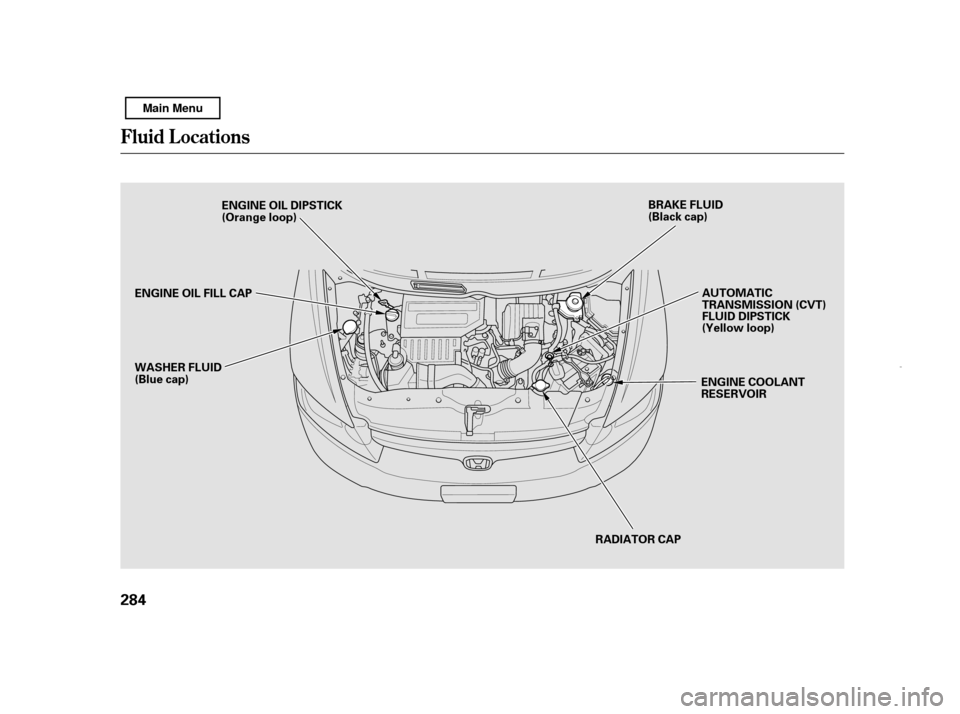
Fluid Locations
284RADIATOR CAP
ENGINE OIL DIPSTICK
(Orange loop)
WASHER FLUID
(Blue cap) AUTOMATIC
TRANSMISSION (CVT)
FLUID DIPSTICK
(Yellow loop)
ENGINE COOLANT
RESERVOIR
BRAKE FLUID
(Black cap)
ENGINE OIL FILL CAP
Main Menu
Page 296 of 369
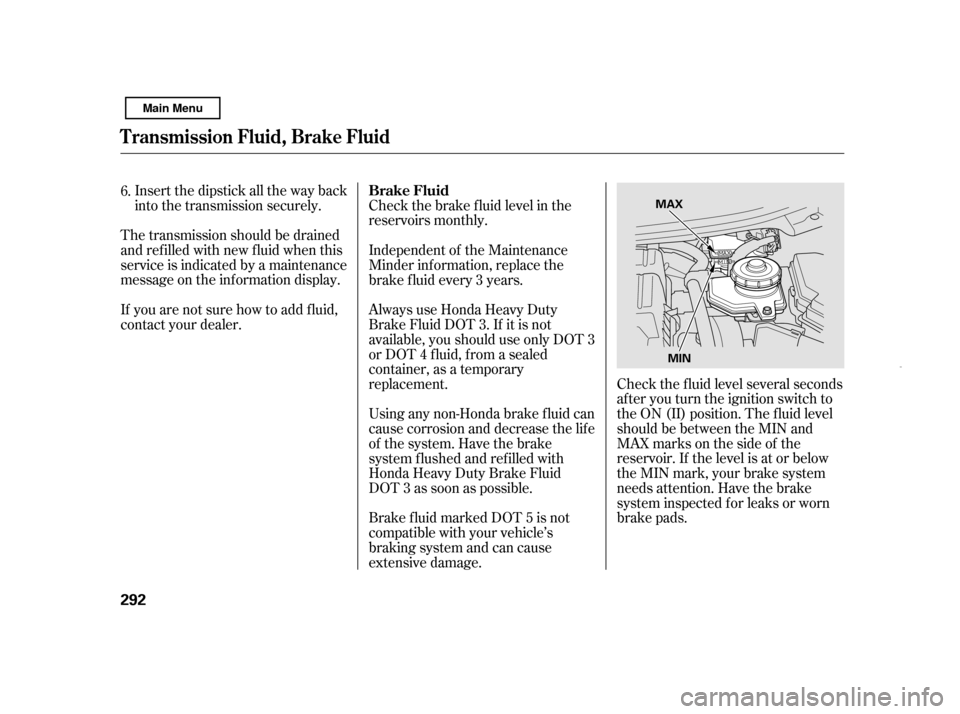
Check the brake f luid level in the
reservoirs monthly.
Insert the dipstick all the way back
into the transmission securely.
The transmission should be drained
and ref illed with new f luid when this
service is indicated by a maintenance
message on the inf ormation display.
If you are not sure how to add f luid,
contact your dealer.
Check the f luid level several seconds
after you turn the ignition switch to
the ON (II) position. The f luid level
should be between the MIN and
MAXmarksonthesideof the
reservoir. If the level is at or below
the MIN mark, your brake system
needs attention. Have the brake
system inspected f or leaks or worn
brake pads.
Independent of the Maintenance
Minder inf ormation, replace the
brake f luid every 3 years.
Brake f luid marked DOT 5 is not
compatible with your vehicle’s
braking system and can cause
extensive damage.
Using any non-Honda brake f luid can
cause corrosion and decrease the lif e
of the system. Have the brake
system f lushed and ref illed with
Honda Heavy Duty Brake Fluid
DOT 3 as soon as possible.
Always use Honda Heavy Duty
Brake Fluid DOT 3. If it is not
available, you should use only DOT 3
or DOT 4 f luid, f rom a sealed
container, as a temporary
replacement.
6.
T ransmission Fluid, Brake Fluid
Brake Fluid
292 MAX
MIN
Main Menu
Page 312 of 369
Mount tire chains on your tires when
required by driving conditions or
local laws. Install them only on the
f ront tires.
Because your vehicle has limited tire
clearance, Honda strongly
recommends using the chains listed
below, made by Security Chain
Company (SCC).
Cable-type: SCC RADIAL CHAIN
SC1030
When installing cables, f ollow the
manuf acturer’s instructions, and
mount them as tight as you can.
Make sure they are not contacting
the brake lines or suspension. Drive
slowly with them installed. If you
hear them coming into contact with
the body or chassis, stop and
investigate. Remove them as soon as
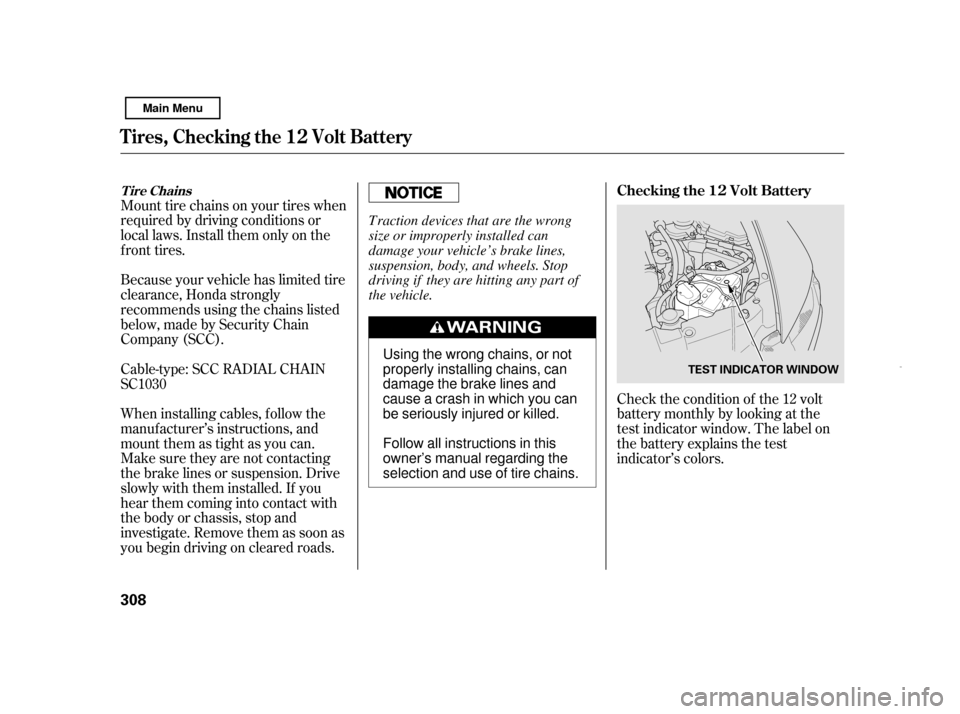
you begin driving on cleared roads.Check the condition of the 12 volt
battery monthly by looking at the
test indicator window. The label on
the battery explains the test
indicator’s colors.
T ire Chains
Tires, Checking the 12 Volt Battery
Checking the 12 Volt Battery
308 TEST INDICATOR WINDOW
Using the wrong chains, or not
properly installing chains, can
damage the brake lines and
cause a crash in which you can
be seriously injured or killed.
Follow all instructions in this
owner’s manual regarding the
selection and use of tire chains.
Traction devices that are the wrong
size or improperly installed can
damage your vehicle’s brake lines,
suspension, body, and wheels. Stop
driving if they are hitting any part of
the vehicle.
Main Menu
Page 313 of 369
�µ
Check the terminals f or corrosion (a
white or yellowish powder). To
remove it, cover the terminals with a
solution of baking soda and water. It
will bubble up and turn brown. When
this stops, wash it of f with plain
water. Dry off the battery with a
cloth or paper towel. Coat the
terminals with grease to help prevent
f urther corrosion.
If additional battery maintenance is
needed, see your dealer or a
qualif ied technician.
Battery posts,
terminals, and related accessories
contain lead and lead compounds.
If you need to connect the battery to
a charger, disconnect both cables to
prevent damaging your vehicle’s
electrical system. Always disconnect
the negative ( ) cable first, and
reconnect it last. If your vehicle’s 12 volt battery is
disconnected or goes dead, the IMA
battery level gauge reading will not
be correct the next time you turn the
ignition switch to the ON (II)
position. It will show less than the
actual level temporarily. It will show
the correct level af ter you drive f or
at least 30 minutes.If you need to park your vehicle f or
an extended period (more than 1
month), there are several things you
should do to prepare it f or storage.
Proper preparation helps prevent
deterioration and makes it easier to
get your vehicle back on the road. If
possible, store your vehicle indoors.
Fill the f uel tank.
Wash and dry the exterior
completely.
Cleantheinterior.Makesurethe
carpeting, floor mats, etc., are
completely dry.
Leave the parking brake off. Put
the transmission in Park.
Block the rear wheels.
CONT INUED
WARNING:
Wash your hands af ter handling. Vehicle Storage
Checking the 12 Volt Battery, Vehicle Storage
Maint enance
309
The battery gives off explosive
hydrogen gas during normaloperation.
A spark or flame can cause the
battery to explode with enough
force to kill or seriously hurt you.
Wear protective clothing and a
face shield, or have a skilled
technician do the batterymaintenance.
Main Menu