Page 321 of 406
•The wiper blades can be cleaned with isopropyl (rubbing) alcohol or
Motorcraft�Premium Windshield Washer Concentrate (ZC-32-A) in
the U.S., or Premium Quality Windshield Washer Fluid [CXC-37-(A, B,
D, or F)] in Canada, available from your authorized dealer. This
washer fluid contains special solution in addition to alcohol which
helps to remove the hot wax deposited on the wiper blade and
windshield from automated car wash facilities. Be sure to replace
wiper blades when they appear worn or do not function properly.
•Do not use abrasives, as they may cause scratches.
•Do not use fuel, kerosene, or paint thinner to clean any parts.
If you cannot remove those streaks after cleaning with the glass cleaner
or if the wipers chatter and move in a jerky motion, clean the outer
surface of the windshield and the wiper blades using a sponge or soft
cloth with a neutral detergent or mild-abrasive cleaning solution. After
cleaning, rinse the windshield and wiper blades with clean water. The
windshield is clean if beads do not form when you rinse the windshield
with water.
Do not use sharp objects, such as a razor blade, to clean the
inside of the rear window or to remove decals, as it may cause
damage to the rear window defroster’s heated grid lines.
INSTRUMENT PANEL/INTERIOR TRIM AND CLUSTER LENS
Clean the instrument panel, interior trim areas and cluster lens with a
clean, damp, white cotton cloth, then use a clean and dry white cotton
cloth to dry these areas.
•Avoid cleaners or polishes that increase the gloss of the upper portion
of the instrument panel. The dull finish in this area helps protect the
driver from undesirable windshield reflection.
•Be certain to wash or wipe your hands clean if you have been in
contact with certain products such as insect repellent and suntan
lotion in order to avoid possible damage to the interior painted
surfaces.
•Do not use household or glass cleaners as these may damage the
finish of the instrument panel, interior trim and cluster lens.
WARNING:Do not use chemical solvents or strong detergents
when cleaning the steering wheel or instrument panel to avoid
contamination of the airbag system.
Cleaning
321
2011 Taurus(500)
Owners Guide, 1st Printing
USA(fus)
Page 327 of 406
OPENING THE HOOD
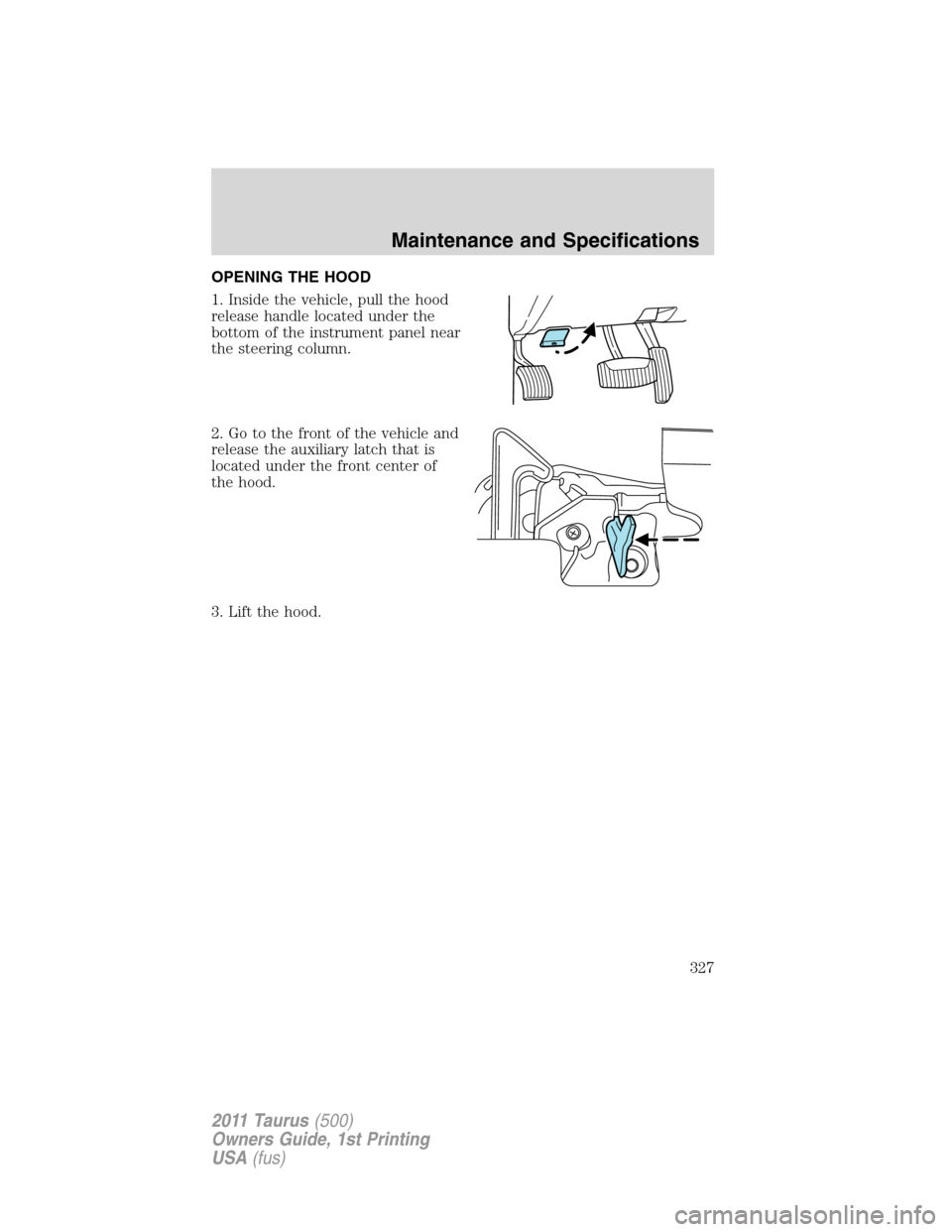
1. Inside the vehicle, pull the hood
release handle located under the
bottom of the instrument panel near
the steering column.
2. Go to the front of the vehicle and
release the auxiliary latch that is
located under the front center of
the hood.
3. Lift the hood.
Maintenance and Specifications
327
2011 Taurus(500)
Owners Guide, 1st Printing
USA(fus)
Page 328 of 406
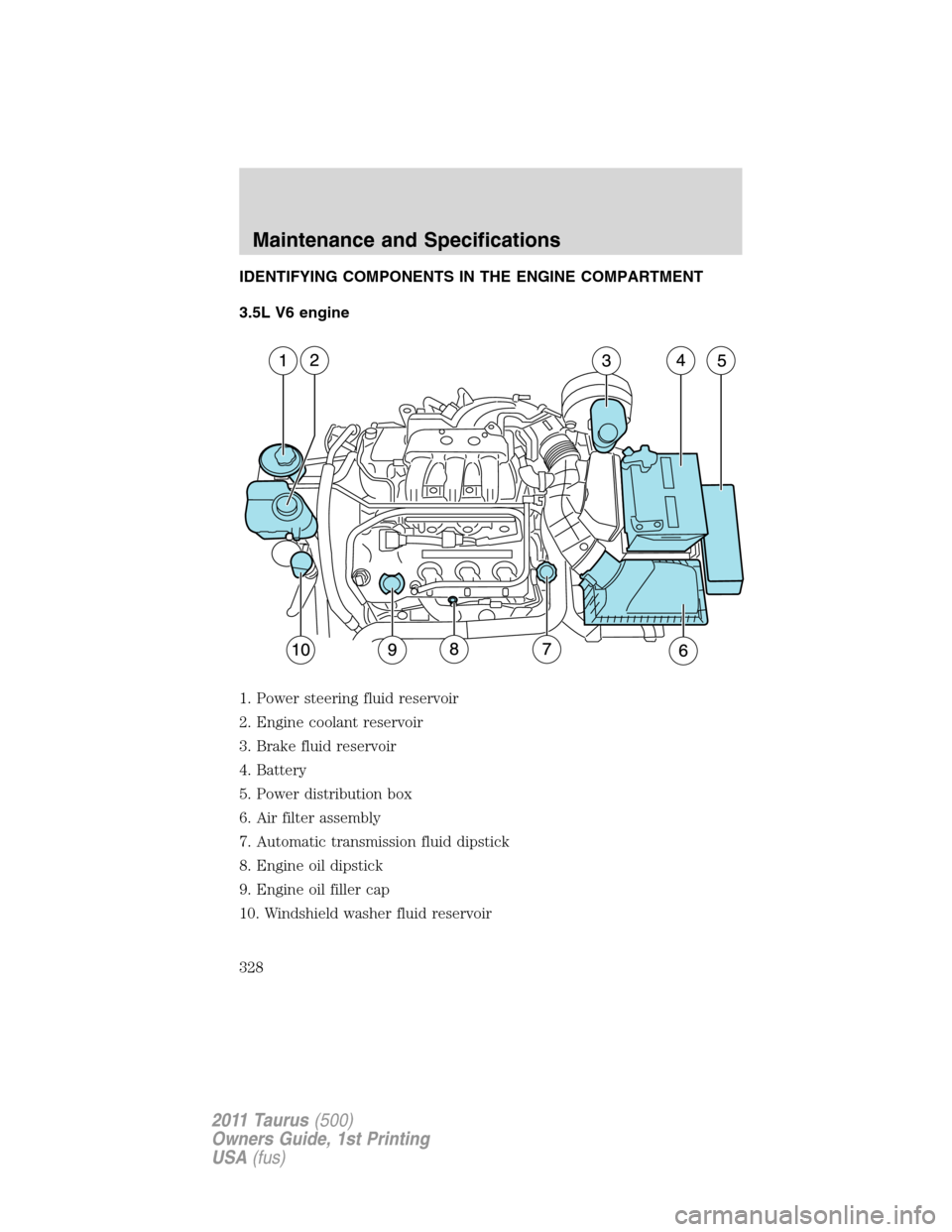
IDENTIFYING COMPONENTS IN THE ENGINE COMPARTMENT
3.5L V6 engine
1. Power steering fluid reservoir
2. Engine coolant reservoir
3. Brake fluid reservoir
4. Battery
5. Power distribution box
6. Air filter assembly
7. Automatic transmission fluid dipstick
8. Engine oil dipstick
9. Engine oil filler cap
10. Windshield washer fluid reservoir
Maintenance and Specifications
328
2011 Taurus(500)
Owners Guide, 1st Printing
USA(fus)
Page 342 of 406
How fail-safe cooling works
If the engine begins to overheat:
•The engine coolant temperature gauge will move to the red (hot)
area.
•The service engine soon
indicator will illuminate.
If the engine reaches a preset over-temperature condition, the engine
will automatically switch to alternating cylinder operation. Each disabled
cylinder acts as an air pump and cools the engine.
When this occurs the vehicle will still operate. However:
•The engine power will be limited.
•The air conditioning system will be disabled.
Continued operation will increase the engine temperature and the engine
will completely shut down, causing steering and braking effort to
increase.
Once the engine temperature cools, the engine can be re-started. Take
your vehicle to a service facility as soon as possible to minimize engine
damage.
When fail-safe mode is activated
You have limited engine power when in the fail-safe mode, so drive the
vehicle with caution. The vehicle will not be able to maintain high-speed
operation and the engine will run rough. Remember that the engine is
capable of completely shutting down automatically to prevent engine
damage, therefore:
1. Pull off the road as soon as safely possible and turn off the engine.
2. Arrange for the vehicle to be taken to a service facility.
3. If this is not possible, wait a short period for the engine to cool.
4. Check the coolant level and replenish if low.
WARNING:Fail-safe mode is for use during emergencies only.
Operate the vehicle in fail-safe mode only as long as necessary to
bring the vehicle to rest in a safe location and seek immediate repairs.
When in fail-safe mode, the vehicle will have limited power, will not be
able to maintain high-speed operation, and may completely shut down
without warning, potentially losing engine power, power steering assist,
and power brake assist, which may increase the possibility of a crash
resulting in serious injury.
Maintenance and Specifications
342
2011 Taurus(500)
Owners Guide, 1st Printing
USA(fus)
Page 355 of 406
indicate that the vehicle is not ready for I/M testing. To determine if the
vehicle is ready for I/M testing, turn the ignition key to the on position
for 15 seconds without cranking the engine. If the service engine
soon
indicator blinks eight times, it means that the vehicle is not
ready for I/M testing; if the service engine soon
indicator stays on
solid, it means that the vehicle is ready for I/M testing.
The OBD-II system is designed to check the emission control system
during normal driving. A complete check may take several days. If the
vehicle is not ready for I/M testing, the following driving cycle consisting
of mixed city and highway driving may be performed:
15 minutes of steady driving on an expressway/highway followed by
20 minutes of stop-and-go driving with at least four 30-second idle
periods.
Allow the vehicle to sit for at least eight hours without starting the
engine. Then, start the engine and complete the above driving cycle. The
engine must warm up to its normal operating temperature. Once started,
do not turn off the engine until the above driving cycle is complete. If
the vehicle is still not ready for I/M testing, the above driving cycle will
have to be repeated.
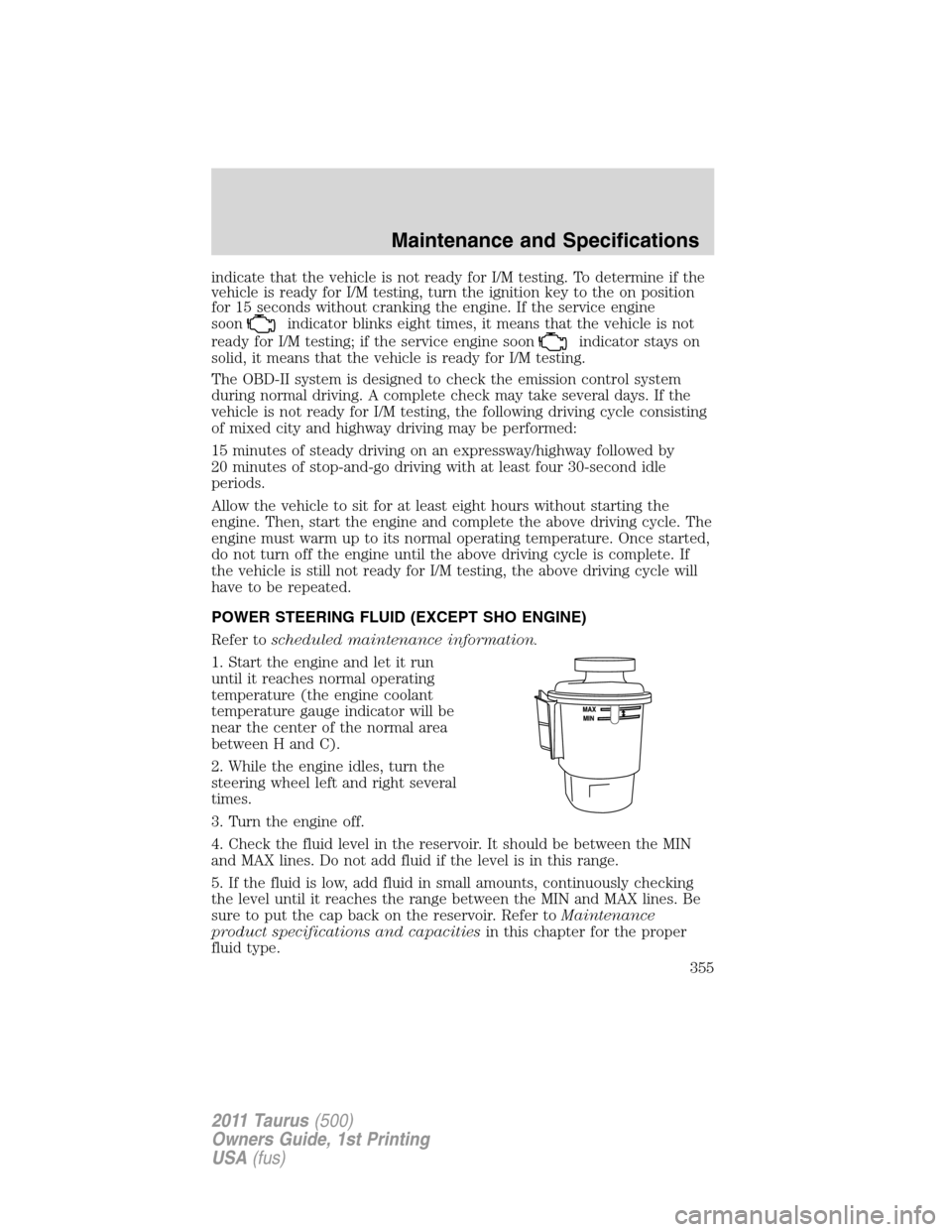
POWER STEERING FLUID (EXCEPT SHO ENGINE)
Refer toscheduled maintenance information.
1. Start the engine and let it run
until it reaches normal operating
temperature (the engine coolant
temperature gauge indicator will be
near the center of the normal area
between H and C).
2. While the engine idles, turn the
steering wheel left and right several
times.
3. Turn the engine off.
4. Check the fluid level in the reservoir. It should be between the MIN
and MAX lines. Do not add fluid if the level is in this range.
5. If the fluid is low, add fluid in small amounts, continuously checking
the level until it reaches the range between the MIN and MAX lines. Be
sure to put the cap back on the reservoir. Refer toMaintenance
product specifications and capacitiesin this chapter for the proper
fluid type.
Maintenance and Specifications
355
2011 Taurus(500)
Owners Guide, 1st Printing
USA(fus)
Page 368 of 406
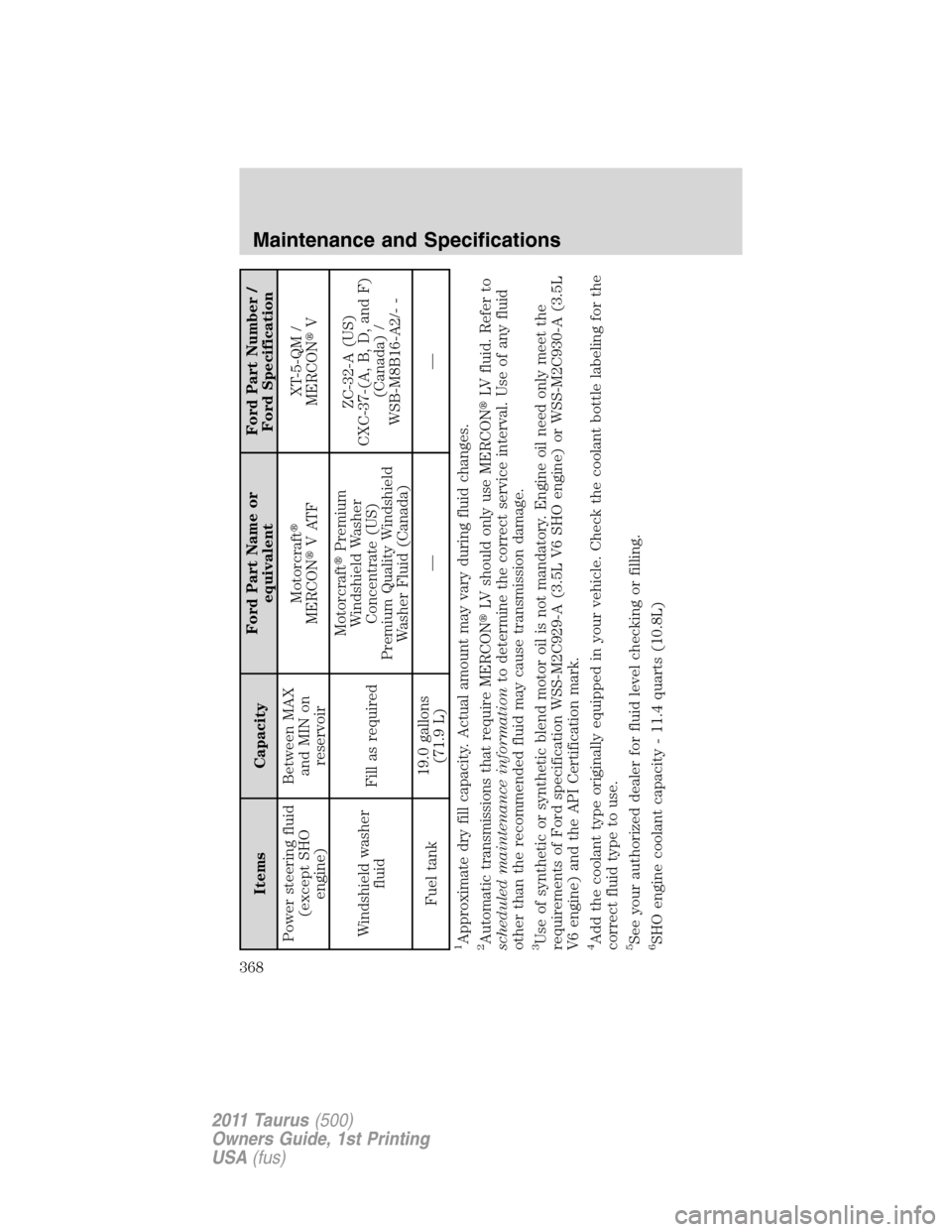
Items CapacityFord Part Name or
equivalentFord Part Number /
Ford Specification
Power steering fluid
(except SHO
engine)Between MAX
and MIN on
reservoirMotorcraft�
MERCON�VATFXT-5-QM /
MERCON�V
Windshield washer
fluidFill as requiredMotorcraft�Premium
Windshield Washer
Concentrate (US)
Premium Quality Windshield
Washer Fluid (Canada)ZC-32-A (US)
CXC-37-(A, B, D, and F)
(Canada) /
WSB-M8B16-A2/- -
Fuel tank19.0 gallons
(71.9 L)——
1Approximate dry fill capacity. Actual amount may vary during fluid changes.2Automatic transmissions that require MERCON�LV should only use MERCON�LV fluid. Refer to
scheduled maintenance informationto determine the correct service interval. Use of any fluid
other than the recommended fluid may cause transmission damage.3Use of synthetic or synthetic blend motor oil is not mandatory. Engine oil need only meet the
requirements of Ford specification WSS-M2C929-A (3.5L V6 SHO engine) or WSS-M2C930-A (3.5L
V6 engine) and the API Certification mark.4Add the coolant type originally equipped in your vehicle. Check the coolant bottle labeling for the
correct fluid type to use.5See your authorized dealer for fluid level checking or filling.6SHO engine coolant capacity - 11.4 quarts (10.8L)
Maintenance and Specifications
368
2011 Taurus(500)
Owners Guide, 1st Printing
USA(fus)
Page 369 of 406
ENGINE DATA
Engine 3.5L V6 engine 3.5L V6 SHO engine
Cubic inches 214 214
FuelSeeOctane
recommendations
earlier in this chapter.SeeOctane
recommendationsearlier
in this chapter.
Firing order 1–4–2–5–3–6 1–4–2–5–3–6
Ignition system Coil on plug Coil on plug
Spark plug gap0.052–0.056 inch
(1.32–1.42 mm)0.033–0.037 inch
(.84–.94 mm)
Compression
ratio10.3:1 10.0:1
Engine drivebelt routing
3.5L V6 engine
1. Short drivebelt is on first pulley groove closest to engine (except
vehicles with electric power assisted steering).
2. Long drivebelt is on second pulley groove farthest from engine.
Maintenance and Specifications
369
2011 Taurus(500)
Owners Guide, 1st Printing
USA(fus)
Page 383 of 406
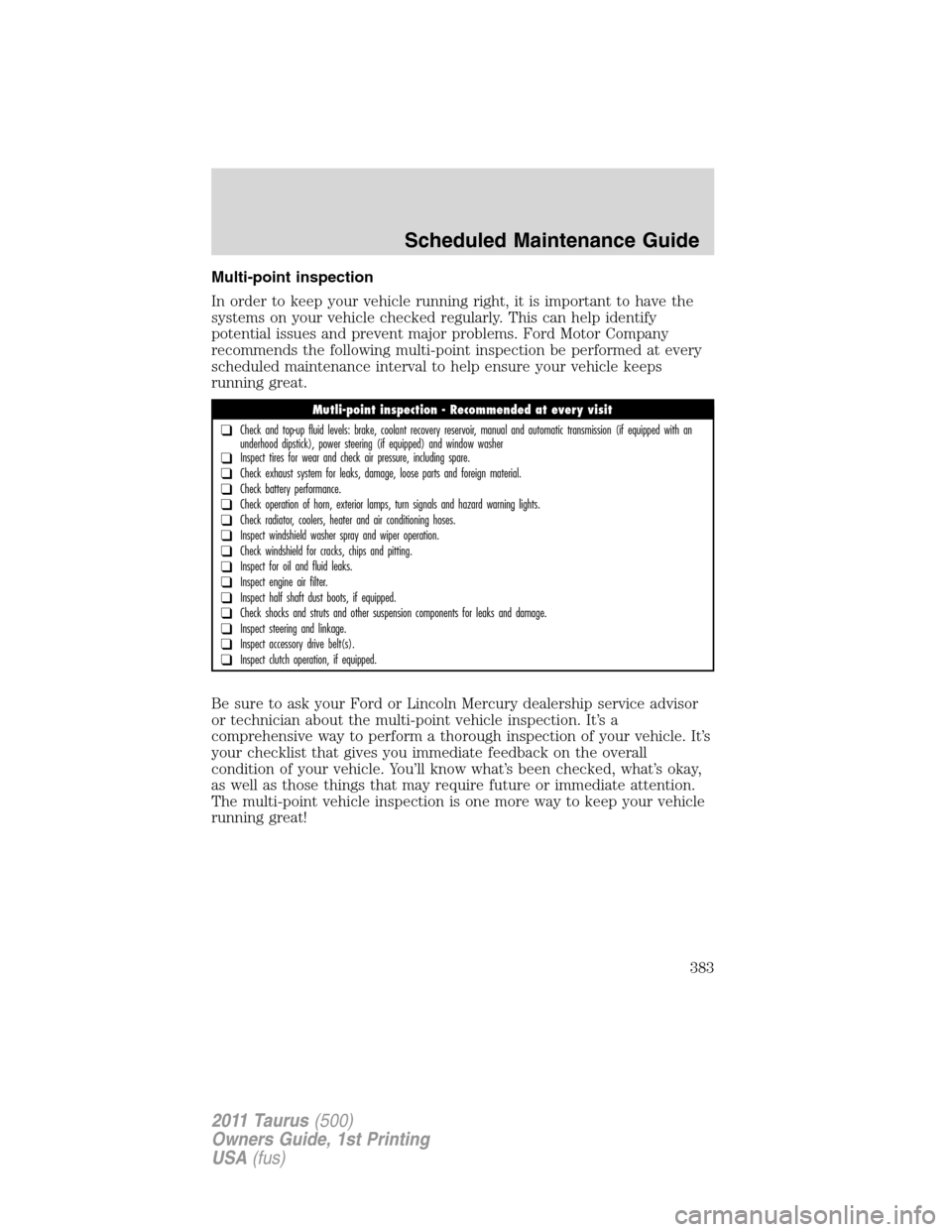
Multi-point inspection
In order to keep your vehicle running right, it is important to have the
systems on your vehicle checked regularly. This can help identify
potential issues and prevent major problems. Ford Motor Company
recommends the following multi-point inspection be performed at every
scheduled maintenance interval to help ensure your vehicle keeps
running great.
Be sure to ask your Ford or Lincoln Mercury dealership service advisor
or technician about the multi-point vehicle inspection. It’s a
comprehensive way to perform a thorough inspection of your vehicle. It’s
your checklist that gives you immediate feedback on the overall
condition of your vehicle. You’ll know what’s been checked, what’s okay,
as well as those things that may require future or immediate attention.
The multi-point vehicle inspection is one more way to keep your vehicle
running great!
Mutli-point inspection - Recommended at every visit
❑Check and top-up fluid levels: brake, coolant recovery reservoir, manual and automatic transmission (if equipped with an
underhood dipstick), power steering (if equipped) and window washer
❑Inspect tires for wear and check air pressure, including spare.
❑Check exhaust system for leaks, damage, loose parts and foreign material.
❑Check battery performance.
❑Check operation of horn, exterior lamps, turn signals and hazard warning lights.
❑Check radiator, coolers, heater and air conditioning hoses.
❑Inspect windshield washer spray and wiper operation.
❑Check windshield for cracks, chips and pitting.
❑Inspect for oil and fluid leaks.
❑Inspect engine air filter.
❑Inspect half shaft dust boots, if equipped.
❑Check shocks and struts and other suspension components for leaks and damage.
❑Inspect steering and linkage.
❑Inspect accessory drive belt(s).
❑Inspect clutch operation, if equipped.
Scheduled Maintenance Guide
383
2011 Taurus(500)
Owners Guide, 1st Printing
USA(fus)