Page 66 of 90
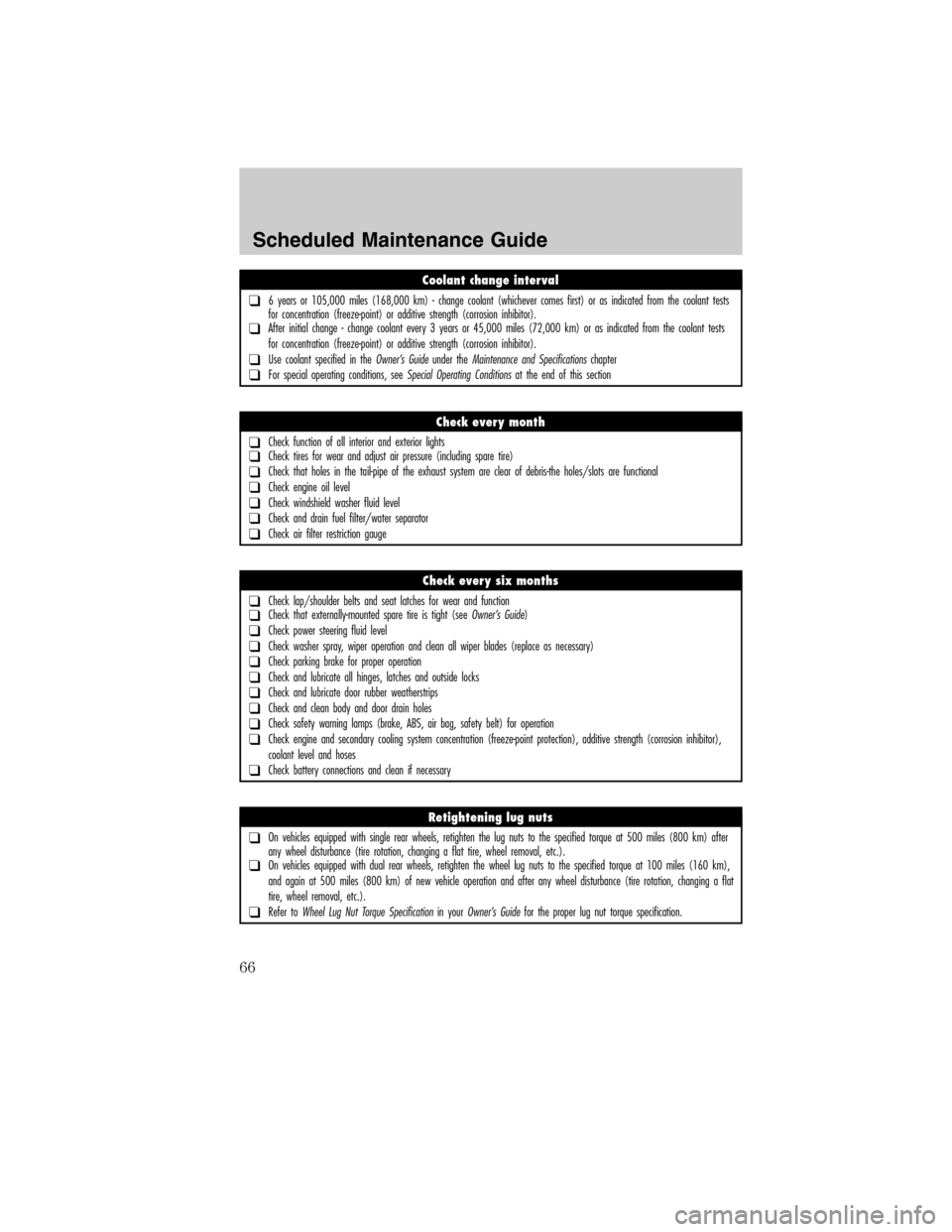
Coolant change interval
❑6 years or 105,000 miles (168,000 km) - change coolant (whichever comes first) or as indicated from the coolant tests
for concentration (freeze-point) or additive strength (corrosion inhibitor).
❑After initial change - change coolant every 3 years or 45,000 miles (72,000 km) or as indicated from the coolant tests
for concentration (freeze-point) or additive strength (corrosion inhibitor).
❑Use coolant specified in theOwner’s Guideunder theMaintenance and Specificationschapter
❑For special operating conditions, seeSpecial Operating Conditionsat the end of this section
Check every month
❑Check function of all interior and exterior lights❑Check tires for wear and adjust air pressure (including spare tire)
❑Check that holes in the tail-pipe of the exhaust system are clear of debris-the holes/slots are functional
❑Check engine oil level
❑Check windshield washer fluid level
❑Check and drain fuel filter/water separator
❑Check air filter restriction gauge
Check every six months
❑Check lap/shoulder belts and seat latches for wear and function❑Check that externally-mounted spare tire is tight (seeOwner’s Guide)
❑Check power steering fluid level
❑Check washer spray, wiper operation and clean all wiper blades (replace as necessary)
❑Check parking brake for proper operation
❑Check and lubricate all hinges, latches and outside locks
❑Check and lubricate door rubber weatherstrips
❑Check and clean body and door drain holes
❑Check safety warning lamps (brake, ABS, air bag, safety belt) for operation
❑Check engine and secondary cooling system concentration (freeze-point protection), additive strength (corrosion inhibitor),
coolant level and hoses
❑Check battery connections and clean if necessary
Retightening lug nuts
❑On vehicles equipped with single rear wheels, retighten the lug nuts to the specified torque at 500 miles (800 km) after
any wheel disturbance (tire rotation, changing a flat tire, wheel removal, etc.).
❑On vehicles equipped with dual rear wheels, retighten the wheel lug nuts to the specified torque at 100 miles (160 km),
and again at 500 miles (800 km) of new vehicle operation and after any wheel disturbance (tire rotation, changing a flat
tire, wheel removal, etc.).
❑Refer toWheel Lug Nut Torque Specificationin yourOwner’s Guidefor the proper lug nut torque specification.
Scheduled Maintenance Guide
66
2011 Econoline(eco)
Supplement, 1st Printing
USA(fus)
Page 67 of 90
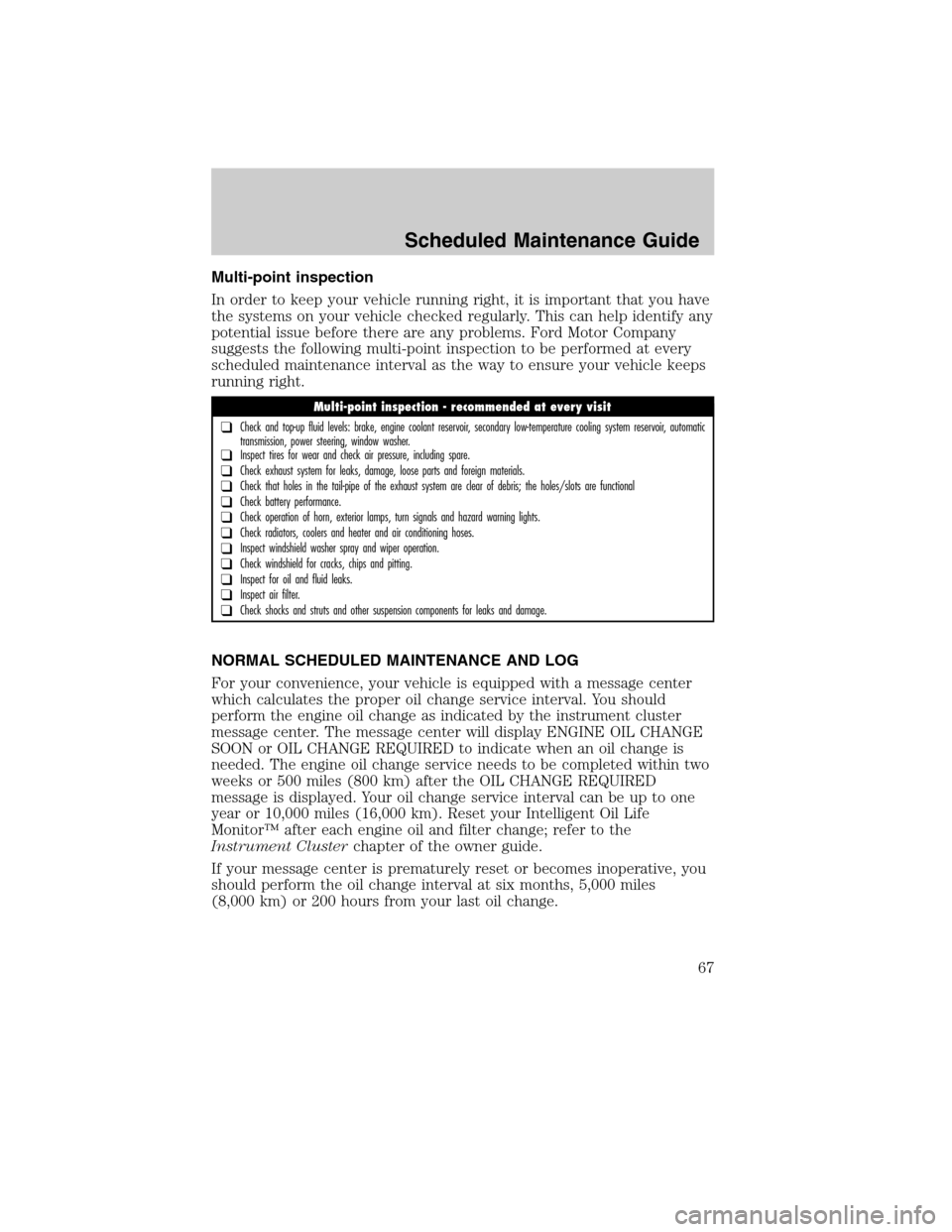
Multi-point inspection
In order to keep your vehicle running right, it is important that you have
the systems on your vehicle checked regularly. This can help identify any
potential issue before there are any problems. Ford Motor Company
suggests the following multi-point inspection to be performed at every
scheduled maintenance interval as the way to ensure your vehicle keeps
running right.
NORMAL SCHEDULED MAINTENANCE AND LOG
For your convenience, your vehicle is equipped with a message center
which calculates the proper oil change service interval. You should
perform the engine oil change as indicated by the instrument cluster
message center. The message center will display ENGINE OIL CHANGE
SOON or OIL CHANGE REQUIRED to indicate when an oil change is
needed. The engine oil change service needs to be completed within two
weeks or 500 miles (800 km) after the OIL CHANGE REQUIRED
message is displayed. Your oil change service interval can be up to one
year or 10,000 miles (16,000 km). Reset your Intelligent Oil Life
Monitor™ after each engine oil and filter change; refer to the
Instrument Clusterchapter of the owner guide.
If your message center is prematurely reset or becomes inoperative, you
should perform the oil change interval at six months, 5,000 miles
(8,000 km) or 200 hours from your last oil change.
Multi-point inspection - recommended at every visit
❑Check and top-up fluid levels: brake, engine coolant reservoir, secondary low-temperature cooling system reservoir, automatic
transmission, power steering, window washer.
❑Inspect tires for wear and check air pressure, including spare.
❑Check exhaust system for leaks, damage, loose parts and foreign materials.
❑Check that holes in the tail-pipe of the exhaust system are clear of debris; the holes/slots are functional
❑Check battery performance.
❑Check operation of horn, exterior lamps, turn signals and hazard warning lights.
❑Check radiators, coolers and heater and air conditioning hoses.
❑Inspect windshield washer spray and wiper operation.
❑Check windshield for cracks, chips and pitting.
❑Inspect for oil and fluid leaks.
❑Inspect air filter.
❑Check shocks and struts and other suspension components for leaks and damage.
Scheduled Maintenance Guide
67
2011 Econoline(eco)
Supplement, 1st Printing
USA(fus)
Page 87 of 90
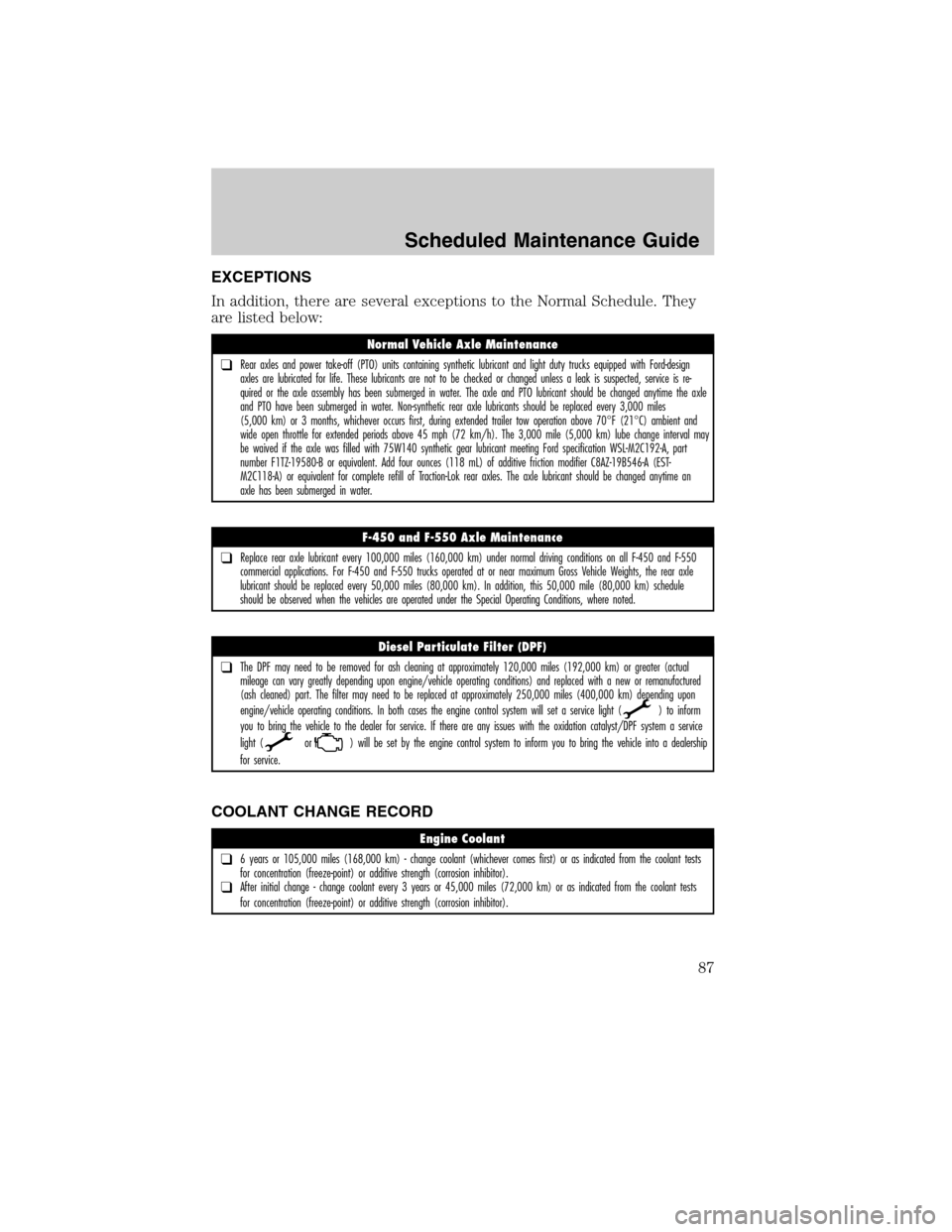
EXCEPTIONS
In addition, there are several exceptions to the Normal Schedule. They
are listed below:
COOLANT CHANGE RECORD
Normal Vehicle Axle Maintenance
❑Rear axles and power take-off (PTO) units containing synthetic lubricant and light duty trucks equipped with Ford-design
axles are lubricated for life. These lubricants are not to be checked or changed unless a leak is suspected, service is re-
quired or the axle assembly has been submerged in water. The axle and PTO lubricant should be changed anytime the axle
and PTO have been submerged in water. Non-synthetic rear axle lubricants should be replaced every 3,000 miles
(5,000 km) or 3 months, whichever occurs first, during extended trailer tow operation above 70°F (21°C) ambient and
wide open throttle for extended periods above 45 mph (72 km/h). The 3,000 mile (5,000 km) lube change interval may
be waived if the axle was filled with 75W140 synthetic gear lubricant meeting Ford specification WSL-M2C192-A, part
number F1TZ-19580-B or equivalent. Add four ounces (118 mL) of additive friction modifier C8AZ-19B546-A (EST-
M2C118-A) or equivalent for complete refill of Traction-Lok rear axles. The axle lubricant should be changed anytime an
axle has been submerged in water.
F-450 and F-550 Axle Maintenance
❑Replace rear axle lubricant every 100,000 miles (160,000 km) under normal driving conditions on all F-450 and F-550
commercial applications. For F-450 and F-550 trucks operated at or near maximum Gross Vehicle Weights, the rear axle
lubricant should be replaced every 50,000 miles (80,000 km). In addition, this 50,000 mile (80,000 km) schedule
should be observed when the vehicles are operated under the Special Operating Conditions, where noted.
Diesel Particulate Filter (DPF)
❑The DPF may need to be removed for ash cleaning at approximately 120,000 miles (192,000 km) or greater (actual
mileage can vary greatly depending upon engine/vehicle operating conditions) and replaced with a new or remanufactured
(ash cleaned) part. The filter may need to be replaced at approximately 250,000 miles (400,000 km) depending upon
engine/vehicle operating conditions. In both cases the engine control system will set a service light (
) to inform
you to bring the vehicle to the dealer for service. If there are any issues with the oxidation catalyst/DPF system a service
light (
or) will be set by the engine control system to inform you to bring the vehicle into a dealership
for service.
Engine Coolant
❑6 years or 105,000 miles (168,000 km) - change coolant (whichever comes first) or as indicated from the coolant tests
for concentration (freeze-point) or additive strength (corrosion inhibitor).
❑After initial change - change coolant every 3 years or 45,000 miles (72,000 km) or as indicated from the coolant tests
for concentration (freeze-point) or additive strength (corrosion inhibitor).
Scheduled Maintenance Guide
87
2011 Econoline(eco)
Supplement, 1st Printing
USA(fus)
Page:
< prev 1-8 9-16 17-24