2011 FORD SUPER DUTY display
[x] Cancel search: displayPage 53 of 90

DIESEL EXHAUST SYSTEM: OXIDATION CATALYST/DIESEL
PARTICULATE FILTER SYSTEM
Your vehicle is equipped with a diesel particulate filter (DPF). The DPF
is an inline filter in the exhaust system which reduces carbon emissions
by trapping exhaust particles before they reach the tailpipe. The DPF
looks similar to a traditional exhaust catalyst, except larger, and is part
of the exhaust system under the vehicle. The DPF is coupled to a diesel
oxidation catalyst, that reduces the amount of harmful exhaust emitted
from the tailpipe. As soot gathers in the system it begins to restrict the
filter. The soot gathered inside the filter needs to be periodically cleaned.
The soot can be cleaned in two different ways; passive regeneration and
active regeneration. Both methods occur automatically and require no
actions from the driver/operator. During either one of these regeneration
methods you may notice an increase/change in exhaust noise/tone. At
certain times, the message center will display various messages related
to the DPF. SeeMessage centerin theInstrument Clusterchapter in
theOwner Guidefor more information.
Passive regeneration
In passive regeneration, the exhaust constituents / temperature are at an
appropriate level where some soot can be reduced or oxidized (burned)
thus cleaning the filter. This method occurs naturally as a result of
normal engine operating conditions (at varying levels due to drive
patterns).
Active regeneration
Once the DPF is full of exhaust particles, the engine control module will
command the exhaust system to clean the DPF through a process called
active regeneration. Active regeneration requires the engine computer to
raise the exhaust temperature to eliminate the particles. During cleaning,
the particles are converted to harmless gasses, and the DPF will then be
clean and ready to continue trapping exhaust particles.
The regeneration process operates more efficiently when the vehicle is
safely operated at least 30 mph (48 km/h) with a steady pedal for
approximately 20 minutes to complete the process. The frequency and
duration of regeneration will fluctuate as both are determined by how
you drive your vehicle, outside air temperature, and altitude. For most
driving, regeneration frequency will vary from 100 - 600 miles (161 -
966 km) between occurrences and each occurrence will last from 9 -
20 minutes. The duration of regeneration is usually reduced if a constant
speed above 30 mph (48 km/h) is maintained.
Maintenance and Specifications
53
2011 Econoline(eco)
Supplement, 1st Printing
USA(fus)
Page 54 of 90
When the engine control module detects that the DPF is nearly full of
particulates and that the vehicle is not being operated in a manner to
allow effective automatic cleaning, the message center will display
several messages guiding the vehicle operator to drive to clean the DPF.
If the vehicle is operated in a manner to allow effective automatic
cleaning, the message center will display CLEANING EXHAUST FILTER,
which is the normal regeneration process. SeeMessage centerin the
Instrument Clusterchapter of theOwner Guidefor more information.
Filter service/maintenance
Over time a slight amount of ash will build up in the DPF which is not
removed during the regeneration process. The DPF may need to be
removed for ash cleaning at approximately 120,000 miles (193,000 km)
or greater (actual mileage can vary greatly depending upon
engine/vehicle operating conditions) and replaced with a new or
remanufactured (ash cleaned) part. The filter may need to be replaced
at approximately 250,000 miles (400,000 km) depending upon
engine/vehicle operating conditions. In both cases the engine control
system will set a service light
to inform you to bring the vehicle to
the dealer for service.
If there are any issues with the oxidation catalyst/DPF system a service
light
orwill be set by the engine control system to inform
you to bring the vehicle into a dealership for service.
Resonator/Tailpipe assembly maintenance
The diesel resonator tail-pipe assembly is a uniquely functioning device
that accompanies the Oxidation Catalyst/DPF assembly. The assembly
serves multiple functions. First it serves as an acoustic device to
attenuate exhaust noise. Second it provides an exit path for the exhaust
from the vehicle. It also is designed to help control the temperature of
the exhaust during DPF regeneration events. The visible holes in each
leg of the twin tip and the holes under the shield just inboard of the
right rear tire(s) are functional. The holes need to be kept clear of
mud/debris or foreign material to maintain proper function of the
exhaust system. Clean and remove debris or foreign material if present
as needed. Spraying with a hose during regular washing of vehicle should
help keep holes clean and clear of debris or foreign material.
Note:Additions of aftermarket devices or modifications to the exhaust
system can reduce the effectiveness of the exhaust system as well as cause
damage to the exhaust system and/or engine. These actions may also affect
the vehicle’s warranty. See theWarranty Guidefor more information.
Maintenance and Specifications
54
2011 Econoline(eco)
Supplement, 1st Printing
USA(fus)
Page 63 of 90

GENERAL MAINTENANCE INFORMATION
Why maintain your vehicle?
This guide describes the scheduled maintenance required for your vehicle.
Carefully following this schedule helps protect against major repair
expenses resulting from neglect or inadequate maintenance and may also
help to increase the value of your vehicle when you sell or trade it.
It is your responsibility to see that all scheduled maintenance is performed
and that the materials used meet Ford engineering specifications. Failure
to perform scheduled maintenance in this guide will invalidate warranty
coverage on parts affected by the lack of maintenance. Be sure receipts for
completed maintenance are kept with the vehicle and confirmation of the
work performed is always recorded in this guide.
Your Ford dealer has factory-trained technicians who can perform the
required maintenance using genuine Ford parts. They are committed to
meeting your service needs and to assuring your continuing satisfaction.
Protecting your investment
Maintenance is an investment that will pay dividends in the form of
improved reliability, durability and resale value. To ensure the proper
performance of your vehicle and its emission control systems, it is imperative
that scheduled maintenance be completed at the designated intervals.
For your convenience, your vehicle is equipped with a message center
which determines the proper oil change service interval. You should
perform the engine oil change as indicated by the instrument cluster
message center. The message center will display ENGINE OIL CHANGE
SOON or OIL CHANGE REQUIRED to indicate when an oil change is
needed. The engine oil change service needs to be completed within two
weeks or 500 miles (800 km) after the OIL CHANGE REQUIRED
message is displayed. Your oil change service interval can be up to one
year or 10,000 miles (16,000 km) depending on operating conditions.
Reset your Intelligent Oil Life Monitor™ after each engine oil and filter
change; refer to theInstrument Clusterchapter of the owner guide.
If your message center is prematurely reset or becomes inoperative, you
should perform the oil change interval at six months, 5,000 miles
(8,000 km) or 200 hours from your last oil change.
Your vehicle is very sophisticated and built with multiple complex
performance systems. Every manufacturer develops these systems using
different specifications and performance features. That’s why it’s
important to rely upon your Ford dealership to properly diagnose and
repair your vehicle.
Scheduled Maintenance Guide
63
2011 Econoline(eco)
Supplement, 1st Printing
USA(fus)
Page 67 of 90
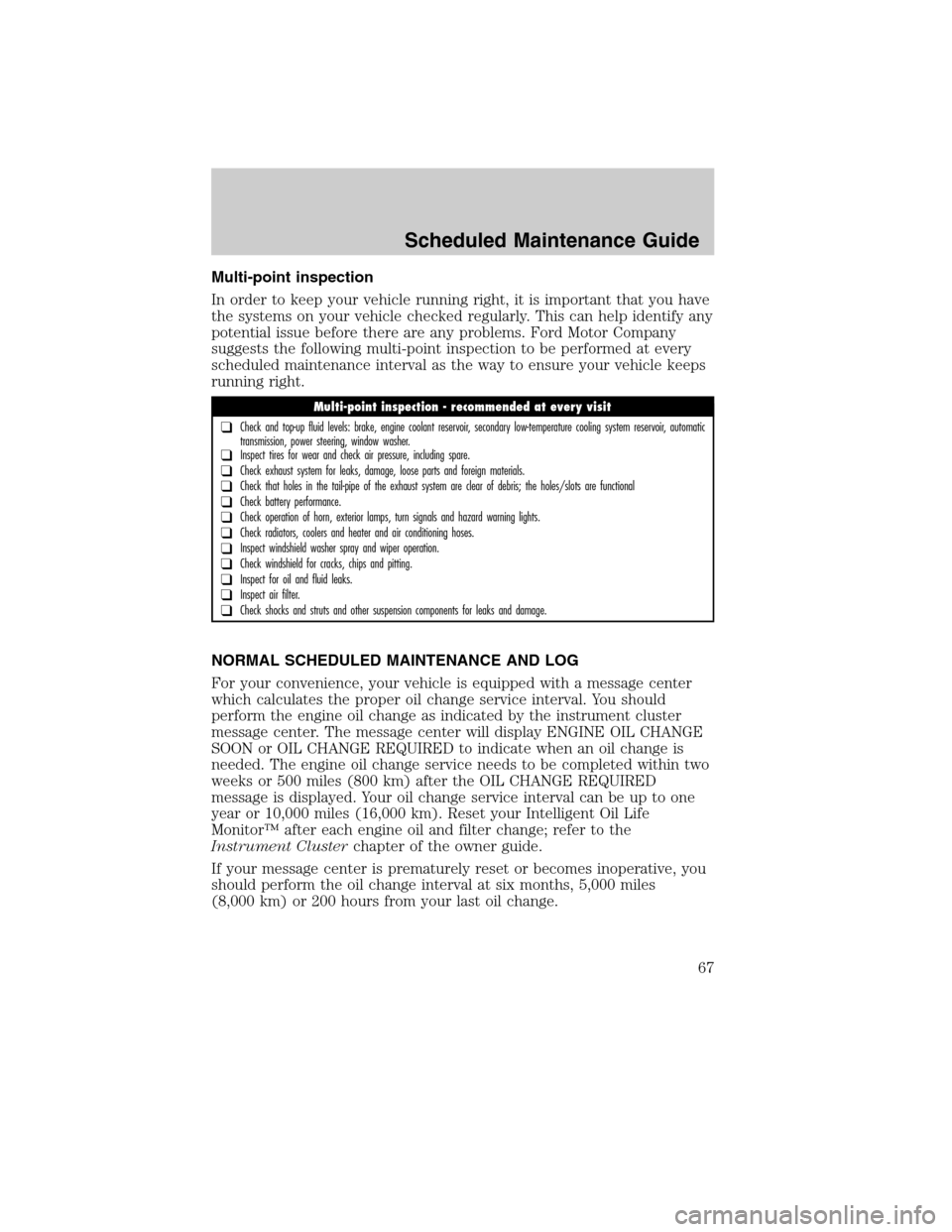
Multi-point inspection
In order to keep your vehicle running right, it is important that you have
the systems on your vehicle checked regularly. This can help identify any
potential issue before there are any problems. Ford Motor Company
suggests the following multi-point inspection to be performed at every
scheduled maintenance interval as the way to ensure your vehicle keeps
running right.
NORMAL SCHEDULED MAINTENANCE AND LOG
For your convenience, your vehicle is equipped with a message center
which calculates the proper oil change service interval. You should
perform the engine oil change as indicated by the instrument cluster
message center. The message center will display ENGINE OIL CHANGE
SOON or OIL CHANGE REQUIRED to indicate when an oil change is
needed. The engine oil change service needs to be completed within two
weeks or 500 miles (800 km) after the OIL CHANGE REQUIRED
message is displayed. Your oil change service interval can be up to one
year or 10,000 miles (16,000 km). Reset your Intelligent Oil Life
Monitor™ after each engine oil and filter change; refer to the
Instrument Clusterchapter of the owner guide.
If your message center is prematurely reset or becomes inoperative, you
should perform the oil change interval at six months, 5,000 miles
(8,000 km) or 200 hours from your last oil change.
Multi-point inspection - recommended at every visit
❑Check and top-up fluid levels: brake, engine coolant reservoir, secondary low-temperature cooling system reservoir, automatic
transmission, power steering, window washer.
❑Inspect tires for wear and check air pressure, including spare.
❑Check exhaust system for leaks, damage, loose parts and foreign materials.
❑Check that holes in the tail-pipe of the exhaust system are clear of debris; the holes/slots are functional
❑Check battery performance.
❑Check operation of horn, exterior lamps, turn signals and hazard warning lights.
❑Check radiators, coolers and heater and air conditioning hoses.
❑Inspect windshield washer spray and wiper operation.
❑Check windshield for cracks, chips and pitting.
❑Inspect for oil and fluid leaks.
❑Inspect air filter.
❑Check shocks and struts and other suspension components for leaks and damage.
Scheduled Maintenance Guide
67
2011 Econoline(eco)
Supplement, 1st Printing
USA(fus)