2011 FORD KUGA Electric
[x] Cancel search: ElectricPage 86 of 2057

Action
Possible Sources
Symptom
BLEED the power steering
system.
REFER to:Power Steering
System Vacuum Bleeding (211-
00 Steering System - General
Information, General Proced-
ures).
Power steering fluid aeration.
Power steering system whine
noise – a high pitched buzzing
sound like an electric motor or
drill. Whine occurs at the higher
engine rpm, 1500 - 5000 rpm,
frequency does not change if
system is loaded or not loaded. FLUSH the power steering
system.
REFER to:
Power Steering
System Flushing (211-00
Steering System - General
Information, General Proced-
ures).
Incorrect power steering fluid.
FLUSH the power steering
system.
REFER to:Power Steering
System Flushing (211-00
Steering System - General
Information, General Proced-
ures).
Overheated power steering fluid.
Certain amount of noise level
acceptable, not a safety critical
item.
Hydraulic operating condition of
the power steering pump.
Power Steering Hiss Noise
Test Condition
Listen for steering hiss noise with the vehicle
parked, transmission in neutral and all windows
closed in the following test conditions.
G37349en2008.50 Kuga8/2011
100-04-
8
Noise, Vibration and Harshness
100-04- 8
DIAGNOSIS AND TESTING
TO MODEL INDEX
BACK TO CHAPTER INDEX
FORD KUGA 2011.0MY WORKSHOP REPAIR MANUAL
Page 154 of 2057

SECTION 412-02 Auxiliary Climate Control
VEHICLE APPLICATION:
2008.50 Kuga
PAGE
CONTENTS
DESCRIPTION AND OPERATION
412-02-2
Auxiliary Climate Control (Component Location) ................................................................
412-02-4
Auxiliary Climate Control (Overview) ..................................................................................
412-02-4
Initial start-up of the fuel-fired booster heater .....................................................................
412-02-4
Lockout ...............................................................................................................................
412-02-4
Unlocking the control unit ...................................................................................................
412-02-5
Auxiliary Climate Control (System Operation and Component Description) ......................
412-02-5
System Diagram.................................................................................................................
412-02-12
System Operation ...............................................................................................................
412-02-12
Electric Booster Heater ...................................................................................................
412-02-12
Fuel-fired heater - function diagram................................................................................
412-02-13
Boost heat mode.............................................................................................................
412-02-13
Programmable fuel fired booster heater .........................................................................
412-02-13
Immediate start-up of the booster heater ........................................................................
412-02-13
Programmed start-up of the booster heater ....................................................................
412-02-14
Emergency shutoff ..........................................................................................................
412-02-14
Component Description ......................................................................................................412-02-14Electric Booster Heater...................................................................................................
412-02-14Detailed illustration of fuel-fired heater ...........................................................................
412-02-16Flame sensor..................................................................................................................
412-02-16Overheat Sensor.............................................................................................................
412-02-16ECT.................................................................................................................................
412-02-16Water pump....................................................................................................................
412-02-16Fuel pump.......................................................................................................................
REMOVAL AND INSTALLATION 412-02-17
Auxiliary Coolant Flow Pump ..............................................................................................
412-02-18
Electric Booster Heater .......................................................................................................
412-02-21
Fuel Fired Booster Heater — 2.5L Duratec (147kW/200PS) - VI5 .....................................
412-02-25
Fuel Fired Booster Heater Fuel Pump ................................................................................
DISASSEMBLY AND ASSEMBLY 412-02-26
Fuel Fired Booster Heater .................................................................................................. 412-02-1
Auxiliary Climate Control
412-02-1
.
TO MODEL INDEX
BACK TO CHAPTER INDEX
FORD KUGA 2011.0MY WORKSHOP REPAIR MANUAL
Page 160 of 2057

Description
Item
Electric Booster HeaterRefer to Component Description: (page
?)
1
GEM (generic electronic module)
2
Outside temperature sensor
3
Climate control system control assembly
4 Description
Item
Generator and Alternator
5
PCM (powertrain control module)
6
Coolant temperature sensor (ECT (engine
coolant temperature) sensor)Refer to Component Description: ECT
(page ?)
7
instrument cluster
8 G1066982en
2008.50 Kuga 8/2011 412-02-7
Auxiliary Climate Control
412-02-7
DESCRIPTION AND OPERATIONTO MODEL INDEX
BACK TO CHAPTER INDEX
FORD KUGA 2011.0MY WORKSHOP REPAIR MANUAL
Page 162 of 2057

Description
Item
Electric Booster HeaterRefer to Component Description: (page
?)
1
GEM2
Outside temperature sensor
3
Climate control system control assembly
4 Description
Item
Generator and Alternator
5
PCM6
Coolant temperature sensor (ECT sensor)Refer to Component Description: ECT
(page ?)
7
instrument cluster
8 G1066982en
2008.50 Kuga 8/2011 412-02-9
Auxiliary Climate Control
412-02-9
DESCRIPTION AND OPERATIONTO MODEL INDEX
BACK TO CHAPTER INDEX
FORD KUGA 2011.0MY WORKSHOP REPAIR MANUAL
Page 165 of 2057

System Operation
Electric Booster Heater
In diesel vehicles which give off little residual heat,
a booster heater is used to heat the passenger
compartment rapidly in the case of low ambient
temperatures.
If the interior temperature has been set to HI, or if
the heater controls have been switched to the
highest setting, the two-zone air conditioning
system sends an "electric booster heater ON"
request signal to the CAN (controller area network)
via the medium speed GEM bus. If a manual air
conditioning system is installed, the signal is
transmitted via a conventional cable connection.
The GEM switches on the electric booster heater
depending on the following parameters:
• Engine coolant temperature is below 60 °C.
• Ambient air temperature is below 10 °C.
• Sufficient generator capacity is available.
The electric booster heater electronics activate
three output stages as a function of a pulse width
modulated signal PWM (pulse width modulation)
generated by the GEM. The output stages switch
the three heating elements of the electric booster
heater ON or OFF individually, whereby the heating
periods of the individual elements can overlap. Due
to the variable switch-on duration, continuously
variable temperature control is possible. The overall
heating power of the three heating elements is
linearly proportional to the PWM signal. If the PWM
signal is below 10% or above 95%, the electric
booster heater is not activated.
The electric booster heater is switched off when
an engine coolant temperature of 70°C or an
ambient air temperature of 20°C is exceeded.
Fuel-fired heater - function diagram G1066982en
2008.50 Kuga 8/2011 412-02-12
Auxiliary Climate Control
412-02-12
DESCRIPTION AND OPERATIONTO MODEL INDEX
BACK TO CHAPTER INDEX
FORD KUGA 2011.0MY WORKSHOP REPAIR MANUAL12345671205304254481201056820108V58911121112E977670
Page 167 of 2057

reprogrammed. However, if the engine hasn't been
run since the last programmed start, the fuel-fired
booster heater will not start up the second time so
as to prevent the battery from being discharged.
The length of time required to pre-heat the vehicle
is calculated in the control unit of the fuel-fired
booster heater and is based on two temperature
values:
• Ambient air temperature: this message is taken
from the GEM via the CAN bus.
• Coolant temperature: this is determined via an internal sensor in the fuel-fired booster heater.
The maximum heating time is 30 minutes at an
outside air temperature of -10 °C or lower. The
heating time decreases proportionally with
increasing ambient temperature until the ambient
temperature is between +15 °C and +20 °C. Then
the minimum heating time is 10 minutes. The
parking heater is deactivated at temperatures
above +20 °C.
The sequence for a programmed start of the
booster heater is as follows:
• Two minutes before the start of the maximum heating time the driver information
system/instrument cluster sends an activation
message to the fuel-fired booster heater via the
CAN bus.
• The fuel-fired booster heater calculates the required heating time and, if necessary, sends
a delay request on the CAN bus.
• At the calculated time, the fuel-fired booster heater starts up. The conditions for start-up are:
engine not running and amount of fuel in the
fuel tank is above 14% of maximum.
• When the coolant temperature reaches +30 °C, the control unit of the fuel-fired booster heater
sends a request to switch on the passenger
compartment blower.
• Eight minutes after the programmed switch-off time, the booster heater stops heating mode
and starts a run-on operation to clean the
system's spark plugs.
• Ten minutes after the switch-off time, the post-cleaning operation is complete. The
additional ten minutes run-on time provides
some leeway in case the driver is late arriving.
After a programmed start-up of the booster heater
it is switched off again after the heating time has
elapsed (or if the fuel level in the fuel tank drops
below 8%). The booster heater stops within 2 minutes of the engine starting. This leaves enough
time to check whether the switch-on conditions for
boost heat mode have been met, thus preventing
the booster heater from having to switch off and
switch back on again. The heater can be switched
off manually at any time from the menu.
Whilst the fuel-fired booster heater is in additional
heating mode and/or parking heating mode, the
instrument cluster receives a fuel consumption
signal; this is used to re-calculate the vehicle's
remaining range and fuel consumption data.
Emergency shutoff
In the event of an accident in which the airbags
are deployed, the control unit of the fuel-fired
booster heater receives a message on the CAN
bus from the restraints control module (RCM).
When this message is received, the booster heater
system switches off immediately.
The booster heater control module deactivates the
system and does not respond to further messages
on the CAN bus. The booster heater control module
needs to be activated with WDS.
Component Description
Electric Booster Heater
The electric booster heater consists of three
individual heating elements, which are incorporated
into a single housing. It is controlled by the generic
electronic module (GEM), taking into account the
following factors:
Detailed illustration of fuel-fired heater
G1066982en
2008.50 Kuga 8/2011 412-02-14
Auxiliary Climate Control
412-02-14
DESCRIPTION AND OPERATIONTO MODEL INDEX
BACK TO CHAPTER INDEX
FORD KUGA 2011.0MY WORKSHOP REPAIR MANUALE97621
Page 169 of 2057
Description
Item
Combustion chamber
16
'O' Ring
17 Description
Item
Combustion blower motor cover
18
Glow plug wiring harness
19
Flame sensor
If the flame goes out independently during
operation of the booster heater, a restart is carried
out. If the booster heater does not ignite within 90
seconds of fuel delivery or if the flame goes out
within 15 minutes of starting, a lockout will be
implemented by the flame sensor.
Lockout can be cancelled by switching the booster
heater off then on again, although this may only
be repeated at most 2 times.
Overheat Sensor
The overheating sensor enables the fuel-fired
booster heater module to determine the coolant
temperature, protecting the heater from
overheating. The overheating sensor is installed
next to the coolant temperature sensor under a
cover on the top of the fuel-fired heater.
In the event of overheating (lack of water, poorly
ventilated coolant circuit), the fuel supply to the
heater is interrupted and a lockout occurs. After
the cause of the overheating has been eliminated,
the heater can be restarted by switching it off and
on again, if the coolant temperature is below 70°C.
If the heater overheats ten times in a row, the
control unit is locked.
ECT
The fuel-fired booster heater module uses the
temperature sensor to determine the coolant
temperature, which it then uses to set the starting
and stopping time. The coolant temperature sensor
is installed next to the overheating sensor under a
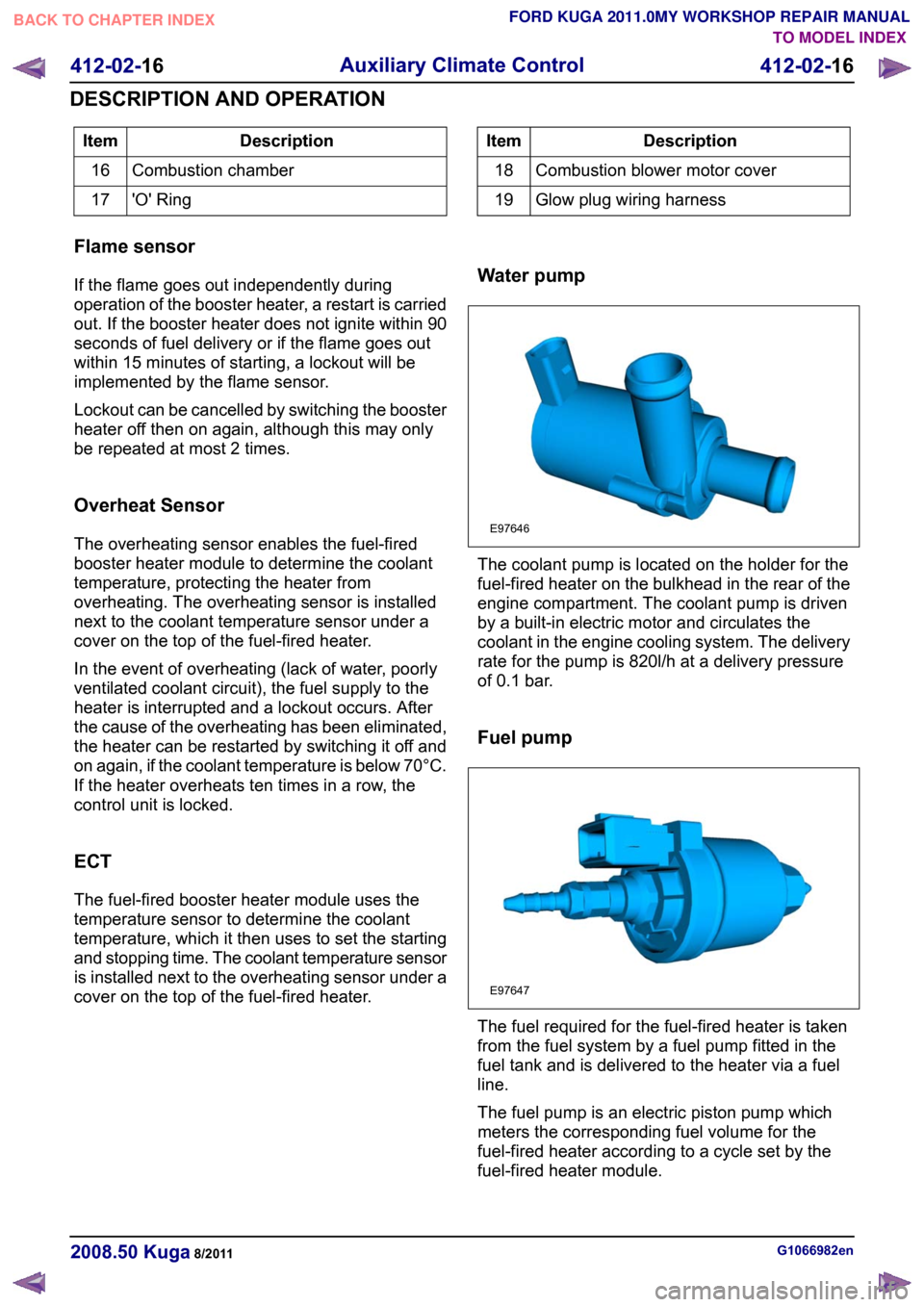
cover on the top of the fuel-fired heater. Water pump The coolant pump is located on the holder for the
fuel-fired heater on the bulkhead in the rear of the
engine compartment. The coolant pump is driven
by a built-in electric motor and circulates the
coolant in the engine cooling system. The delivery
rate for the pump is 820l/h at a delivery pressure
of 0.1 bar.
Fuel pump
The fuel required for the fuel-fired heater is taken
from the fuel system by a fuel pump fitted in the
fuel tank and is delivered to the heater via a fuel
line.
The fuel pump is an electric piston pump which
meters the corresponding fuel volume for the
fuel-fired heater according to a cycle set by the
fuel-fired heater module.
G1066982en
2008.50 Kuga 8/2011 412-02-16
Auxiliary Climate Control
412-02-16
DESCRIPTION AND OPERATIONTO MODEL INDEX
BACK TO CHAPTER INDEX
FORD KUGA 2011.0MY WORKSHOP REPAIR MANUALE97646 E97647
Page 171 of 2057
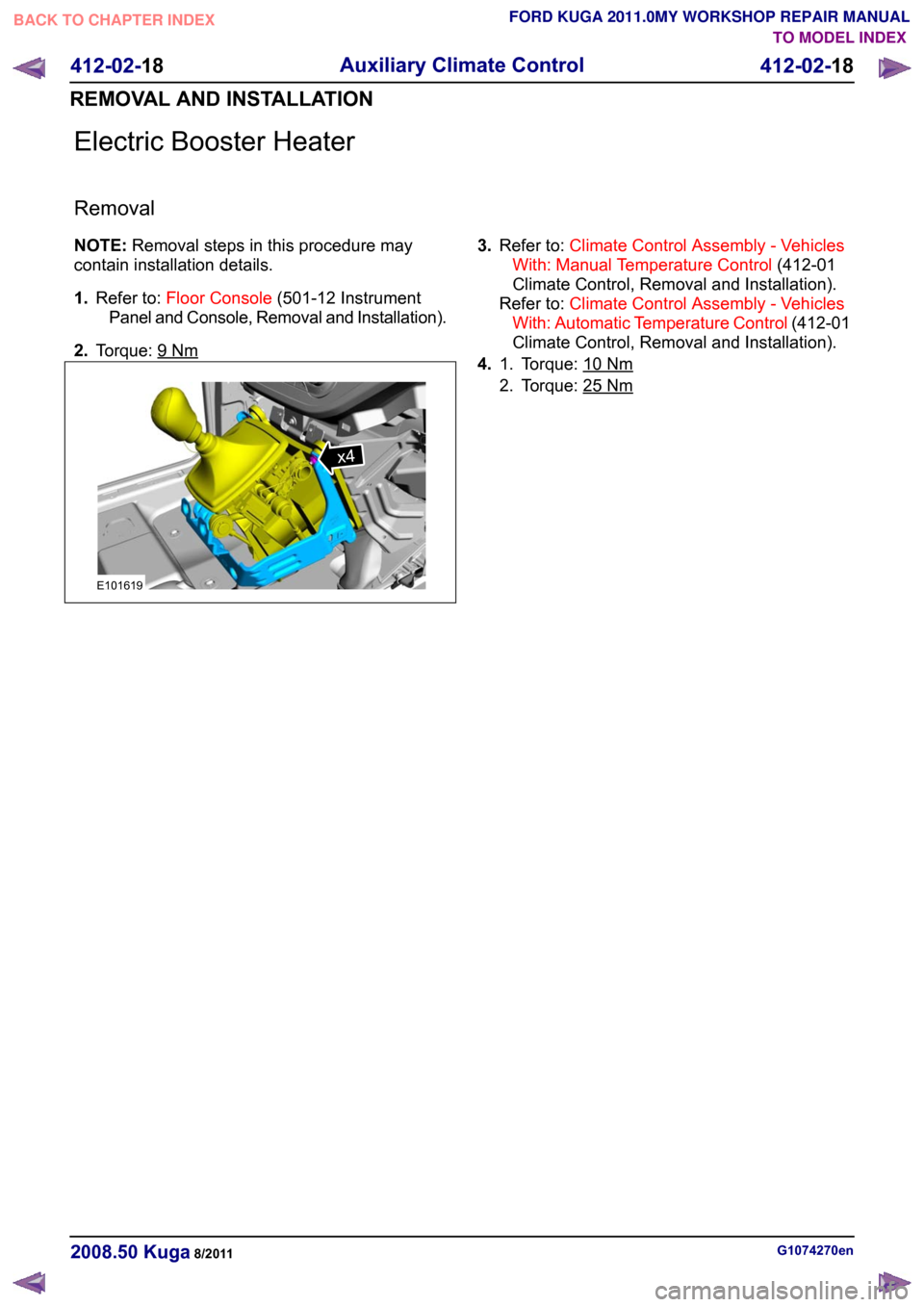
Electric Booster Heater
Removal
NOTE:
Removal steps in this procedure may
contain installation details.
1. Refer to: Floor Console (501-12 Instrument
Panel and Console, Removal and Installation).
2. Torque: 9 Nm 3.
Refer to: Climate Control Assembly - Vehicles
With: Manual Temperature Control (412-01
Climate Control, Removal and Installation).
Refer to: Climate Control Assembly - Vehicles
With: Automatic Temperature Control (412-01
Climate Control, Removal and Installation).
4. Torque: 10 Nm1.
2. Torque: 25
Nm
G1074270en
2008.50 Kuga 8/2011 412-02-18
Auxiliary Climate Control
412-02-18
REMOVAL AND INSTALLATIONTO MODEL INDEX
BACK TO CHAPTER INDEX
FORD KUGA 2011.0MY WORKSHOP REPAIR MANUALx4E101619