Page 228 of 357
WARNING:Do not start your vehicle in a closed garage or in
other enclosed areas. Exhaust fumes can be toxic. Always open
the garage door before you start the engine. SeeGuarding against
exhaust fumesin this chapter for more instructions.
WARNING:If you smell exhaust fumes inside your vehicle, have
your dealer inspect your vehicle immediately. Do not drive if you
smell exhaust fumes.
Important safety precautions
When the engine starts, the idle RPM runs faster to warm the engine. If
the engine idle speed does not slow down automatically, have the vehicle
checked.
Before starting the vehicle:
1. Make sure all occupants buckle their safety belts. For more
information on safety belts and their proper usage, refer to theSeating
and Safety Restraintschapter.
2. Make sure the headlamps and electrical accessories are off.
If starting a vehicle with an automatic transmission:
•Make sure the parking brake is
set.
12
Driving
228
2011 Fiesta(fie)
Owners Guide, 1st Printing
USA(fus)
Page 235 of 357
Under normal operating conditions, brake dust may accumulate on the
wheels. Some brake dust is inevitable as brakes wear and does not
contribute to brake noise. The use of modern friction materials with
emphasis on improved performance and environmental considerations
can lead to more dust than in the past. Brake dust can be cleaned by
weekly washing with soapy water and a soft sponge. Heavier deposits can
be removed with Motorcraft�Wheel and Tire Cleaner (ZC-37–A).
Four-wheel anti-lock brake system (ABS)
Your vehicle is equipped with an anti-lock braking system (ABS). This
system helps you maintain steering control during emergency stops by
keeping the brakes from locking. Noise from the ABS pump motor and
brake pedal pulsation may be observed during ABS braking and the
brake pedal may suddenly travel a little farther as soon as ABS braking is
done and normal brake operation resumes. These are normal
characteristics of the ABS and should be no reason for concern.
Using ABS
When hard braking is required, apply continuous force on the brake
pedal. Do not pump the brake pedal since this will reduce the
effectiveness of the ABS and will increase your vehicle’s stopping
distance. The ABS will be activated immediately, allowing you to retain
steering control during hard braking and on slippery surfaces. However,
the ABS does not decrease stopping distance.
ABS warning lamp
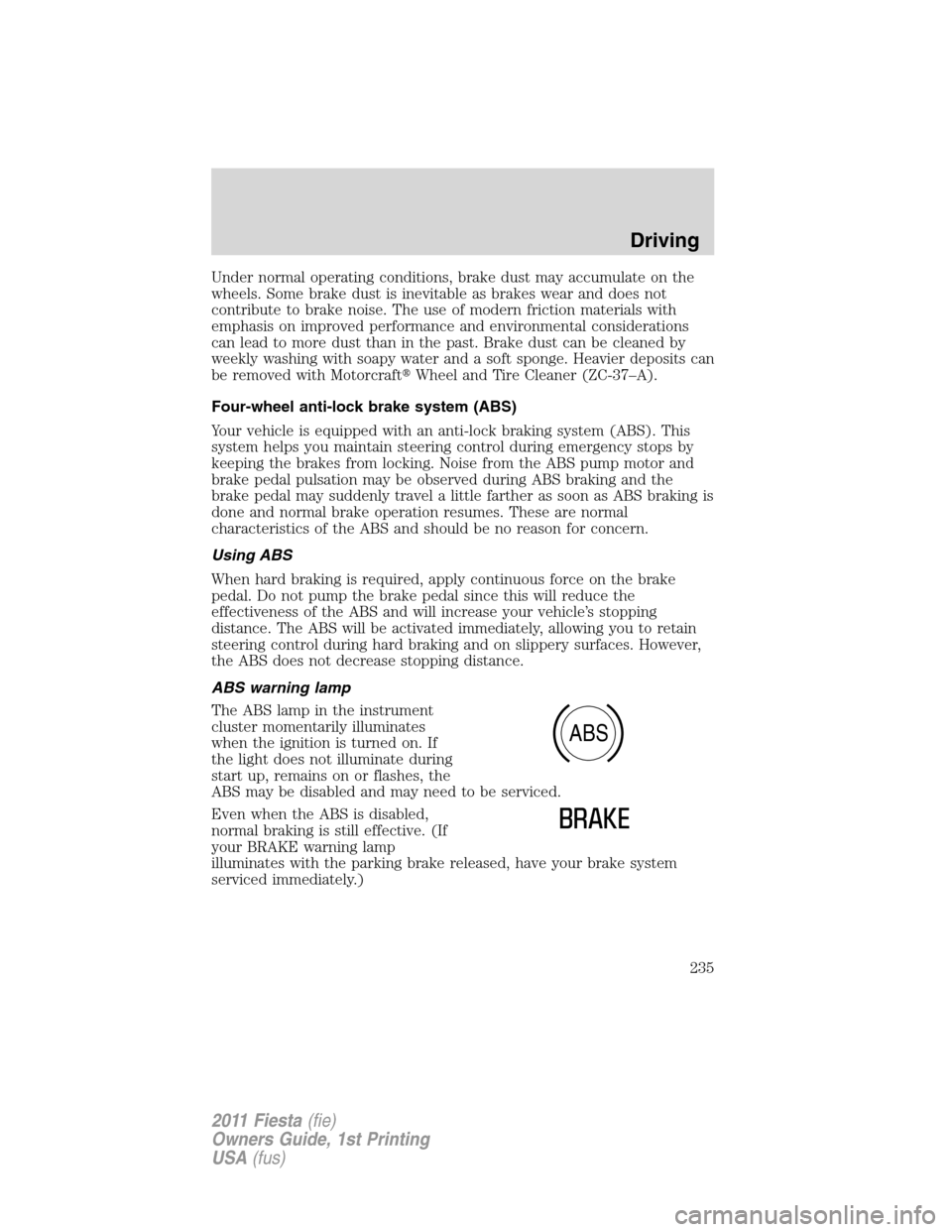
The ABS lamp in the instrument
cluster momentarily illuminates
when the ignition is turned on. If
the light does not illuminate during
start up, remains on or flashes, the
ABS may be disabled and may need to be serviced.
Even when the ABS is disabled,
normal braking is still effective. (If
your BRAKE warning lamp
illuminates with the parking brake released, have your brake system
serviced immediately.)
ABS
Driving
235
2011 Fiesta(fie)
Owners Guide, 1st Printing
USA(fus)
Page 236 of 357
Parking brake
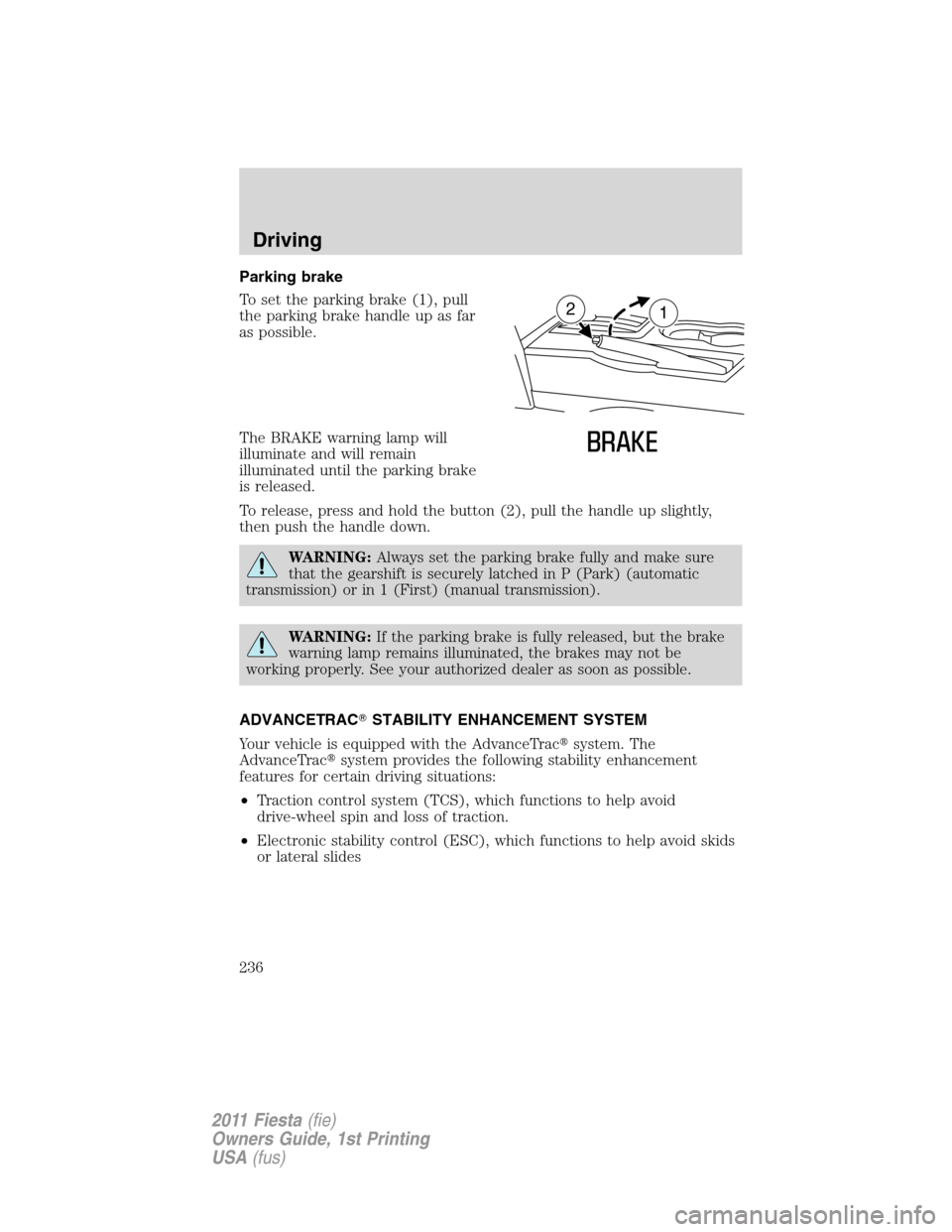
To set the parking brake (1), pull
the parking brake handle up as far
as possible.
The BRAKE warning lamp will
illuminate and will remain
illuminated until the parking brake
is released.
To release, press and hold the button (2), pull the handle up slightly,
then push the handle down.
WARNING:Always set the parking brake fully and make sure
that the gearshift is securely latched in P (Park) (automatic
transmission) or in 1 (First) (manual transmission).
WARNING:If the parking brake is fully released, but the brake
warning lamp remains illuminated, the brakes may not be
working properly. See your authorized dealer as soon as possible.
ADVANCETRAC�STABILITY ENHANCEMENT SYSTEM
Your vehicle is equipped with the AdvanceTrac�system. The
AdvanceTrac�system provides the following stability enhancement
features for certain driving situations:
•Traction control system (TCS), which functions to help avoid
drive-wheel spin and loss of traction.
•Electronic stability control (ESC), which functions to help avoid skids
or lateral slides
12
Driving
236
2011 Fiesta(fie)
Owners Guide, 1st Printing
USA(fus)
Page 238 of 357
When an event occurs that activates AdvanceTrac�, you may experience
the following:
•A slight deceleration of the vehicle
•The stability control light will flash.
•A vibration in the pedal when your foot is on the brake pedal
•If the driving condition is severe and your foot is not on the brake, the
brake pedal may move as the systems applies higher brake forces. You
may also hear a whoosh of air from under the instrument panel during
this severe condition.
•The brake pedal may feel stiffer than usual.
Traction control system (TCS)
Traction control is a driver aid feature that helps your vehicle maintain
traction of the wheels, typically when driving on slippery and/or hilly
road surfaces, by detecting and controlling wheel spin.
Excessive wheel spin is controlled in two ways, which may work
separately or in tandem, engine traction control and brake traction
control. Engine traction control works to limit drive-wheel spin by
momentarily reducing engine power. Brake traction control works to limit
wheel spin by momentarily applying the brakes to the wheel that is
slipping. Traction control is most active at low speeds.
During TCS events, the stability control light in the instrument cluster
will flash.
If the TCS is activated excessively in a short period of time, the braking
portion of the system may become temporarily disabled to allow the
brakes to cool down. In this situation, TCS will use only engine power
reduction or transfer to help control the wheels from over-spinning.
When the brakes have cooled down, the system will regain all features.
Anti-lock braking, and ESC are not affected by this condition and will
continue to function during the cool-down period.
Electronic stability control (ESC)
Electronic stability control (ESC) may enhance your vehicle’s directional
stability during adverse maneuvers, for example when cornering severely
or avoiding objects in the roadway. ESC operates by applying brakes to
one or more of the wheels individually and, if necessary, reducing engine
power if the system detects that the vehicle is about to skid or slide
laterally.
During ESC events, the stability control light in the instrument cluster
will flash.
Driving
238
2011 Fiesta(fie)
Owners Guide, 1st Printing
USA(fus)
Page 240 of 357

If the steering wanders or pulls, check for:
•an improperly inflated tire.
•uneven tire wear.
•loose or worn suspension components.
•loose or worn steering components.
•improper steering alignment.
A high crown in the road or high crosswinds may also make the steering
seem to wander/pull.
Speed sensitive steering
The steering in your vehicle is speed sensitive. At lower speeds the assist
is increased to improve maneuverability.
If the amount of effort required to steer your vehicle changes while
driving at a constant vehicle speed, have the power steering system
checked by your authorized dealer.
BRAKE-SHIFT INTERLOCK
This vehicle is equipped with a brake-shift interlock feature that prevents
the gearshift lever from being moved from P (Park) when the ignition is
in the on position unless the brake pedal is pressed.
If you cannot move the gearshift lever out of P (Park) with ignition in
the on position and the brake pedal pressed, it is possible that a fuse has
blown or the vehicle’s brake lamps are not operating properly. Refer to
Fuses and relaysin theRoadside Emergencieschapter.
Driving
240
2011 Fiesta(fie)
Owners Guide, 1st Printing
USA(fus)
Page 241 of 357
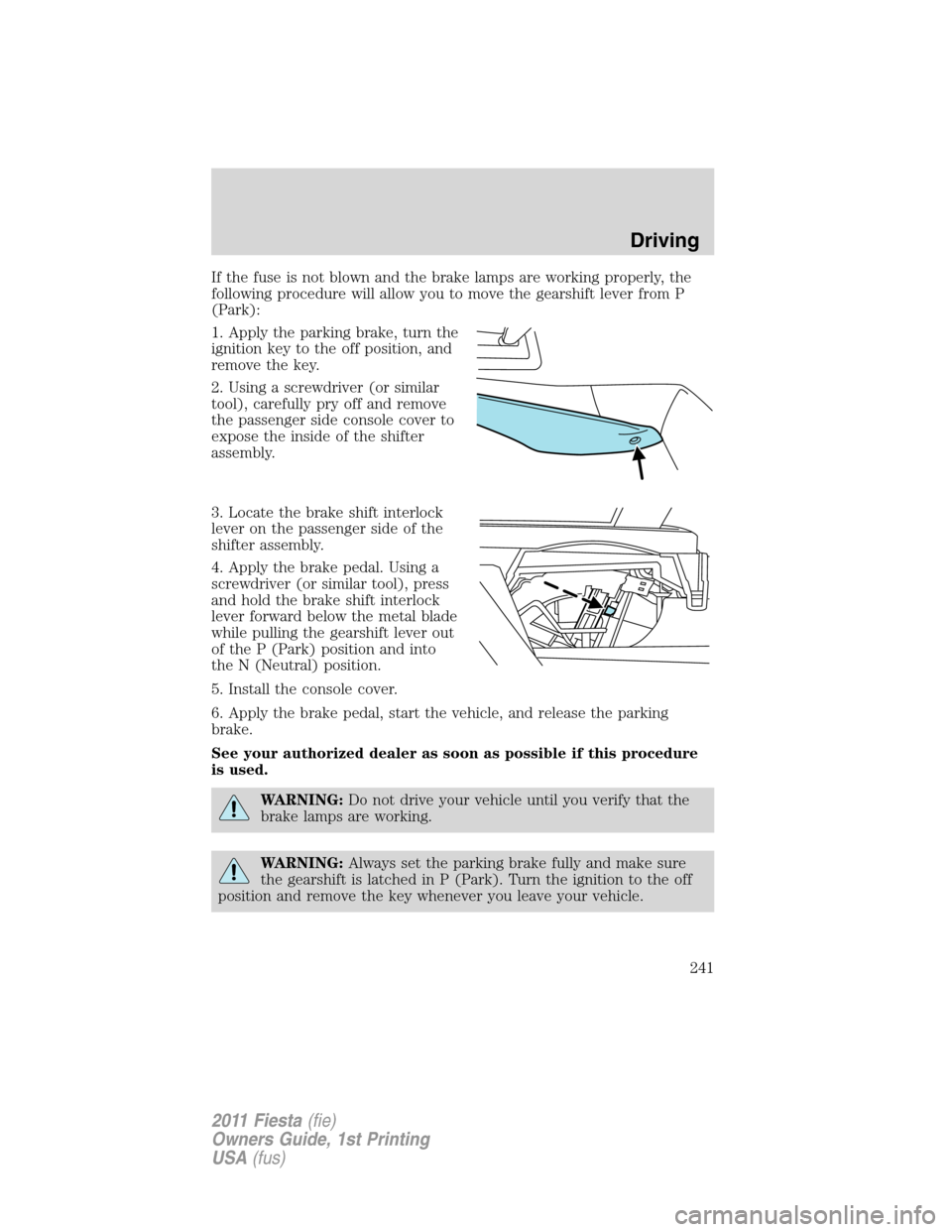
If the fuse is not blown and the brake lamps are working properly, the
following procedure will allow you to move the gearshift lever from P
(Park):
1. Apply the parking brake, turn the
ignition key to the off position, and
remove the key.
2. Using a screwdriver (or similar
tool), carefully pry off and remove
the passenger side console cover to
expose the inside of the shifter
assembly.
3. Locate the brake shift interlock
lever on the passenger side of the
shifter assembly.
4. Apply the brake pedal. Using a
screwdriver (or similar tool), press
and hold the brake shift interlock
lever forward below the metal blade
while pulling the gearshift lever out
of the P (Park) position and into
the N (Neutral) position.
5. Install the console cover.
6. Apply the brake pedal, start the vehicle, and release the parking
brake.
See your authorized dealer as soon as possible if this procedure
is used.
WARNING:Do not drive your vehicle until you verify that the
brake lamps are working.
WARNING:Always set the parking brake fully and make sure
the gearshift is latched in P (Park). Turn the ignition to the off
position and remove the key whenever you leave your vehicle.
Driving
241
2011 Fiesta(fie)
Owners Guide, 1st Printing
USA(fus)
Page 242 of 357

WARNING:If the parking brake is fully released, but the brake
warning lamp remains illuminated, the brakes may not be
working properly. See your authorized dealer.
AUTOMATIC TRANSMISSION OPERATION (IF EQUIPPED)
Understanding the gearshift positions of the 6–speed automatic
transmission (if equipped)
P (Park)
This position locks the transmission
and prevents the front wheels from
turning.
To put your vehicle in gear:
•Press the brake pedal.
•Move the gearshift lever into the
desired gear.
To put your vehicle in P (Park):
•Come to a complete stop.
•Move the gearshift lever and
securely latch it in P (Park).
WARNING:Always set the parking brake fully and make sure
the gearshift is latched in P (Park). Turn the ignition to the off
position and remove the key whenever you leave your vehicle.
WARNING:Do not apply the brake pedal and accelerator pedal
simultaneously. Applying both pedals simultaneously for more
than three seconds will limit engine rpm, which may result in difficulty
maintaining speed in traffic and could lead to serious injury.
R (Reverse)
With the gearshift lever in R (Reverse), the vehicle will move backward.
Always come to a complete stop before shifting into and out of R
(Reverse).
Driving
242
2011 Fiesta(fie)
Owners Guide, 1st Printing
USA(fus)
Page 243 of 357

N (Neutral)
With the gearshift lever in N (Neutral), the vehicle can be started and is
free to roll. Hold the brake pedal down while in this position.
D (Drive)
The normal driving position for the best fuel economy. Transmission
operates in gears one through six.
D (Drive) with Overdrive Cancel/Grade Assist
Pressing the transmission control
switch on the side of the gearshift
lever activates overdrive cancel and
grade assist.
Overdrive cancel/grade assist
•Overdrive is deactivated.
•The transmission operates in gears one through five.
•The grade assist lamp in the
instrument cluster is illuminated.
•Improves driving experience in hilly terrain or mountainous areas by
providing additional grade (engine) braking and extends lower gear
operation on uphill climbs.
•Provides additional engine braking through the automatic transmission
shift strategy which reacts to vehicle inputs (vehicle acceleration,
accelerator pedal, brake pedal and vehicle speed).
•Allows the transmission to select gears that will provide the desired
engine braking based on the vehicle inputs mentioned above. This will
increase engine RPM during engine braking.
Driving
243
2011 Fiesta(fie)
Owners Guide, 1st Printing
USA(fus)
