2011 FORD FIESTA brake
[x] Cancel search: brakePage 244 of 357

Overdrive cancel with grade assist is designed to provide optimal gear
selection in hilly terrain or mountainous areas. It is recommended that
you return to D (Drive) on flat terrain to provide the best fuel economy
and transmission function.
To return to D (Drive), press the transmission control switch again.
•The grade assist lamp in the instrument cluster will not be illuminated.
•The transmission will operate in gears one through five.
L (Low)
This position:
•Provides maximum engine braking.
•Will downshift to the lowest available gear for the current vehicle
speed; allows for first gear when vehicle reaches slower speeds.
Hill start assist (HSA) system (if equipped)
The hill start assist (HSA) system makes it easier to pull away when the
vehicle is on a slope without the need to use the parking brake. When
HSA is active, the vehicle will remain stationary on the slope for two to
three seconds after you release the brake pedal. During this time, you
have time to move your foot from the brake to the accelerator pedal and
pull away. The brakes are released automatically once the engine has
developed sufficient drive to prevent the vehicle from rolling down the
slope. This is an advantage when pulling away on a slope, for example
from a car park ramp, traffic lights or when reversing uphill into a
parking space.
WARNING:HSA does not replace the parking brake. When you
leave the vehicle, always apply the parking brake and select P
(Park).
Using HSA
The HSA system is activated automatically when the vehicle is stopped
on a slope greater than four degrees. HSA operates with the vehicle
facing downhill if reverse gear is selected.
WARNING:You must remain in the vehicle once you have
activated HSA.
Driving
244
2011 Fiesta(fie)
Owners Guide, 1st Printing
USA(fus)
Page 245 of 357

WARNING:During all times you are responsible for controlling
the vehicle, supervising the HSA system and intervening, if
required.
Activating HSA
1. Press the brake pedal to bring the vehicle to a complete standstill.
Keep the brake pedal pressed.
2. If the sensors detect that the vehicle is on a slope, the HSA system
will be activated automatically in D (Drive) uphill or R (Reverse)
downhill.
3. When you remove your foot from the brake pedal, the vehicle will
remain on the slope without rolling away for approximately two to three
seconds. This hold time will automatically be extended if you are in the
process of driving off.
4. Drive off in the normal manner. The brakes will be released
automatically.
Note:If the engine is revved excessively, HSA will be deactivated.
Deactivating hill start assist
To deactivate HSA, perform one of the following:
•Apply the parking brake.
•Drive off uphill without re-applying the brake.
•Wait for two to three seconds until the HSA system deactivates
automatically.
•If hill start assist is active in D (Drive), select R (Reverse).
•If hill start assist is active in R (Reverse), select N (Neutral).
Note:The HSA warning lamp in the
instrument cluster momentarily
illuminates when the ignition is
turned on. If a malfunction is
detected in the HSA system, HSA will be deactivated and this warning
lamp will appear on the instrument cluster.
If your vehicle gets stuck in mud or snow
If your vehicle gets stuck in mud or snow, it may be rocked out by
shifting between forward and reverse gears, stopping between shifts in a
steady pattern. Press lightly on the accelerator in each gear.
Do not rock the vehicle if the engine is not at normal operating
temperature or damage to the transmission may occur.
Driving
245
2011 Fiesta(fie)
Owners Guide, 1st Printing
USA(fus)
Page 246 of 357

Do not rock the vehicle for more than a minute or damage to the
transmission and tires may occur, or the engine may overheat.
MANUAL TRANSMISSION OPERATION (IF EQUIPPED)
Using the clutch
Manual transmission vehicles have a starter interlock that prevents
cranking the engine unless the clutch pedal is fully pressed.
To start the vehicle:
1. Make sure the parking brake is fully set.
2. Press the clutch pedal to the
floor, then put the gearshift lever in
the neutral position.
3. Start the engine.
4. Press the brake pedal and move
the gearshift lever to the desired
gear; 1 (First) or R (Reverse).
5. Release the parking brake, then slowly release the clutch pedal while
slowly pressing on the accelerator.
During each shift, the clutch pedal must be fully pressed to the floor.
Make sure the floor mat is properly positioned so it doesn’t interfere with
the full extension of the clutch pedal.
Failure to fully press the clutch pedal to the floor may cause
increased shift efforts, prematurely wear transmission
components or damage the transmission.
Do not drive with your foot resting on the clutch pedal or use the
clutch pedal to hold your vehicle at a standstill while waiting on a
hill. These actions will severely reduce the life of the clutch and
could nullify a clutch warranty claim.
Recommended shift speeds
Do not downshift into 1 (First) when your vehicle is moving
faster than 15 mph (24 km/h). This will damage the clutch.
Driving
246
2011 Fiesta(fie)
Owners Guide, 1st Printing
USA(fus)
Page 247 of 357
Upshift according to the following chart:
Recommended upshifts (for best fuel economy) when
accelerating
5-speed manual transmission
Shift from:
1 - 2 14 mph (23 km/h)
2 - 3 24 mph (39 km/h)
3 - 4 32 mph (51 km/h)
4 - 5 44 mph (71 km/h)
Reverse
Make sure that your vehicle is at a complete stop before you shift
into R (Reverse). Failure to do so may damage the transmission.
Hold the clutch pedal down and move the gearshift lever into the neutral
position. Wait at least three seconds before shifting into R (Reverse).
Note:The gearshift lever can only be moved into R (Reverse) by moving
it from left of 3 (Third) and 4 (Fourth) before shifting into R (Reverse).
This is a lockout feature that protects the transmission from accidentally
being shifted into R (Reverse) from 5 (Fifth).
If R (Reverse) is not fully engaged, press the clutch pedal down and
return the gearshift to the neutral position. Release the clutch pedal for
a moment, then press it down and shift to R (Reverse) again.
Parking your vehicle
1. Apply the brake and shift into the neutral position.
2. Fully apply the parking brake, hold the clutch pedal down, then shift
into 1 (First).
3. Turn the ignition off.
WARNING:Do not park your vehicle in Neutral, it may move
unexpectedly and injure someone. Use 1 (First) gear and set the
parking brake fully.
Driving
247
2011 Fiesta(fie)
Owners Guide, 1st Printing
USA(fus)
Page 249 of 357
DRIVING THROUGH WATER
If driving through deep or standing
water is unavoidable, proceed very
slowly especially when the depth is
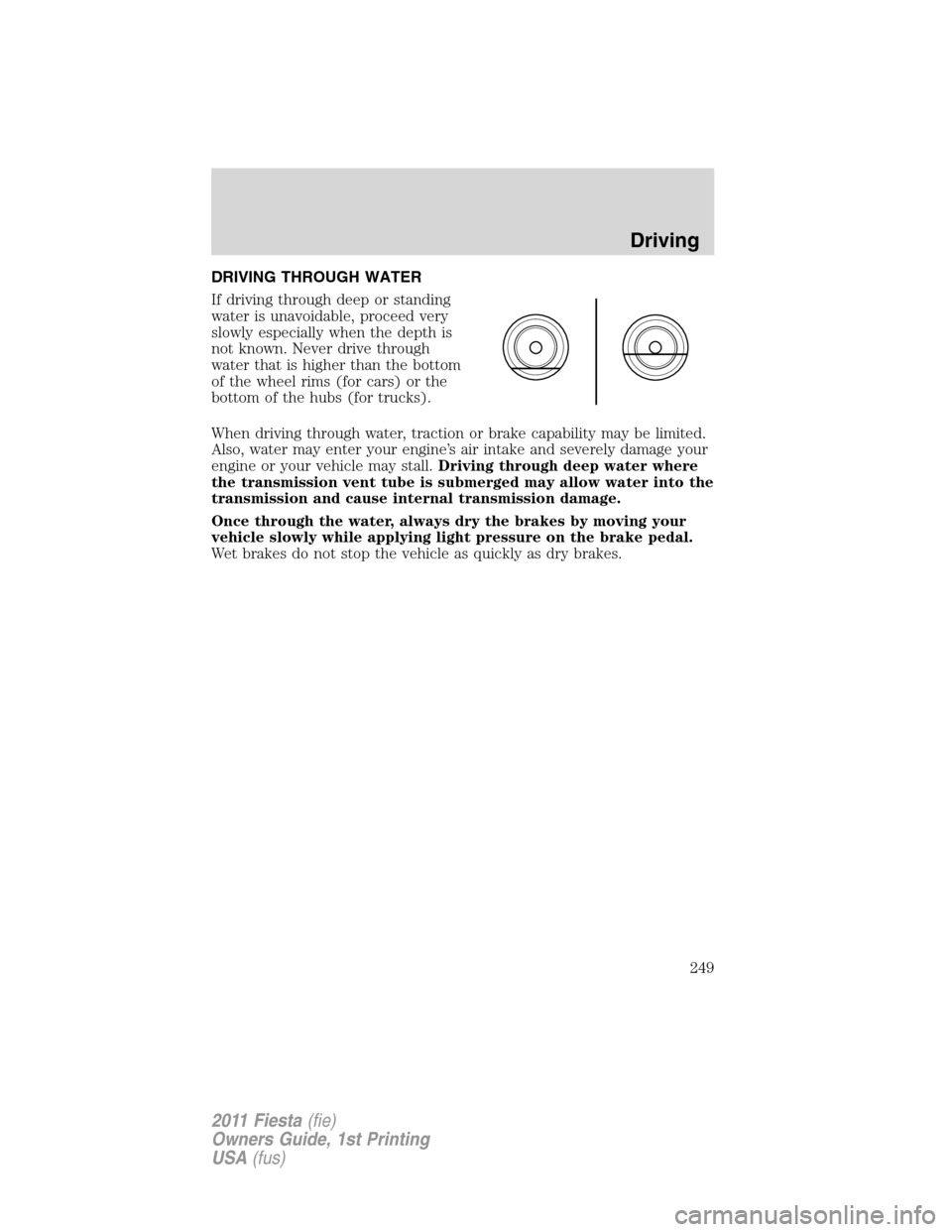
not known. Never drive through
water that is higher than the bottom
of the wheel rims (for cars) or the
bottom of the hubs (for trucks).
When driving through water, traction or brake capability may be limited.
Also, water may enter your engine’s air intake and severely damage your
engine or your vehicle may stall.Driving through deep water where
the transmission vent tube is submerged may allow water into the
transmission and cause internal transmission damage.
Once through the water, always dry the brakes by moving your
vehicle slowly while applying light pressure on the brake pedal.
Wet brakes do not stop the vehicle as quickly as dry brakes.
Driving
249
2011 Fiesta(fie)
Owners Guide, 1st Printing
USA(fus)
Page 255 of 357

Fuse/Relay
LocationFuse Amp
RatingProtected circuits
F21 10A BCM, Climate control, Passive
anti-theft system transceiver,
Electronic power steering module,
Instrument cluster, Engine
compartment fuse panel
F22 7.5A Accelerator pedal position sensor,
Powertrain control module
(PCM), Gear shifter, Anti-lock
brake system (ABS) ignition feed
F23 10A Transmission control unit ignition
feed, TPMS ignition feed
F24 7.5A Front dome lamp, Moon roof
switch
F25 7.5A Exterior mirrors
F26 7.5A TPMS
F27 — Not used
F28 — Not used
F29 — Not used
F30 — Not used
F31 30A Driver and rear power window
switches
F32 20A Passenger compartment fuse
panel battery saver relay
F33 20A Power points
F34 30A Driver and passenger power
window switches
F35 20A Moon roof
F36 — Not used
R1 — Ignition relay
R2 — Left rear stop/turn lamp relay
R3 — Right rear stop/turn lamp relay
R4 — Driver heated seat relay
Roadside Emergencies
255
2011 Fiesta(fie)
Owners Guide, 1st Printing
USA(fus)
Page 257 of 357

To remove a fuse, use the fuse puller tool provided on the inside of the
passenger compartment fuse panel cover.
The high-current fuses are coded as follows:
Fuse/Relay
LocationFuse Amp
RatingProtected circuits
F1 40A* Anti-lock brake system (ABS)
pump
F2 50A* Transmission control module
(TCM)
F3 40A* Engine cooling fan relay
F4 40A* Heater blower relay, Climate
controls
F5 60A* Passenger compartment fuse
panel
F6 30A* Body control module (BCM) –
door locks
F22
F6 F1
F2
F3
F4
F5
F7
F8
F9
F10
F11
F12
F13
F14
F15
F16
F17
F18
F19
F20
F21F23F24
F25
F26
F27
F28
F29
F30
F31
F32
F33
F34
F35
F36
F37
F38 F39 F40
R7
R1
R2
R3R8
R9
R10
R11
R6 R5 R4
R12
R13
Roadside Emergencies
257
2011 Fiesta(fie)
Owners Guide, 1st Printing
USA(fus)
Page 260 of 357

CHANGING THE TIRES
If you get a flat tire while driving, do not apply the brake heavily.
Instead, gradually decrease your speed. Hold the steering wheel firmly
and slowly move to a safe place on the side of the road.
Note:The tire pressure monitoring system (TPMS) indicator light will
illuminate when the spare tire is in use. To restore the full functionality
of the monitoring system, all road wheels equipped with tire pressure
monitoring sensors must be mounted on the vehicle.
Have a flat serviced by an authorized dealer in order to prevent damage
to the TPMS sensors, refer toTire pressure monitoring system
(TPMS)in theTires, Wheels and Loadingchapter. Replace the spare
tire with a road tire as soon as possible. During repairing or replacing of
the flat tire, have the authorized dealer inspect the TPMS sensor for
damage.
WARNING:The use of tire sealants may damage your tire
pressure monitoring system (TPMS) and should not be used.
However, if you must use a sealant, the TPMS sensor and valve stem
on the wheel must be replaced by an authorized Ford dealer.
WARNING:Refer toTire pressure monitoring system (TPMS)
in theTires, Wheels and Loadingchapter for important
information. If the tire pressure monitor sensor becomes damaged, it
will no longer function.
Dissimilar spare tire/wheel information
WARNING:Failure to follow these guidelines could result in an
increased risk of loss of vehicle control, injury or death.
If you have a dissimilar spare tire/wheel, then it is intended for
temporary use only. This means that if you need to use it, you should
replace it as soon as possible with a road tire/wheel that is the same size
and type as the road tires and wheels that were originally provided by
Ford. If the dissimilar spare tire or wheel is damaged, it should be
replaced rather than repaired.
Roadside Emergencies
260
2011 Fiesta(fie)
Owners Guide, 1st Printing
USA(fus)