Page 174 of 449
5. To return the seatback to the
floor from tumbled position, rotate
the seat down until you hear it
latching to the floor.
6. To return the seatback to the
upright position
•Lift the seatback toward the rear
of the vehicle, and
•Rotate the seatback until you
hear a click, locking it in the
upright position.
Note:The seatback will not raise if
the rear latch hooks are not
properly engaged to the floor
striker. If the seatback does not raise, then repeat steps 3 and 4.
7. Pull the head restraint back up to its normal adjusted position.
WARNING:Before returning the seatback to its original
position, make sure that cargo or any objects are not trapped
behind the seatback. After returning the seatback to its original
position, pull on the seatback to ensure that it has fully latched. An
unlatched seat may become dangerous in the event of a sudden stop or
collision.
Seating and Safety Restraints
173
2011 Explorer(exp)
Owners Guide, 1st Printing
USA(fus)
Page 175 of 449
2nd row power fold and tumble seat (six–passenger vehicles only)
WARNING:Ensure that the seat is unoccupied when folding it
down. Folding the seat while occupied could result in occupant
injury or damage to the seat.
Press the control located at the
back of the rear door opening one
time to fold the seat back down and
tumble the seat forward for access
to the 3rd row.
Exiting the third row seat
1. Stow the head restraints:
•Center head restraints (if equipped):Press the head restraint
release button while sliding the head restraint fully down.
•Outboard head restraints:Pull the head restraint release strap.
Note:Outboard head restraints do not adjust vertically.
2. Pull on the strap located on the
back of the second row seat. This
will fold the seatback forward. Pull
the strap a second time to tumble
the seat forward, allowing easy exit
from the 3rd row seat.
Seating and Safety Restraints
174
2011 Explorer(exp)
Owners Guide, 1st Printing
USA(fus)
Page 176 of 449

3. To return the seatback to the
floor from tumbled position, rotate
the seat down until you hear it
latching to the floor.
4. To return the seatback to the
upright position
•Lift the seatback toward the rear
of the vehicle, and
•Rotate the seatback until you
hear a click, locking it in the
upright position.
Note:The seatback will not raise if
the rear latch hooks are not
properly engaged to the floor
striker. If the seatback does not raise, then repeat steps 3 and 4.
5. Pull the head restraint up to its normal position.
WARNING:Before returning the seatback to its original position,
make sure that cargo or any objects are not trapped behind the
seatback. After returning the seatback to its original position, pull on the
seatback to ensure that it has fully latched. An unlatched seat may
become dangerous in the event of a sudden stop or collision.
Ensure that the rear latch hooks are
properly engaged with the floor
striker.
Note: Ensure that the seat and
seatback are latched securely in
position. Keep floor area free of
objects that would prevent proper
seat engagement.
Seating and Safety Restraints
175
2011 Explorer(exp)
Owners Guide, 1st Printing
USA(fus)
Page 177 of 449
WARNING:Do not adjust or release the seat floor latch while
vehicle is in motion. Do not operate the vehicle with seats in
tumbled position. Always latch the vehicle seat to the floor, whether
the seat is occupied or empty. If not latched or if the seat is tumbled,
the seat may cause injury during a sudden stop.
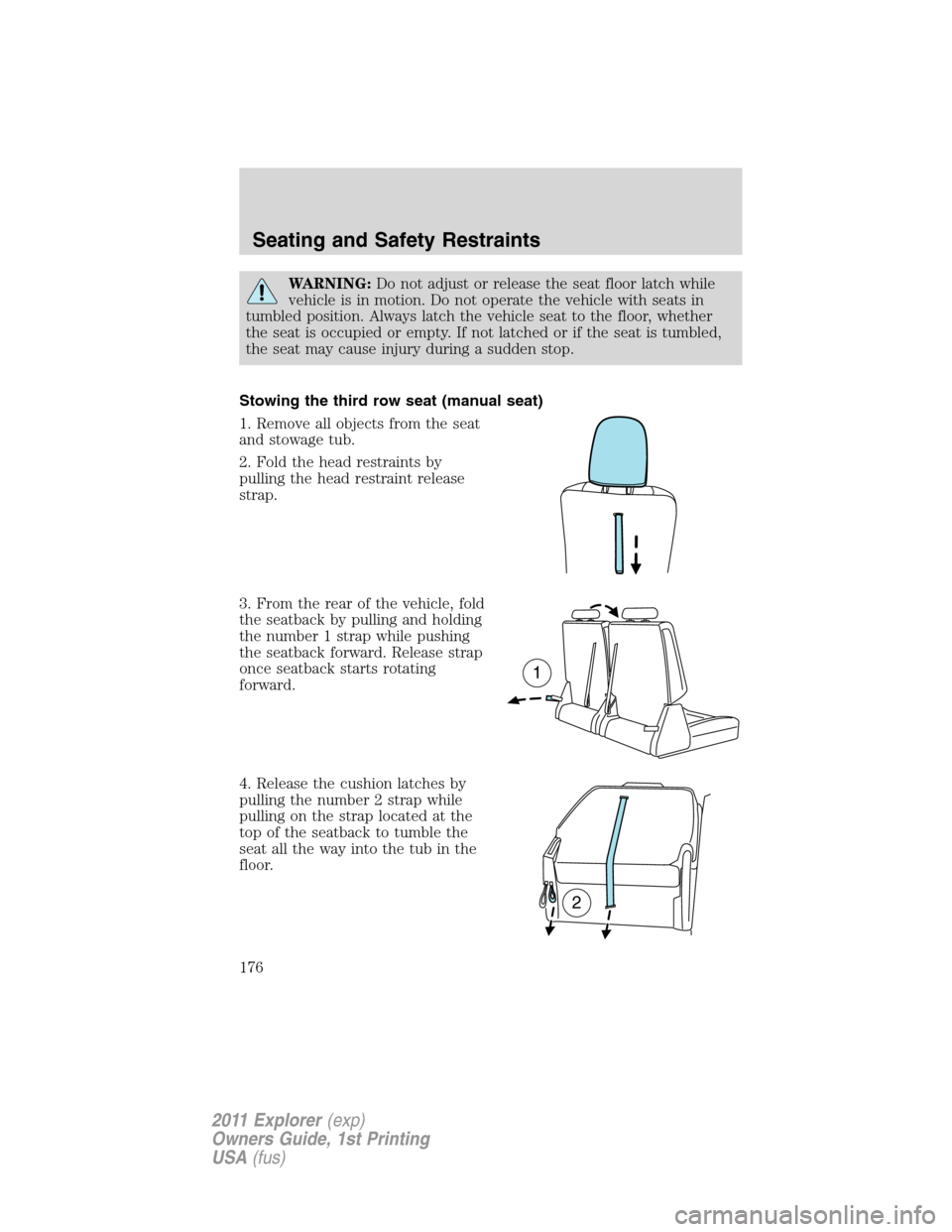
Stowing the third row seat (manual seat)
1. Remove all objects from the seat
and stowage tub.
2. Fold the head restraints by
pulling the head restraint release
strap.
3. From the rear of the vehicle, fold
the seatback by pulling and holding
the number 1 strap while pushing
the seatback forward. Release strap
once seatback starts rotating
forward.
4. Release the cushion latches by
pulling the number 2 strap while
pulling on the strap located at the
top of the seatback to tumble the
seat all the way into the tub in the
floor.
1
2
Seating and Safety Restraints
176
2011 Explorer(exp)
Owners Guide, 1st Printing
USA(fus)
Page 178 of 449
Note:Do not use the seat anchors as cargo tie downs.
Note:Do not use the third row
seatback as a load floor when the
seatback is folded.
Note:Ensure that the area under the seat is free of objects before
stowing it.
Unstowing the third row seat
Note:Ensure that there are no objects such as books, purses or brief
cases on the load floor before unstowing the seat. Failure to remove all
objects from the top of the load floor prior to unstowing it may cause
damage to the seat.
Note:Ensure the area under the load floor is free of objects before
unstowing it.
1. Unlatch and lift the seat out of the tub in the floor by squeezing and
pulling up on the handle. Once the seat is at a vertical position, push the
seat over, letting it fall onto the latches.
Seating and Safety Restraints
177
2011 Explorer(exp)
Owners Guide, 1st Printing
USA(fus)
Page 180 of 449

PowerFold�third-row seat (if equipped)
The third row seat features a power one-touch operation that allows you
to adjust the Left, Right, or Both seats into a NORMAL, STOW or FOLD
position with just one touch of a button. The third row seat also includes
obstacle detection that allows the seat to stop and reverse direction if it
hits an obstacle so that the obstacle can be removed.
The third row power seat buttons are located behind the third row seats
on the left-hand quarter trim panel.
Note:The power fold seats work only when the vehicle is in P (Park)
and the tailgate is open. If the ignition is off and the feature is still
running, the battery saver will turn it off after 10 minutes. You can
reactivate the power seats by pressing
on the remote entry key
transmitter or by using the unlock procedure on the keyless entry
keypad. Refer to theLocks and Securitychapter.
Press the seat selection button (4) to select either right-hand seat, the
left-hand seat or both. First select the seat you would like to adjust, then
select one of the following:
•Press the NORMAL button (1) to return the seat to the normal
seating position.
•Press the STOW button (2) to stow the seat into the tub floor.
•Press the FOLD button (3) (the top portion of the button) to fold
down the seatback.
Note:Pressing a different button while the power seat feature is already
being performed may cause the first selected seat movement to be
cancelled. Allow the first seat movement to be completed before pressing
a button for another function.
Note:Ensure that there are no objects such as books, purses or brief
cases on the load floor before unstowing the seat. Failure to remove all
objects from the top of the load floor prior to unstowing it may cause
damage to the seat.
1234
NORMAL
STOWRH
BOTH
LHFOLD
Seating and Safety Restraints
179
2011 Explorer(exp)
Owners Guide, 1st Printing
USA(fus)
Page 181 of 449
Note:In order to allow the seat to complete the stowed position, do not
place objects under the seat before stowing. Remove all objects from the
seat and stowage tub.
Note:In the unlikely event that the third row power seat stops
prematurely, or travels to an unexpected position, press the FOLD
button (3) to reset the seat and return it to a normal position.
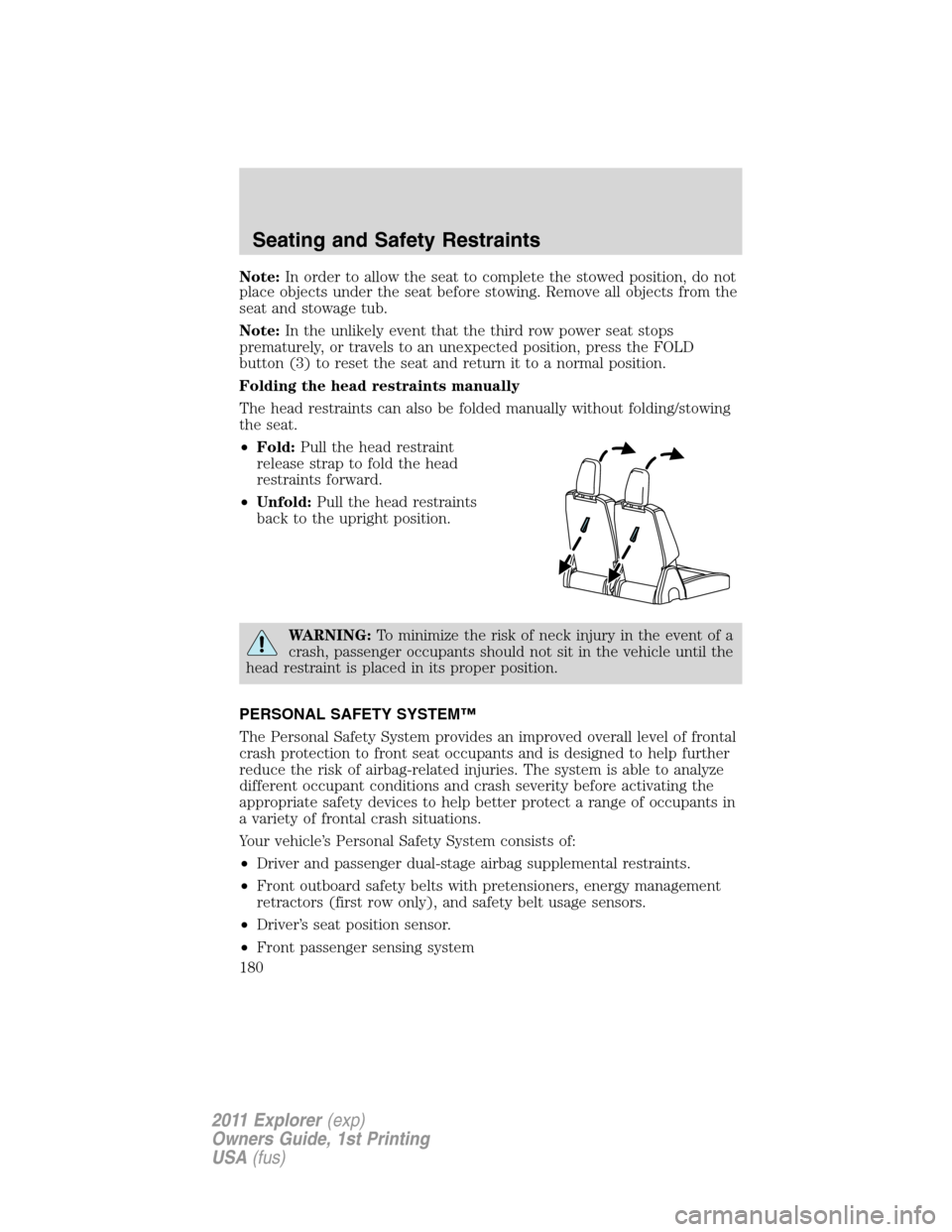
Folding the head restraints manually
The head restraints can also be folded manually without folding/stowing
the seat.
•Fold:Pull the head restraint
release strap to fold the head
restraints forward.
•Unfold:Pull the head restraints
back to the upright position.
WARNING:To minimize the risk of neck injury in the event of a
crash, passenger occupants should not sit in the vehicle until the
head restraint is placed in its proper position.
PERSONAL SAFETY SYSTEM™
The Personal Safety System provides an improved overall level of frontal
crash protection to front seat occupants and is designed to help further
reduce the risk of airbag-related injuries. The system is able to analyze
different occupant conditions and crash severity before activating the
appropriate safety devices to help better protect a range of occupants in
a variety of frontal crash situations.
Your vehicle’s Personal Safety System consists of:
•Driver and passenger dual-stage airbag supplemental restraints.
•Front outboard safety belts with pretensioners, energy management
retractors (first row only), and safety belt usage sensors.
•Driver’s seat position sensor.
•Front passenger sensing system
Seating and Safety Restraints
180
2011 Explorer(exp)
Owners Guide, 1st Printing
USA(fus)
Page 200 of 449

WARNING:Modifying or adding equipment to the front end of
the vehicle (including frame, bumper, front end body structure
and tow hooks) may affect the performance of the airbag system,
increasing the risk of injury. Do not modify the front end of the
vehicle.
Children and airbags
Children must always be properly
restrained. Accident statistics
suggest that children are safer when
properly restrained in the rear
seating positions than in the front
seating position. Failure to follow
these instructions may increase the
risk of injury in a collision.
WARNING:Airbags can kill
or injure a child in a child
seat.NEVERplace a rear-facing
child seat in front of an active
airbag. If you must use a
forward-facing child seat in the
front seat, move the seat all the
way back.
How does the airbag supplemental restraint system work?
The airbag SRS is designed to
activate when the vehicle sustains
longitudinal deceleration sufficient to
cause the sensors to close an
electrical circuit that initiates airbag
inflation. The fact that the airbags
did not inflate in a collision does not
mean that something is wrong with
the system. Rather, it means the
forces were not of the type sufficient
to cause activation. Front airbags are
designed to inflate in frontal and
near-frontal collisions, not rollover, side-impact, or rear-impacts unless the
collision causes sufficient longitudinal deceleration.
Seating and Safety Restraints
199
2011 Explorer(exp)
Owners Guide, 1st Printing
USA(fus)