Page 399 of 497

CAUTION!
•Do not attempt to use sling type equipment when
towing. When securing the vehicle to a flat bed
truck, do not attach to front or rear suspension
components. Damage to your vehicle may result
from improper towing.
•If the vehicle being towed requires steering, the
ignition must be in the ON/RUN or ACC position,
not in the LOCK position.
Towing Without The Ignition Key Fob
Special care must be taken when the vehicle is towed
with the ignition in the LOCK position. The only ap-
proved method of towing without the ignition key is
with a flatbed truck. Proper towing equipment is neces-
sary to prevent damage to the vehicle.
Two-Wheel Drive Models
The manufacturer recommends towing your vehicle with
all four wheelsOFFthe ground using a flatbed.
If flatbed equipment is not available, and the transmis-
sion is operable, the vehicle may be towed (with rear
wheels on the ground) with the transmission in NEU-
TRAL. Speed must not exceed 30 mph (48 km/h) and the
distance must not exceed 15 miles (24 km).
CAUTION!
Towing faster than 30 mph (48 km/h) or farther than
15 miles (24 km) with rear wheels on the ground can
cause severe damage to the transmission. Such dam-
age is not covered by the New Vehicle Limited
Warranty.
If the transmission is not operable, or the vehicle must be
towed faster than 30 mph (48 km/h) or farther than
396 WHAT TO DO IN EMERGENCIES
Page 400 of 497
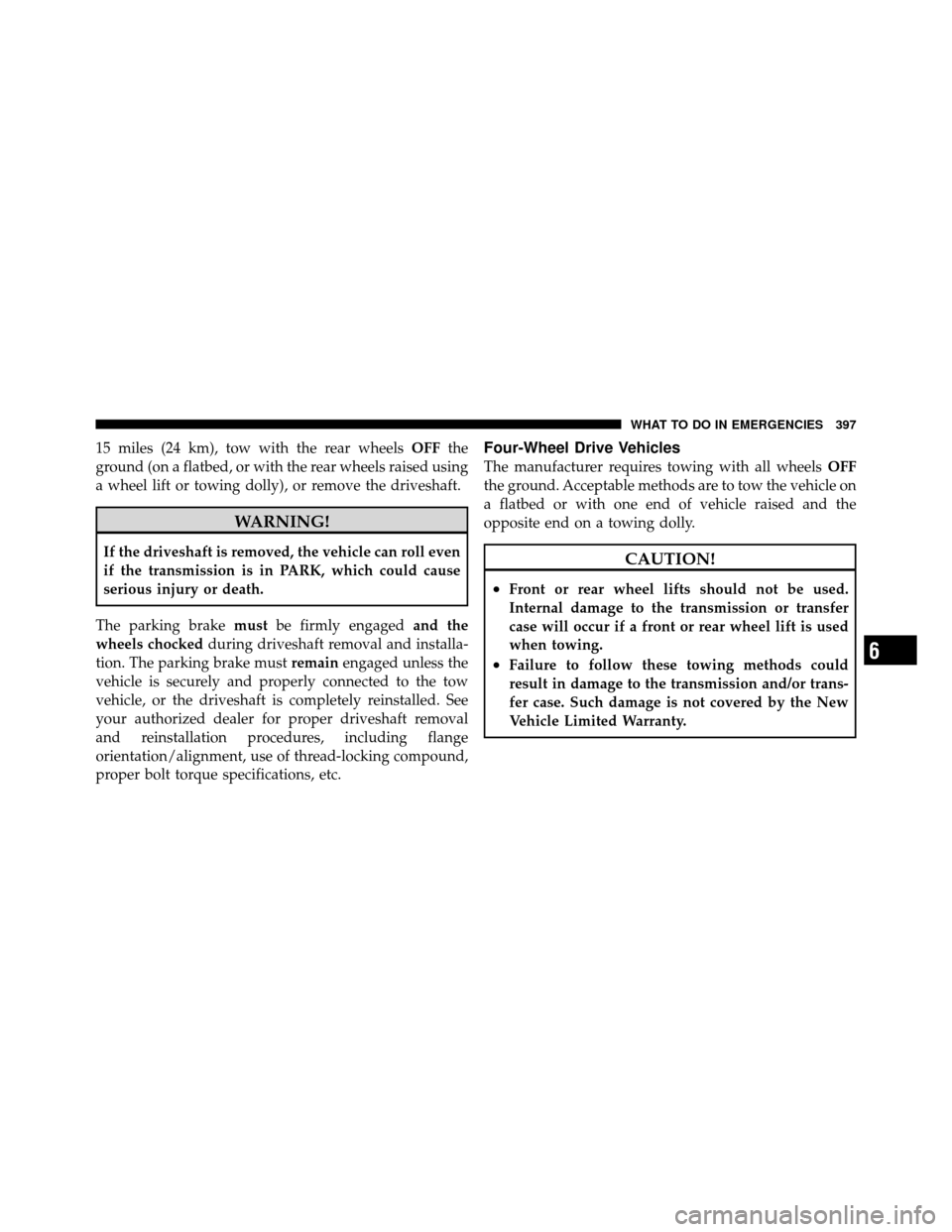
15 miles (24 km), tow with the rear wheelsOFFthe
ground (on a flatbed, or with the rear wheels raised using
a wheel lift or towing dolly), or remove the driveshaft.
WARNING!
If the driveshaft is removed, the vehicle can roll even
if the transmission is in PARK, which could cause
serious injury or death.
The parking brake mustbe firmly engaged and the
wheels chocked during driveshaft removal and installa-
tion. The parking brake must remainengaged unless the
vehicle is securely and properly connected to the tow
vehicle, or the driveshaft is completely reinstalled. See
your authorized dealer for proper driveshaft removal
and reinstallation procedures, including flange
orientation/alignment, use of thread-locking compound,
proper bolt torque specifications, etc.
Four-Wheel Drive Vehicles
The manufacturer requires towing with all wheels OFF
the ground. Acceptable methods are to tow the vehicle on
a flatbed or with one end of vehicle raised and the
opposite end on a towing dolly.
CAUTION!
•Front or rear wheel lifts should not be used.
Internal damage to the transmission or transfer
case will occur if a front or rear wheel lift is used
when towing.
•Failure to follow these towing methods could
result in damage to the transmission and/or trans-
fer case. Such damage is not covered by the New
Vehicle Limited Warranty.6
WHAT TO DO IN EMERGENCIES 397
Page 406 of 497

ONBOARD DIAGNOSTIC SYSTEM — OBD II
Your vehicle is equipped with a sophisticated onboard
diagnostic system called OBD II. This system monitors
the performance of the emissions, engine, and automatic
transmission control systems. When these systems are
operating properly, your vehicle will provide excellent
performance and fuel economy, as well as engine emis-
sions well within current government regulations.
If any of these systems require service, the OBD II system
will turn on the “Malfunction Indicator Light” (MIL). It
will also store diagnostic codes and other information to
assist your service technician in making repairs. Al-
though your vehicle will usually be drivable and not
need towing, see your authorized dealer for service as
soon as possible.CAUTION!
•Prolonged driving with the MIL on could cause
further damage to the emission control system. It
could also affect fuel economy and drivability. The
vehicle must be serviced before any emissions
tests can be performed.
•If the MIL is flashing while the engine is running,
severe catalytic converter damage and power loss
will soon occur. Immediate service is required.
Loose Fuel Filler Cap Message
If the vehicle diagnostic system determines that the fuel
filler cap is loose, improperly installed, or damaged, a
“gASCAP” message will display in the odometer or a
“CHECK GASCAP” message will be displayed in the
Electronic Vehicle Information Center (EVIC). Refer to
“Electronic Vehicle Information Center (EVIC)” in “Under-
standing Your Instrument Panel” for further information.
7
MAINTAINING YOUR VEHICLE 403
Page 420 of 497

•Do not try to start the engine by pushing or towing the
vehicle.
•Do not idle the engine with any spark plug wires
disconnected or removed, such as when diagnostic
testing, or for prolonged periods during very rough
idle or malfunctioning operating conditions.
Cooling System
WARNING!
You or others can be badly burned by hot engine
coolant (antifreeze) or steam from your radiator. If
you see or hear steam coming from under the hood,
do not open the hood until the radiator has had time
to cool. Never try to open a cooling system pressure
cap when the radiator or coolant bottle is hot.
Engine Coolant Checks
Check engine coolant (antifreeze) protection every
12 months (before the onset of freezing weather, where
applicable). If the engine coolant (antifreeze) is dirty or
rusty in appearance, the system should be drained,
flushed and refilled with fresh engine coolant (anti-
freeze). Check the front of the A/C condenser (if
equipped) or radiator for any accumulation of bugs,
leaves, etc. If dirty, clean by gently spraying water from a
garden hose vertically down the face of the A/C con-
denser (if equipped) or the back of the radiator core.
Check the engine cooling system hoses for brittle rubber,
cracking, tears, cuts, and tightness of the connection at
the coolant recovery bottle and radiator. Inspect the
entire system for leaks.
With the engine at normal operating temperature (but
not running), check the cooling system pressure cap for
proper vacuum sealing by draining a small amount of
7
MAINTAINING YOUR VEHICLE 417
Page 433 of 497
Wheel And Wheel Trim Care
All wheels and wheel trim, especially aluminum and
chrome-plated wheels, should be cleaned regularly with
a mild soap and water to prevent corrosion. To remove
heavy soil, use MOPAR�Wheel Cleaner or equivalent, or
select a nonabrasive, non-acidic cleaner. Do not use
scouring pads, steel wool, a bristle brush or metal pol-
ishes. Only MOPAR� cleaners or equivalent are recom-
mended. Do not use oven cleaner. Avoid automatic car
washes that use acidic solutions or harsh brushes that
may damage the wheels’ protective finish.
Stain Repel Fabric Cleaning Procedure –
If Equipped
Stain Repel seats may be cleaned in the following man-
ner:
•Remove as much of the stain as possible by blotting
with a clean, dry towel.
•Blot any remaining stain with a clean, damp towel.
•For tough stains, apply MOPAR� Total Clean or
equivalent, or a mild soap solution to a clean, damp
cloth and remove the stain. Use a fresh, damp towel to
remove soap residue.
•For grease stains, apply MOPAR� Multi-Purpose
Cleaner or equivalent to a clean, damp cloth and
remove the stain. Use a fresh, damp towel to remove
soap residue.
•Do not use any harsh solvents or any other form of
protectants on Stain Repel products.
Interior Care
Use MOPAR� Total Clean or equivalent to clean fabric
upholstery and carpeting.
Interior trim should be cleaned starting with a damp
cloth, a damp cloth with MOPAR� Total Clean or equiva-
lent, then MOPAR� Spot & Stain Remover or equivalent
430 MAINTAINING YOUR VEHICLE
Page 434 of 497
if absolutely necessary. Do not use harsh cleaners or
Armor All�. Use MOPAR�Total Clean or equivalent to
clean vinyl upholstery.
WARNING!
Do not use volatile solvents for cleaning purposes.
Many are potentially flammable, and if used in
closed areas they may cause respiratory harm.
Glass Surfaces
All glass surfaces should be cleaned on a regular basis
with MOPAR� Glass Cleaner or any commercial
household-type glass cleaner. Never use an abrasive
cleaner. Use caution when cleaning inside rear windows
equipped with electric defrosters. Do not use scrapers or
other sharp instruments that may scratch the elements. When cleaning the rear view mirror, spray cleaner on the
towel or rag that you are using. Do not spray cleaner
directly on the mirror.
Cleaning Plastic Instrument Cluster Lenses
The lenses in front of the instruments in this vehicle are
molded in clear plastic. When cleaning the lenses, care
must be taken to avoid scratching the plastic.
1. Clean with a wet soft rag. A mild soap solution may be
used, but do not use high alcohol content or abrasive
cleaners. If soap is used, wipe clean with a clean damp
rag.
2. Dry with a soft cloth.
7
MAINTAINING YOUR VEHICLE 431
Page 437 of 497
Cavity CartridgeFuseMini-
Fuse Description
J21 20 Amp Blue Front/Rear Washer
J22 25 Amp Natural Sunroof Module – If
Equipped
M1 15 Amp
Blue Rear Center Brake
Lamp, Brake Switch
M2 20 Amp
Yellow Trailer Lighting
M3 20 Amp
Yellow Frt/Rear Axle Lockers
M4 10 Amp
Red Trailer Tow
M5 25 Amp
Natural 115V AC Inverter – If
Equipped
M6 20 Amp
Yellow Rain Sensor – If
EquippedCavity Cartridge
FuseMini-
Fuse Description
M7 20 Amp
Yellow Cigar Lighter
M8 20 Amp
Yellow Front Heated Seat – If
Equipped
M9 — —
M10 15 Amp
Blue Ignition Off Draw –
Video System, Satel-
lite Radio, DVD,
Hands-Free Module,
Antenna, Universal
Garage Door Opener,
Vanity Lamp
M11 10 Amp
Red Ignition Off Draw –
Climate Control Sys-
tem, MW SENSR, Un-
derhood Lamp
434 MAINTAINING YOUR VEHICLE
Page 438 of 497
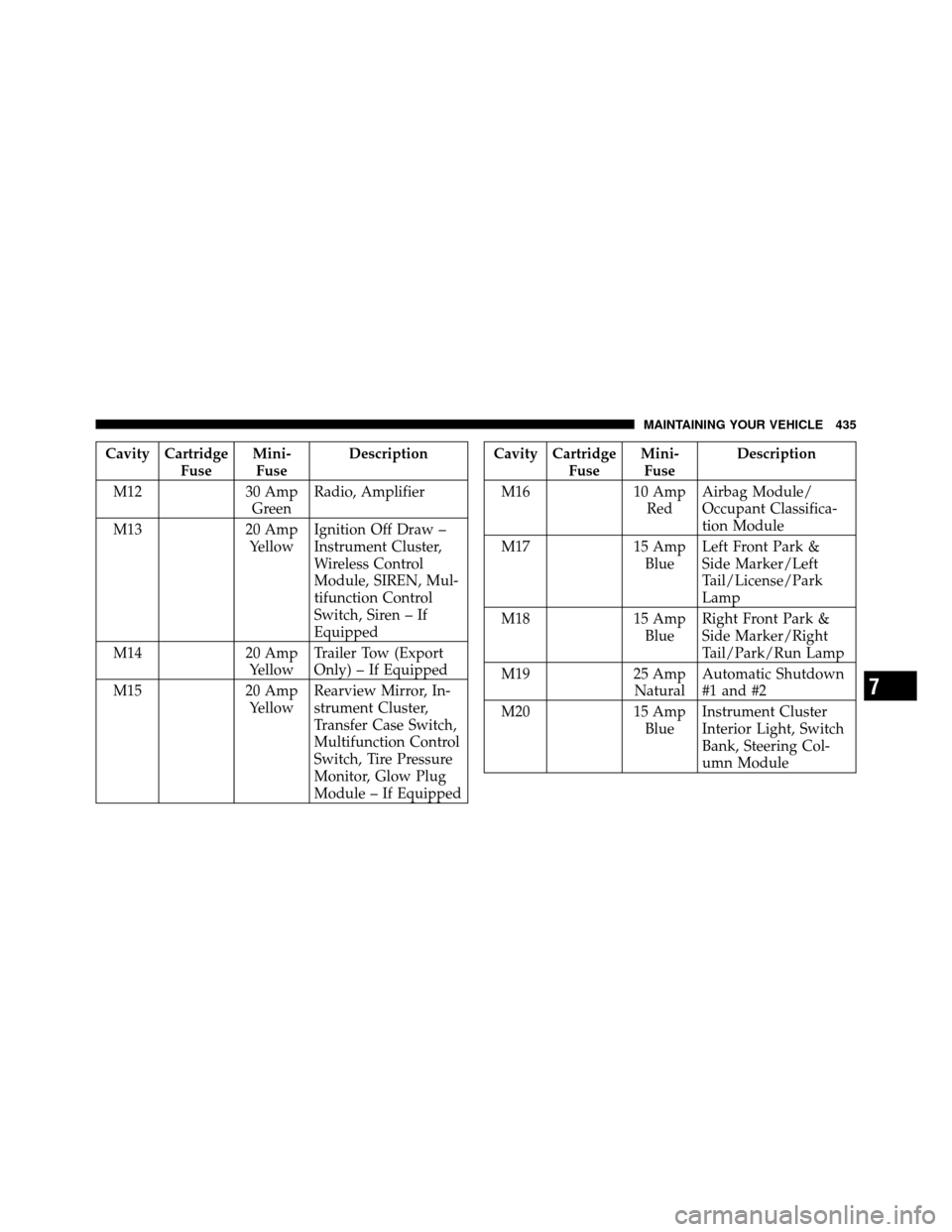
Cavity CartridgeFuseMini-
Fuse Description
M12 30 Amp
Green Radio, Amplifier
M13 20 Amp
Yellow Ignition Off Draw –
Instrument Cluster,
Wireless Control
Module, SIREN, Mul-
tifunction Control
Switch, Siren – If
Equipped
M14 20 Amp
Yellow Trailer Tow (Export
Only) – If Equipped
M15 20 Amp
Yellow Rearview Mirror, In-
strument Cluster,
Transfer Case Switch,
Multifunction Control
Switch, Tire Pressure
Monitor, Glow Plug
Module – If EquippedCavity Cartridge
FuseMini-
Fuse Description
M16 10 Amp
Red Airbag Module/
Occupant Classifica-
tion Module
M17 15 Amp
Blue Left Front Park &
Side Marker/Left
Tail/License/Park
Lamp
M18 15 Amp
Blue Right Front Park &
Side Marker/Right
Tail/Park/Run Lamp
M19 25 Amp
Natural Automatic Shutdown
#1 and #2
M20 15 Amp
Blue Instrument Cluster
Interior Light, Switch
Bank, Steering Col-
umn Module
7
MAINTAINING YOUR VEHICLE 435