Page 56 of 497
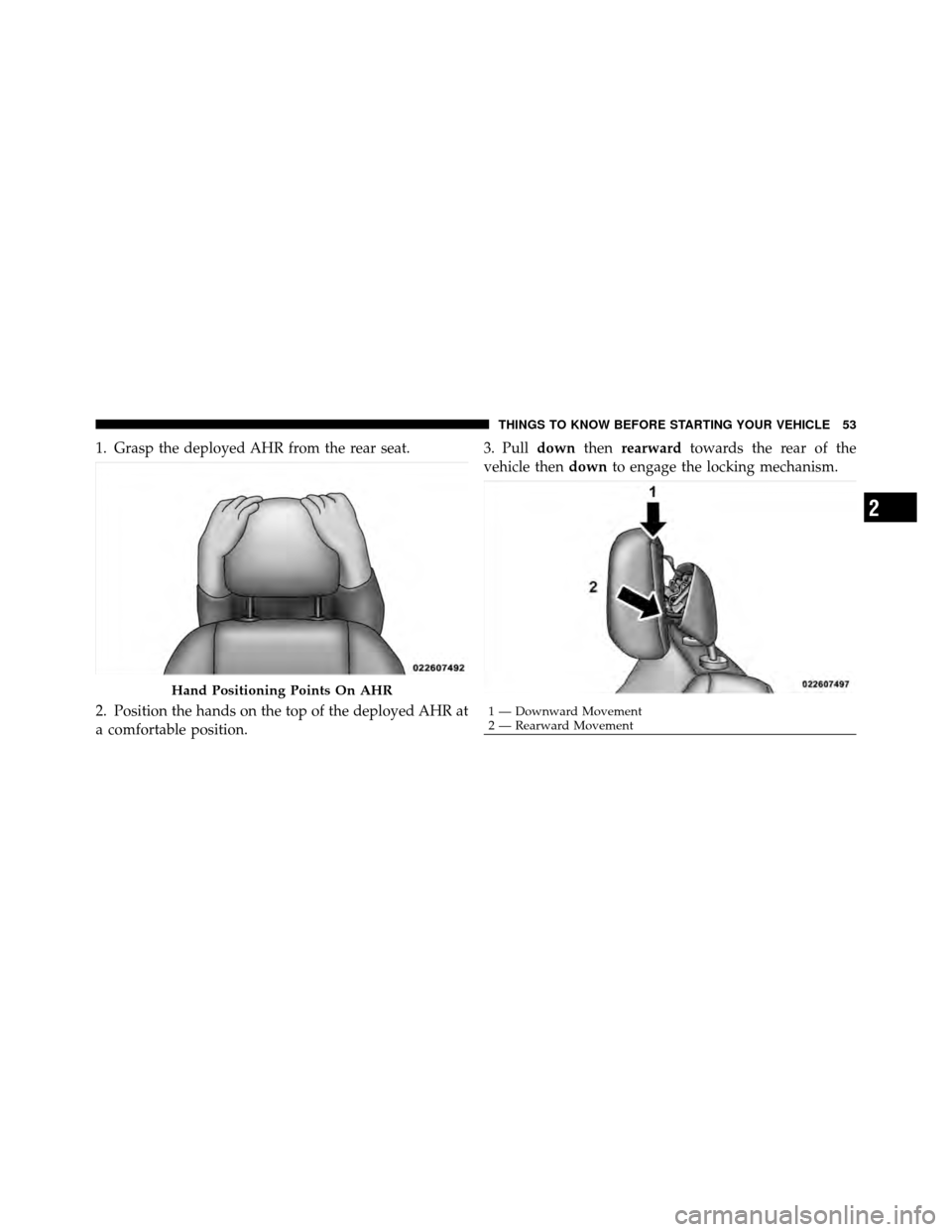
1. Grasp the deployed AHR from the rear seat.
2. Position the hands on the top of the deployed AHR at
a comfortable position.3. Pull
downthenrearward towards the rear of the
vehicle then downto engage the locking mechanism.
Hand Positioning Points On AHR
1 — Downward Movement
2 — Rearward Movement
2
THINGS TO KNOW BEFORE STARTING YOUR VEHICLE 53
Page 57 of 497
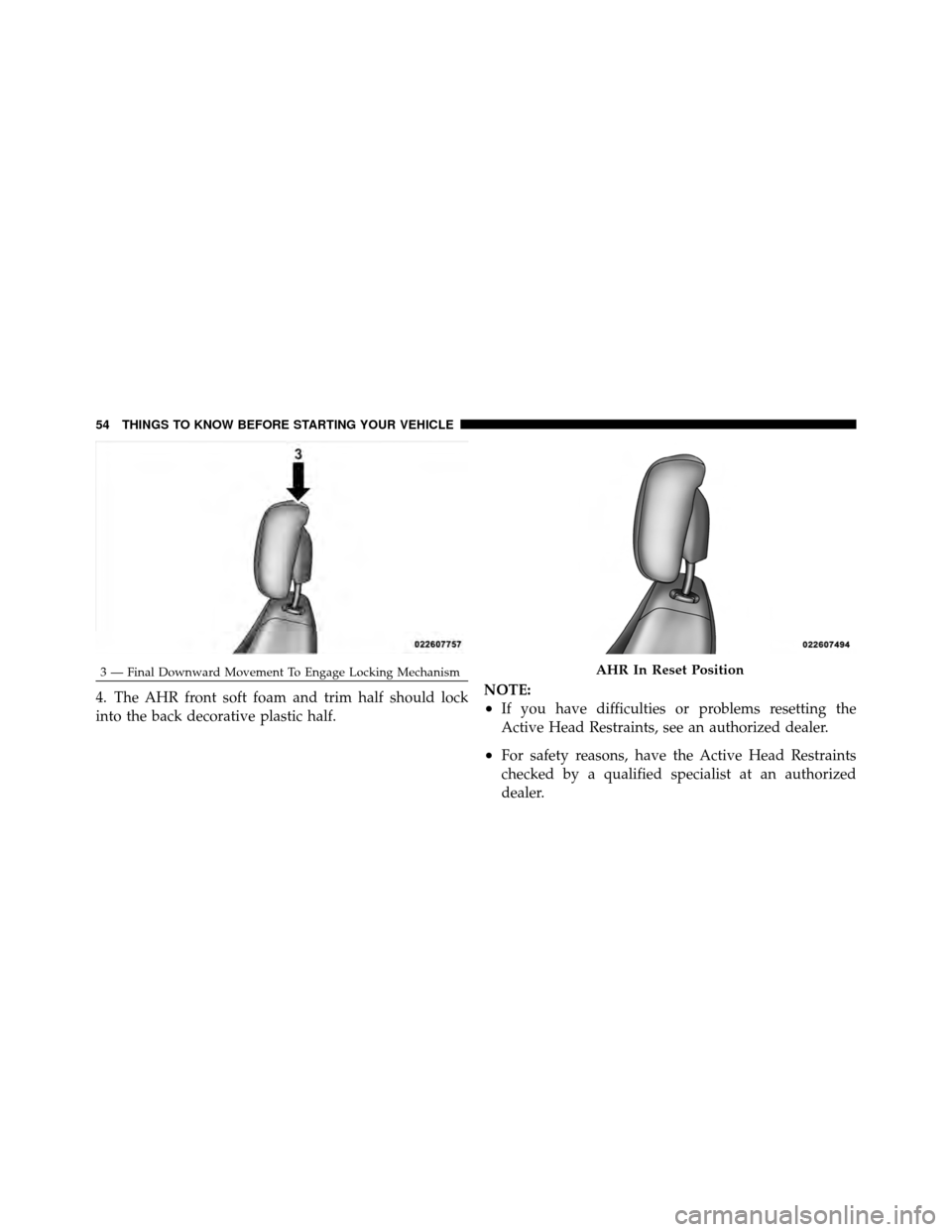
4. The AHR front soft foam and trim half should lock
into the back decorative plastic half.NOTE:•If you have difficulties or problems resetting the
Active Head Restraints, see an authorized dealer.
•For safety reasons, have the Active Head Restraints
checked by a qualified specialist at an authorized
dealer.
3—Final Downward Movement To Engage Locking MechanismAHR In Reset Position
54 THINGS TO KNOW BEFORE STARTING YOUR VEHICLE
Page 58 of 497
Energy Management Feature
This vehicle has a safety belt system with an energy
management feature in the front seating positions to help
further reduce the risk of injury in the event of a head-on
accident.
This safety belt system has a retractor assembly that is
designed to release webbing in a controlled manner. This
feature is designed to help reduce the belt force acting on
the occupant’s chest.
WARNING!
•The belt and retractor assembly must be replaced
if the seat belt assembly “Automatic Locking Re-
tractor (ALR)” feature or any other seat belt func-
tion is not working properly when checked ac-
cording to the procedures in the Service Manual.
•Failure to replace the belt and retractor assembly
could increase the risk of injury in accidents.
Enhanced Seat Belt Use Reminder System
(BeltAlert�)
BeltAlert�is a feature intended to remind the driver and
front passenger (if equipped with front passenger
BeltAlert�) to fasten their seat belts. If the driver or front
seat passenger is unbelted, the Seat Belt Reminder Light
will turn on and remain on until both front seat belts are
fastened.
The BeltAlert� warning sequence begins within 60 sec-
onds of the vehicle speed over 5 mph (8 km/h), by
blinking the Seat Belt Reminder Light and sounding an
intermittent chime. Once the sequence starts, it will
continue for 96 seconds or until the respective seat belts
are fastened. After the sequence completes, the Seat Belt
Reminder Light remains illuminated until the respective
seat belts are fastened. The driver should instruct all
other occupants to fasten their seat belts. If a front seat
belt is unbuckled while traveling at speeds greater than
2
THINGS TO KNOW BEFORE STARTING YOUR VEHICLE 55
Page 60 of 497
NOTE:Although BeltAlert� has been deactivated, the
Seat Belt Reminder Light will continue to illuminate
while the driver ’s or front passenger ’s (if equipped with
belt alert) seat belt remains unfastened.
Seat Belt Lock Out
The center rear seat belt system has a lock out feature that
will not allow you to extract the center webbing unless
the rear seat upper latch is engaged.
Seat Belts And Pregnant Women
We recommend that pregnant women use the seat belts
throughout their pregnancy. Keeping the mother safe is
the best way to keep the baby safe.
Pregnant women should wear the lap part of the belt
across the thighs and as snug across the hips as possible.
Keep the belt low so that it does not come across the
abdomen. That way the strong bones of the hips will take
the force if there is an accident.
Seat Belt Extender
If a seat belt is too short even when fully extended and
when the adjustable upper shoulder belt anchorage (if
equipped) is in its lowest position, your authorized
dealer can provide you with a seat belt extender. This
extender should be used only if the existing belt is not
long enough. When it is not required, remove the ex-
tender and store it.
WARNING!
Using a seat belt extender when not needed can
increase the risk of injury in an accident. Only use
when the lap belt is not long enough when it is worn
low and snug, and in the recommended seating
positions. Remove and store the extender when not
needed.
2
THINGS TO KNOW BEFORE STARTING YOUR VEHICLE 57
Page 66 of 497
WARNING!
•If your vehicle is equipped with left and right
Supplemental Side Air Bag Inflatable Curtain
(SABIC), do not stack luggage or other cargo up
high enough to block the location of the SABIC.
The area where the SABIC is located should re-
main free from any obstructions.
•Do not use accessory seat covers or place objects
between you and the side air bags; the perfor-
mance could be adversely affected and/or objects
could be pushed into you, causing serious injury.
WARNING! (Continued)
•If your vehicle is equipped with SABIC air bags,
do not have any accessory items installed which
will alter the roof, including adding a sunroof to
your vehicle. Do not add roof racks that require
permanent attachments (bolts or screws) for instal-
lation on the vehicle roof. Do not drill into the roof
of the vehicle for any reason.
Knee Impact Bolsters
The Knee Impact Bolsters help protect the knees of the
driver and the front passenger, and position front occu-
pants for the best interaction with the Advanced Front
Air Bag.
2
THINGS TO KNOW BEFORE STARTING YOUR VEHICLE 63
Page 68 of 497

Because air bag sensors measure vehicle deceleration
over time, vehicle speed and damage by themselves are
not good indicators of whether or not an air bag should
have deployed.
Seat belts are necessary for your protection in all crashes,
and also are needed to help keep you in position, away
from an inflating air bag.
The ORC also monitors the readiness of the electronic
parts of the air bag system whenever the ignition switch
is in the START or ON/RUN positions. If the key is in the
LOCK position, in the ACC position, or not in the
ignition, the air bag system is not on and the air bags will
not inflate.
The ORC contains a backup power supply system that
may deploy the air bags even if the battery loses power or
it becomes disconnected prior to deployment.Also, the ORC turns on the “Air Bag Warning
Light” for four to eight seconds for a self-check
when the ignition is first turned to ON/RUN.
After the self-check, the “Air Bag Warning
Light” will turn off. If the ORC detects a malfunction in
any part of the system, it turns on the “Air Bag Warning
Light” either momentarily or continuously. A single
chime will sound if the light comes on again after initial
startup.
It also includes diagnostics that will illuminate the instru-
ment cluster Air Bag Warning Light if a malfunction is
noted that could affect the air bag system. The diagnos-
tics also record the nature of the malfunction.
2
THINGS TO KNOW BEFORE STARTING YOUR VEHICLE 65
Page 74 of 497
WARNING!
If your vehicle is equipped with left and right
Supplemental Side Air Bag Inflatable Curtains
(SABIC), do not stack luggage or other cargo up high
enough to block the location of the SABIC. The area
where the SABIC is located should remain free from
any obstructions.
The front passenger seat assembly contains critical com-
ponents that affect the front passenger air bag deploy-
ment. Correctly functioning front passenger seat compo-
nents are critical for the Occupant Classification System
(OCS) to properly classify the front passenger and calcu-
late the proper air bag deployment. Do not make any
modifications to the front passenger seat components,
assembly, or to the seat cover. The following requirements must be strictly adhered to:•Do not modify the front passenger seat assembly or
components in any way.
•Do not use prior or future model year seat covers not
designated for the specific model being repaired. Al-
ways use the correct seat cover specified for the
vehicle.
•Do not replace the seat cover with an aftermarket seat
cover.
•Do not add a secondary seat cover other than those
approved by Chrysler Group LLC/Mopar�.
•At no time should any Supplemental Restraint System
(SRS) component or SRS related component or fas-
tener be modified or replaced with any part except
those which are approved by Chrysler Group
LLC/Mopar�.
2
THINGS TO KNOW BEFORE STARTING YOUR VEHICLE 71
Page 75 of 497

WARNING!
Unapproved modifications or service procedures to
the front passenger seat assembly, its related compo-
nents or seat cover may inadvertently change the air
bag deployment in case of a frontal crash. This could
result in death or serious injury to the front seat
passenger if the vehicle is involved in a collision. A
modified vehicle may not comply with required
Federal Motor Vehicle Safety Standards (FMVSS)
and/or Canadian Motor Vehicle Safety Standards
(CMVSS).
Enhanced Accident Response System
In the event of an impact causing air bag deployment, if
the communication network remains intact, and the
power remains intact, depending on the nature of theevent the ORC will determine whether to have the
Enhanced Accident Response System perform the follow-
ing functions:
•Cut off fuel to the engine.
•Flash hazard lights as long as the battery has power or
until the ignition key is turned off.
•Turn on the interior lights, which remain on as long as
the battery has power or until the ignition key is
removed.
•Unlock the doors automatically.
If A Deployment Occurs
The front air bags are designed to deflate immediately
after deployment.
NOTE:
Front and/or side air bags will not deploy in all
collisions. This does not mean something is wrong with
the air bag system.
72 THINGS TO KNOW BEFORE STARTING YOUR VEHICLE