Page 343 of 497

CAUTION!
Do not use tire chains on vehicles equipped with
tires other than P235/65R17 and P225/75R16 tires.
There may not be adequate clearance for the chains
and you are risking structural or body damage to
your vehicle.
TIRE ROTATION RECOMMENDATIONS
The tires on the front and rear of your vehicle operate at
different loads and perform different steering, handling,
and braking functions. For these reasons, they wear at
unequal rates.
These effects can be reduced by timely rotation of tires.
The benefits of rotation are especially worthwhile with
aggressive tread designs such as those on On/Off-Road
type tires. Rotation will increase tread life, help to main-
tain mud, snow, and wet traction levels, and contribute to
a smooth, quiet ride.
CAUTION!
Proper operation of four-wheel drive vehicles de-
pends on tires of equal size, type and circumference
on each wheel. Any difference in tire size can cause
damage to the transfer case. Tire rotation schedule
should be followed to balance tire wear.
Refer to the “Maintenance Schedule” for the proper
maintenance intervals. More frequent rotation is permis-
sible if desired. The reasons for any rapid or unusual
wear should be corrected prior to rotation being per-
formed.
NOTE: The premium Tire Pressure Monitor System will
automatically locate the pressure values displayed in the
correct vehicle position following a tire rotation.
The suggested rotation method is the “forward-cross”
shown in the following diagram.
340 STARTING AND OPERATING
Page 347 of 497

The TPMS consists of the following components:
•Receiver Module
•Four Tire Pressure Monitoring Sensors
•Tire Pressure Monitoring Telltale Light
The matching full-size spare wheel and tire assembly (if
equipped) has a tire pressure monitoring sensor. The
matching full-size spare can be used in place of any of the
four road tires. The TPMS will only monitor the pressure
in the full-size spare when it is used in place of a road
tire. Otherwise, a spare with a pressure below the low-
pressure limit will not cause the “Tire Pressure Monitor-
ing Telltale Light” to illuminate or the chime to sound.
Tire Pressure Monitoring Low Pressure Warnings
The “Tire Pressure Monitoring Telltale Light” will
illuminate in the instrument cluster and a chime
will sound when tire pressure is low in one or
more of the four active road tires. Should this occur, you
should stop as soon as possible, check the inflation
pressure of each tire on your vehicle, and inflate each tire
to the vehicle’s recommended cold placard pressure
value. Once the system receives the updated tire pres-
sures, the system will automatically update and the “Tire
Pressure Monitoring Telltale Light” will turn off. The
vehicle may need to be driven for up to 20 minutes above
15 mph (24 km/h) in order for the TPMS to receive this
information.
344 STARTING AND OPERATING
Page 349 of 497

Vehicles With Compact Spare
1. The compact spare tire does not have a tire pressure
monitoring sensor. Therefore, the TPMS will not monitor
the pressure in the compact spare tire.
2. If you install the compact spare tire in place of a road
tire that has a pressure below the low-pressure warning
limit, a chime will sound and the “TPMS Telltale Light”
will turn on upon the next ignition key cycle.
3. After driving the vehicle for up to 20 minutes above
15 mph (24 km/h), the “TPMS Telltale Light” will flash
on and off for 75 seconds and then remain on solid.
4. For each subsequent ignition key cycle, a chime will
sound and the “TPMS Telltale Light” will flash on and off
for 75 seconds and then remain on solid.
5. Once you repair or replace the original road tire and
reinstall it on the vehicle in place of the compact spare,
the TPMS will update automatically and the “TPMSTelltale Light” will turn off, as long as no tire pressure is
below the low-pressure warning limit in any of the four
active road tires. The vehicle may need to be driven for
up to 20 minutes above 15 mph (24 km/h) in order for the
TPMS to receive this information.
Premium System – If Equipped
The Tire Pressure Monitor System (TPMS) uses wireless
technology with wheel rim mounted electronic sensors to
monitor tire pressure levels. Sensors, mounted to each
wheel as part of the valve stem, transmit tire pressure
readings to the receiver module.
NOTE:
It is particularly important for you to check the
tire pressure in all of the tires on your vehicle monthly
and to maintain the proper pressure.
The TPMS consists of the following components:
•Receiver Module
•Four Tire Pressure Monitoring Sensors
346 STARTING AND OPERATING
Page 374 of 497
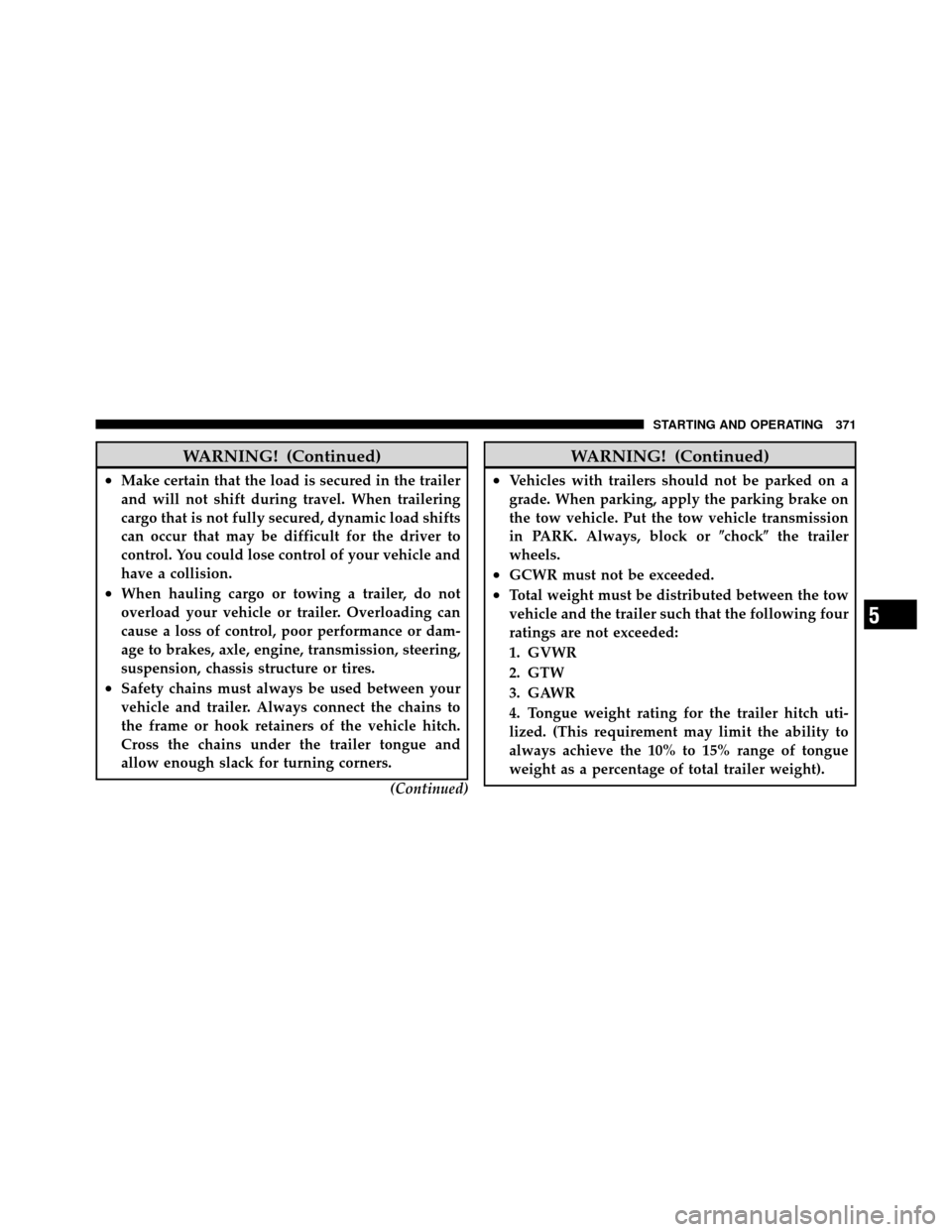
WARNING! (Continued)
•Make certain that the load is secured in the trailer
and will not shift during travel. When trailering
cargo that is not fully secured, dynamic load shifts
can occur that may be difficult for the driver to
control. You could lose control of your vehicle and
have a collision.
•When hauling cargo or towing a trailer, do not
overload your vehicle or trailer. Overloading can
cause a loss of control, poor performance or dam-
age to brakes, axle, engine, transmission, steering,
suspension, chassis structure or tires.
•Safety chains must always be used between your
vehicle and trailer. Always connect the chains to
the frame or hook retainers of the vehicle hitch.
Cross the chains under the trailer tongue and
allow enough slack for turning corners.(Continued)
WARNING! (Continued)
•Vehicles with trailers should not be parked on a
grade. When parking, apply the parking brake on
the tow vehicle. Put the tow vehicle transmission
in PARK. Always, block or�chock�the trailer
wheels.
•GCWR must not be exceeded.
•Total weight must be distributed between the tow
vehicle and the trailer such that the following four
ratings are not exceeded:
1. GVWR
2. GTW
3. GAWR
4. Tongue weight rating for the trailer hitch uti-
lized. (This requirement may limit the ability to
always achieve the 10% to 15% range of tongue
weight as a percentage of total trailer weight).
5
STARTING AND OPERATING 371
Page 380 of 497
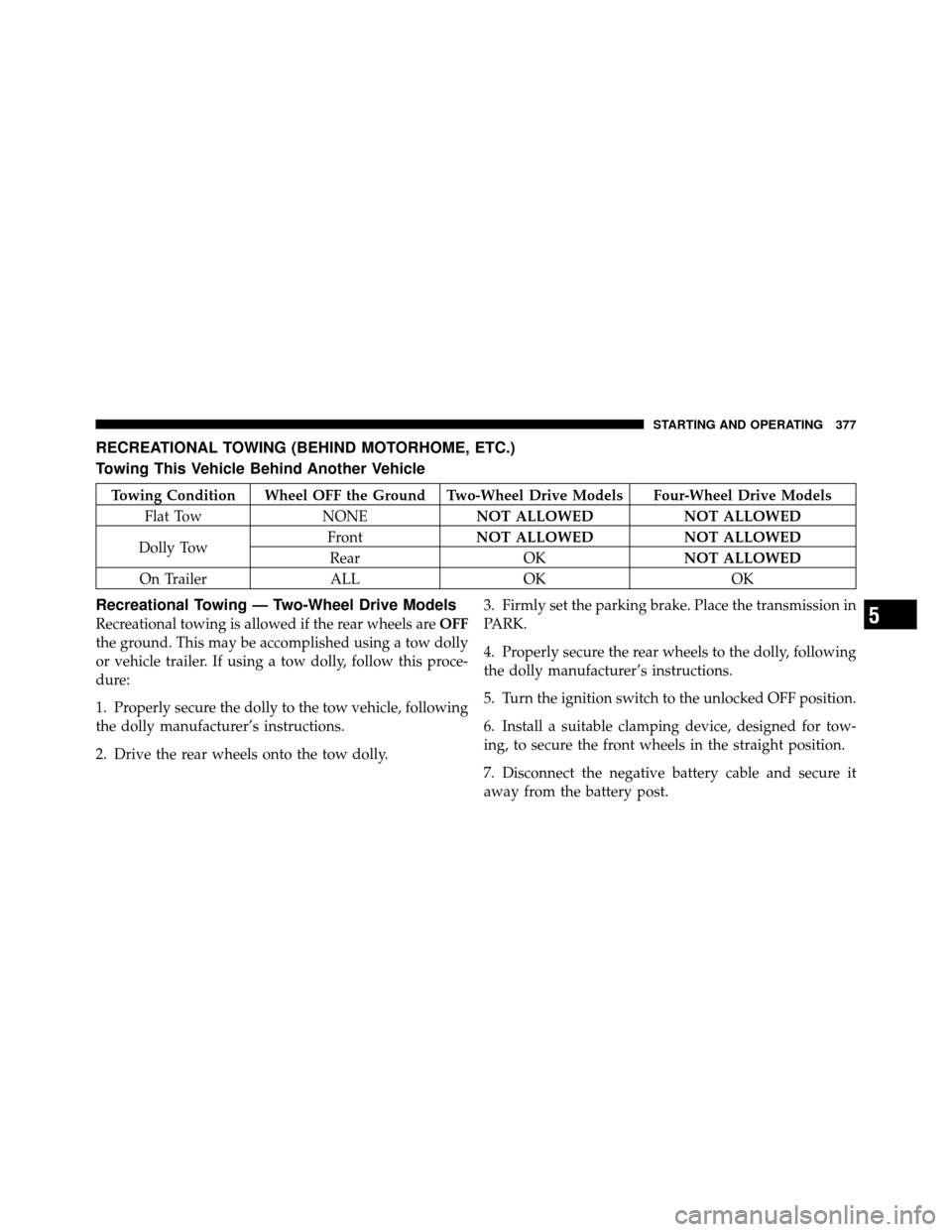
RECREATIONAL TOWING (BEHIND MOTORHOME, ETC.)
Towing This Vehicle Behind Another Vehicle
Towing Condition Wheel OFF the Ground Two-Wheel Drive Models Four-Wheel Drive ModelsFlat Tow NONENOT ALLOWED NOT ALLOWED
Dolly Tow Front
NOT ALLOWED NOT ALLOWED
Rear OKNOT ALLOWED
On Trailer ALL OK OK
Recreational Towing — Two-Wheel Drive Models
Recreational towing is allowed if the rear wheels are OFF
the ground. This may be accomplished using a tow dolly
or vehicle trailer. If using a tow dolly, follow this proce-
dure:
1. Properly secure the dolly to the tow vehicle, following
the dolly manufacturer’s instructions.
2. Drive the rear wheels onto the tow dolly. 3. Firmly set the parking brake. Place the transmission in
PARK.
4. Properly secure the rear wheels to the dolly, following
the dolly manufacturer’s instructions.
5. Turn the ignition switch to the unlocked OFF position.
6. Install a suitable clamping device, designed for tow-
ing, to secure the front wheels in the straight position.
7. Disconnect the negative battery cable and secure it
away from the battery post.5
STARTING AND OPERATING 377
Page 381 of 497
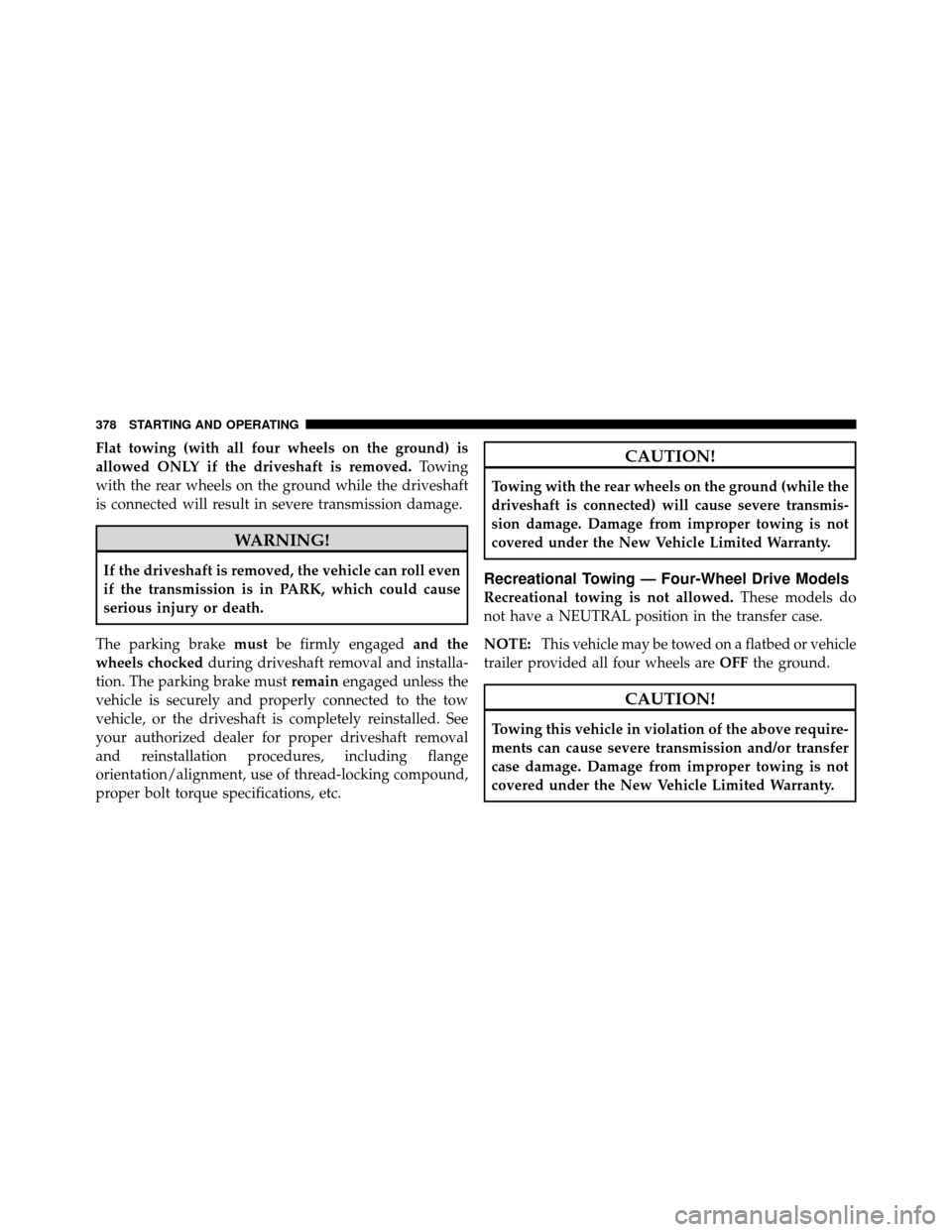
Flat towing (with all four wheels on the ground) is
allowed ONLY if the driveshaft is removed.Towing
with the rear wheels on the ground while the driveshaft
is connected will result in severe transmission damage.
WARNING!
If the driveshaft is removed, the vehicle can roll even
if the transmission is in PARK, which could cause
serious injury or death.
The parking brake mustbe firmly engaged and the
wheels chocked during driveshaft removal and installa-
tion. The parking brake must remainengaged unless the
vehicle is securely and properly connected to the tow
vehicle, or the driveshaft is completely reinstalled. See
your authorized dealer for proper driveshaft removal
and reinstallation procedures, including flange
orientation/alignment, use of thread-locking compound,
proper bolt torque specifications, etc.
CAUTION!
Towing with the rear wheels on the ground (while the
driveshaft is connected) will cause severe transmis-
sion damage. Damage from improper towing is not
covered under the New Vehicle Limited Warranty.
Recreational Towing — Four-Wheel Drive Models
Recreational towing is not allowed. These models do
not have a NEUTRAL position in the transfer case.
NOTE:
This vehicle may be towed on a flatbed or vehicle
trailer provided all four wheels are OFF
the ground.
CAUTION!
Towing this vehicle in violation of the above require-
ments can cause severe transmission and/or transfer
case damage. Damage from improper towing is not
covered under the New Vehicle Limited Warranty.
378 STARTING AND OPERATING
Page 382 of 497
WHAT TO DO IN EMERGENCIES
CONTENTS
�Hazard Warning Flashers ................ 380
� If Your Engine Overheats ................ 380
� Jacking And Tire Changing ............... 381
▫ Jack Location ....................... 382
▫ Spare Tire Stowage ................... 382
▫ Spare Tire Removal ................... 383
▫ Preparations For Jacking ............... 383
▫ Jacking Instructions ................... 384 �
Jump-Starting Procedures ................ 388
▫ Preparations For Jump-Start ............. 388
▫ Jump-Starting Procedure ............... 390
� Freeing A Stuck Vehicle ................. 392
� Shift Lever Override ................... 393
� Towing A Disabled Vehicle ............... 394
▫ Towing Without The Ignition Key FOB ..... 396
▫ Two-Wheel Drive Models .............. 396
▫ Four-Wheel Drive Vehicles .............. 397
6
Page 399 of 497

CAUTION!
•Do not attempt to use sling type equipment when
towing. When securing the vehicle to a flat bed
truck, do not attach to front or rear suspension
components. Damage to your vehicle may result
from improper towing.
•If the vehicle being towed requires steering, the
ignition must be in the ON/RUN or ACC position,
not in the LOCK position.
Towing Without The Ignition Key Fob
Special care must be taken when the vehicle is towed
with the ignition in the LOCK position. The only ap-
proved method of towing without the ignition key is
with a flatbed truck. Proper towing equipment is neces-
sary to prevent damage to the vehicle.
Two-Wheel Drive Models
The manufacturer recommends towing your vehicle with
all four wheelsOFFthe ground using a flatbed.
If flatbed equipment is not available, and the transmis-
sion is operable, the vehicle may be towed (with rear
wheels on the ground) with the transmission in NEU-
TRAL. Speed must not exceed 30 mph (48 km/h) and the
distance must not exceed 15 miles (24 km).
CAUTION!
Towing faster than 30 mph (48 km/h) or farther than
15 miles (24 km) with rear wheels on the ground can
cause severe damage to the transmission. Such dam-
age is not covered by the New Vehicle Limited
Warranty.
If the transmission is not operable, or the vehicle must be
towed faster than 30 mph (48 km/h) or farther than
396 WHAT TO DO IN EMERGENCIES
