Page 434 of 562
•An electronically actuated trailer brake controller is
required when towing a trailer with electronically
actuated brakes. When towing a trailer equipped with
a hydraulic surge actuated brake system, an electronic
brake controller is not required.
•Trailer brakes are recommended for trailers over
1,000 lbs (454 kg) and required for trailers in excess of
2,000 lbs (907 kg).
CAUTION!
If the trailer weighs more than 1,000 lbs (454 kg)
loaded, it should have its own brakes and they
should be of adequate capacity. Failure to do this
could lead to accelerated brake lining wear, higher
brake pedal effort, and longer stopping distances.
WARNING!
•Do not connect trailer brakes to your vehicle’s
hydraulic brake lines. It can overload your brake
system and cause it to fail. You might not have
brakes when you need them and could have a
collision.
•Towing any trailer will increase your stopping
distance. When towing you should allow for addi-
tional space between your vehicle and the vehicle
in front of you. Failure to do so could result in an
collision.
Towing Requirements – Trailer Lights And Wiring
Whenever you pull a trailer, regardless of the trailer size,
stop lights and turn signals on the trailer are required for
motoring safety.
432 STARTING AND OPERATING
Page 435 of 562
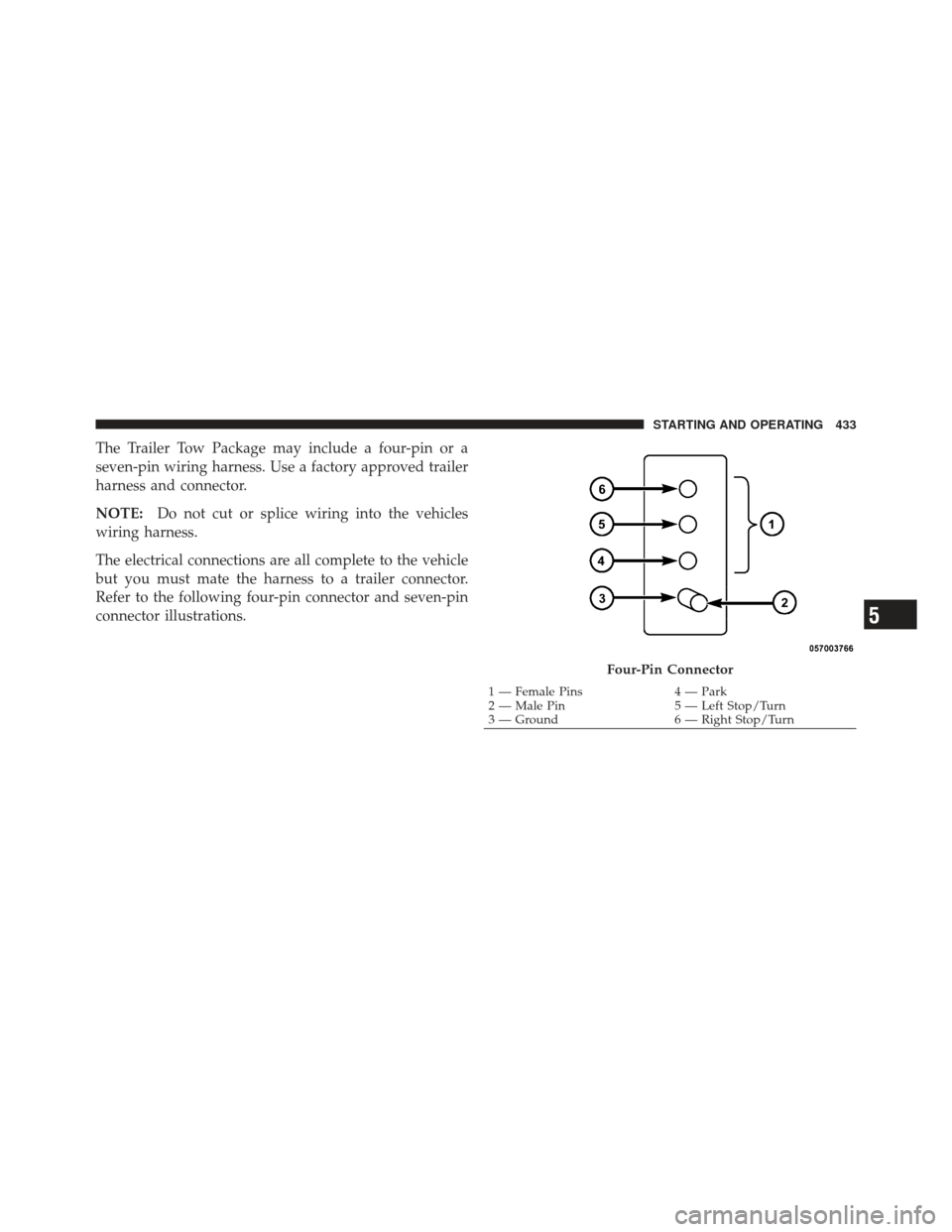
The Trailer Tow Package may include a four-pin or a
seven-pin wiring harness. Use a factory approved trailer
harness and connector.
NOTE:Do not cut or splice wiring into the vehicles
wiring harness.
The electrical connections are all complete to the vehicle
but you must mate the harness to a trailer connector.
Refer to the following four-pin connector and seven-pin
connector illustrations.
Four-Pin Connector
1 — Female Pins 4 — Park
2 — Male Pin 5 — Left Stop/Turn
3 — Ground 6 — Right Stop/Turn
5
STARTING AND OPERATING 433
Page 436 of 562
Towing Tips
Before setting out on a trip, practice turning, stopping
and backing the trailer in an area away from heavy
traffic.
Automatic Transmission
The DRIVE gear can be selected when towing. However,
if frequent shifting occurs while in DRIVE, move the shift
lever into fifth gear.
NOTE:Moving the shift lever into fifth gear while
operating the vehicle under heavy operating conditions
will improve performance and extend transmission life
by reducing excessive shifting and heat build up. This
action will also provide better engine braking.
The automatic transmission fluid and filter should be
changed if you REGULARLY tow a trailer for more than
45 minutes of continuous operation. Refer to “Mainte-
nance Schedule” for the proper maintenance intervals.
Seven-Pin Connector
1 — Battery 5 — Ground
2 — Backup Lamps 6 — Left Stop/Turn
3 — Right Stop/Turn 7 — Running Lamps
4 — Electric Brakes
434 STARTING AND OPERATING
Page 437 of 562
NOTE:
•Check the automatic transmission fluid level before
towing.
•The transmission is sealed and requires an authorized
dealer to check the transmission fluid.
Electronic Speed Control – If Equipped
•
Do not use in hilly terrain or with heavy loads.
•When using the speed control, if you experience speed
drops greater than 10 mph (16 km/h), disengage until
you can get back to cruising speed.
•Use speed control in flat terrain and with light loads to
maximize fuel efficiency.
Cooling System
To reduce potential for engine and transmission over-
heating, take the following actions:
•City Driving
When stopped for short periods of time, shift the trans-
mission into NEUTRAL but do not increase engine idle
speed.
•Highway Driving
Reduce speed.
•Air Conditioning
Turn off temporarily.
5
STARTING AND OPERATING 435
Page 438 of 562
RECREATIONAL TOWING (BEHIND
MOTORHOME, ETC.)
CAUTION!
Towing this vehicle behind another vehicle (flat-
towing with all four wheels on the ground) is not
recommended.
NOTE: If the vehicle requires towing, make sure all four
wheels are off the ground.
436 STARTING AND OPERATING
Page 439 of 562
WHAT TO DO IN EMERGENCIES
CONTENTS
�Hazard Warning Flashers ................ 438
� If Your Engine Overheats ................ 438
� Jacking And Tire Changing ............... 439
▫ Jack Location ....................... 440
▫ Spare Tire Removal ................... 441
▫ To Access Spare Tire Winch Drive Nut ..... 441
▫ Spare Tire Tools ..................... 444
▫ Spare Tire Removal Instructions .......... 445
▫ Preparations For Jacking ............... 447
▫ Jacking Instructions ................... 448 ▫
Wheel Nuts ........................ 453
▫ Securing The Spare Tire ................ 454
� Jump-Starting Procedure ................ 456
▫ Preparations For Jump-Start ............. 457
▫ Jump-Starting Procedure ............... 458
� Freeing A Stuck Vehicle ................. 460
� Shift Lever Override ................... 461
� Towing A Disabled Vehicle ............... 462
▫ Without The Ignition Key .............. 464
6
Page 442 of 562
WARNING! (Continued)
•The jack is designed to be used as a tool for
changing tires only. The jack should not be used to
lift the vehicle for service purposes. The vehicle
should be jacked on a firm level surface only.
Avoid ice or slippery areas.
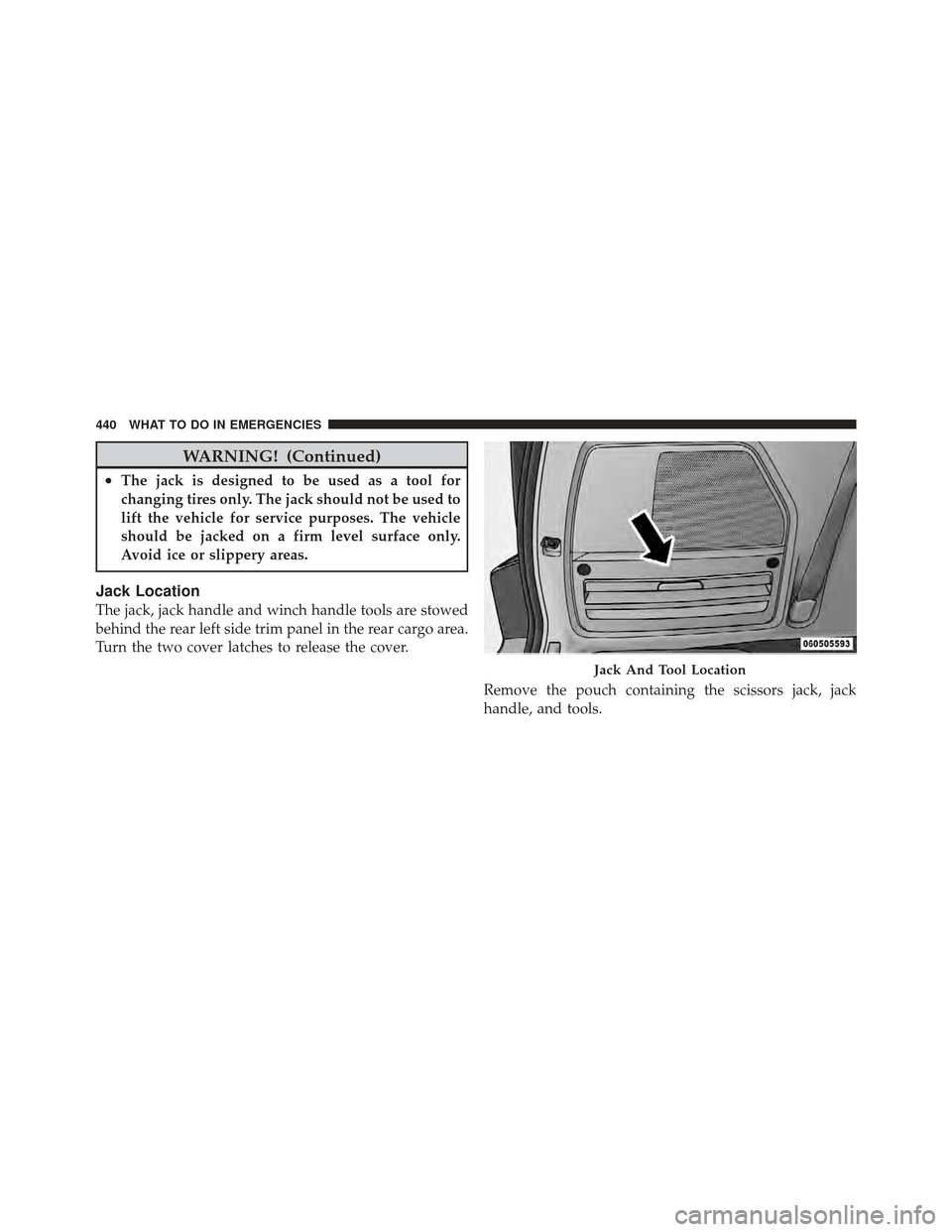
Jack Location
The jack, jack handle and winch handle tools are stowed
behind the rear left side trim panel in the rear cargo area.
Turn the two cover latches to release the cover.Remove the pouch containing the scissors jack, jack
handle, and tools.
Jack And Tool Location
440 WHAT TO DO IN EMERGENCIES
Page 443 of 562
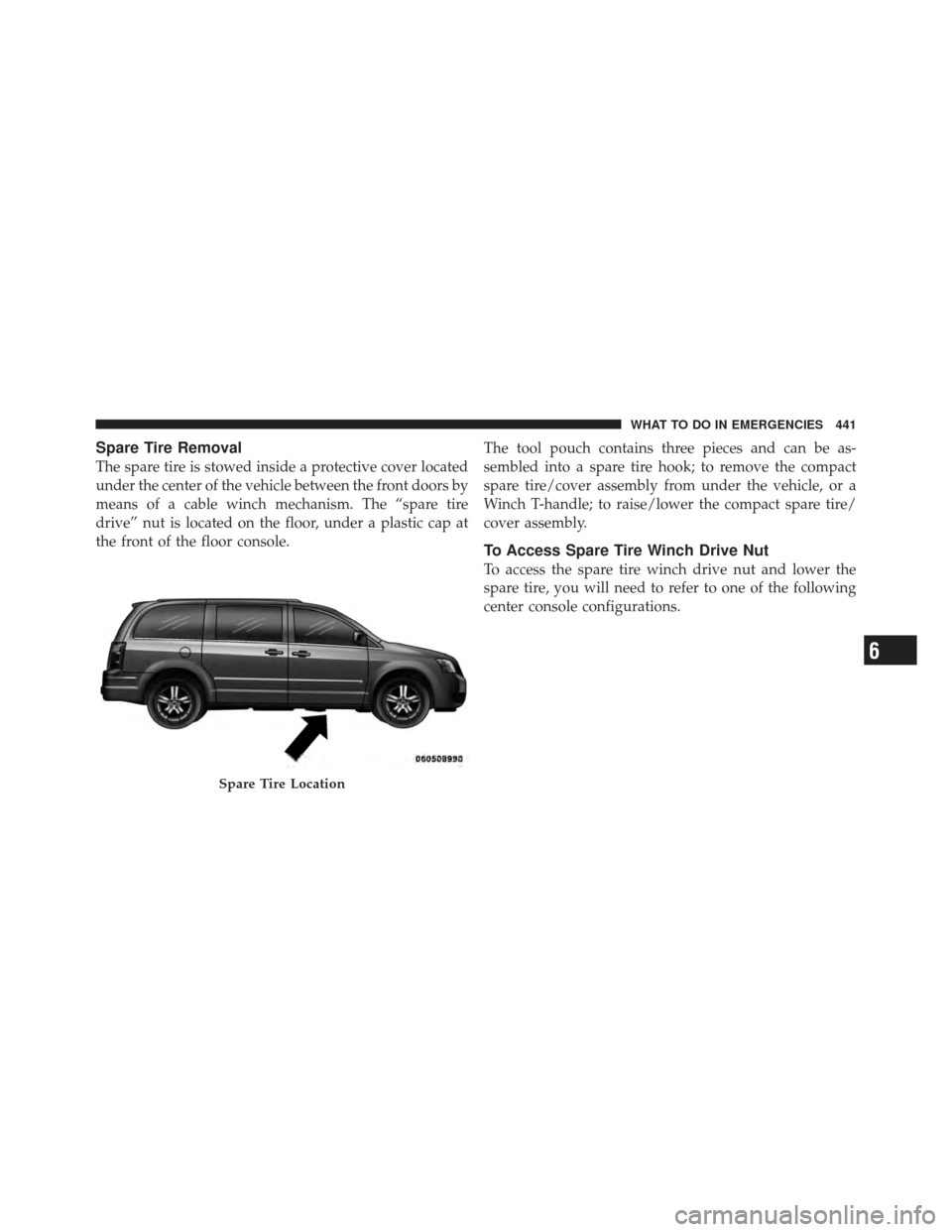
Spare Tire Removal
The spare tire is stowed inside a protective cover located
under the center of the vehicle between the front doors by
means of a cable winch mechanism. The “spare tire
drive” nut is located on the floor, under a plastic cap at
the front of the floor console.The tool pouch contains three pieces and can be as-
sembled into a spare tire hook; to remove the compact
spare tire/cover assembly from under the vehicle, or a
Winch T-handle; to raise/lower the compact spare tire/
cover assembly.
To Access Spare Tire Winch Drive Nut
To access the spare tire winch drive nut and lower the
spare tire, you will need to refer to one of the following
center console configurations.
Spare Tire Location
6
WHAT TO DO IN EMERGENCIES 441