Page 57 of 562
WARNING!
Infants in rear facing child restraints should never
ride in the front seat of a vehicle with a passenger
Advanced Front Air Bag. An air bag deployment can
cause severe injury or death to infants in that posi-
tion.
Children that are not big enough to wear the vehicle seat
belt properly (see section on Child Restraints) should be
secured in the rear seat in child restraints or belt-
positioning booster seats. Older children who do not use
child restraints or belt-positioning booster seats should
ride properly buckled up in the rear seat. Never allow
children to slide the shoulder belt behind them or under
their arm. If a child from 1 to 12 years old (not in a rear facing child
seat) must ride in the front passenger seat, move the seat
as far back as possible and use the proper child restraint.
(Refer to “Child Restraints”)
You should read the instructions provided with your
child restraint to make sure that you are using it properly.
2.
All occupants should always wear their lap and
shoulder belts properly.
3. The driver and front passenger seats should be
moved back as far as practical to allow the Advanced
Front Air Bags room to inflate.
4. Do not lean against the door or window. If your
vehicle has side air bags, and deployment occurs, the
side air bags will inflate forcefully into the space
between you and the door.
2
THINGS TO KNOW BEFORE STARTING YOUR VEHICLE 55
Page 64 of 562
6. To release the belt, push the red button on the buckle.
The belt will automatically retract to its stowed position.
If necessary, slide the latch plate down the webbing to
allow the belt to retract fully.
WARNING!
A frayed or torn belt could rip apart in an accident
and leave you with no protection. Inspect the belt
system periodically, checking for cuts, frays, or loose
parts. Damaged parts must be replaced immediately.
Do not disassemble or modify the system. Seat belt
assemblies must be replaced after an accident if they
have been damaged (bent retractor, torn webbing,
etc.).
Third Row Center Shoulder Belt Instructions
The shoulder belt for the third row center seat is located
in the headliner slightly behind the third row seat.Pull the strap down and secure the small latch plate of
the lap belt into the small buckle until you hear a “click”.
Position the shoulder belt on your chest so that it is
comfortable and not resting on your neck. When the belt
is long enough to fit, insert the large latch plate into the
buckle until you hear a “click.” The retractor should
withdraw any slack in the belt.
To release the small latch plate, position the end of the
large latch plate against the red button on the small latch
plate and push upward. Reinstall the latch plates into the
headliner.
Adjustable Upper Shoulder Belt Anchorage
In the front seats and the second row outboard seats, the
shoulder belt anchorage can be adjusted upward or
downward to help position the belt away from your
neck. The upper anchorage can be adjusted upward by
62 THINGS TO KNOW BEFORE STARTING YOUR VEHICLE
Page 65 of 562
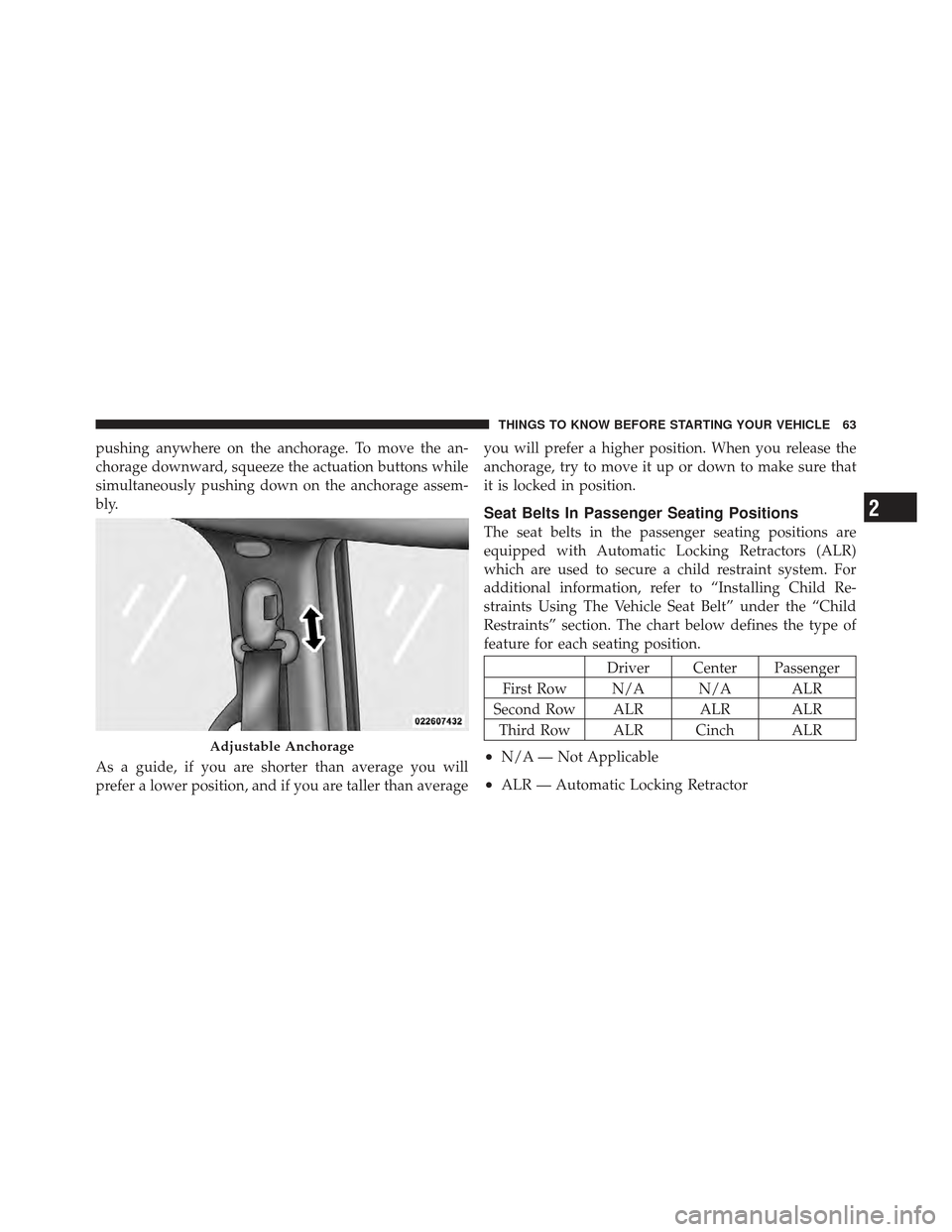
pushing anywhere on the anchorage. To move the an-
chorage downward, squeeze the actuation buttons while
simultaneously pushing down on the anchorage assem-
bly.
As a guide, if you are shorter than average you will
prefer a lower position, and if you are taller than averageyou will prefer a higher position. When you release the
anchorage, try to move it up or down to make sure that
it is locked in position.
Seat Belts In Passenger Seating Positions
The seat belts in the passenger seating positions are
equipped with Automatic Locking Retractors (ALR)
which are used to secure a child restraint system. For
additional information, refer to “Installing Child Re-
straints Using The Vehicle Seat Belt” under the “Child
Restraints” section. The chart below defines the type of
feature for each seating position.
Driver Center Passenger
First Row N/A N/A ALR
Second Row ALR ALR ALR Third Row ALR Cinch ALR
•N/A — Not Applicable
•ALR — Automatic Locking Retractor
Adjustable Anchorage
2
THINGS TO KNOW BEFORE STARTING YOUR VEHICLE 63
Page 72 of 562
Enhanced Seat Belt Use Reminder System
(BeltAlert�)
BeltAlert�is a feature intended to remind the driver and
front passenger (if equipped with front passenger
BeltAlert�) to fasten their seat belts. If the driver or front
seat passenger is unbelted, the Seat Belt Reminder Light
will turn on and remain on until both front seat belts are
fastened.
The BeltAlert� warning sequence begins within 60 sec-
onds of the vehicle speed over 5 mph (8 km/h), by
blinking the Seat Belt Reminder Light and sounding an
intermittent chime. Once the sequence starts, it will
continue for 96 seconds or until the respective seat belts
are fastened. After the sequence completes, the Seat Belt
Reminder Light remains illuminated until the respective
seat belts are fastened. The driver should instruct all
other occupants to fasten their seat belts. If a front seat
belt is unbuckled while traveling at speeds greater than 5 mph (8 km/h), BeltAlert�
will chime once and illumi-
nate the Seat Belt Reminder Light, then will proceed to
the 96 second warning sequence.
The front passenger seat BeltAlert� is not active when the
front passenger seat is unoccupied. BeltAlert �may be
triggered when an animal or heavy object is on the front
passenger seat or when the seat is folded flat (if
equipped). It is recommended that pets be restrained in
the rear seat in pet harnesses or pet carriers that are
secured by seat belts, and cargo is properly stowed.
BeltAlert� can be enabled or disabled by your authorized
dealer or by following these steps:
NOTE: The following steps must occur within the first
60 seconds of the ignition switch being cycled to the
ON/RUN position. Chrysler Group LLC does not recom-
mend deactivating BeltAlert�.
70 THINGS TO KNOW BEFORE STARTING YOUR VEHICLE
Page 89 of 562
To read data recorded by an EDR, special equipment is
required, and access to the vehicle or the EDR is needed.
In addition to the vehicle manufacturer, other parties,
such as law enforcement, that have the special equip-
ment, can read the information if they have access to the
vehicle or the EDR.
Child Restraints
Everyone in your vehicle needs to be buckled up all the
time, including babies and children. Every state in the
United States and all Canadian provinces require that
small children ride in proper restraint systems. This is the
law, and you can be prosecuted for ignoring it.
Children 12 years or younger should ride properly
buckled up in a rear seat. According to crash statistics,
children are safer when properly restrained in the rear
seats rather than in the front.
WARNING!
In a collision, an unrestrained child, even a tiny baby,
can become a projectile inside the vehicle. The force
required to hold even an infant on your lap could
become so great that you could not hold the child, no
matter how strong you are. The child and others
could be badly injured. Any child riding in your
vehicle should be in a proper restraint for the child’s
size.
Infants And Small Children
There are different sizes and types of restraints for
children from newborn size to the child almost large
enough for an adult safety belt. Always check the child
seat Owner’s Manual to ensure you have the right seat
for your child. Use the restraint that is correct for your
child.
2
THINGS TO KNOW BEFORE STARTING YOUR VEHICLE 87
Page 92 of 562
WARNING!
•Improper installation can lead to failure of an
infant or child restraint. It could come loose in a
collision. The child could be badly injured or
killed. Follow the manufacturer’s directions ex-
actly when installing an infant or child restraint.
•A rearward-facing child restraint should only be
used in a rear seat. A rearward-facing child re-
straint in the front seat may be struck by a deploy-
ing passenger air bag which may cause severe or
fatal injury to the infant.
Here are some tips on getting the most out of your child
restraint:
•Before buying any restraint system, make sure that it
has a label certifying that it meets all applicable Safety
Standards. Chrysler Group LLC also recommends that you make sure that you can install the child restraint in
the vehicle where you will use it, before you buy it.
•The restraint must be appropriate for your child’s
weight and height. Check the label on the restraint for
weight and height limits.
•Carefully follow the instructions that come with the
restraint. If you install the restraint improperly, it may
not work when you need it.
•Buckle the child into the seat according to the child
restraint manufacturer’s directions.
WARNING!
When your child restraint is not in use, secure it in
the vehicle with the seat belt or remove it from the
vehicle. Do not leave it loose in the vehicle. In a
sudden stop or accident, it could strike the occupants
or seatbacks and cause serious personal injury.
90 THINGS TO KNOW BEFORE STARTING YOUR VEHICLE
Page 95 of 562
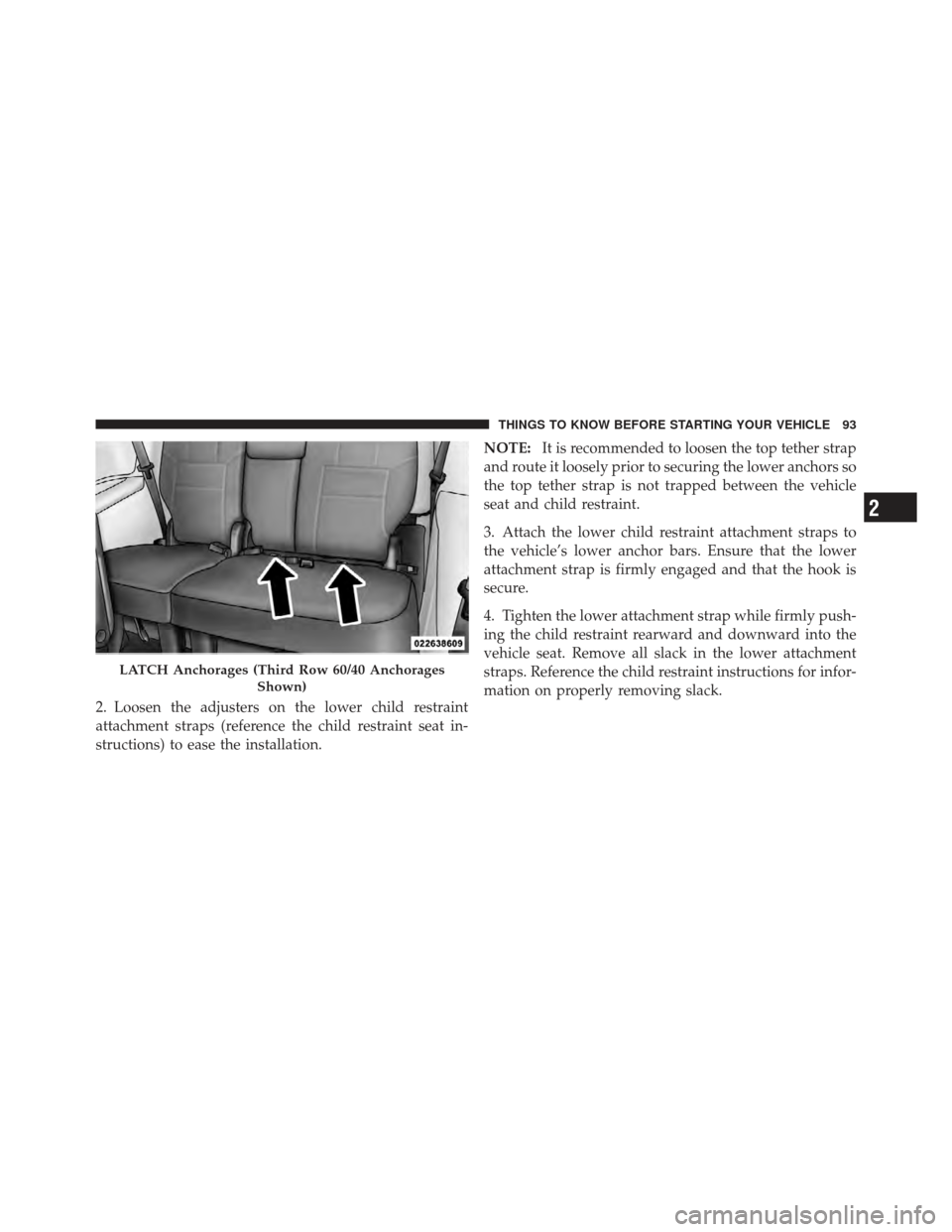
2. Loosen the adjusters on the lower child restraint
attachment straps (reference the child restraint seat in-
structions) to ease the installation.NOTE:
It is recommended to loosen the top tether strap
and route it loosely prior to securing the lower anchors so
the top tether strap is not trapped between the vehicle
seat and child restraint.
3. Attach the lower child restraint attachment straps to
the vehicle’s lower anchor bars. Ensure that the lower
attachment strap is firmly engaged and that the hook is
secure.
4. Tighten the lower attachment strap while firmly push-
ing the child restraint rearward and downward into the
vehicle seat. Remove all slack in the lower attachment
straps. Reference the child restraint instructions for infor-
mation on properly removing slack.
LATCH Anchorages (Third Row 60/40 Anchorages
Shown)
2
THINGS TO KNOW BEFORE STARTING YOUR VEHICLE 93
Page 96 of 562
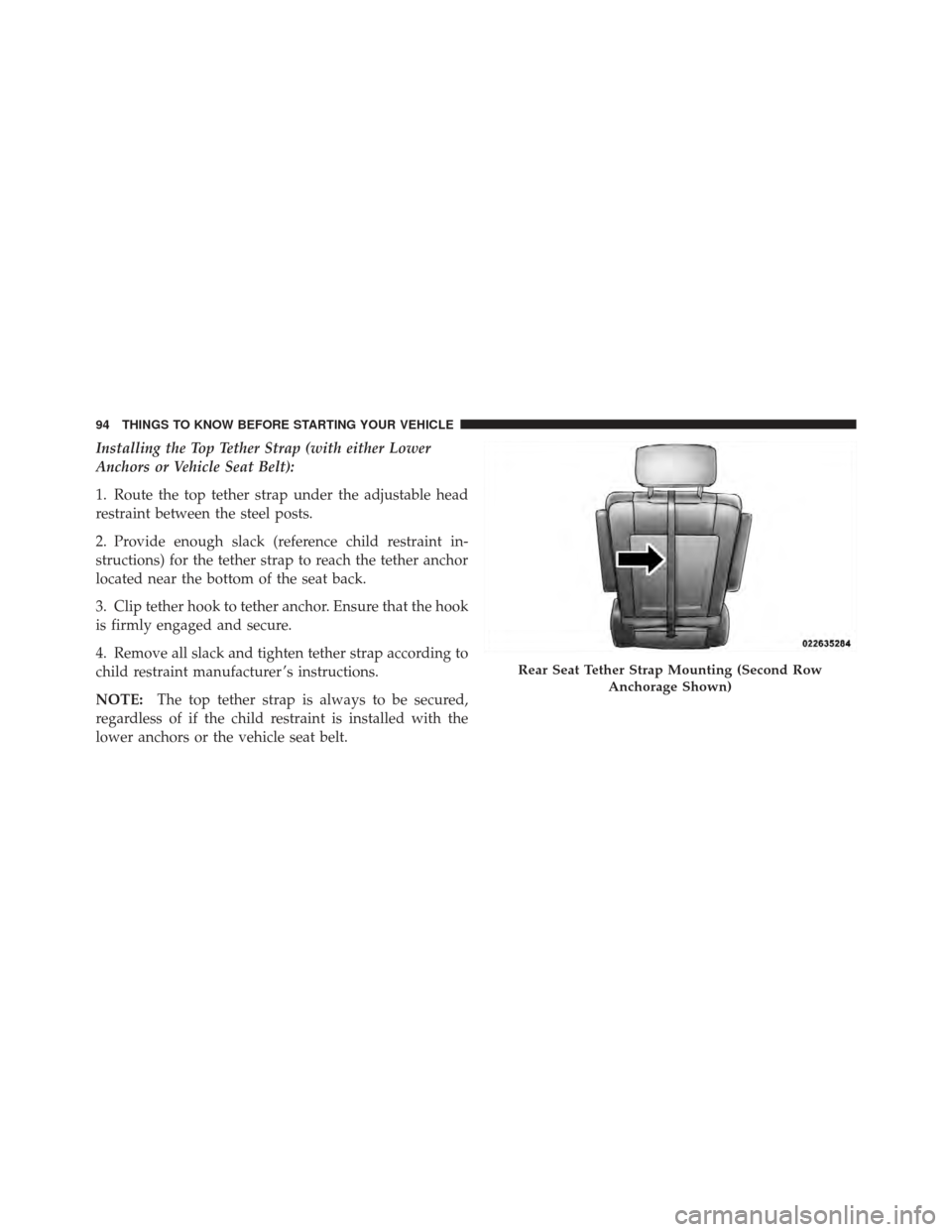
Installing the Top Tether Strap (with either Lower
Anchors or Vehicle Seat Belt):
1. Route the top tether strap under the adjustable head
restraint between the steel posts.
2. Provide enough slack (reference child restraint in-
structions) for the tether strap to reach the tether anchor
located near the bottom of the seat back.
3. Clip tether hook to tether anchor. Ensure that the hook
is firmly engaged and secure.
4. Remove all slack and tighten tether strap according to
child restraint manufacturer ’s instructions.
NOTE:The top tether strap is always to be secured,
regardless of if the child restraint is installed with the
lower anchors or the vehicle seat belt.
Rear Seat Tether Strap Mounting (Second Row
Anchorage Shown)
94 THINGS TO KNOW BEFORE STARTING YOUR VEHICLE