Page 353 of 452
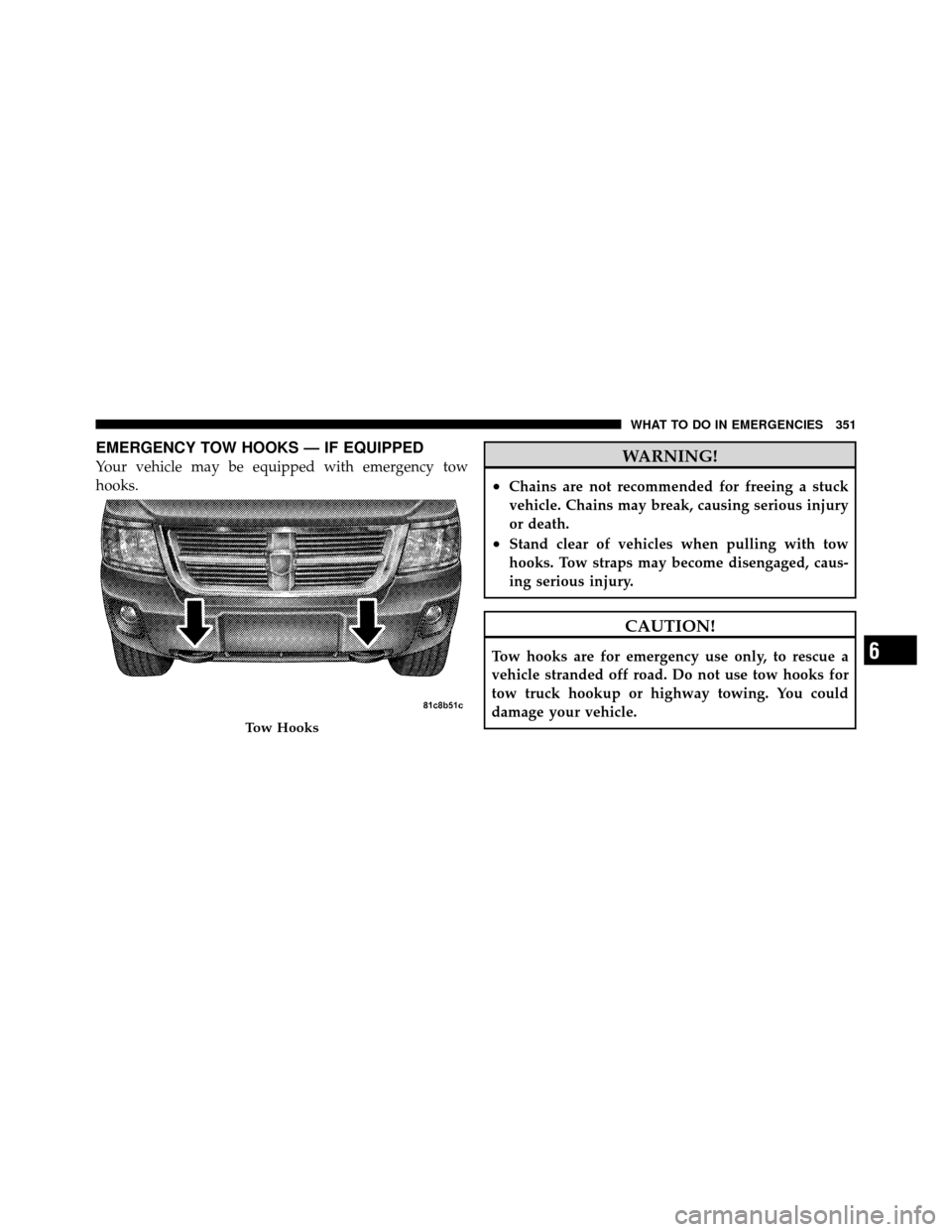
EMERGENCY TOW HOOKS — IF EQUIPPED
Your vehicle may be equipped with emergency tow
hooks.WARNING!
•Chains are not recommended for freeing a stuck
vehicle. Chains may break, causing serious injury
or death.
•Stand clear of vehicles when pulling with tow
hooks. Tow straps may become disengaged, caus-
ing serious injury.
CAUTION!
Tow hooks are for emergency use only, to rescue a
vehicle stranded off road. Do not use tow hooks for
tow truck hookup or highway towing. You could
damage your vehicle.
Tow Hooks
6
WHAT TO DO IN EMERGENCIES 351
Page 354 of 452
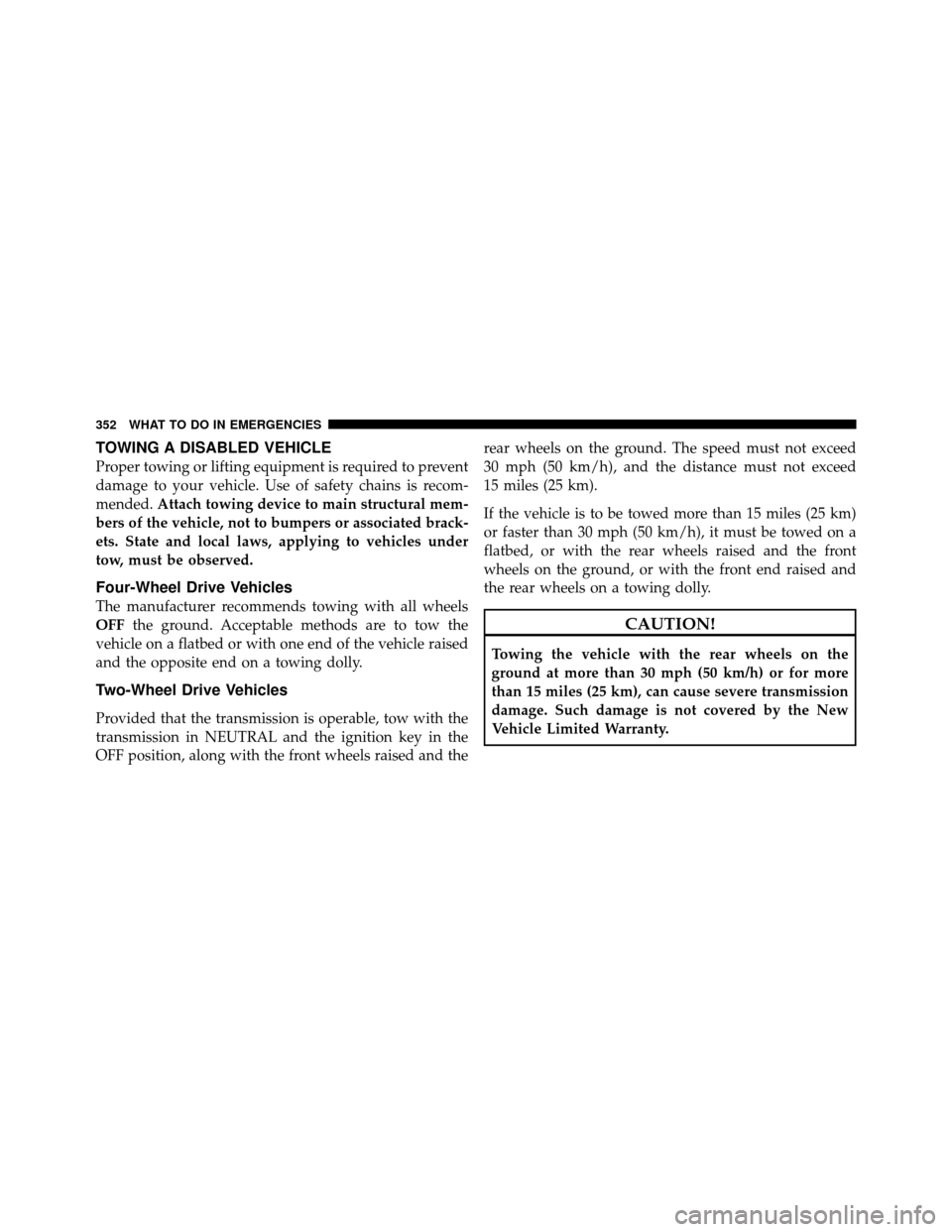
TOWING A DISABLED VEHICLE
Proper towing or lifting equipment is required to prevent
damage to your vehicle. Use of safety chains is recom-
mended.Attach towing device to main structural mem-
bers of the vehicle, not to bumpers or associated brack-
ets. State and local laws, applying to vehicles under
tow, must be observed.
Four-Wheel Drive Vehicles
The manufacturer recommends towing with all wheels
OFF the ground. Acceptable methods are to tow the
vehicle on a flatbed or with one end of the vehicle raised
and the opposite end on a towing dolly.
Two-Wheel Drive Vehicles
Provided that the transmission is operable, tow with the
transmission in NEUTRAL and the ignition key in the
OFF position, along with the front wheels raised and the rear wheels on the ground. The speed must not exceed
30 mph (50 km/h), and the distance must not exceed
15 miles (25 km).
If the vehicle is to be towed more than 15 miles (25 km)
or faster than 30 mph (50 km/h), it must be towed on a
flatbed, or with the rear wheels raised and the front
wheels on the ground, or with the front end raised and
the rear wheels on a towing dolly.
CAUTION!
Towing the vehicle with the rear wheels on the
ground at more than 30 mph (50 km/h) or for more
than 15 miles (25 km), can cause severe transmission
damage. Such damage is not covered by the New
Vehicle Limited Warranty.
352 WHAT TO DO IN EMERGENCIES
Page 359 of 452
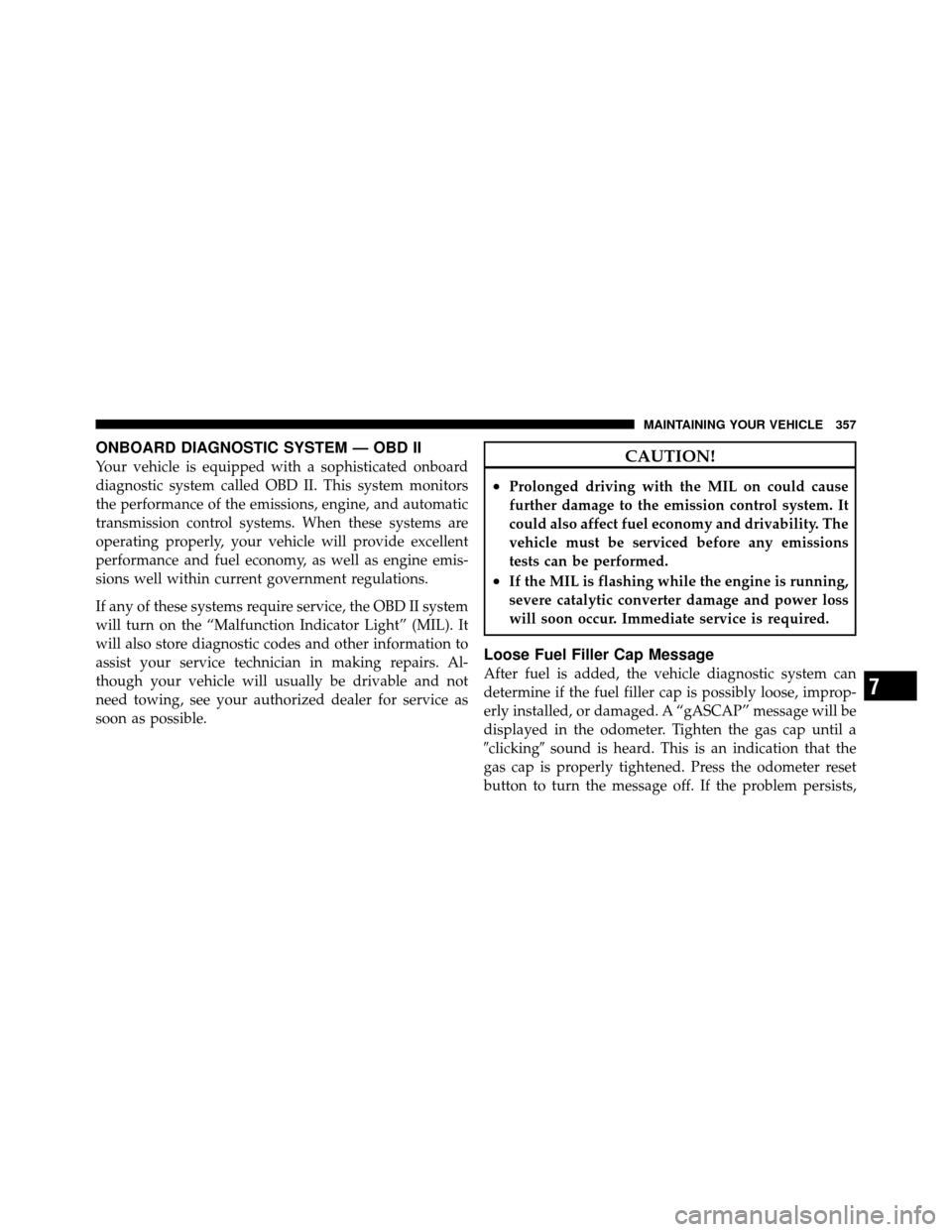
ONBOARD DIAGNOSTIC SYSTEM — OBD II
Your vehicle is equipped with a sophisticated onboard
diagnostic system called OBD II. This system monitors
the performance of the emissions, engine, and automatic
transmission control systems. When these systems are
operating properly, your vehicle will provide excellent
performance and fuel economy, as well as engine emis-
sions well within current government regulations.
If any of these systems require service, the OBD II system
will turn on the “Malfunction Indicator Light” (MIL). It
will also store diagnostic codes and other information to
assist your service technician in making repairs. Al-
though your vehicle will usually be drivable and not
need towing, see your authorized dealer for service as
soon as possible.CAUTION!
•Prolonged driving with the MIL on could cause
further damage to the emission control system. It
could also affect fuel economy and drivability. The
vehicle must be serviced before any emissions
tests can be performed.
•If the MIL is flashing while the engine is running,
severe catalytic converter damage and power loss
will soon occur. Immediate service is required.
Loose Fuel Filler Cap Message
After fuel is added, the vehicle diagnostic system can
determine if the fuel filler cap is possibly loose, improp-
erly installed, or damaged. A “gASCAP” message will be
displayed in the odometer. Tighten the gas cap until a
�clicking�sound is heard. This is an indication that the
gas cap is properly tightened. Press the odometer reset
button to turn the message off. If the problem persists,
7
MAINTAINING YOUR VEHICLE 357
Page 372 of 452
CAUTION! (Continued)
•Damage to the catalytic converter can result if your
vehicle is not kept in proper operating condition.
In the event of engine malfunction, particularly
involving engine misfire or other apparent loss of
performance, have your vehicle serviced promptly.
Continued operation of your vehicle with a severe
malfunction could cause the converter to overheat,
resulting in possible damage to the converter and
vehicle.
Under normal operating conditions, the catalytic con-
verter will not require maintenance. However, it is im-
portant to keep the engine properly tuned to assure
proper catalyst operation and prevent possible catalyst
damage. NOTE:
Intentional tampering with emissions control
systems can result in civil penalties being assessed
against you.
In unusual situations involving grossly malfunctioning
engine operation, a scorching odor may suggest severe
and abnormal catalyst overheating. If this occurs, stop
the vehicle, turn off the engine and allow it to cool.
Service, including a tune-up to manufacturer’s specifica-
tions, should be obtained immediately.
To minimize the possibility of catalytic converter dam-
age:
•Do not shut off the engine or interrupt the ignition,
when the transmission is in gear and the vehicle is in
motion.
•Do not try to start the engine by pushing or towing the
vehicle.
370 MAINTAINING YOUR VEHICLE
Page 386 of 452
•If you detect any stone chips or scratches in the paint,
touch them up immediately. The cost of such repairs is
considered the responsibility of the owner.
•If your vehicle is damaged due to a collision or similar
cause, which destroys the paint and protective coating,
have your vehicle repaired as soon as possible. The
cost of such repairs is considered the responsibility of
the owner.
•If you carry special cargo such as chemicals, fertilizers,
de-icer salt, etc., be sure that such materials are well
packaged and sealed.
•If a lot of driving is done on gravel roads, consider
mud or stone shields behind each wheel.
•Use MOPAR�Touch Up Paint or equivalent on
scratches as soon as possible. Your authorized dealer
has touch up-paint to match the color of your vehicle.
Wheel And Wheel Trim Care
All wheels and wheel trim, especially aluminum and
chrome-plated wheels, should be cleaned regularly with
a mild soap and water to prevent corrosion. To remove
heavy soil, use MOPAR� Wheel Cleaner or equivalent, or
select a nonabrasive, non-acidic cleaner. Do not use
scouring pads, steel wool, a bristle brush or metal pol-
ishes. Only MOPAR� cleaners or equivalent are recom-
mended. Do not use oven cleaner. Avoid automatic car
washes that use acidic solutions or harsh brushes that
may damage the wheels’ protective finish.
Stain Repel Fabric Cleaning Procedure –
If Equipped
Stain Repel seats may be cleaned in the following man-
ner:
•Remove as much of the stain as possible by blotting
with a clean, dry towel.
•Blot any remaining stain with a clean, damp towel.
384 MAINTAINING YOUR VEHICLE
Page 387 of 452
•For tough stains, apply MOPAR�Total Clean or
equivalent or a mild soap solution to a clean, damp
cloth and remove the stain. Use a fresh, damp towel to
remove soap residue.
•For grease stains, apply MOPAR� Multi-Purpose
Cleaner or equivalent to a clean, damp cloth and
remove the stain. Use a fresh, damp towel to remove
soap residue.
•Do not use any harsh solvents or any other form of
protectants on Stain Repel products.
Interior Care
Use MOPAR� Total Clean or equivalent to clean fabric
upholstery and carpeting.
Interior trim should be cleaned starting with a damp
cloth, a damp cloth with MOPAR� Total Clean or equiva-
lent, then MOPAR� Spot & Stain Remover or equivalent, if absolutely necessary. Do not use harsh cleaners or
Armor All�. Use MOPAR�
Total Clean or equivalent to
clean vinyl upholstery.
Use MOPAR� Vinyl Cleaner or equivalent to clean vinyl
upholstery and trim.
Leather Seat Care And Cleaning
MOPAR� Total Clean or equivalent is specifically recom-
mended for leather upholstery.
Your leather upholstery can be best preserved by regular
cleaning with a damp soft cloth. Small particles of dirt
can act as an abrasive and damage the leather upholstery
and should be removed promptly with a damp cloth.
Stubborn soils can be removed easily with a soft cloth
and MOPAR� Total Clean or equivalent. Care should be
taken to avoid soaking your leather upholstery with any
liquid. Please do not use polishes, oils, cleaning fluids,
solvents, detergents, or ammonia-based cleaners to clean
7
MAINTAINING YOUR VEHICLE 385
Page 388 of 452
your leather upholstery. Application of a leather condi-
tioner is not required to maintain the original condition.
WARNING!
Do not use volatile solvents for cleaning purposes.
Many are potentially flammable, and if used in
closed areas they may cause respiratory harm.
Glass Surfaces
All glass surfaces should be cleaned on a regular basis
with any commercial household-type glass cleaner.
Never use an abrasive type cleaner. Use caution when
cleaning inside rear windows equipped with electric
defrosters, or windshields equipped with a windshield
wiper de-icer. Do not use scrapers or other sharp instru-
ments, which may scratch the elements.
When cleaning the rearview mirror, spray cleaner on the
towel or rag that you are using. Do not spray cleaner
directly on the mirror.
Cleaning Plastic Instrument Cluster Lenses
The lenses in front of the instruments in this vehicle are
molded in clear plastic. When cleaning the lenses, care
must be taken to avoid scratching the plastic.
1. Clean with a wet soft rag. A mild soap solution may be
used, but do not use high alcohol content or abrasive
cleaners. If soap is used, wipe clean with a clean damp
rag.
2. Dry with a soft cloth.
Seat Belt Maintenance
Do not bleach, dye or clean the belts with chemical
solvents or abrasive cleaners. This will weaken the fabric.
Sun damage will also weaken the fabric.
If the belts need cleaning, use a mild soap solution or
lukewarm water. Do not remove the belts from the car to
wash them. Dry with a soft cloth.
386 MAINTAINING YOUR VEHICLE
Page 390 of 452
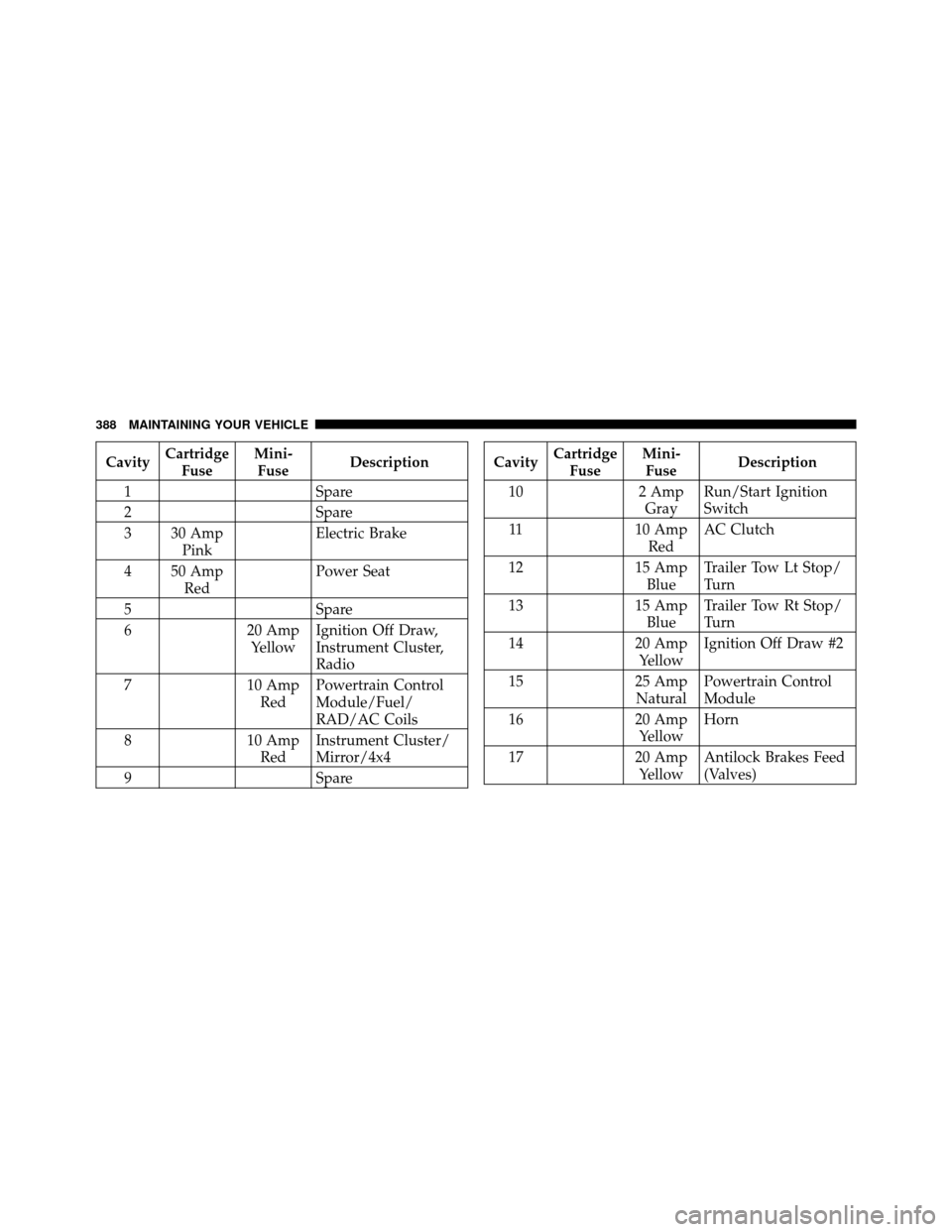
CavityCartridge
Fuse Mini-
Fuse Description
1 Spare
2 Spare
3 30 Amp Pink Electric Brake
4 50 Amp Red Power Seat
5 Spare
6 20 Amp
Yellow Ignition Off Draw,
Instrument Cluster,
Radio
7 10 Amp
Red Powertrain Control
Module/Fuel/
RAD/AC Coils
8 10 Amp
Red Instrument Cluster/
Mirror/4x4
9 SpareCavityCartridge
Fuse Mini-
Fuse Description
10 2 Amp
Gray Run/Start Ignition
Switch
11 10 Amp
Red AC Clutch
12 15 Amp
Blue Trailer Tow Lt Stop/
Turn
13 15 Amp
Blue Trailer Tow Rt Stop/
Turn
14 20 Amp
Yellow Ignition Off Draw #2
15 25 Amp
Natural Powertrain Control
Module
16 20 Amp
Yellow Horn
17 20 Amp
Yellow Antilock Brakes Feed
(Valves)
388 MAINTAINING YOUR VEHICLE