Page 357 of 452
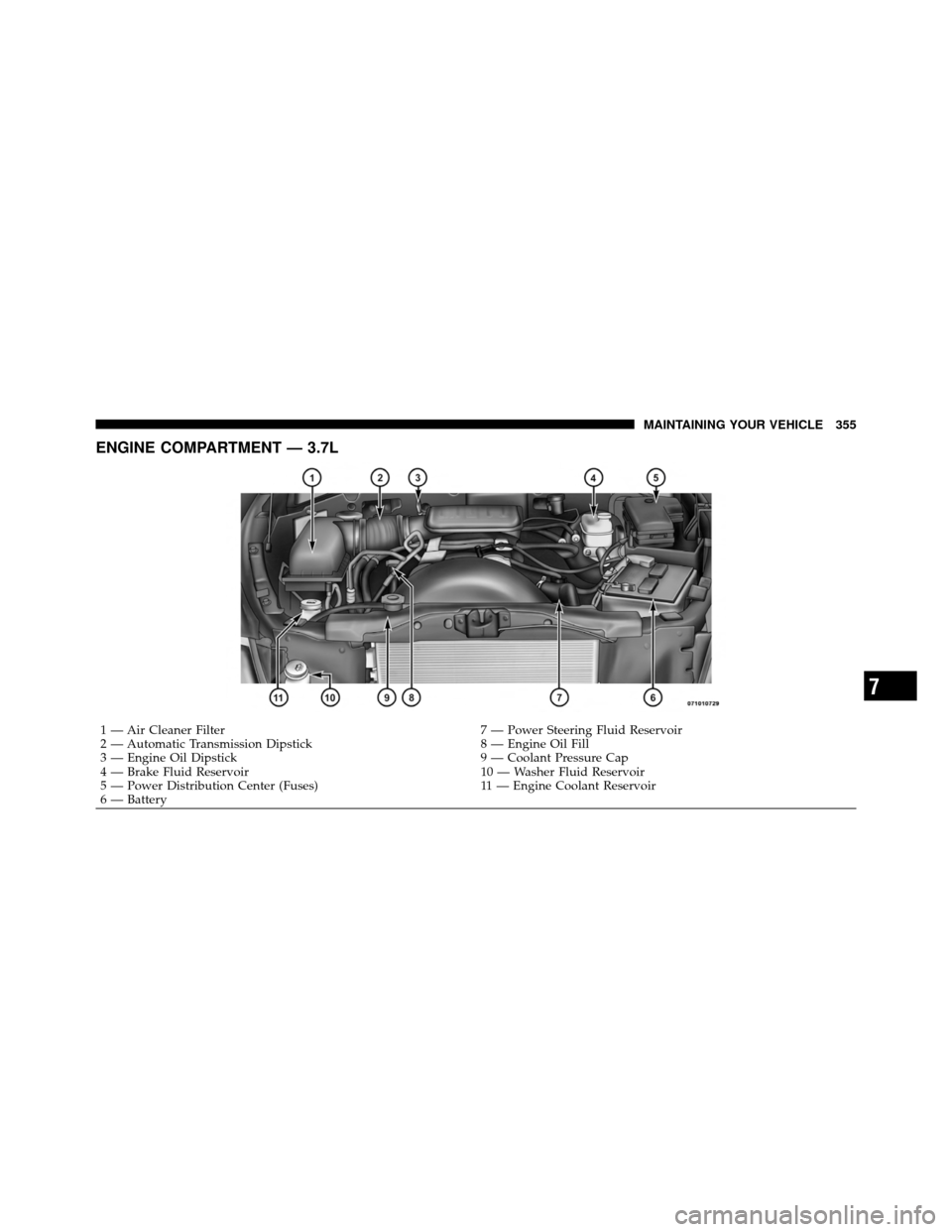
ENGINE COMPARTMENT — 3.7L
1 — Air Cleaner Filter7 — Power Steering Fluid Reservoir
2 — Automatic Transmission Dipstick 8 — Engine Oil Fill
3 — Engine Oil Dipstick 9 — Coolant Pressure Cap
4 — Brake Fluid Reservoir 10 — Washer Fluid Reservoir
5 — Power Distribution Center (Fuses) 11 — Engine Coolant Reservoir
6 — Battery
7
MAINTAINING YOUR VEHICLE 355
Page 358 of 452
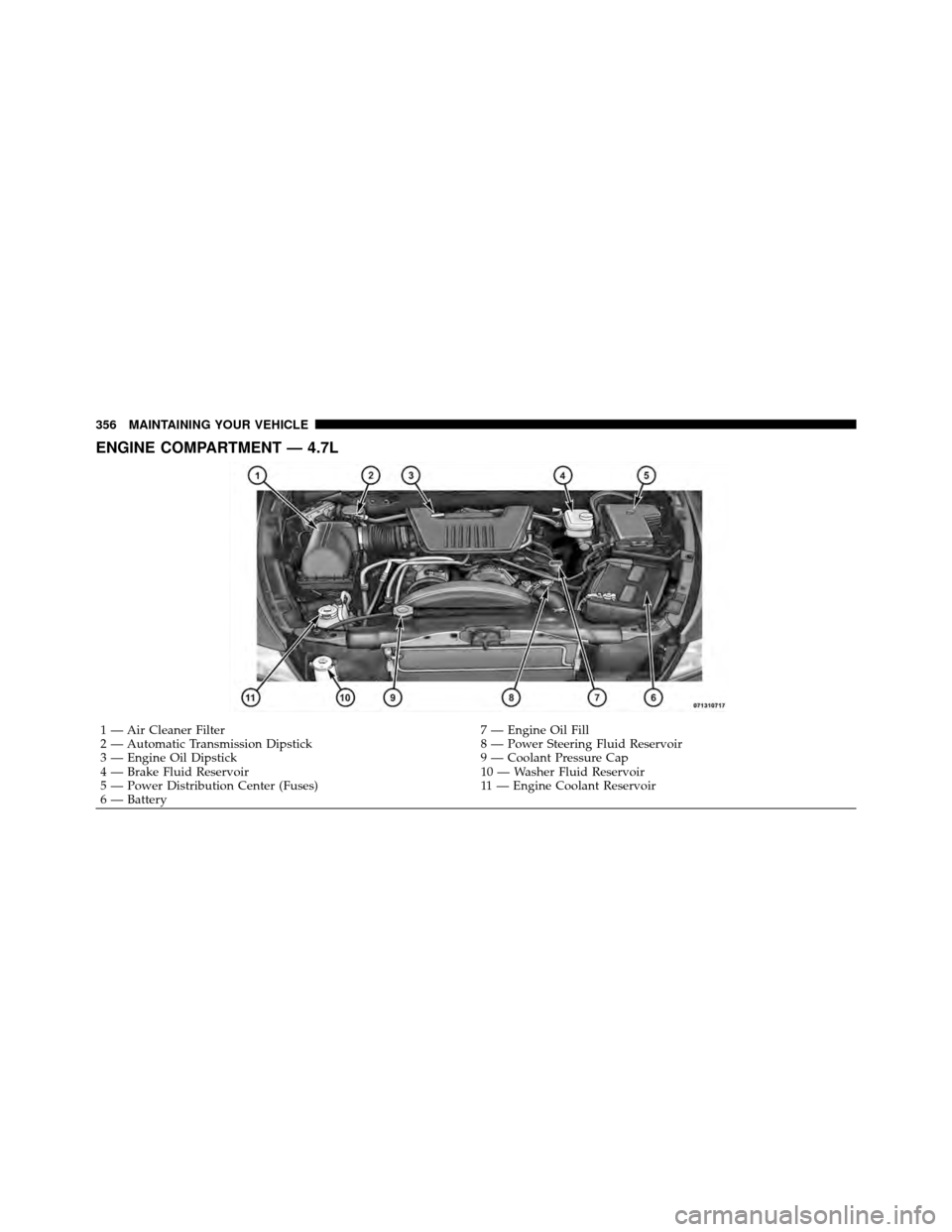
ENGINE COMPARTMENT — 4.7L
1 — Air Cleaner Filter7 — Engine Oil Fill
2 — Automatic Transmission Dipstick 8 — Power Steering Fluid Reservoir
3 — Engine Oil Dipstick 9 — Coolant Pressure Cap
4 — Brake Fluid Reservoir 10 — Washer Fluid Reservoir
5 — Power Distribution Center (Fuses) 11 — Engine Coolant Reservoir
6 — Battery
356 MAINTAINING YOUR VEHICLE
Page 378 of 452

•If frequent engine coolant (antifreeze) additions are
required, or if the level in the coolant recovery bottle
does not drop when the engine cools, the cooling
system should be pressure tested for leaks.
•Maintain engine coolant (antifreeze) concentration at
50% HOAT engine coolant (antifreeze) (minimum)
and distilled/deionized water for proper corrosion
protection of your engine, which contains aluminum
components.
•Make sure that the radiator and coolant recovery
bottle overflow hoses are not kinked or obstructed.
•Keep the front of the radiator clean. If your vehicle is
equipped with air conditioning, also keep the front of
the condenser clean.
•Do not change the thermostat for Summer or Winter
operation. If replacement is ever necessary, install
ONLY the correct type thermostat. Other designs mayresult in unsatisfactory engine coolant (antifreeze)
performance, poor gas mileage, and increased
emissions.
Brake System
Fluid Level Check – Brake Master Cylinder
The fluid level in the master cylinder should be checked
whenever the vehicle is serviced, or immediately if the
“Brake Warning Light” is on. If necessary, add fluid to
bring level to the full mark on the side of the reservoir of
the brake master cylinder. Be sure to clean the top of the
master cylinder area before removing the cap. With disc
brakes, the fluid level can be expected to fall as the brake
pads wear. Brake fluid level should be checked when
pads are replaced. If the brake fluid level is abnormally
low, check the system for leaks.
Refer to “Fluids, Lubricants, and Genuine Parts” in
“Maintaining Your Vehicle” for further information.
376 MAINTAINING YOUR VEHICLE
Page 409 of 452

Your authorized dealer will reset the oil change indicator
message after completing the scheduled oil change. If a
scheduled oil change is performed by someone other
than your authorized dealer, the message can be reset by
referring to the steps described under “Electronic Vehicle
Information Center (EVIC)/Oil Change Required” in
“Understanding Your Instrument Panel” or under “In-
strument Cluster Description/Odometer/Trip Odom-
eter” in “Understanding Your Instrument Panel” for
further information.
At Each Stop For Fuel
•Check the engine oil level about five minutes after a
fully warmed engine is shut off. Checking the oil level
while the vehicle is on level ground will improve the
accuracy of the oil level reading. Add oil only when
the level is at or below the ADD or MIN mark.
•Check the windshield washer solvent and add if
required.
Once A Month
•Check tire pressure and look for unusual wear or
damage.
•Inspect the battery, and clean and tighten the terminals
as required.
•Check the fluid levels of the coolant reservoir, brake
master cylinder, and transmission, and add as needed.
•Check all lights and other electrical items for correct
operation.
8
M A I
N T
E
N A
N CE
S
C
H E
D
U L
E
SMAINTENANCE SCHEDULES 407