Page 337 of 452
JACKING AND TIRE CHANGING
WARNING!
•Do not attempt to change a tire on the side of the
vehicle close to moving traffic. Pull far enough off
the road to avoid the danger of being hit when
operating the jack or changing the wheel.
•Being under a jacked-up vehicle is dangerous. The
vehicle could slip off the jack and fall on you. You
could be crushed. Never put any part of your body
under a vehicle that is on a jack.
•Never start or run the engine while the vehicle is
on a jack. If you need to get under a raised vehicle,
take it to a service center where it can be raised on
a lift.(Continued)
WARNING! (Continued)
•The jack is designed to be used as a tool for
changing tires only. The jack should not be used to
lift the vehicle for service purposes. The vehicle
should be jacked on a firm level surface only.
Avoid ice or slippery areas.
Jack Location
In this vehicle, the scissor jack and tire changing tools for
Extended Cab models are stowed in a compartment
under the rear passenger seat. Crew Cab model scissor
jack and tire changing tools are accessed by lifting up the
rear passenger seat.
The jack is secured in place by turning the jack screw
until the jack is secured into place.
6
WHAT TO DO IN EMERGENCIES 335
Page 343 of 452
Instructions
WARNING!
Carefully follow these tire changing warnings to
help prevent personal injury or damage to your
vehicle:
•Always park on a firm, level surface as far from
the edge of the roadway as possible before raising
the vehicle.
•Turn on the Hazard Warning flasher.
•Block the wheel diagonally opposite the wheel to
be raised.
•Set the parking brake firmly and set an automatic
transmission in PARK; a manual transmission in
REVERSE.
•Never start or run the engine with the vehicle on a
jack.(Continued)
WARNING! (Continued)
•Do not let anyone sit in the vehicle when it is on a
jack.
•Do not get under the vehicle when it is on a jack.
•Only use the jack in the positions indicated and
for lifting this vehicle during a tire change.
•If working on or near a roadway, be extremely
careful of motor traffic.
•To assure that spare tires, flat or inflated, are
securely stowed, spares must be stowed with the
valve stem facing the ground.
Jack Warning Label
6
WHAT TO DO IN EMERGENCIES 341
Page 347 of 452
WARNING! (Continued)
•Always park on a firm, level surface as far from
the edge of the roadway as possible before raising
the vehicle.
•Block the wheel diagonally opposite the wheel to
be raised.
•Apply the parking brake firmly before jacking.
•Never start the engine with the vehicle on a jack.
•Do not let anyone sit in the vehicle when it is on a
jack.
•Do not get under the vehicle when it is on a jack.
•Only use the jack in the positions indicated.
•If working on or near a roadway, be extremely
careful of motor traffic.
•To assure that spare tires, flat or inflated, are
securely stowed, spares must be stowed with the
valve stem facing the ground.
To Stow The Flat Or Spare
Turn the wheel so that the valve stem is down. Slide the
wheel retainer through the center of the wheel and
position it properly across the wheel opening.
For convenience in checking the spare tire inflation, stow
with the valve stem toward the rear of the vehicle.
Rotate the winch mechanism until the wheel is drawn
into place against the underside of the vehicle. Continue
to rotate until you feel the winch mechanism slip or click
three times. It cannot be overtightened. Push against the
tire several times to be sure it is firmly in place.
NOTE:To Stow the Flat or Spare: Wheel retainer does
not fit through the center of the aluminum wheel. The tire
must be stored in a safe manner in the bed of the truck.
JUMP-STARTING PROCEDURES
If your vehicle has a discharged battery it can be jump-
started using a set of jumper cables and a battery in
6
WHAT TO DO IN EMERGENCIES 345
Page 379 of 452
WARNING!
•Use only manufacturer’s recommended brake
fluid. Refer to “Fluids, Lubricants, and Genuine
Parts” in “Maintaining Your Vehicle” for further
information. Using the wrong type of brake fluid
can severely damage your brake system and/or
impair its performance. The proper type of brake
fluid for your vehicle is also identified on the
original factory installed hydraulic master cylin-
der reservoir.(Continued)
WARNING! (Continued)
•To avoid contamination from foreign matter or
moisture, use only new brake fluid or fluid that
has been in a tightly closed container. Keep the
master cylinder reservoir cap secured at all times.
Brake fluid in a open container absorbs moisture
from the air resulting in a lower boiling point.
This may cause it to boil unexpectedly during hard
or prolonged braking, resulting in sudden brake
failure. This could result in a collision.
•Overfilling the brake fluid reservoir can result in
spilling brake fluid on hot engine parts, causing
the brake fluid to catch fire. Brake fluid can also
damage painted and vinyl surfaces, care should be
taken to avoid its contact with these surfaces.(Continued)
7
MAINTAINING YOUR VEHICLE 377
Page 434 of 452

Adding Engine Coolant (Antifreeze).......... 373
Adding Fuel ........................... 310
Air Cleaner, Engine (Engine Air Cleaner Filter) . . . 363
Air Conditioner Maintenance ............... 366
Air Conditioning ........................ 238
Air Conditioning Refrigerant .............366,367
Air Conditioning System ................238,366
Air Conditioning, Operating Tips ..........238,241
Air Filter .............................. 363
Air Pressure, Tires ....................... 285
Airbag ........................... 51,58,190
Airbag Deployment ....................... 59
Airbag Light ........................ 57,61,78
Airbag Maintenance ....................... 60
Airbag, Side .......................... 55,58
Airbag, Window (Side Curtain) ...........54,55,58
Alarm (Security Alarm) .................18,181
Alarm System (Security Alarm) ............... 18
Alarm, Panic ............................ 23 Alterations/Modifications, Vehicle
............. 7
Antenna, Satellite Radio ................208,232
Anti-Lock Brake System (ABS) .............. 273
Anti-Lock Warning Light .................. 181
Anti-Theft Security Alarm (Theft Alarm) ........ 18
Anti-Theft System ..................... 18,181
Antifreeze (Engine Coolant) ..............372,401
Disposal ........................... 374
Appearance Care ........................ 382
Assistance Towing ....................... 102
Auto Unlock, Doors ....................... 31
Automatic Dimming Mirror ................. 86
Automatic Door Locks ..................... 29
Automatic Transaxle .................... 12,252
Interlock System ...................... 15
Automatic Transmission .............249,253,378
Adding Fluid ....................... 379
Fluid Level Check .................... 379
Fluid Type ......................... 403
432 INDEX
Page 446 of 452
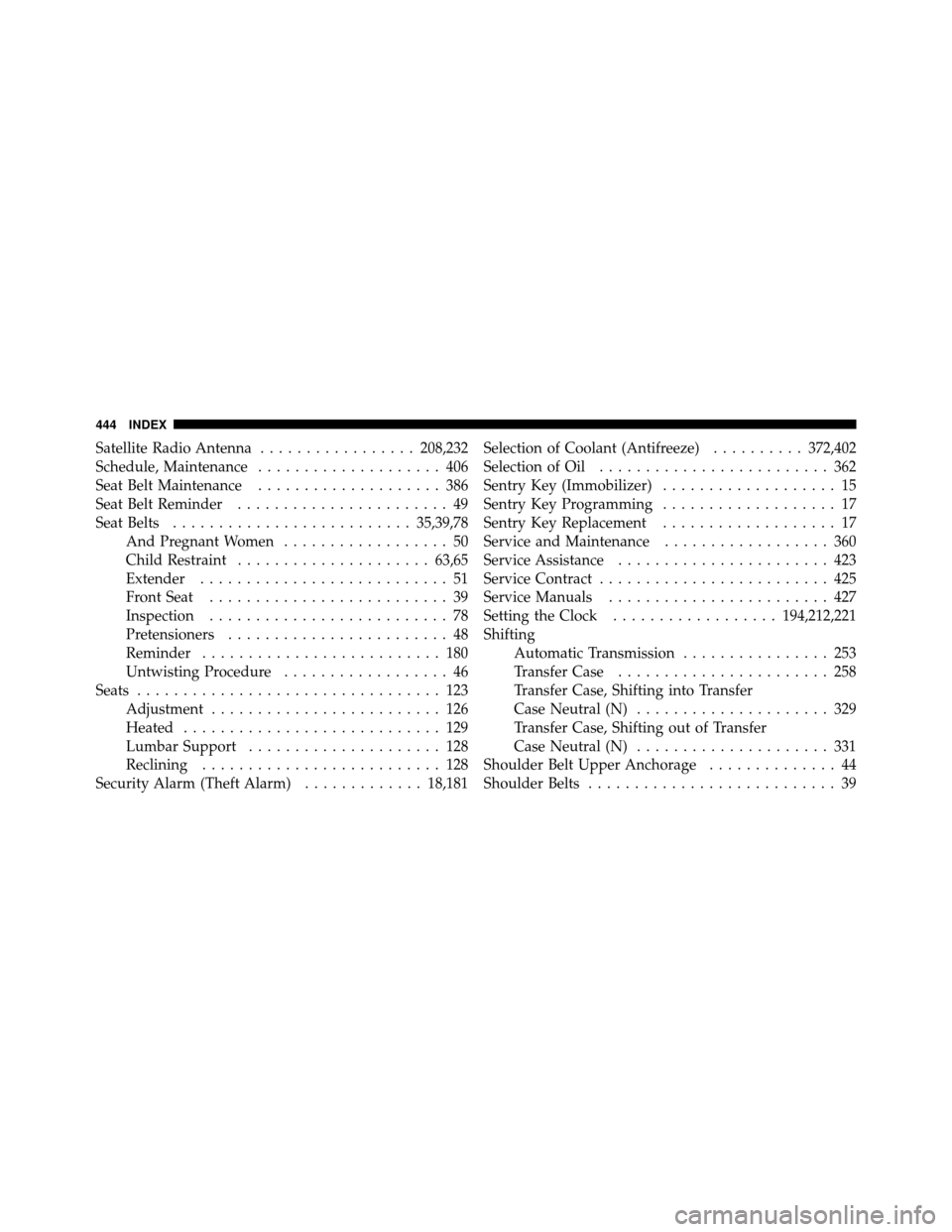
Satellite Radio Antenna.................208,232
Schedule, Maintenance .................... 406
Seat Belt Maintenance .................... 386
Seat Belt Reminder ....................... 49
Seat Belts .......................... 35,39,78
And Pregnant Women .................. 50
Child Restraint ..................... 63,65
Extender ........................... 51
Front Seat .......................... 39
Inspection .......................... 78
Pretensioners ........................ 48
Reminder .......................... 180
Untwisting Procedure .................. 46
Seats ................................. 123
Adjustment ......................... 126
Heated ............................ 129
Lumbar Support ..................... 128
Reclining .......................... 128
Security Alarm (Theft Alarm) .............18,181Selection of Coolant (Antifreeze)
..........372,402
Selection of Oil ......................... 362
Sentry Key (Immobilizer) ................... 15
Sentry Key Programming ................... 17
Sentry Key Replacement ................... 17
Service and Maintenance .................. 360
Service Assistance ....................... 423
Service Contract ......................... 425
Service Manuals ........................ 427
Setting the Clock .................. 194,212,221
Shifting Automatic Transmission ................ 253
Transfer Case ....................... 258
Transfer Case, Shifting into Transfer
Case Neutral (N) ..................... 329
Transfer Case, Shifting out of Transfer
Case Neutral (N) ..................... 331
Shoulder Belt Upper Anchorage .............. 44
Shoulder Belts ........................... 39
444 INDEX