Page 291 of 452
WARNING!
Compact spares are for temporary emergency use
only. With these spares, do not drive more than
50 mph (80 km/h). Temporary use spares have limited
tread life. When the tread is worn to the tread wear
indicators, the temporary use spare tire needs to be
replaced. Be sure to follow the warnings, which
apply to your spare. Failure to do so could result in
spare tire failure and loss of vehicle control.
Full Size Spare – If Equipped
The full size spare is for temporary emergency use only.
This tire may look like the original equipped tire on the
front or rear axle of your vehicle, but it is not. This spare
tire may have limited tread life. When the tread is worn
to the tread wear indicators, the temporary use full size
spare tire needs to be replaced. Since it is not the same asyour original equipment tire, replace (or repair) the
original equipment tire and reinstall on the vehicle at the
first opportunity.
Limited-Use Spare – If Equipped
The limited-use spare tire is for temporary emergency
use only. This tire is identified by a label located on the
limited-use spare wheel. This label contains the driving
limitations for this spare. This tire may look like the
original equipped tire on the front or rear axle of your
vehicle, but it is not. Installation of this limited-use spare
tire affects vehicle handling. Since it is not the same as
your original equipment tire, replace (or repair) the
original equipment tire and reinstall on the vehicle at the
first opportunity.
5
STARTING AND OPERATING 289
Page 292 of 452
WARNING!
Limited-use spares are for emergency use only. In-
stallation of this limited-use spare tire affects vehicle
handling. With this tire, do not drive more than the
speed listed on the limit-use spare wheel. Keep
inflated to the cold tire inflation pressure listed on
your Tire and Loading Information Placard located
on the driver ’s side door opening. Replace (or repair)
the original equipment tire at the first opportunity
and reinstall it on your vehicle. Failure to do so could
result in loss of vehicle control.
Tire Spinning
When stuck in mud, sand, snow, or ice conditions, do not
spin your vehicle’s wheels faster than 30 mph (48 km/h)
or for longer than 30 seconds continuously without
stopping when you are stuck.Refer to “Freeing A Stuck Vehicle” in “What To Do In
Emergencies” for further information.
WARNING!
Fast spinning tires can be dangerous. Forces gener-
ated by excessive wheel speeds may cause tire dam-
age or failure. A tire could explode and injure some-
one. Do not spin your vehicle’s wheels faster than
30 mph (48 km/h) or for more than 30 seconds
continuously when you are stuck, and do not let
anyone near a spinning wheel, no matter what the
speed.
Tread Wear Indicators
Tread wear indicators are in the original equipment tires
to help you in determining when your tires should be
replaced.
290 STARTING AND OPERATING
Page 293 of 452
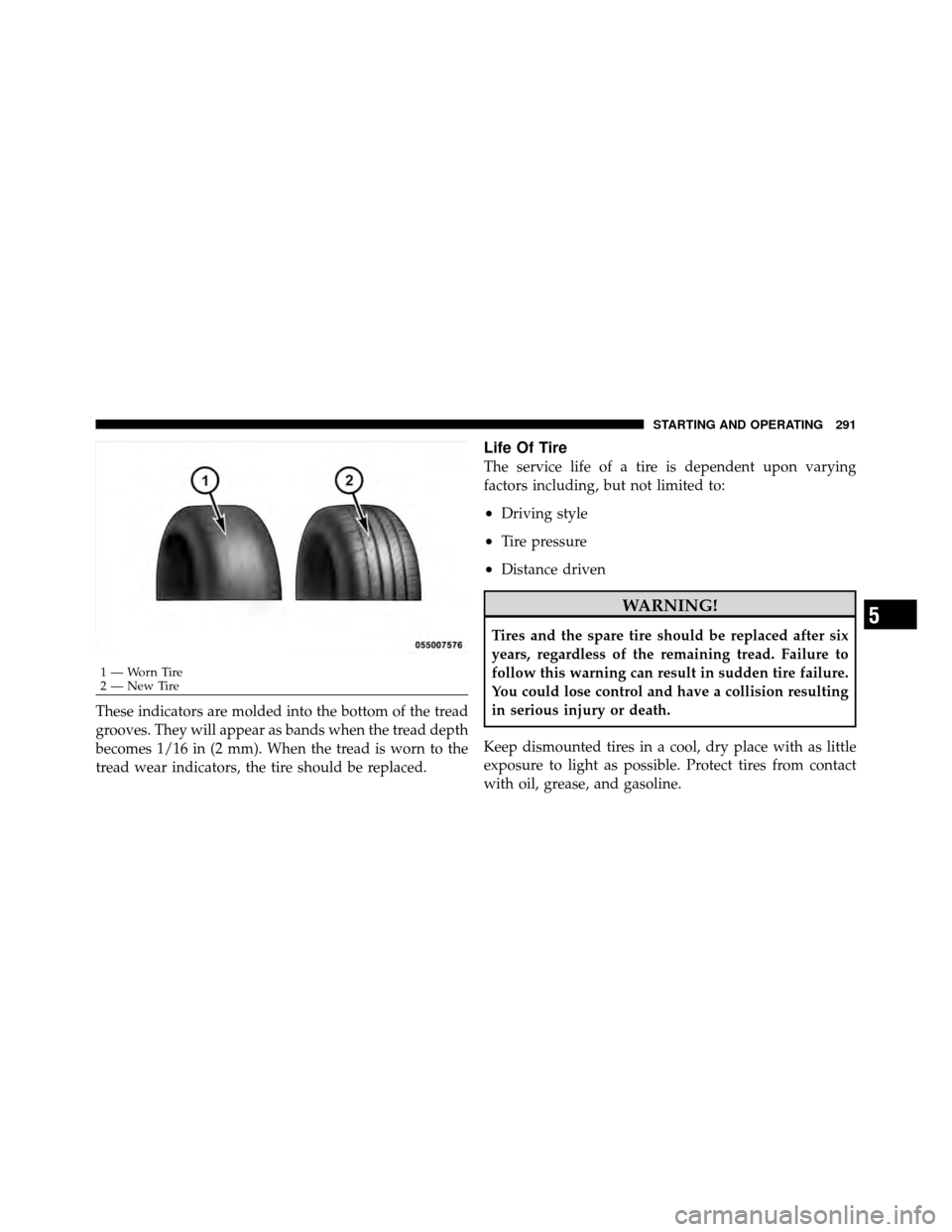
These indicators are molded into the bottom of the tread
grooves. They will appear as bands when the tread depth
becomes 1/16 in (2 mm). When the tread is worn to the
tread wear indicators, the tire should be replaced.
Life Of Tire
The service life of a tire is dependent upon varying
factors including, but not limited to:
•Driving style
•Tire pressure
•Distance driven
WARNING!
Tires and the spare tire should be replaced after six
years, regardless of the remaining tread. Failure to
follow this warning can result in sudden tire failure.
You could lose control and have a collision resulting
in serious injury or death.
Keep dismounted tires in a cool, dry place with as little
exposure to light as possible. Protect tires from contact
with oil, grease, and gasoline.
1 — Worn Tire
2 — New Tire
5
STARTING AND OPERATING 291
Page 302 of 452

The “Tire Pressure Monitoring Telltale Light” will flash on
and off for 75 seconds, and remain on solid when a system
fault is detected. The system fault will also sound a chime.
If the ignition key is cycled, this sequence will repeat,
providing the system fault still exists. The “Tire Pressure
Monitoring Telltale Light” will turn off when the fault
condition no longer exists. A system fault can occur by any
of the following scenarios: 1) Jamming due to electronic
devices or driving next to facilities emitting the same radio
frequencies as the TPM sensors; 2) Installing some form of
aftermarket window tinting that affects radio wave sig-
nals; 3) Lots of snow or ice around the wheels or wheel
housings; 4) Using tire chains on the vehicle; 5) Using
wheels/tires not equipped with TPM sensors.
NOTE: Your vehicle is equipped with a non-matching
full size spare wheel and tire assembly.
1. This spare tire does not have a tire pressure monitor-
ing sensor. Therefore, the TPMS will not monitor the tire
pressure in the spare tire.2. If you install the full size spare tire in place of a road
tire that has a pressure below the low-pressure warning
limit, upon the next ignition key cycle a chime will sound
and the “TPM Telltale Light” will still turn ON due to the
low tire.
3. However, after driving the vehicle for up to 20 min-
utes above 15 mph (24 km/h), the “TPM Telltale Light”
will flash on and off for 75 seconds and then remain on
solid.
4. For each subsequent ignition key cycle, a chime will
sound and the “TPM Telltale Light” will flash on and off
for 75 seconds and then remain on solid.
5. Once you repair or replace the original road tire, and
reinstall it on the vehicle in place of the full size spare tire,
the TPMS will update automatically and the “TPM
Telltale Light” will turn OFF, as long as no tire pressure is
below the low-pressure warning limit in any of the four
300 STARTING AND OPERATING
Page 325 of 452
Towing Requirements – Tires
Do not attempt to tow a trailer while using a compact
spare tire.
Proper tire inflation pressures are essential to the safe
and satisfactory operation of your vehicle. For proper
tire inflation procedures, refer to “Tires – General
Information” in “Starting and Operating” for further
information.
Check the trailer tires for proper tire inflation pres-
sures before trailer usage.
Check for signs of tire wear or visible tire damage
before towing a trailer. For the proper inspection
procedure, refer to “Tires – General Information” in
“Starting and Operating” for further information.
When replacing tires, refer to “Tires – General Infor-
mation” in “Starting and Operating” for further infor-
mation. Replacing tires with a higher load carrying
capacity will not increase the vehicle’s GVWR and
GAWR limits.
Towing Requirements – Trailer Brakes
Do not interconnect the hydraulic brake system or
vacuum system of your vehicle with that of the trailer.
This could cause inadequate braking and possible
personal injury.
An electronically actuated trailer brake controller is
required when towing a trailer with electronically
actuated brakes. When towing a trailer equipped with
a hydraulic surge actuated brake system, an electronic
brake controller is not required.
5
STARTING AND OPERATING 323
Page 335 of 452
WHAT TO DO IN EMERGENCIES
CONTENTS
�Hazard Warning Flashers ................ 334
� Jacking And Tire Changing ............... 335
▫ Jack Location ....................... 335
▫ Removing The Spare Tire ............... 337
▫ Preparations ........................ 340
▫ Instructions ........................ 341
▫ To Stow The Flat Or Spare .............. 345�
Jump-Starting Procedures ................ 345
▫ Preparations For Jump-Start ............. 346
▫ Jump-Starting Procedure ............... 347
� Freeing A Stuck Vehicle ................. 349
� Emergency Tow Hooks — If Equipped ...... 351
� Towing A Disabled Vehicle ............... 352
▫ Four-Wheel Drive Vehicles .............. 352
▫ Two-Wheel Drive Vehicles .............. 352
6
Page 338 of 452
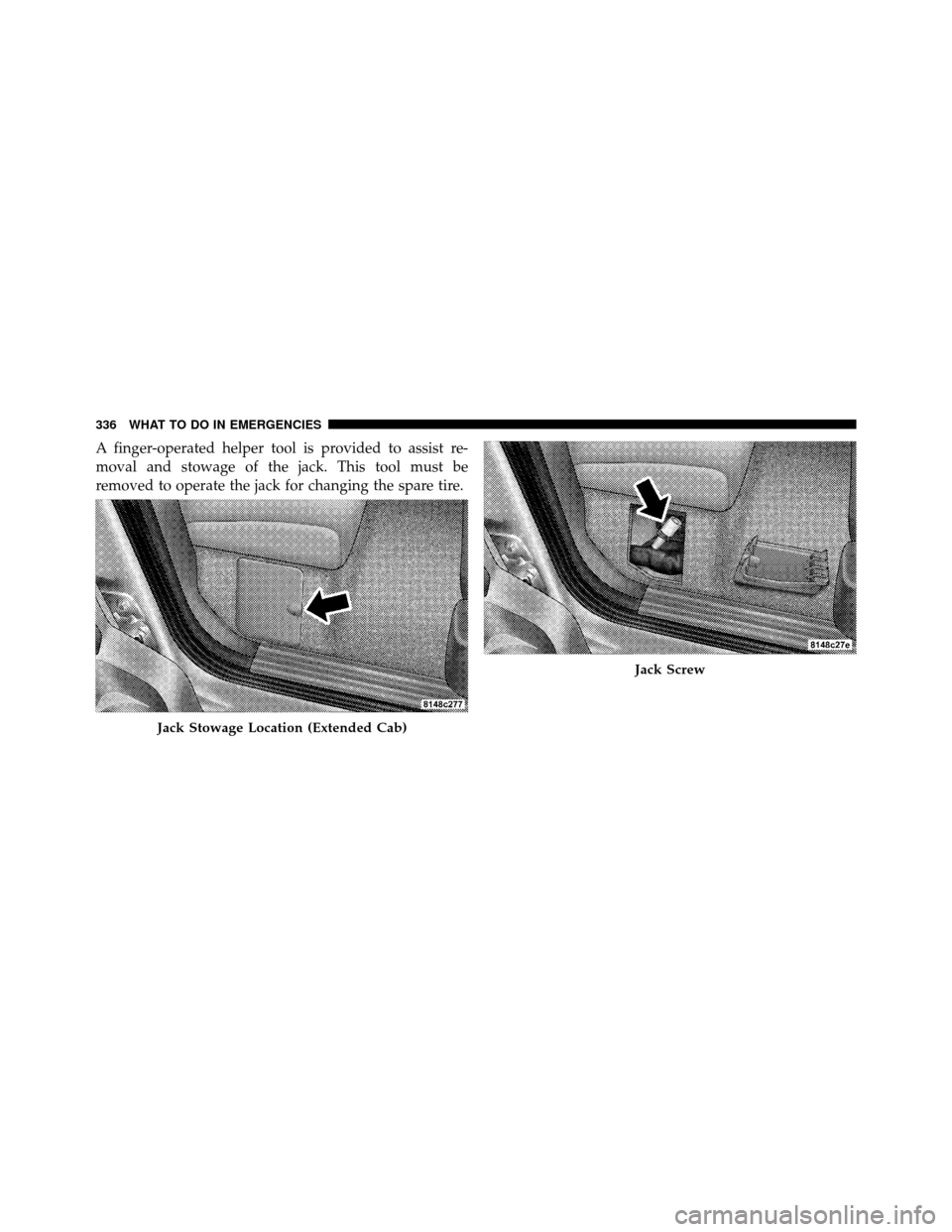
A finger-operated helper tool is provided to assist re-
moval and stowage of the jack. This tool must be
removed to operate the jack for changing the spare tire.
Jack Stowage Location (Extended Cab)
Jack Screw
336 WHAT TO DO IN EMERGENCIES
Page 339 of 452
WARNING!
The jack is designed as a tool for changing tires only.
The jack should not be used to lift the vehicle for
service purposes, unless suitable supports are placed
under the vehicle as a safety measure. The vehicle
should be jacked on a firm level surface only. Avoid
icy or slippery areas.
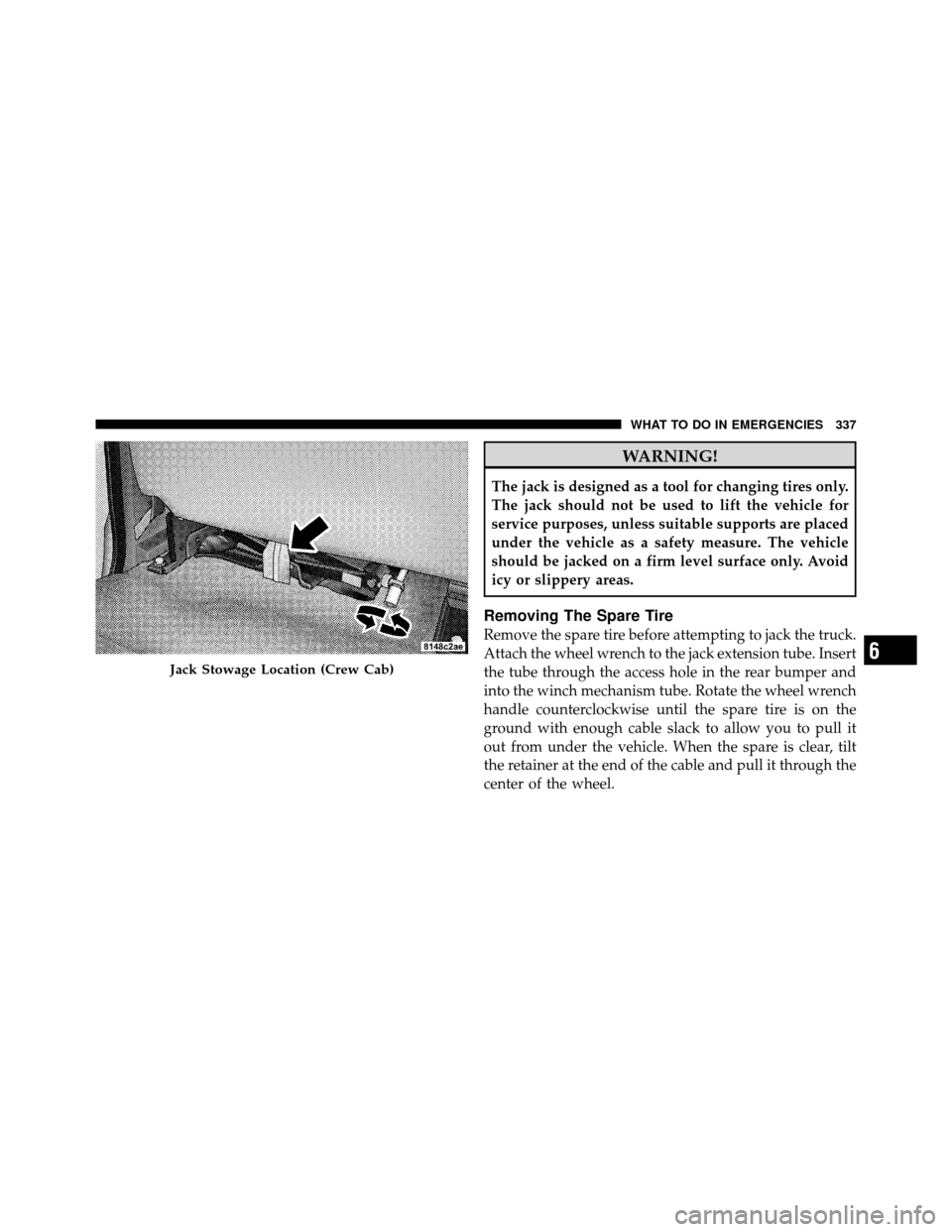
Removing The Spare Tire
Remove the spare tire before attempting to jack the truck.
Attach the wheel wrench to the jack extension tube. Insert
the tube through the access hole in the rear bumper and
into the winch mechanism tube. Rotate the wheel wrench
handle counterclockwise until the spare tire is on the
ground with enough cable slack to allow you to pull it
out from under the vehicle. When the spare is clear, tilt
the retainer at the end of the cable and pull it through the
center of the wheel.
Jack Stowage Location (Crew Cab)6
WHAT TO DO IN EMERGENCIES 337