2011 CHEVROLET SUBURBAN warning
[x] Cancel search: warningPage 460 of 542
Black plate (70,1)Chevrolet Tahoe/Suburban Owner Manual - 2011
10-70 Vehicle Care
If you need to replace any of the
wheels, wheel bolts, wheel nuts,
or Tire Pressure Monitor System
(TPMS) sensors, replace them only
with new GM original equipment
parts. This way, you will be sure to
have the right wheel, wheel bolts,
wheel nuts, and TPMS sensors for
the vehicle.
{WARNING
Using the wrong replacement
wheels, wheel bolts, or wheel
nuts on your vehicle can be
dangerous. It could affect the
braking and handling of your
vehicle, make your tires lose air
and make you lose control. You
could have a collision in which
you or others could be injured.
Always use the correct wheel,
wheel bolts, and wheel nuts for
replacement.Notice:
The wrong wheel can
also cause problems with bearing
life, brake cooling, speedometer
or odometer calibration,
headlamp aim, bumper height,
vehicle ground clearance, and tire
or tire chain clearance to the
body and chassis.
See If a Tire Goes Flat on
page 10‑71 for more information.
Used Replacement Wheels
{WARNING
Putting a used wheel on the
vehicle is dangerous. You cannot
know how it has been used or
how far it has been driven.
It could fail suddenly and cause a
crash. If you have to replace a
wheel, use a new GM original
equipment wheel.
Tire Chains
If your vehicle is a Hybrid, see the
Hybrid Supplement for more
information.
{WARNING
If your vehicle has P265/65R18 or
P275/55R20 size tires, do not use
tire chains. They can damage
your vehicle because there is not
enough clearance. Tire chains
used on a vehicle without the
proper amount of clearance can
cause damage to the brakes,
suspension, or other vehicle
parts. The area damaged by the
tire chains could cause you to
lose control of your vehicle and
you or others may be injured in a
crash.
(Continued)
Page 461 of 542

Black plate (71,1)Chevrolet Tahoe/Suburban Owner Manual - 2011
Vehicle Care 10-71
WARNING (Continued)
Use another type of traction
device only if its manufacturer
recommends it for use on your
vehicle and tire size combination
and road conditions. Follow that
manufacturer's instructions. To
help avoid damage to your
vehicle, drive slowly, readjust or
remove the device if it is
contacting your vehicle, and do
not spin your vehicle's wheels.
If you do find traction devices that
will fit, install them on the rear
tires.Notice:
If your vehicle has P265/
70R17 size tires, use tire chains
only where legal and only when
you must. Use chains that are the
proper size for your vehicle's
tires. Install them on the rear
tires only.
Do not use chains on the front
tires.
Tighten them as tightly as
possible with the ends securely
fastened. Drive slowly and follow
the chain manufacturer's
instructions. If you can hear the
chains contacting your vehicle,
stop and retighten them. If the
contact continues, slow down
until it stops. Driving too fast or
spinning the wheels with chains
on will damage your vehicle.
If a Tire Goes Flat
It is unusual for a tire to blowout
while you are driving, especially if
you maintain your vehicle's tires
properly. If air goes out of a tire, it is
much more likely to leak out slowly.
But if you should ever have a
blowout, here are a few tips about
what to expect and what to do:
If a front tire fails, the flat tire
creates a drag that pulls the vehicle
toward that side. Take your foot off
the accelerator pedal and grip the
steering wheel firmly. Steer to
maintain lane position, and then
gently brake to a stop, well off the
road, if possible.
A rear blowout, particularly on a
curve, acts much like a skid and
may require the same correction
you would use in a skid. In any rear
blowout remove your foot from the
accelerator pedal. Get the vehicle
under control by steering the way
you want the vehicle to go. It may
Page 462 of 542
Black plate (72,1)Chevrolet Tahoe/Suburban Owner Manual - 2011
10-72 Vehicle Care
be very bumpy and noisy, but you
can still steer. Gently brake to a
stop, well off the road, if possible.
{WARNING
Driving on a flat tire will cause
permanent damage to the tire.
Re-inflating a tire after it has
been driven on while severely
under-inflated or flat may cause a
blowout and a serious crash.
Never attempt to re-inflate a tire
that has been driven on while
severely under-inflated or flat.
Have your dealer or an authorized
tire service center repair or
replace the flat tire as soon as
possible.
{WARNING
Lifting a vehicle and getting
under it to do maintenance or
repairs is dangerous without the
appropriate safety equipment and
training. If a jack is provided with
the vehicle, it is designed only for
changing a flat tire. If it is used for
anything else, you or others could
be badly injured or killed if the
vehicle slips off the jack. If a jack
is provided with the vehicle, only
use it for changing a flat tire.
If your vehicle is a hybrid, see the
hybrid supplement for more
information.
If a tire goes flat, avoid further tire
and wheel damage by driving slowly
to a level place, well off the road,
if possible. Turn on the hazard
warning flashers. See Hazard
Warning Flashers on page 6‑5.
{WARNING
Changing a tire can be
dangerous. The vehicle can slip
off the jack and roll over or fall on
you or other people. You and they
could be badly injured or even
killed. Find a level place to
change your tire. To help prevent
the vehicle from moving:
1. Set the parking brake firmly.
2. Put the shift lever in P (Park).
3. If you have a four-wheel-drive vehicle with
a N (Neutral) transfer case
position, be sure the
transfer case is in a drive
gear —not in N (Neutral).
(Continued)
Page 463 of 542

Black plate (73,1)Chevrolet Tahoe/Suburban Owner Manual - 2011
Vehicle Care 10-73
WARNING (Continued)
4. Turn off the engine and donot restart while the vehicle
is raised.
5. Do not allow passengers to remain in the vehicle.
6. Put the wheel blocks at the front and rear of the tire
farthest away from the one
being changed. That would
be the tire on the other side,
at the opposite end of the
vehicle. When the vehicle has a flat tire (B),
use the following example as a
guide to assist you in the placement
of wheel blocks (A).
A. Wheel Block
B. Flat Tire
The following information explains
how to use the jack and change
a tire.
Tire Changing
Removing the Spare Tire and
Tools
The equipment you will need to
change a flat tire is stored under the
storage tray, which is located on the
driver side trim panel (over the rear
wheelhouse).
Regular Wheelbase Shown,
Extended Wheelbase Similar
1. Remove the tray to access the tools by pulling up on the finger
depression under the jack
symbol.
Page 469 of 542
Black plate (79,1)Chevrolet Tahoe/Suburban Owner Manual - 2011
Vehicle Care 10-79
Rear Position–All Other Models
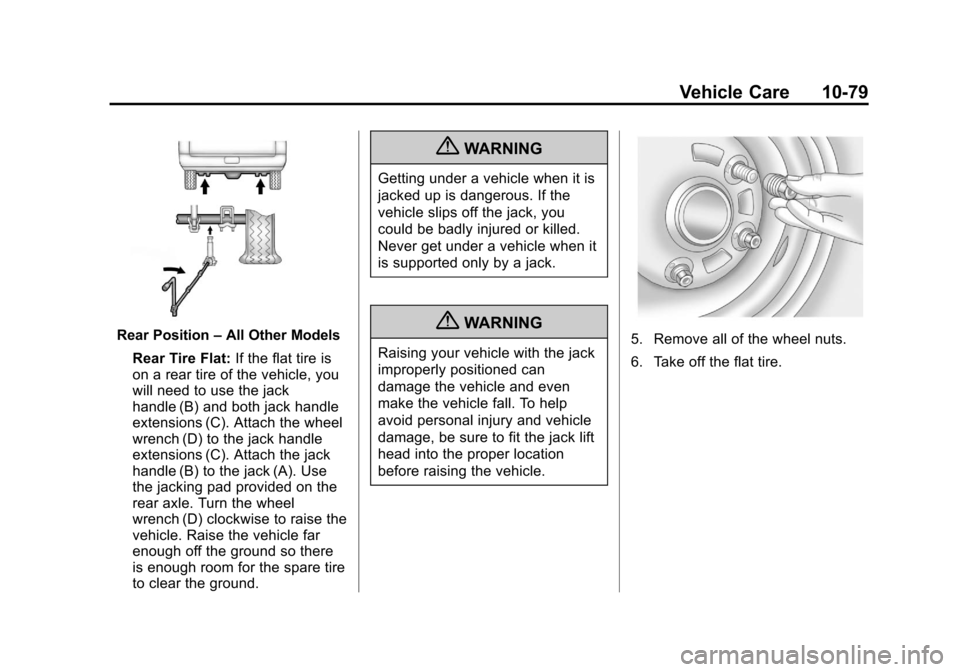
Rear Tire Flat: If the flat tire is
on a rear tire of the vehicle, you
will need to use the jack
handle (B) and both jack handle
extensions (C). Attach the wheel
wrench (D) to the jack handle
extensions (C). Attach the jack
handle (B) to the jack (A). Use
the jacking pad provided on the
rear axle. Turn the wheel
wrench (D) clockwise to raise the
vehicle. Raise the vehicle far
enough off the ground so there
is enough room for the spare tire
to clear the ground.
{WARNING
Getting under a vehicle when it is
jacked up is dangerous. If the
vehicle slips off the jack, you
could be badly injured or killed.
Never get under a vehicle when it
is supported only by a jack.
{WARNING
Raising your vehicle with the jack
improperly positioned can
damage the vehicle and even
make the vehicle fall. To help
avoid personal injury and vehicle
damage, be sure to fit the jack lift
head into the proper location
before raising the vehicle.5. Remove all of the wheel nuts.
6. Take off the flat tire.
Page 470 of 542

Black plate (80,1)Chevrolet Tahoe/Suburban Owner Manual - 2011
10-80 Vehicle Care
7. Remove any rust or dirt from thewheel bolts, mounting surfaces,
and spare wheel.
{WARNING
Rust or dirt on a wheel, or on the
parts to which it is fastened, can
make wheel nuts become loose
after time. The wheel could come
off and cause an accident. When
changing a wheel, remove any
rust or dirt from places where the
wheel attaches to the vehicle. In
an emergency, use a cloth or a
paper towel to do this; but be sure
to use a scraper or wire brush
later, if needed, to get all the rust
or dirt off. See If a Tire Goes Flat
on page 10‑71.
8. Put the wheel nuts back on with the rounded end of the nuts
toward the wheel after mounting
the spare tire.
{WARNING
Never use oil or grease on bolts
or nuts because the nuts might
come loose. The vehicle's wheel
could fall off, causing a crash.
9. Tighten each wheel nut by hand. Then use the wheel wrench to
tighten the nuts until the wheel is
held against the hub.
10. Turn the wheel wrench counterclockwise to lower the
vehicle. Lower the jack
completely.
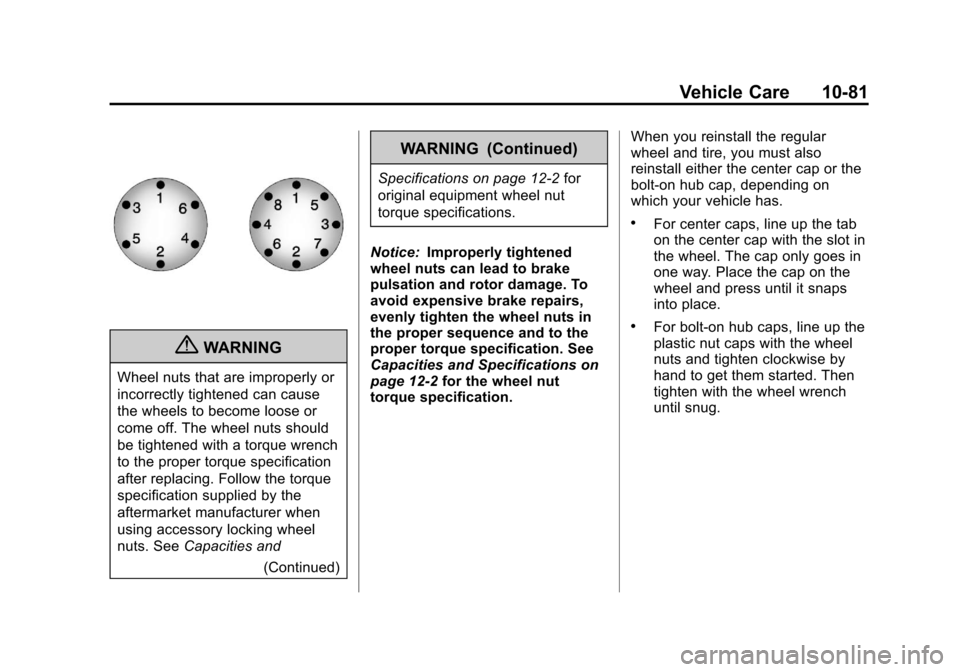
11. Tighten the nuts firmly in a crisscross sequence as shown
by turning the wheel wrench
clockwise.
Page 471 of 542
Black plate (81,1)Chevrolet Tahoe/Suburban Owner Manual - 2011
Vehicle Care 10-81
{WARNING
Wheel nuts that are improperly or
incorrectly tightened can cause
the wheels to become loose or
come off. The wheel nuts should
be tightened with a torque wrench
to the proper torque specification
after replacing. Follow the torque
specification supplied by the
aftermarket manufacturer when
using accessory locking wheel
nuts. SeeCapacities and
(Continued)
WARNING (Continued)
Specifications on page 12‑2 for
original equipment wheel nut
torque specifications.
Notice: Improperly tightened
wheel nuts can lead to brake
pulsation and rotor damage. To
avoid expensive brake repairs,
evenly tighten the wheel nuts in
the proper sequence and to the
proper torque specification. See
Capacities and Specifications on
page 12‑2 for the wheel nut
torque specification. When you reinstall the regular
wheel and tire, you must also
reinstall either the center cap or the
bolt-on hub cap, depending on
which your vehicle has.
.For center caps, line up the tab
on the center cap with the slot in
the wheel. The cap only goes in
one way. Place the cap on the
wheel and press until it snaps
into place.
.For bolt-on hub caps, line up the
plastic nut caps with the wheel
nuts and tighten clockwise by
hand to get them started. Then
tighten with the wheel wrench
until snug.
Page 472 of 542
Black plate (82,1)Chevrolet Tahoe/Suburban Owner Manual - 2011
10-82 Vehicle Care
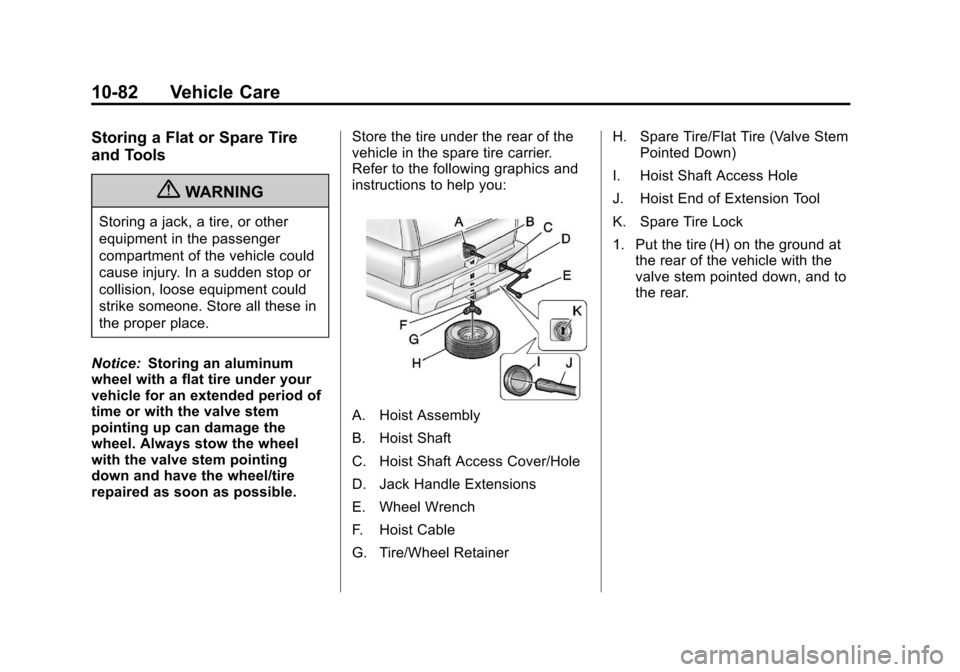
Storing a Flat or Spare Tire
and Tools
{WARNING
Storing a jack, a tire, or other
equipment in the passenger
compartment of the vehicle could
cause injury. In a sudden stop or
collision, loose equipment could
strike someone. Store all these in
the proper place.
Notice: Storing an aluminum
wheel with a flat tire under your
vehicle for an extended period of
time or with the valve stem
pointing up can damage the
wheel. Always stow the wheel
with the valve stem pointing
down and have the wheel/tire
repaired as soon as possible. Store the tire under the rear of the
vehicle in the spare tire carrier.
Refer to the following graphics and
instructions to help you:
A. Hoist Assembly
B. Hoist Shaft
C. Hoist Shaft Access Cover/Hole
D. Jack Handle Extensions
E. Wheel Wrench
F. Hoist Cable
G. Tire/Wheel RetainerH. Spare Tire/Flat Tire (Valve Stem
Pointed Down)
I. Hoist Shaft Access Hole
J. Hoist End of Extension Tool
K. Spare Tire Lock
1. Put the tire (H) on the ground at the rear of the vehicle with the
valve stem pointed down, and to
the rear.