2011 CHEVROLET SUBURBAN air suspension
[x] Cancel search: air suspensionPage 346 of 542
Black plate (58,1)Chevrolet Tahoe/Suburban Owner Manual - 2011
9-58 Driving and Operating
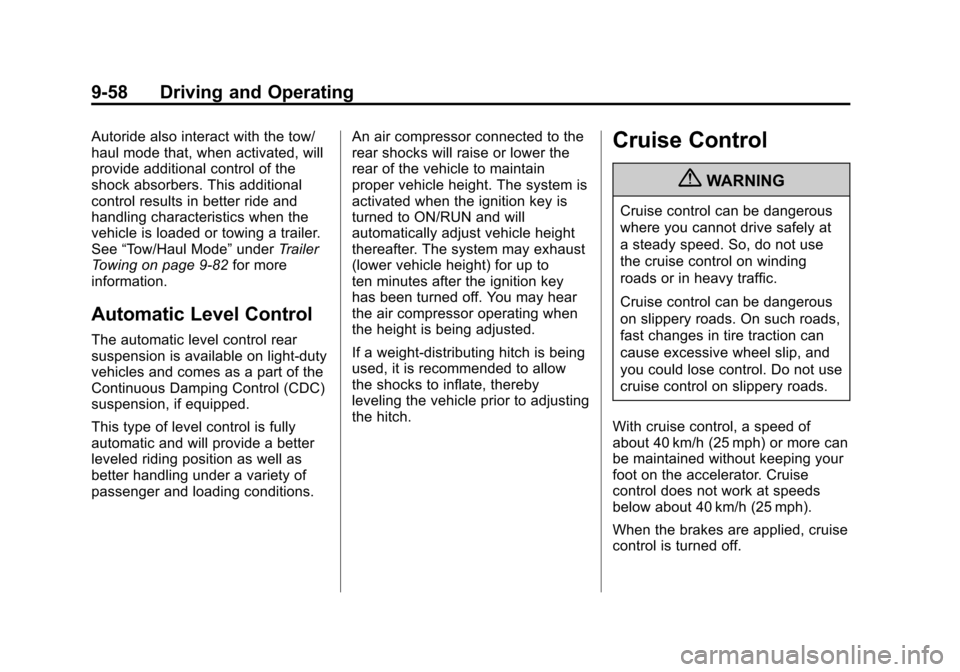
Autoride also interact with the tow/
haul mode that, when activated, will
provide additional control of the
shock absorbers. This additional
control results in better ride and
handling characteristics when the
vehicle is loaded or towing a trailer.
See“Tow/Haul Mode” underTrailer
Towing on page 9‑82 for more
information.
Automatic Level Control
The automatic level control rear
suspension is available on light‐duty
vehicles and comes as a part of the
Continuous Damping Control (CDC)
suspension, if equipped.
This type of level control is fully
automatic and will provide a better
leveled riding position as well as
better handling under a variety of
passenger and loading conditions. An air compressor connected to the
rear shocks will raise or lower the
rear of the vehicle to maintain
proper vehicle height. The system is
activated when the ignition key is
turned to ON/RUN and will
automatically adjust vehicle height
thereafter. The system may exhaust
(lower vehicle height) for up to
ten minutes after the ignition key
has been turned off. You may hear
the air compressor operating when
the height is being adjusted.
If a weight‐distributing hitch is being
used, it is recommended to allow
the shocks to inflate, thereby
leveling the vehicle prior to adjusting
the hitch.
Cruise Control
{WARNING
Cruise control can be dangerous
where you cannot drive safely at
a steady speed. So, do not use
the cruise control on winding
roads or in heavy traffic.
Cruise control can be dangerous
on slippery roads. On such roads,
fast changes in tire traction can
cause excessive wheel slip, and
you could lose control. Do not use
cruise control on slippery roads.
With cruise control, a speed of
about 40 km/h (25 mph) or more can
be maintained without keeping your
foot on the accelerator. Cruise
control does not work at speeds
below about 40 km/h (25 mph).
When the brakes are applied, cruise
control is turned off.
Page 433 of 542
Black plate (43,1)Chevrolet Tahoe/Suburban Owner Manual - 2011
Vehicle Care 10-43
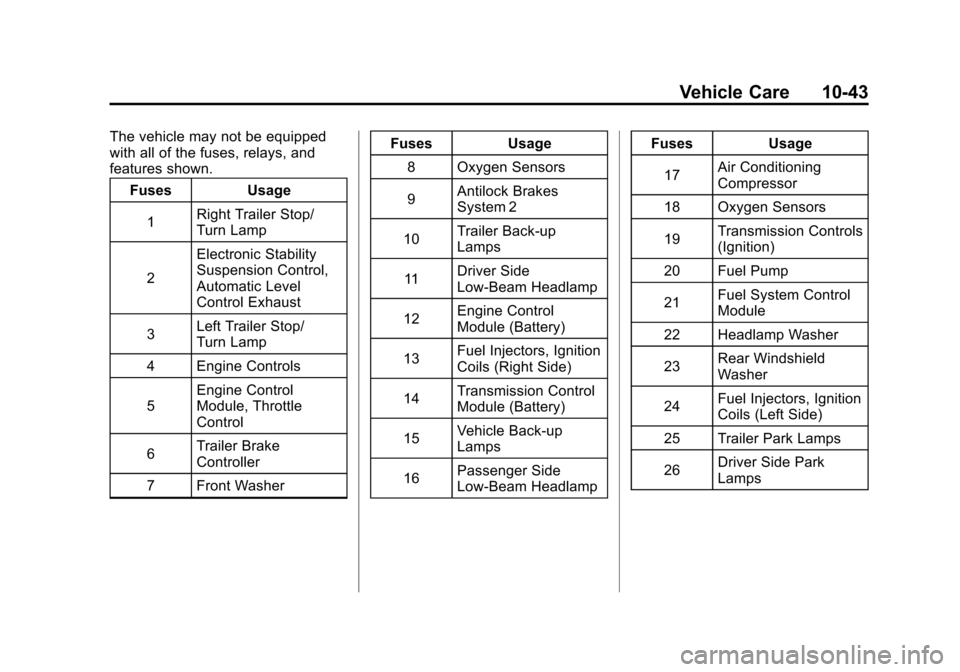
The vehicle may not be equipped
with all of the fuses, relays, and
features shown.Fuses Usage
1 Right Trailer Stop/
Turn Lamp
2 Electronic Stability
Suspension Control,
Automatic Level
Control Exhaust
3 Left Trailer Stop/
Turn Lamp
4 Engine Controls
5 Engine Control
Module, Throttle
Control
6 Trailer Brake
Controller
7 Front Washer Fuses Usage
8 Oxygen Sensors
9 Antilock Brakes
System 2
10 Trailer Back-up
Lamps
11 Driver Side
Low-Beam Headlamp
12 Engine Control
Module (Battery)
13 Fuel Injectors, Ignition
Coils (Right Side)
14 Transmission Control
Module (Battery)
15 Vehicle Back-up
Lamps
16 Passenger Side
Low-Beam Headlamp Fuses Usage
17 Air Conditioning
Compressor
18 Oxygen Sensors
19 Transmission Controls
(Ignition)
20 Fuel Pump
21 Fuel System Control
Module
22 Headlamp Washer
23 Rear Windshield
Washer
24 Fuel Injectors, Ignition
Coils (Left Side)
25 Trailer Park Lamps
26 Driver Side Park
Lamps
Page 460 of 542
Black plate (70,1)Chevrolet Tahoe/Suburban Owner Manual - 2011
10-70 Vehicle Care
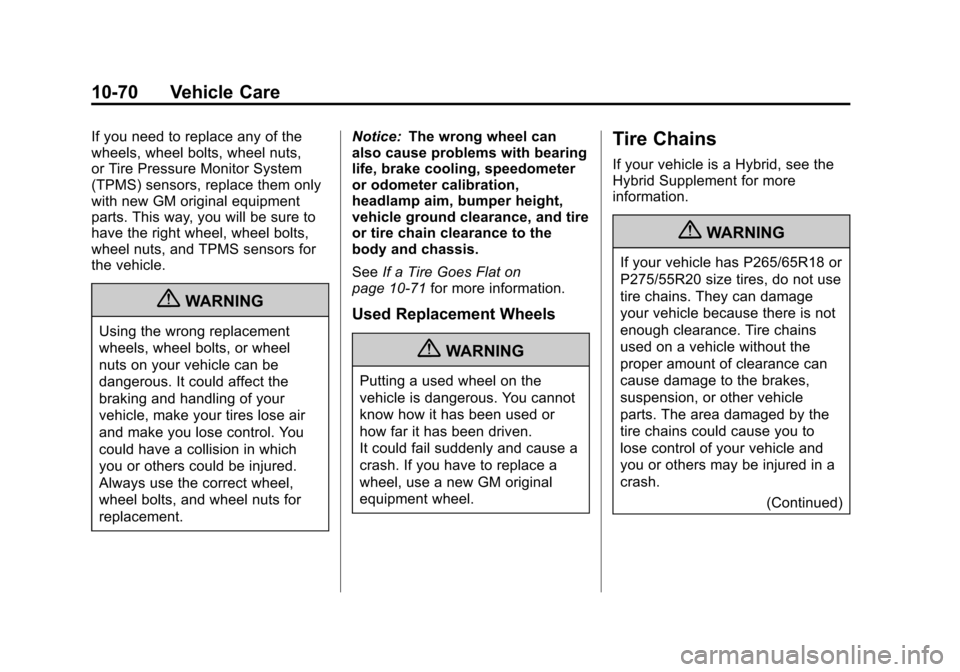
If you need to replace any of the
wheels, wheel bolts, wheel nuts,
or Tire Pressure Monitor System
(TPMS) sensors, replace them only
with new GM original equipment
parts. This way, you will be sure to
have the right wheel, wheel bolts,
wheel nuts, and TPMS sensors for
the vehicle.
{WARNING
Using the wrong replacement
wheels, wheel bolts, or wheel
nuts on your vehicle can be
dangerous. It could affect the
braking and handling of your
vehicle, make your tires lose air
and make you lose control. You
could have a collision in which
you or others could be injured.
Always use the correct wheel,
wheel bolts, and wheel nuts for
replacement.Notice:
The wrong wheel can
also cause problems with bearing
life, brake cooling, speedometer
or odometer calibration,
headlamp aim, bumper height,
vehicle ground clearance, and tire
or tire chain clearance to the
body and chassis.
See If a Tire Goes Flat on
page 10‑71 for more information.
Used Replacement Wheels
{WARNING
Putting a used wheel on the
vehicle is dangerous. You cannot
know how it has been used or
how far it has been driven.
It could fail suddenly and cause a
crash. If you have to replace a
wheel, use a new GM original
equipment wheel.
Tire Chains
If your vehicle is a Hybrid, see the
Hybrid Supplement for more
information.
{WARNING
If your vehicle has P265/65R18 or
P275/55R20 size tires, do not use
tire chains. They can damage
your vehicle because there is not
enough clearance. Tire chains
used on a vehicle without the
proper amount of clearance can
cause damage to the brakes,
suspension, or other vehicle
parts. The area damaged by the
tire chains could cause you to
lose control of your vehicle and
you or others may be injured in a
crash.
(Continued)
Page 500 of 542
Black plate (4,1)Chevrolet Tahoe/Suburban Owner Manual - 2011
11-4 Service and Maintenance
.Engine air cleaner filter
inspection. SeeEngine Air
Cleaner/Filter on page 10‑15.
.Brake system inspection
(or every 12 months, whichever
occurs first).
.Steering and suspension
inspection. Visual inspection for
damaged, loose, or missing
parts or signs of wear.
.Lubricate the front suspension,
steering linkage, and parking
brake cable guides. For vehicles
mainly driven in heavy city traffic
in hot weather, in hilly or
mountainous terrain, when
frequently towing a trailer,
or used for taxi, police,
or delivery service, lubricate
every 5 000 km/3,000 miles.
Control arm ball joints on
2500 series vehicles require
lubrication but should not be
lubricated unless their
temperature is −12°C (10°F) or
higher, or they could be damaged. Control arm ball joints
on 1500 series vehicles are
maintenance‐free.
.Body hinges and latches, key
lock cylinders, folding seat
hardware, and liftgate hinges,
linkage, and handle pivot points
lubrication. See
Recommended
Fluids and Lubricants on
page 11‑7. More frequent
lubrication may be required
when the vehicle is exposed to a
corrosive environment. Applying
silicone grease on weatherstrips
with a clean cloth makes them
last longer, seal better, and not
stick or squeak.
.Restraint system components
check. See Safety System
Check on page 3‑40.
.Fuel system inspection for
damage or leaks.
.Exhaust system and nearby heat
shields inspection for loose or
damaged components.
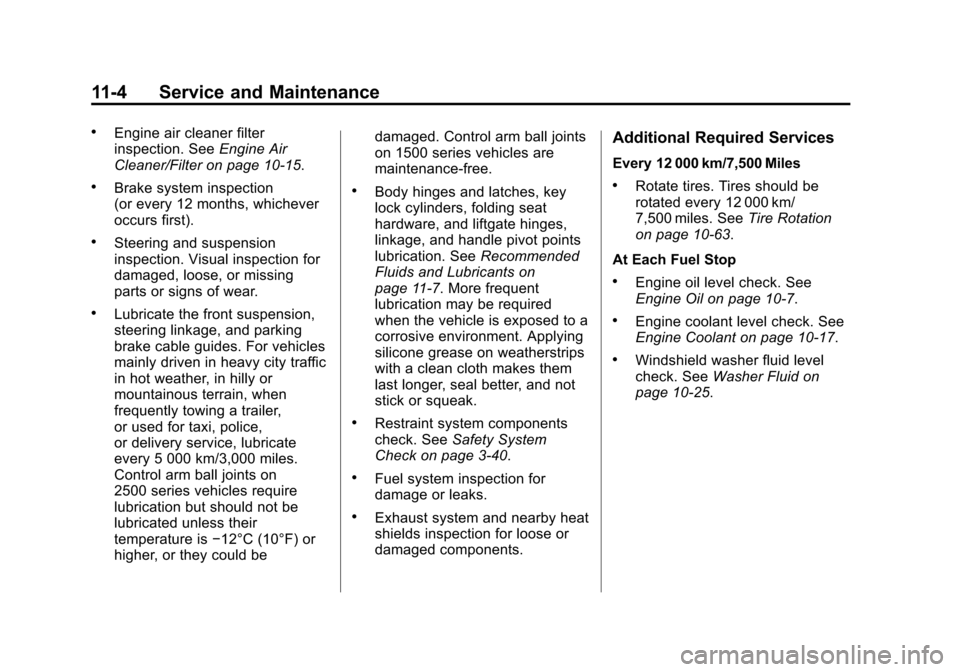
Additional Required Services
Every 12 000 km/7,500 Miles
.Rotate tires. Tires should be
rotated every 12 000 km/
7,500 miles. See Tire Rotation
on page 10‑63.
At Each Fuel Stop
.Engine oil level check. See
Engine Oil on page 10‑7.
.Engine coolant level check. See
Engine Coolant on page 10‑17.
.Windshield washer fluid level
check. See Washer Fluid on
page 10‑25.
Page 526 of 542

Black plate (14,1)Chevrolet Tahoe/Suburban Owner Manual - 2011
13-14 Customer Information
Gather the following information:
.Driver's name, address, and
telephone number
.Driver's license number
.Owner's name, address, and
telephone number
.Vehicle license plate number
.Vehicle make, model, and
model year
.Vehicle Identification
Number (VIN)
.Insurance company and policy
number
.General description of the
damage to the other vehicle
Choose a reputable repair facility
that uses quality replacement parts.
See “Collision Parts” earlier in this
section.
If the airbag has inflated, see What
Will You See After an Airbag
Inflates? on page 3‑48.
Managing the Vehicle Damage
Repair Process
In the event that your vehicle
requires damage repairs, GM
recommends that you take an active
role in its repair. If you have a
pre-determined repair facility of
choice, take your vehicle there,
or have it towed there. Specify to
the facility that any required
replacement collision parts be
original equipment parts, either new
Genuine GM parts or recycled
original GM parts. Remember,
recycled parts will not be covered by
your GM vehicle warranty.
Insurance pays the bill for the repair,
but you must live with the repair.
Depending on your policy limits,
your insurance company may
initially value the repair using
aftermarket parts. Discuss this with
your repair professional, and insist
on Genuine GM parts. Remember,
if your vehicle is leased, you may be
obligated to have the vehicle repaired with Genuine GM parts,
even if your insurance coverage
does not pay the full cost.
If another party's insurance
company is paying for the repairs,
you are not obligated to accept a
repair valuation based on that
insurance company's collision policy
repair limits, as you have no
contractual limits with that company.
In such cases, you can have control
of the repair and parts choices as
long as the cost stays within
reasonable limits.
Service Publications
Ordering Information
Service Manuals
Service Manuals have the diagnosis
and repair information on the
engines, transmission, axle,
suspension, brakes, electrical,
steering, body, etc.