Page 433 of 542
Black plate (43,1)Chevrolet Tahoe/Suburban Owner Manual - 2011
Vehicle Care 10-43
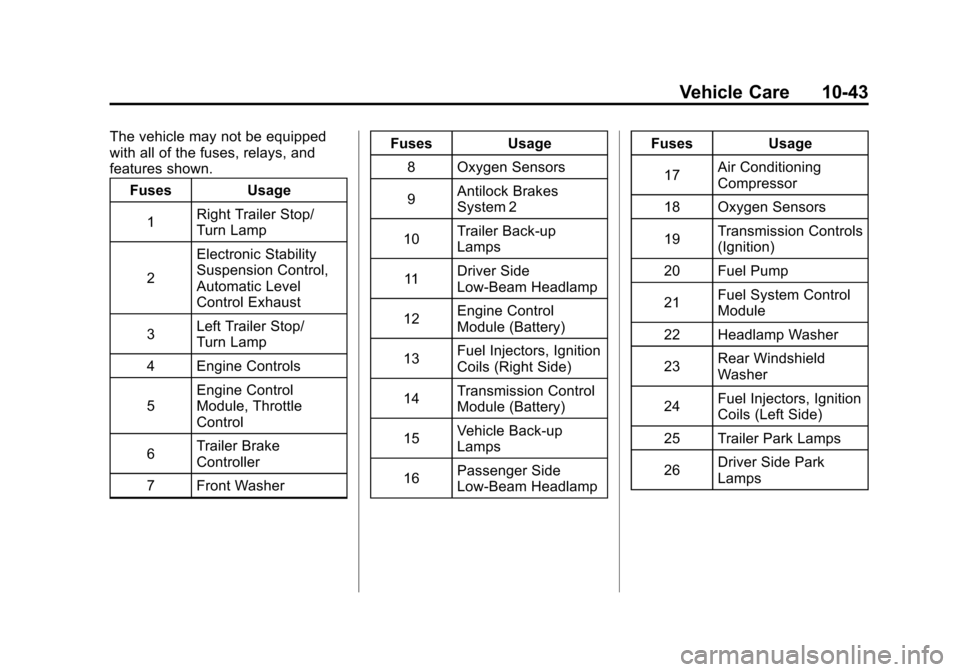
The vehicle may not be equipped
with all of the fuses, relays, and
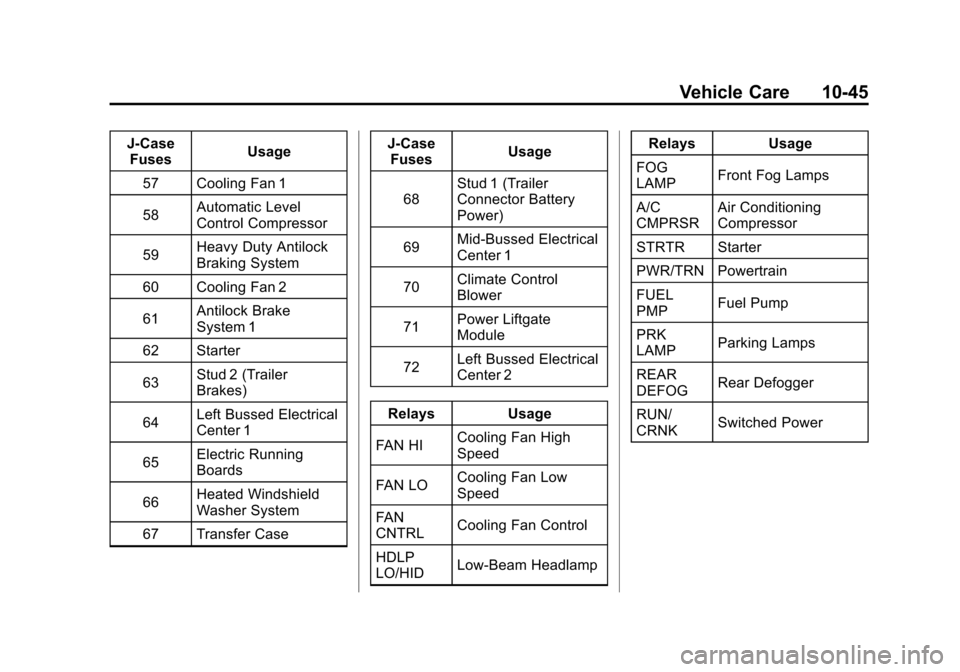
features shown.Fuses Usage
1 Right Trailer Stop/
Turn Lamp
2 Electronic Stability
Suspension Control,
Automatic Level
Control Exhaust
3 Left Trailer Stop/
Turn Lamp
4 Engine Controls
5 Engine Control
Module, Throttle
Control
6 Trailer Brake
Controller
7 Front Washer Fuses Usage
8 Oxygen Sensors
9 Antilock Brakes
System 2
10 Trailer Back-up
Lamps
11 Driver Side
Low-Beam Headlamp
12 Engine Control
Module (Battery)
13 Fuel Injectors, Ignition
Coils (Right Side)
14 Transmission Control
Module (Battery)
15 Vehicle Back-up
Lamps
16 Passenger Side
Low-Beam Headlamp Fuses Usage
17 Air Conditioning
Compressor
18 Oxygen Sensors
19 Transmission Controls
(Ignition)
20 Fuel Pump
21 Fuel System Control
Module
22 Headlamp Washer
23 Rear Windshield
Washer
24 Fuel Injectors, Ignition
Coils (Left Side)
25 Trailer Park Lamps
26 Driver Side Park
Lamps
Page 435 of 542
Black plate (45,1)Chevrolet Tahoe/Suburban Owner Manual - 2011
Vehicle Care 10-45
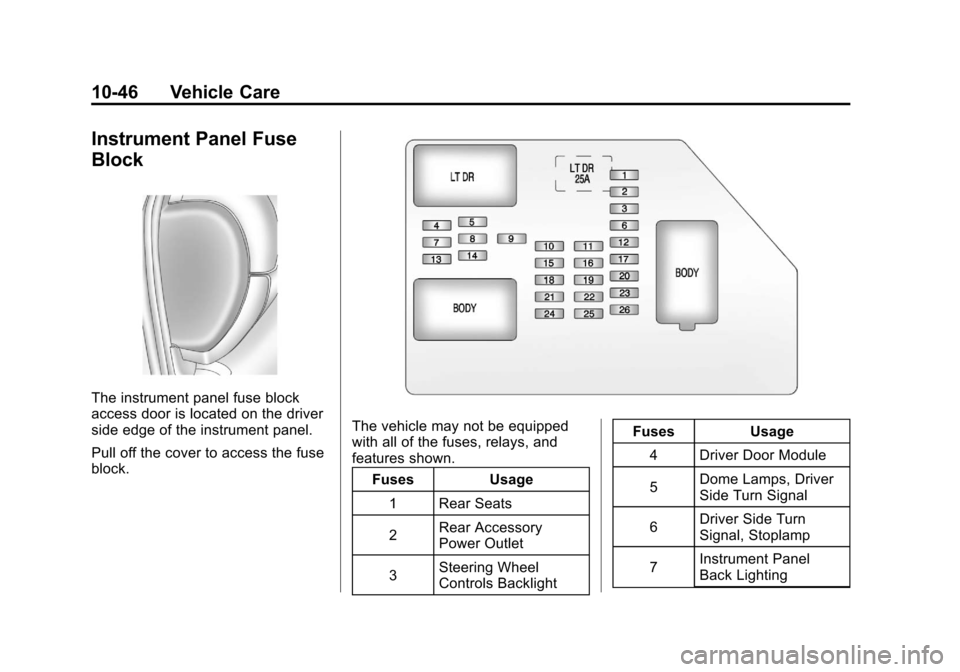
J-CaseFuses Usage
57 Cooling Fan 1
58 Automatic Level
Control Compressor
59 Heavy Duty Antilock
Braking System
60 Cooling Fan 2
61 Antilock Brake
System 1
62 Starter
63 Stud 2 (Trailer
Brakes)
64 Left Bussed Electrical
Center 1
65 Electric Running
Boards
66 Heated Windshield
Washer System
67 Transfer Case J-Case
Fuses Usage
68 Stud 1 (Trailer
Connector Battery
Power)
69 Mid-Bussed Electrical
Center 1
70 Climate Control
Blower
71 Power Liftgate
Module
72 Left Bussed Electrical
Center 2
Relays Usage
FAN HI Cooling Fan High
Speed
FAN LO Cooling Fan Low
Speed
FAN
CNTRL Cooling Fan Control
HDLP
LO/HID Low-Beam Headlamp Relays Usage
FOG
LAMP Front Fog Lamps
A/C
CMPRSR Air Conditioning
Compressor
STRTR Starter
PWR/TRN Powertrain
FUEL
PMP Fuel Pump
PRK
LAMP Parking Lamps
REAR
DEFOG Rear Defogger
RUN/
CRNK Switched Power
Page 436 of 542
Black plate (46,1)Chevrolet Tahoe/Suburban Owner Manual - 2011
10-46 Vehicle Care
Instrument Panel Fuse
Block
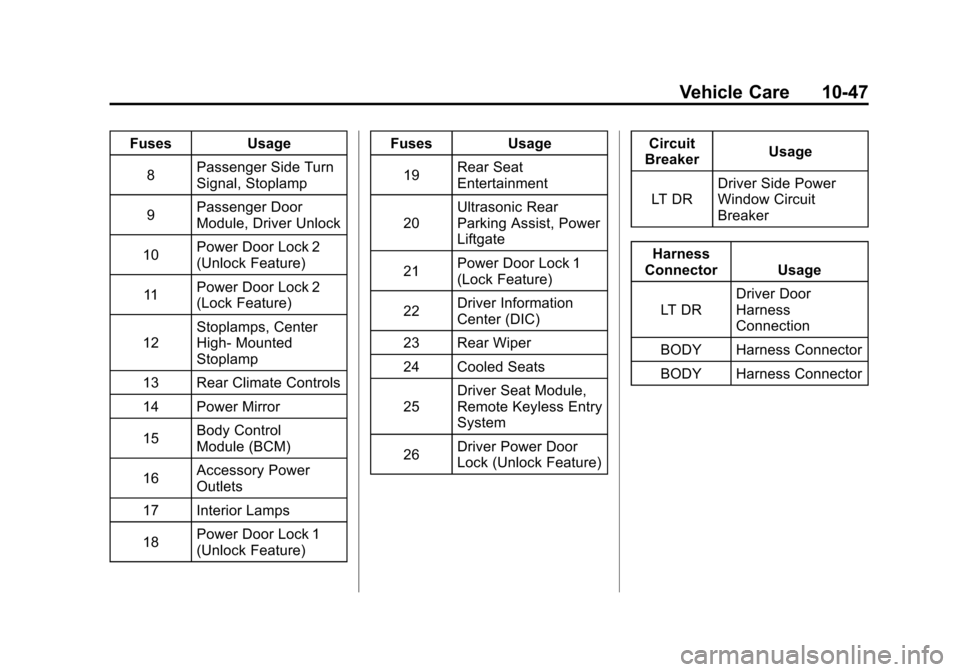
The instrument panel fuse block
access door is located on the driver
side edge of the instrument panel.
Pull off the cover to access the fuse
block.
The vehicle may not be equipped
with all of the fuses, relays, and
features shown.Fuses Usage
1 Rear Seats
2 Rear Accessory
Power Outlet
3 Steering Wheel
Controls Backlight Fuses Usage
4 Driver Door Module
5 Dome Lamps, Driver
Side Turn Signal
6 Driver Side Turn
Signal, Stoplamp
7 Instrument Panel
Back Lighting
Page 437 of 542
Black plate (47,1)Chevrolet Tahoe/Suburban Owner Manual - 2011
Vehicle Care 10-47
FusesUsage
8 Passenger Side Turn
Signal, Stoplamp
9 Passenger Door
Module, Driver Unlock
10 Power Door Lock 2
(Unlock Feature)
11 Power Door Lock 2
(Lock Feature)
12 Stoplamps, Center
High‐
Mounted
Stoplamp
13 Rear Climate Controls
14 Power Mirror
15 Body Control
Module (BCM)
16 Accessory Power
Outlets
17 Interior Lamps
18 Power Door Lock 1
(Unlock Feature) Fuses
Usage
19 Rear Seat
Entertainment
20 Ultrasonic Rear
Parking Assist, Power
Liftgate
21 Power Door Lock 1
(Lock Feature)
22 Driver Information
Center (DIC)
23 Rear Wiper
24 Cooled Seats
25 Driver Seat Module,
Remote Keyless Entry
System
26 Driver Power Door
Lock (Unlock Feature) Circuit
Breaker Usage
LT DR Driver Side Power
Window Circuit
Breaker
Harness
Connector Usage
LT DR Driver Door
Harness
Connection
BODY Harness Connector
BODY Harness Connector
Page 438 of 542
Black plate (48,1)Chevrolet Tahoe/Suburban Owner Manual - 2011
10-48 Vehicle Care
Center Instrument Panel Fuse
Block
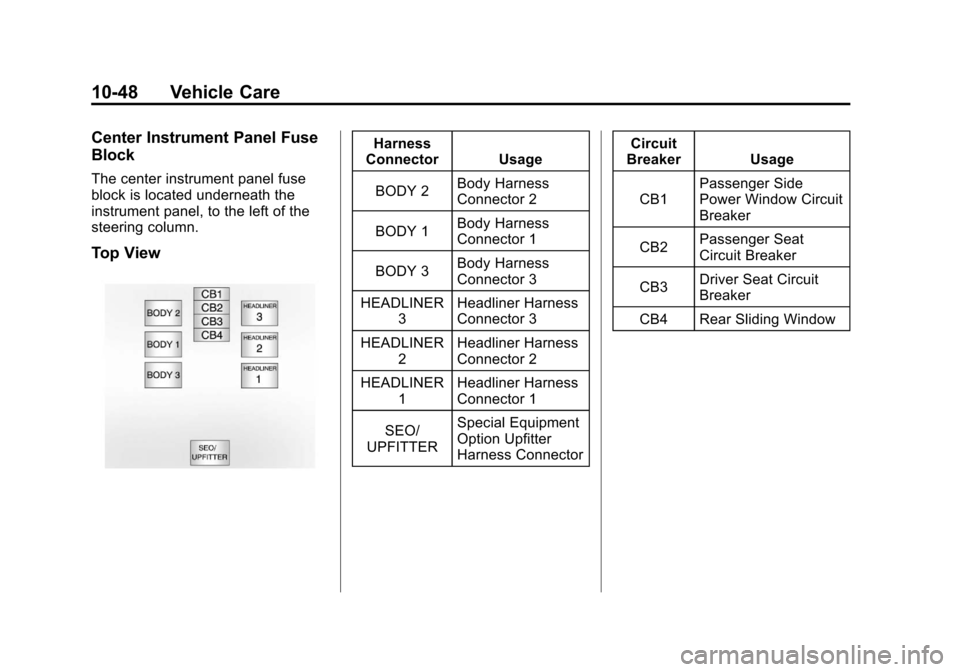
The center instrument panel fuse
block is located underneath the
instrument panel, to the left of the
steering column.
Top View
Harness
Connector Usage
BODY 2 Body Harness
Connector 2
BODY 1 Body Harness
Connector 1
BODY 3 Body Harness
Connector 3
HEADLINER 3 Headliner Harness
Connector 3
HEADLINER 2 Headliner Harness
Connector 2
HEADLINER 1 Headliner Harness
Connector 1
SEO/
UPFITTER Special Equipment
Option Upfitter
Harness Connector Circuit
Breaker Usage
CB1 Passenger Side
Power Window Circuit
Breaker
CB2 Passenger Seat
Circuit Breaker
CB3 Driver Seat Circuit
Breaker
CB4 Rear Sliding Window
Page 453 of 542
Black plate (63,1)Chevrolet Tahoe/Suburban Owner Manual - 2011
Vehicle Care 10-63
7. Proceed to the passenger siderear tire, and repeat the
procedure in Step 5.
8. Proceed to the driver side rear tire, and repeat the procedure in
Step 5. The horn sounds two
times to indicate the sensor
identification code has been
matched to the driver side rear
tire, and the TPMS sensor
matching process is no longer
active. The TIRE LEARNING
ACTIVE message on the DIC
display screen goes off.
9. Turn the ignition switch to LOCK/OFF.
10. Set all four tires to the recommended air pressure
level as indicated on the Tire
and Loading Information label.
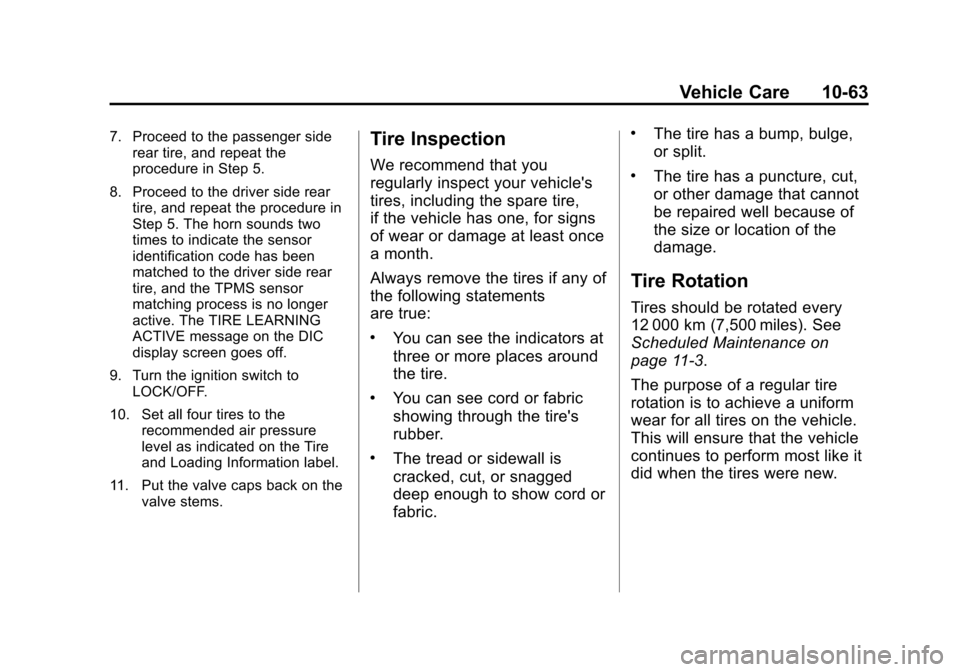
11. Put the valve caps back on the valve stems.Tire Inspection
We recommend that you
regularly inspect your vehicle's
tires, including the spare tire,
if the vehicle has one, for signs
of wear or damage at least once
a month.
Always remove the tires if any of
the following statements
are true:
.You can see the indicators at
three or more places around
the tire.
.You can see cord or fabric
showing through the tire's
rubber.
.The tread or sidewall is
cracked, cut, or snagged
deep enough to show cord or
fabric.
.The tire has a bump, bulge,
or split.
.The tire has a puncture, cut,
or other damage that cannot
be repaired well because of
the size or location of the
damage.
Tire Rotation
Tires should be rotated every
12 000 km (7,500 miles). See
Scheduled Maintenance on
page 11‑3.
The purpose of a regular tire
rotation is to achieve a uniform
wear for all tires on the vehicle.
This will ensure that the vehicle
continues to perform most like it
did when the tires were new.
Page 457 of 542
Black plate (67,1)Chevrolet Tahoe/Suburban Owner Manual - 2011
Vehicle Care 10-67
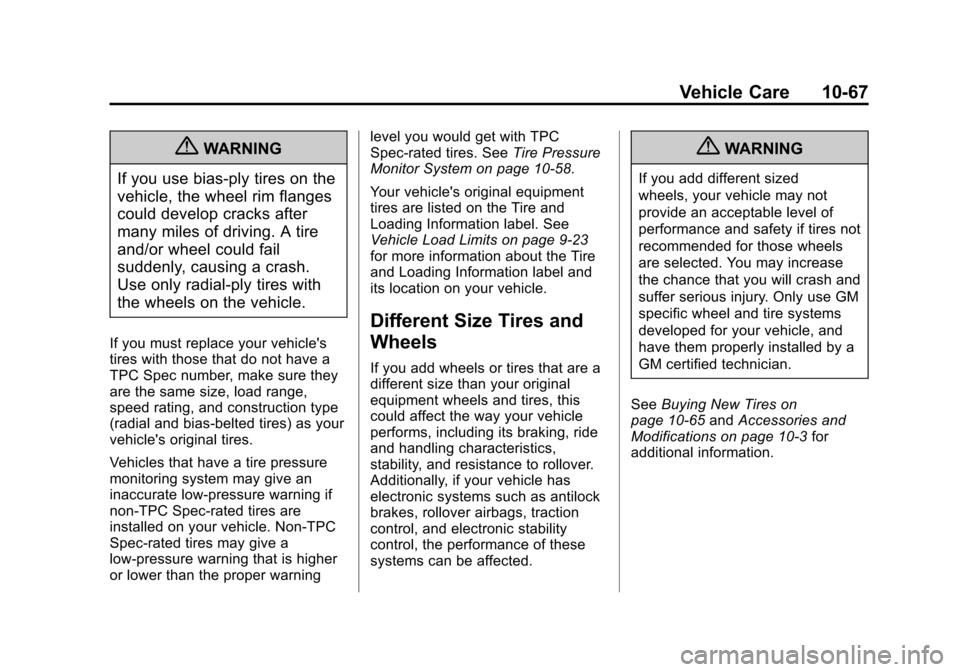
{WARNING
If you use bias-ply tires on the
vehicle, the wheel rim flanges
could develop cracks after
many miles of driving. A tire
and/or wheel could fail
suddenly, causing a crash.
Use only radial-ply tires with
the wheels on the vehicle.
If you must replace your vehicle's
tires with those that do not have a
TPC Spec number, make sure they
are the same size, load range,
speed rating, and construction type
(radial and bias‐belted tires) as your
vehicle's original tires.
Vehicles that have a tire pressure
monitoring system may give an
inaccurate low‐pressure warning if
non‐TPC Spec-rated tires are
installed on your vehicle. Non‐TPC
Spec-rated tires may give a
low‐pressure warning that is higher
or lower than the proper warning level you would get with TPC
Spec-rated tires. See
Tire Pressure
Monitor System on page 10‑58.
Your vehicle's original equipment
tires are listed on the Tire and
Loading Information label. See
Vehicle Load Limits on page 9‑23
for more information about the Tire
and Loading Information label and
its location on your vehicle.
Different Size Tires and
Wheels
If you add wheels or tires that are a
different size than your original
equipment wheels and tires, this
could affect the way your vehicle
performs, including its braking, ride
and handling characteristics,
stability, and resistance to rollover.
Additionally, if your vehicle has
electronic systems such as antilock
brakes, rollover airbags, traction
control, and electronic stability
control, the performance of these
systems can be affected.
{WARNING
If you add different sized
wheels, your vehicle may not
provide an acceptable level of
performance and safety if tires not
recommended for those wheels
are selected. You may increase
the chance that you will crash and
suffer serious injury. Only use GM
specific wheel and tire systems
developed for your vehicle, and
have them properly installed by a
GM certified technician.
See Buying New Tires on
page 10‑65 andAccessories and
Modifications on page 10‑3 for
additional information.
Page 463 of 542

Black plate (73,1)Chevrolet Tahoe/Suburban Owner Manual - 2011
Vehicle Care 10-73
WARNING (Continued)
4. Turn off the engine and donot restart while the vehicle
is raised.
5. Do not allow passengers to remain in the vehicle.
6. Put the wheel blocks at the front and rear of the tire
farthest away from the one
being changed. That would
be the tire on the other side,
at the opposite end of the
vehicle. When the vehicle has a flat tire (B),
use the following example as a
guide to assist you in the placement
of wheel blocks (A).
A. Wheel Block
B. Flat Tire
The following information explains
how to use the jack and change
a tire.
Tire Changing
Removing the Spare Tire and
Tools
The equipment you will need to
change a flat tire is stored under the
storage tray, which is located on the
driver side trim panel (over the rear
wheelhouse).
Regular Wheelbase Shown,
Extended Wheelbase Similar
1. Remove the tray to access the tools by pulling up on the finger
depression under the jack
symbol.