2011 CHEVROLET SILVERADO fuel
[x] Cancel search: fuelPage 485 of 588

Black plate (63,1)Chevrolet Silverado Owner Manual - 2011
Vehicle Care 10-63
UTQGS (Uniform Tire
Quality Grading Standards)
:
A tire information system that
provides consumers with
ratings for a tire's traction,
temperature, and treadwear.
Ratings are determined by
tire manufacturers using
government testing procedures.
The ratings are molded into
the sidewall of the tire.
SeeUniform Tire Quality
Grading
on page 10‑78.
Vehicle Capacity Weight
:
The number of designated
seating positions multiplied by
68 kg (150 lbs) plus the rated
cargo load. See Vehicle Load
Limits
on page 9‑23.
Vehicle Maximum Load on the
Tire
:Load on an individual tire
due to curb weight, accessory
weight, occupant weight, and
cargo weight. Vehicle Placard
:A label
permanently attached to a
vehicle showing the vehicle's
capacity weight and the
original equipment tire size
and recommended inflation
pressure. See “Tire and Loading
Information Label” underVehicle
Load Limits
on page 9‑23.
Tire Pressure
Tires need the correct amount
of air pressure to operate
effectively.
Notice:Do not let anyone tell
you that under‐inflation or
over‐inflation is all right. It is
not. If your tires do not have
enough air (under‐inflation),
you can get the following:
.Tire overloading and
over-heating which could
lead to a blowout.
.Premature or
irregular wear.
.Poor handling.
.Reduced fuel economy.
If your tires have too much air
(over‐inflation), you can get
the following:
.Unusual wear.
.Poor handling.
.Rough ride.
.Needless damage from
road hazards.
A vehicle-specific Tire and
Loading Information label
is attached to your vehicle.
This label shows your vehicle's
original equipment tires and the
correct inflation pressures for
your tires when they are cold.
Page 488 of 588

Black plate (66,1)Chevrolet Silverado Owner Manual - 2011
10-66 Vehicle Care
As an added safety feature, your
vehicle has been equipped with a
tire pressure monitoring system
(TPMS) that illuminates a low
tire pressure telltale when one or
more of your tires is significantly
under‐inflated.
Accordingly, when the low tire
pressure telltale illuminates, you
should stop and check your tires as
soon as possible, and inflate them
to the proper pressure. Driving on
a significantly under‐inflated tire
causes the tire to overheat and can
lead to tire failure. Under‐inflation
also reduces fuel efficiency and
tire tread life, and may affect the
vehicle's handling and stopping
ability.Please note that the TPMS is
not a substitute for proper tire
maintenance, and it is the driver's
responsibility to maintain correct
tire pressure, even if under‐inflation
has not reached the level to trigger
illumination of the TPMS low tire
pressure telltale.
Your vehicle has also been
equipped with a TPMS malfunction
indicator to indicate when the
system is not operating properly.
The TPMS malfunction indicator is
combined with the low tire pressure
telltale. When the system detects a
malfunction, the telltale will flash for
approximately one minute and then
remain continuously illuminated.
This sequence will continue upon
subsequent vehicle start‐ups as
long as the malfunction exists.When the malfunction indicator is
illuminated, the system may not
be able to detect or signal low
tire pressure as intended. TPMS
malfunctions may occur for a variety
of reasons, including the installation
of replacement or alternate tires or
wheels on the vehicle that prevent
the TPMS from functioning properly.
Always check the TPMS malfunction
telltale after replacing one or more
tires or wheels on your vehicle to
ensure that the replacement or
alternate tires and wheels allow
the TPMS to continue to function
properly.
See
Tire Pressure Monitor
Operation
on page 10‑67for
additional information.
Page 532 of 588

Black plate (110,1)Chevrolet Silverado Owner Manual - 2011
10-110 Vehicle Care
Finish Damage
Any stone chips, fractures or deep
scratches in the finish should be
repaired right away. Bare metal will
corrode quickly and may develop
into major repair expense.
Minor chips and scratches can be
repaired with touch-up materials
available from your dealer. Larger
areas of finish damage can be
corrected in your dealer's body
and paint shop.
Chemicals used for ice and snow
removal and dust control can collect
on the underbody. If these are not
removed, corrosion and rust can
develop on the underbody parts
such as fuel lines, frame, floor pan,
and exhaust system even though
they have corrosion protection.
At least every spring, flush these
materials from the underbody
with plain water. Clean any areas
where mud and debris can collect.Dirt packed in close areas of the
frame should be loosened before
being flushed. Your dealer or an
underbody car washing system
can do this.
Underbody Maintenance
Chemicals used for ice and snow
removal and dust control can collect
on the underbody. If these are not
removed, corrosion and rust can
develop on the underbody parts
such as fuel lines, frame, floor pan,
and exhaust system even though
they have corrosion protection.
At least every spring, flush these
materials from the underbody
with plain water. Clean any areas
where mud and debris can collect.
Dirt packed in close areas of the
frame should be loosened before
being flushed. Your dealer or an
underbody car washing system
can do this.
Chemical Paint Spotting
Some weather and atmospheric
conditions can create a chemical
fallout. Airborne pollutants can fall
upon and attack painted surfaces on
the vehicle. This damage can take
two forms: blotchy, ring-shaped
discolorations, and small, irregular
dark spots etched into the paint
surface.
Although no defect in the paint job
causes this, we will repair, at no
charge to the owner, the surfaces
of new vehicles damaged by this
fallout condition within 12 months
or 20 000 km (12,000 miles) of
purchase, whichever occurs first.
Page 537 of 588

Black plate (1,1)Chevrolet Silverado Owner Manual - 2011
Service and Maintenance 11-1
Service and
Maintenance
General Information
General Information . . . . . . . . . . 11-1
Scheduled Maintenance
Scheduled Maintenance . . . . . 11-2
Recommended Fluids,
Lubricants, and Parts
Recommended Fluids andLubricants . . . . . . . . . . . . . . . . . . 11-8
Maintenance Replacement Parts . . . . . . . . . . . . . . . . . . . . . . 11-11
Maintenance Records
Maintenance Records . . . . . . 11-12
General Information
This maintenance section applies
to vehicles with a gasoline engine.
For diesel engine vehicles, see the
maintenance schedule section in
the Duramax Diesel Supplement.
Notice: Maintenance
intervals, checks, inspections,
recommended fluids, and
lubricants are necessary to
keep this vehicle in good working
condition. Damage caused by
failure to follow scheduled
maintenance might not be
covered by the vehicle warranty.
As the vehicle owner, you are
responsible for the scheduled
maintenance in this section.
We recommend having your
dealer perform these services.
Proper vehicle maintenance helps
to keep the vehicle in good working
condition, improves fuel economy,
and reduces vehicle emissions for
better air quality. Because of all the different ways
people use vehicles, maintenance
needs vary. The vehicle might need
more frequent checks and services.
Please read the information under
Scheduled Maintenance. To keep
the vehicle in good condition, see
your dealer.
The maintenance schedule is for
vehicles that:
.Carry passengers and cargo
within recommended limits on
the Tire and Loading Information
label. See
Vehicle Load Limits
on page 9‑23.
.Are driven on reasonable road
surfaces within legal driving
limits.
.Are driven off-road in the
recommended manner.
SeeOff-Road Driving
on
page 9‑7.
.Use the recommended fuel.
See Recommended Fuelon
page 9‑84.
Page 540 of 588

Black plate (4,1)Chevrolet Silverado Owner Manual - 2011
11-4 Service and Maintenance
.Lubricate the front suspension,
steering linkage, and parking
brake cable guides. Control arm
ball joints on 2500/3500 series
vehicles require lubrication but
should not be lubricated unless
their temperature is−12°C
(10°F) or higher, or they could
be damaged. Control arm ball
joints on 1500 series vehicles
are maintenance‐free. Vehicles
used under severe commercial
operating conditions require
lubrication on a regular basis
every 5 000 km/3,000 miles..Body hinges and latches, key
lock cylinders, folding seat
hardware, and tailgate hinges,
linkage, and handle pivot points
lubrication. See Recommended
Fluids and Lubricants
on
page 11‑8. More frequent
lubrication may be required
when the vehicle is exposed to a
corrosive environment. Applying
silicone grease on weatherstrips
with a clean cloth makes them
last longer, seal better, and not
stick or squeak.
.Restraint system component
check. See Safety System
Check on page 3‑29.
.Fuel system inspection for
damage or leaks.
.Exhaust system and nearby heat
shields inspection for loose or
damaged components.
.Vehicles with diesel engine
or GVWR above 4 536 kg
(10,000 lbs) only: Shields
inspection for damage or
looseness. Adjust or replace
as required. This is a Noise
Emission Control Service.
Applicable to vehicles sold in the
United States and recommended
for vehicles sold in Canada.
Page 541 of 588
Black plate (5,1)Chevrolet Silverado Owner Manual - 2011
Service and Maintenance 11-5
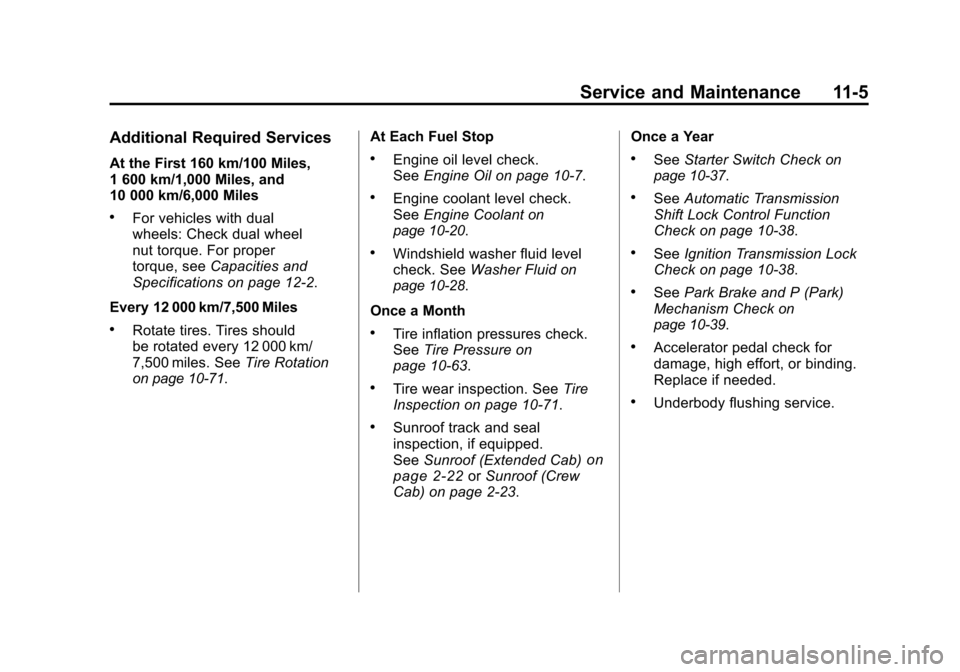
Additional Required Services
At the First 160 km/100 Miles,
1 600 km/1,000 Miles, and
10 000 km/6,000 Miles
.For vehicles with dual
wheels: Check dual wheel
nut torque. For proper
torque, seeCapacities and
Specifications on page 12‑2.
Every 12 000 km/7,500 Miles
.Rotate tires. Tires should
be rotated every 12 000 km/
7,500 miles. See Tire Rotation
on page 10‑71. At Each Fuel Stop
.Engine oil level check.
See
Engine Oil on page 10‑7.
.Engine coolant level check.
SeeEngine Coolanton
page 10‑20.
.Windshield washer fluid level
check. See Washer Fluidon
page 10‑28.
Once a Month
.Tire inflation pressures check.
See Tire Pressure on
page 10‑63.
.Tire wear inspection. See Tire
Inspection on page 10‑71.
.Sunroof track and seal
inspection, if equipped.
See Sunroof (Extended Cab)
on
page 2‑22or Sunroof (Crew
Cab) on page 2‑23. Once a Year
.See
Starter Switch Checkon
page 10‑37.
.See Automatic Transmission
Shift Lock Control Function
Check on page 10‑38.
.See Ignition Transmission Lock
Check on page 10‑38.
.See Park Brake and P (Park)
Mechanism Checkon
page 10‑39.
.Accelerator pedal check for
damage, high effort, or binding.
Replace if needed.
.Underbody flushing service.
Page 543 of 588
Black plate (7,1)Chevrolet Silverado Owner Manual - 2011
Service and Maintenance 11-7
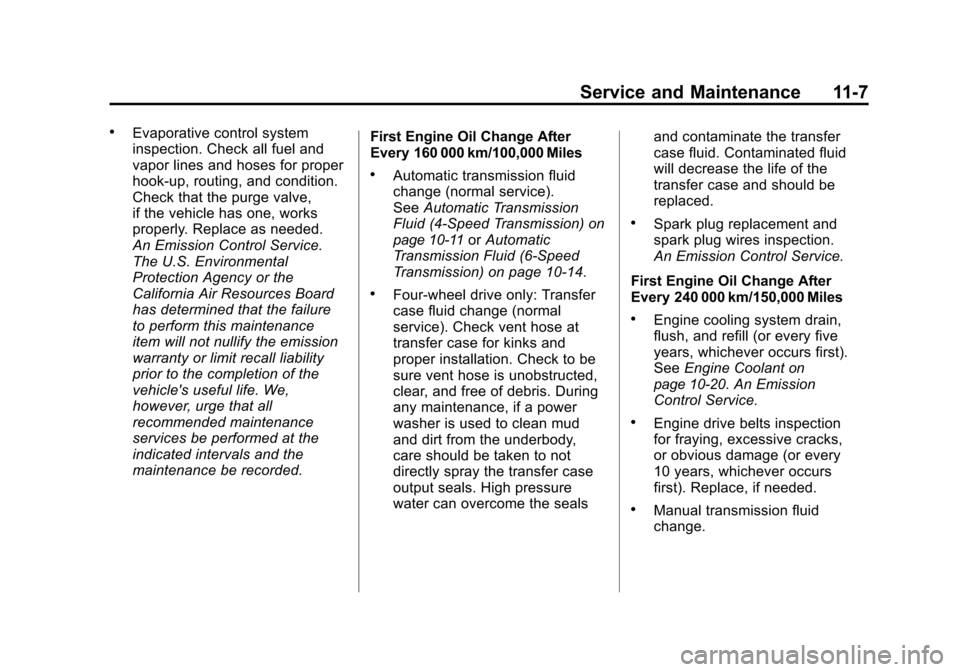
.Evaporative control system
inspection. Check all fuel and
vapor lines and hoses for proper
hook‐up, routing, and condition.
Check that the purge valve,
if the vehicle has one, works
properly. Replace as needed.
An Emission Control Service.
The U.S. Environmental
Protection Agency or the
California Air Resources Board
has determined that the failure
to perform this maintenance
item will not nullify the emission
warranty or limit recall liability
prior to the completion of the
vehicle's useful life. We,
however, urge that all
recommended maintenance
services be performed at the
indicated intervals and the
maintenance be recorded.First Engine Oil Change After
Every 160 000 km/100,000 Miles
.Automatic transmission fluid
change (normal service).
See
Automatic Transmission
Fluid (4-Speed Transmission)
on
page 10‑11or Automatic
Transmission Fluid (6-Speed
Transmission) on page 10‑14.
.Four‐wheel drive only: Transfer
case fluid change (normal
service). Check vent hose at
transfer case for kinks and
proper installation. Check to be
sure vent hose is unobstructed,
clear, and free of debris. During
any maintenance, if a power
washer is used to clean mud
and dirt from the underbody,
care should be taken to not
directly spray the transfer case
output seals. High pressure
water can overcome the seals and contaminate the transfer
case fluid. Contaminated fluid
will decrease the life of the
transfer case and should be
replaced.
.Spark plug replacement and
spark plug wires inspection.
An Emission Control Service.
First Engine Oil Change After
Every 240 000 km/150,000 Miles
.Engine cooling system drain,
flush, and refill (or every five
years, whichever occurs first).
See Engine Coolant
on
page 10‑20. An Emission
Control Service.
.Engine drive belts inspection
for fraying, excessive cracks,
or obvious damage (or every
10 years, whichever occurs
first). Replace, if needed.
.Manual transmission fluid
change.
Page 546 of 588

Black plate (10,1)Chevrolet Silverado Owner Manual - 2011
11-10 Service and Maintenance
UsageFluid/Lubricant
Transfer Case (Four‐Wheel Drive) DEXRON
®-VI Automatic Transmission Fluid.
Front Axle Propshaft Spline
or One-Piece Propshaft Spline
(Two-Wheel Drive with 4‐Speed Auto. Trans.) Spline Lubricant, Special Lubricant (GM Part No. U.S. 12345879,
in Canada 10953511).
Rear Driveline Center Spline Chassis Lubricant (GM Part No. U.S. 12377985, in Canada 88901242) or
lubricant meeting requirements of NLGI #2, Category LB or GC-LB.
Hood Hinges Multi-Purpose Lubricant, Superlube (GM Part No. U.S. 12346241,
in Canada 10953474).
Body Door Hinge Pins, Tailgate
Hinge and Linkage, Folding Seats, and Fuel Door Hinge Multi-Purpose Lubricant, Superlube (GM Part No. U.S. 12346241,
in Canada 10953474).
Tailgate Handle Pivot Points, Hinges, Latch Bolt, and Linkage Multi-Purpose Lubricant, Superlube (GM Part No. U.S. 12346241,
in Canada 10953474).
Weatherstrip Conditioning Weatherstrip Lubricant (GM Part No. U.S. 3634770, in Canada 10953518)
or Dielectric Silicone Grease (GM Part No. U.S. 12345579,
in Canada 992887).
Weatherstrip Squeaks Synthetic Grease with Teflon, Superlube (GM Part No. U.S. 12371287,
in Canada 10953437).