Page 310 of 430
Black plate (34,1)Chevrolet HHR Owner Manual - 2011
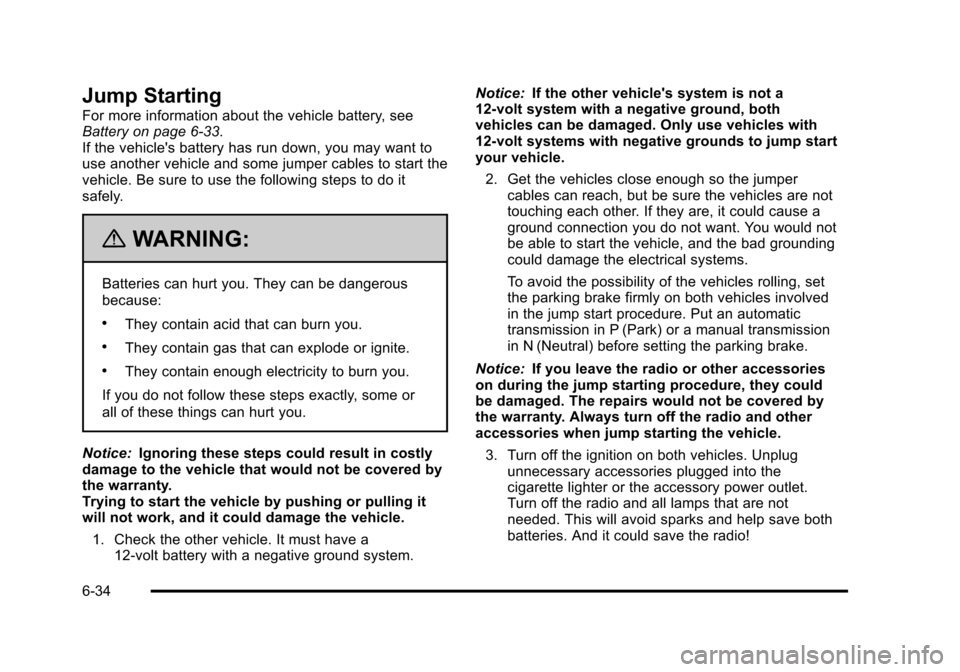
Jump Starting
For more information about the vehicle battery, see
Battery on page 6‑33.
If the vehicle's battery has run down, you may want to
use another vehicle and some jumper cables to start the
vehicle. Be sure to use the following steps to do it
safely.
{WARNING:
Batteries can hurt you. They can be dangerous
because:
.They contain acid that can burn you.
.They contain gas that can explode or ignite.
.They contain enough electricity to burn you.
If you do not follow these steps exactly, some or
all of these things can hurt you.
Notice: Ignoring these steps could result in costly
damage to the vehicle that would not be covered by
the warranty.
Trying to start the vehicle by pushing or pulling it
will not work, and it could damage the vehicle.
1. Check the other vehicle. It must have a 12-volt battery with a negative ground system. Notice:
If the other vehicle's system is not a
12-volt system with a negative ground, both
vehicles can be damaged. Only use vehicles with
12-volt systems with negative grounds to jump start
your vehicle.
2. Get the vehicles close enough so the jumper cables can reach, but be sure the vehicles are not
touching each other. If they are, it could cause a
ground connection you do not want. You would not
be able to start the vehicle, and the bad grounding
could damage the electrical systems.
To avoid the possibility of the vehicles rolling, set
the parking brake firmly on both vehicles involved
in the jump start procedure. Put an automatic
transmission in P (Park) or a manual transmission
in N (Neutral) before setting the parking brake.
Notice: If you leave the radio or other accessories
on during the jump starting procedure, they could
be damaged. The repairs would not be covered by
the warranty. Always turn off the radio and other
accessories when jump starting the vehicle.
3. Turn off the ignition on both vehicles. Unplug unnecessary accessories plugged into the
cigarette lighter or the accessory power outlet.
Turn off the radio and all lamps that are not
needed. This will avoid sparks and help save both
batteries. And it could save the radio!
6-34
Page 327 of 430

Black plate (51,1)Chevrolet HHR Owner Manual - 2011
(C) Aspect Ratio:A two‐digit number that
indicates the tire height‐to‐width measurements.
For example, if the tire size aspect ratio is 60, as
shown in item C of the illustration, it would mean
that the tire's sidewall is 60 percent as high as it
is wide.
(D) Construction Code
:A letter code is used to
indicate the type of ply construction in the tire.
The letter R means radial ply construction; the
letter D means diagonal or bias ply construction;
and the letter B means belted‐bias ply
construction.
(E) Rim Diameter
:Diameter of the wheel in
inches.
(F) Service Description
:These characters
represent the load index and speed rating of the
tire. The load index represents the load carrying
capacity a tire is certified to carry. The speed
rating is the maximum speed a tire is certified to
carry a load.
Tire Terminology and Definitions
Air Pressure:The amount of air inside the tire
pressing outward on each square inch of the tire.
Air pressure is expressed in pounds per square
inch (psi) or kilopascal (kPa).
Accessory Weight
:This means the combined
weight of optional accessories. Some examples of
optional accessories are, automatic transmission,
power steering, power brakes, power windows,
power seats, and air conditioning.
Aspect Ratio
:The relationship of a tire's height to
its width.
Belt
:A rubber coated layer of cords that is
located between the plies and the tread. Cords
may be made from steel or other reinforcing
materials.
Bead
:The tire bead contains steel wires wrapped
by steel cords that hold the tire onto the rim.
Bias Ply Tire
:A pneumatic tire in which the plies
are laid at alternate angles less than 90 degrees
to the centerline of the tread.
6-51
Page 354 of 430
Black plate (78,1)Chevrolet HHR Owner Manual - 2011
Tire Sealant and Compressor Kit
Storage
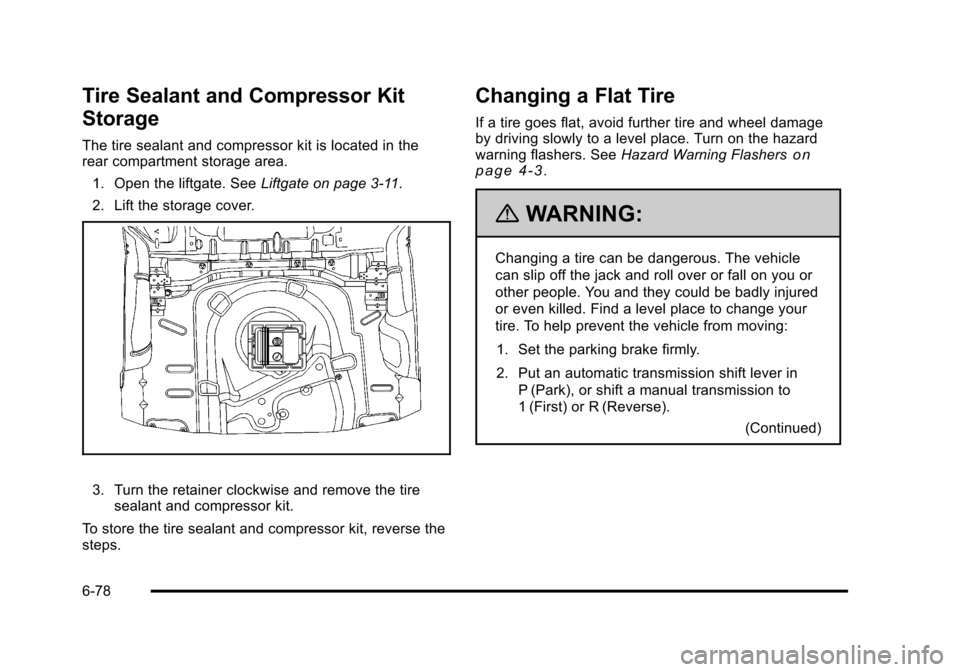
The tire sealant and compressor kit is located in the
rear compartment storage area.1. Open the liftgate. See Liftgate on page 3‑11.
2. Lift the storage cover.
3. Turn the retainer clockwise and remove the tire sealant and compressor kit.
To store the tire sealant and compressor kit, reverse the
steps.
Changing a Flat Tire
If a tire goes flat, avoid further tire and wheel damage
by driving slowly to a level place. Turn on the hazard
warning flashers. See Hazard Warning Flashers
on
page 4‑3.
{WARNING:
Changing a tire can be dangerous. The vehicle
can slip off the jack and roll over or fall on you or
other people. You and they could be badly injured
or even killed. Find a level place to change your
tire. To help prevent the vehicle from moving:
1. Set the parking brake firmly.
2. Put an automatic transmission shift lever in P (Park), or shift a manual transmission to
1 (First) or R (Reverse).
(Continued)
6-78
Page 383 of 430
Black plate (107,1)Chevrolet HHR Owner Manual - 2011
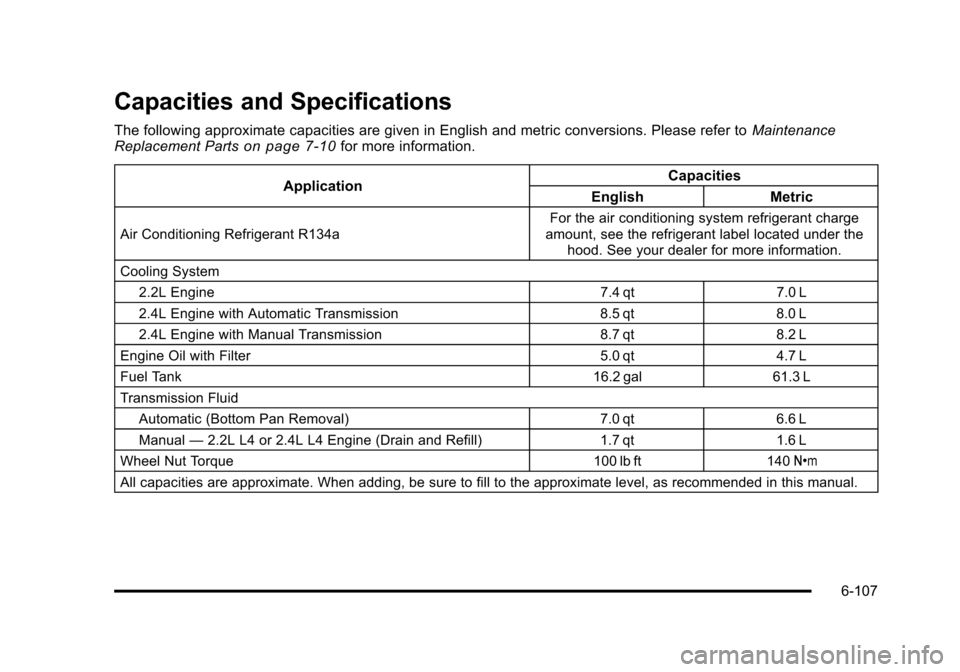
Capacities and Specifications
The following approximate capacities are given in English and metric conversions. Please refer toMaintenance
Replacement Partson page 7‑10for more information.
Application Capacities
English Metric
Air Conditioning Refrigerant R134a For the air conditioning system refrigerant charge
amount, see the refrigerant label located under the hood. See your dealer for more information.
Cooling System 2.2L Engine 7.4 qt7.0 L
2.4L Engine with Automatic Transmission 8.5 qt8.0 L
2.4L Engine with Manual Transmission 8.7 qt8.2 L
Engine Oil with Filter 5.0 qt4.7 L
Fuel Tank 16.2 gal61.3 L
Transmission Fluid
Automatic (Bottom Pan Removal) 7.0 qt6.6 L
Manual —2.2L L4 or 2.4L L4 Engine (Drain and Refill) 1.7 qt1.6 L
Wheel Nut Torque 100 lb ft140Y
All capacities are approximate. When adding, be sure to fill to the approximate level, as recommended in this manual.
6-107
Page 384 of 430
Black plate (108,1)Chevrolet HHR Owner Manual - 2011
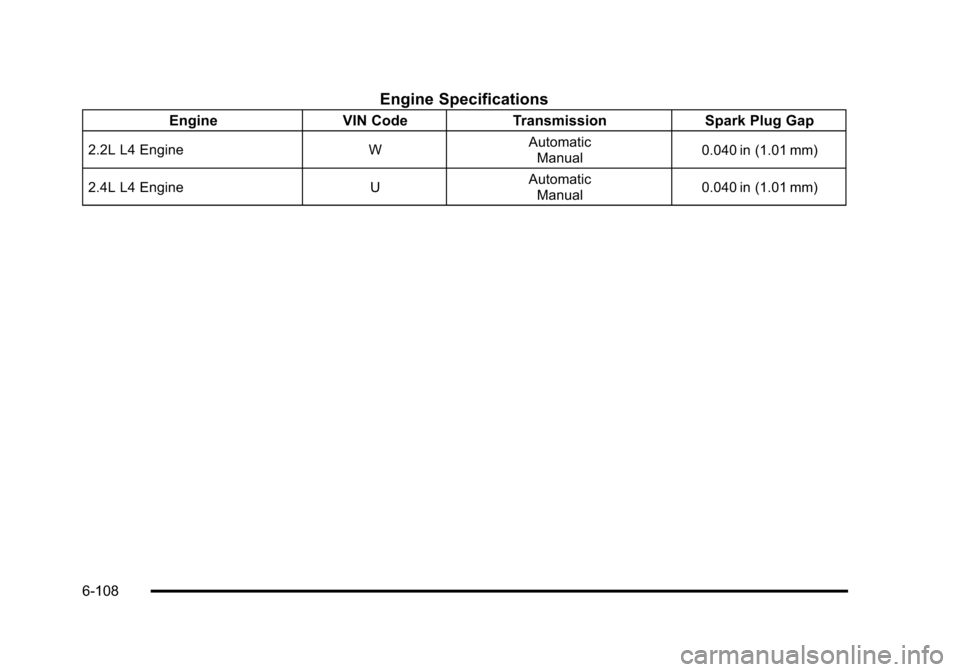
Engine Specifications
EngineVIN CodeTransmission Spark Plug Gap
2.2L L4 Engine WAutomatic
Manual 0.040 in (1.01 mm)
2.4L L4 Engine UAutomatic
Manual 0.040 in (1.01 mm)
6-108
Page 389 of 430
Black plate (5,1)Chevrolet HHR Owner Manual - 2011
Once a Year
.Starter switch check. SeeOwner Checks and
Services on page 7‑6.
.Automatic transmission shiftlock control function
check. See Owner Checks and Serviceson
page 7‑6.
.Ignition transmission lock check. See Owner
Checks and Services on page 7‑6.
.Parking brake and automatic transmission P (Park)
mechanism check. See Owner Checks and
Services on page 7‑6.
.Throttle system inspection for interference, binding
or for damaged or missing parts. Replace parts as
needed. Replace any components that have high
effort or excessive wear. Do not lubricate
accelerator or cruise control cables.
.Underbody flushing service.
First Engine Oil Change After Every
40 000 km/25,000 Miles
.Passenger compartment air filter replacement
(or every 24 months, whichever occurs first). More
frequent replacement may be needed if you drive
in areas with heavy traffic, areas with poor air
quality, or areas with high dust levels.
Replacement may also be needed if you notice
reduced air flow, windows fogging up, or odors.
Your dealer can help you determine when it is the
right time to replace the filter.
First Engine Oil Change After Every
80 000 km/50,000 Miles
.Engine air cleaner filter replacement. See Engine
Air Cleaner/Filter on page 6‑20.
.Automatic transmission fluid change (severe
service only) for vehicles mainly driven in heavy
city traffic in hot weather, in hilly or mountainous
terrain, when frequently towing a trailer, or used for
taxi, police, or delivery service. See Automatic
Transmission Fluid on page 6‑21.
7-5
Page 390 of 430
Black plate (6,1)Chevrolet HHR Owner Manual - 2011
.Evaporative control system inspection. Check all
fuel and vapor lines and hoses for proper hook‐up,
routing, and condition. Check that the purge valve,
if the vehicle has one, works properly. Replace as
needed.An Emission Control Service. The U.S.
Environmental Protection Agency or the California
Air Resources Board has determined that the
failure to perform this maintenance item will not
nullify the emission warranty or limit recall liability
prior to the completion of the vehicle's useful life.
We, however, urge that all recommended
maintenance services be performed at the
indicated intervals and the maintenance be
recorded.
First Engine Oil Change After Every
160 000 km/100,000 Miles
.Spark plug replacement and spark plug wires
inspection. An Emission Control Service.
First Engine Oil Change After Every
240 000 km/150,000 Miles
.Engine cooling system drain, flush, and refill (or
every five years, whichever occurs first). See
Engine Coolant
on page 6‑24.An Emission
Control Service.
.Engine drive belts inspection for fraying, excessive
cracks, or obvious damage (or every 10 years,
whichever occurs first). Replace, if needed.
Owner Checks and Services
Starter Switch Check
{WARNING:
When you are doing this inspection, the vehicle
could move suddenly. If the vehicle moves, you or
others could be injured.
1. Before starting this check, be sure there is enough room around the vehicle.
2. Firmly apply both the parking brake and the regular brake. See Parking Brake on page 3‑30.
Do not use the accelerator pedal, and be ready to
turn off the engine immediately if it starts.
3. For automatic transmission vehicles, try to start the engine in each gear. The starter should work only
in P (Park) or N (Neutral). If the starter works in any
other position, your vehicle needs service.
For manual transmission vehicles, put the shift
lever in Neutral, push the clutch pedal down
halfway, and try to start the engine. The starter
should work only when the clutch pedal is pushed
down all the way to the floor. If the starter works
when the clutch pedal is not pushed all the way
down, your vehicle needs service.
7-6
Page 391 of 430
Black plate (7,1)Chevrolet HHR Owner Manual - 2011
Automatic Transmission Shift Lock
Control Function Check
{WARNING:
When you are doing this inspection, the vehicle
could move suddenly. If the vehicle moves, you or
others could be injured.
1. Before starting this check, be sure there is enough room around the vehicle. It should be parked on a
level surface.
2. Firmly apply the parking brake. See Parking Brake
on page 3‑30.
Be ready to apply the regular brake immediately if
the vehicle begins to move. 3. With the engine off, turn the ignition to ON/RUN,
but do not start the engine. Without applying the
regular brake, try to move the shift lever out of
P (Park) with normal effort. If the shift lever moves
out of P (Park), contact your dealer for service.
Ignition Transmission Lock Check
While parked, and with the parking brake set, try to turn
the ignition to LOCK/OFF in each shift lever position.
.For automatic transmission vehicles, the ignition
should turn to LOCK/OFF only when the shift lever
is in P (Park). The ignition key should come out
only in LOCK/OFF.
.For manual transmission vehicles, the ignition key
should come out only in LOCK/OFF.
Turn the steering wheel to the left and to the right.
It should only lock when turned to the right.
Contact your dealer if service is required.
7-7