2011 CHEVROLET HHR maintenance
[x] Cancel search: maintenancePage 336 of 430
Black plate (60,1)Chevrolet HHR Owner Manual - 2011
8. The driver side rear turn signal comes on toindicate that corner sensor is ready to be learned.
Proceed to the driver side rear tire, and repeat the
procedure in Step 5.
9. After hearing the single horn chirp for the driver side rear tire, two additional horn chirps sound to
indicate the tire learning process is done. Turn the
ignition switch to LOCK/OFF.
If no tires are learned after entering the TPMS
learn mode, or if communication with the receiver
stops, or if the time limit has expired, turn the
ignition switch to LOCK/OFF and start over
beginning with Step 2.
10. Set all four tires to the recommended air pressure level as indicated on the Tire and Loading
Information label.
11. Put the valve caps back on the valve stems.
Tire Inspection and Rotation
We recommend that you regularly inspect your
vehicle's tires, including the spare tire, for signs of
wear or damage. See When It Is Time for New
Tires
on page 6‑62for more information. Always remove the tires if any of the following
statements are true:
.You can see the indicators at three or more
places around the tire.
.You can see cord or fabric showing through
the tire's rubber.
.The tread or sidewall is cracked, cut,
or snagged deep enough to show cord or
fabric.
.The tire has a bump, bulge, or split.
.The tire has a puncture, cut, or other damage
that cannot be repaired well because of the
size or location of the damage.
Tires should be rotated every 12 000 km
(7,500 miles). See Scheduled Maintenance
on
page 7‑3
.
The purpose of a regular tire rotation is to achieve
a uniform wear for all tires on the vehicle. This will
ensure that your vehicle continues to perform
most like it did when the tires were new.
6-60
Page 338 of 430
Black plate (62,1)Chevrolet HHR Owner Manual - 2011
When It Is Time for New Tires
Various factors, such as maintenance, temperatures,
driving speeds, vehicle loading, and road conditions
influence when you need new tires.
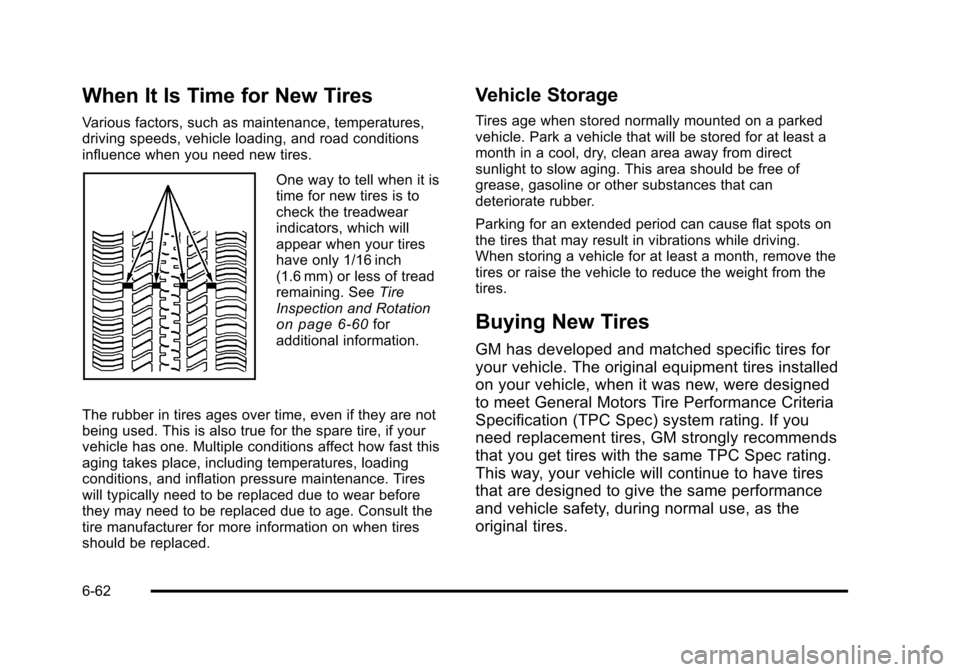
One way to tell when it is
time for new tires is to
check the treadwear
indicators, which will
appear when your tires
have only 1/16 inch
(1.6 mm) or less of tread
remaining. SeeTire
Inspection and Rotation
on page 6‑60for
additional information.
The rubber in tires ages over time, even if they are not
being used. This is also true for the spare tire, if your
vehicle has one. Multiple conditions affect how fast this
aging takes place, including temperatures, loading
conditions, and inflation pressure maintenance. Tires
will typically need to be replaced due to wear before
they may need to be replaced due to age. Consult the
tire manufacturer for more information on when tires
should be replaced.
Vehicle Storage
Tires age when stored normally mounted on a parked
vehicle. Park a vehicle that will be stored for at least a
month in a cool, dry, clean area away from direct
sunlight to slow aging. This area should be free of
grease, gasoline or other substances that can
deteriorate rubber.
Parking for an extended period can cause flat spots on
the tires that may result in vibrations while driving.
When storing a vehicle for at least a month, remove the
tires or raise the vehicle to reduce the weight from the
tires.
Buying New Tires
GM has developed and matched specific tires for
your vehicle. The original equipment tires installed
on your vehicle, when it was new, were designed
to meet General Motors Tire Performance Criteria
Specification (TPC Spec) system rating. If you
need replacement tires, GM strongly recommends
that you get tires with the same TPC Spec rating.
This way, your vehicle will continue to have tires
that are designed to give the same performance
and vehicle safety, during normal use, as the
original tires.
6-62
Page 345 of 430
Black plate (69,1)Chevrolet HHR Owner Manual - 2011
A rear blowout, particularly on a curve, acts much like a
skid and may require the same correction you would
use in a skid. In any rear blowout remove your foot from
the accelerator pedal. Get the vehicle under control by
steering the way you want the vehicle to go. It may be
very bumpy and noisy, but you can still steer. Gently
brake to a stop, well off the road, if possible.
{WARNING:
Driving on a flat tire will cause permanent damage
to the tire. Re-inflating a tire after it has been
driven on while severely under-inflated or flat may
cause a blowout and a serious crash. Never
attempt to re-inflate a tire that has been driven on
while severely under-inflated or flat. Have your
dealer or an authorized tire service center repair
or replace the flat tire as soon as possible.
{WARNING:
Lifting a vehicle and getting under it to do
maintenance or repairs is dangerous without the
appropriate safety equipment and training. If a
jack is provided with the vehicle, it is designed
only for changing a flat tire. If it is used for
anything else, you or others could be badly
injured or killed if the vehicle slips off the jack. If a
jack is provided with the vehicle, only use it for
changing a flat tire.
This vehicle may come with a jack and spare tire or a
tire sealant and compressor kit. To use the jack and
spare tire, see Changing a Flat Tire
on page 6‑78.
To use the tire sealant and compressor kit, see Tire
Sealant and Compressor Kit
on page 6‑70.
6-69
Page 374 of 430
Black plate (98,1)Chevrolet HHR Owner Manual - 2011
Tires
To clean the tires, use a stiff brush with tire cleaner.
Notice:Using petroleum-based tire dressing
products on the vehicle may damage the paint finish
and/or tires. When applying a tire dressing, always
wipe off any overspray from all painted surfaces on
the vehicle.
Sheet Metal Damage
If the vehicle is damaged and requires sheet metal
repair or replacement, make sure the body repair shop
applies anti-corrosion material to parts repaired or
replaced to restore corrosion protection.
Original manufacturer replacement parts will provide the
corrosion protection while maintaining the vehicle
warranty.
Finish Damage
Any stone chips, fractures or deep scratches in the
finish should be repaired right away. Bare metal will
corrode quickly and may develop into major repair
expense.
Minor chips and scratches can be repaired with
touch-up materials available from your dealer. Larger
areas of finish damage can be corrected in your
dealer's body and paint shop.
Underbody Maintenance
Chemicals used for ice and snow removal and dust
control can collect on the underbody. If these are not
removed, corrosion and rust can develop on the
underbody parts such as fuel lines, frame, floor pan,
and exhaust system even though they have corrosion
protection.
At least every spring, flush these materials from the
underbody with plain water. Clean any areas where
mud and debris can collect. Dirt packed in close areas
of the frame should be loosened before being flushed.
Your dealer or an underbody car washing system can
do this.
Chemical Paint Spotting
Some weather and atmospheric conditions can create a
chemical fallout. Airborne pollutants can fall upon and
attack painted surfaces on the vehicle. This damage
can take two forms: blotchy, ring-shaped discolorations,
and small, irregular dark spots etched into the paint
surface.
Although no defect in the paint job causes this, we will
repair, at no charge to the owner, the surfaces of new
vehicles damaged by this fallout condition within
12 months or 12,000 miles (20 000 km) of purchase,
whichever occurs first.
6-98
Page 383 of 430
Black plate (107,1)Chevrolet HHR Owner Manual - 2011
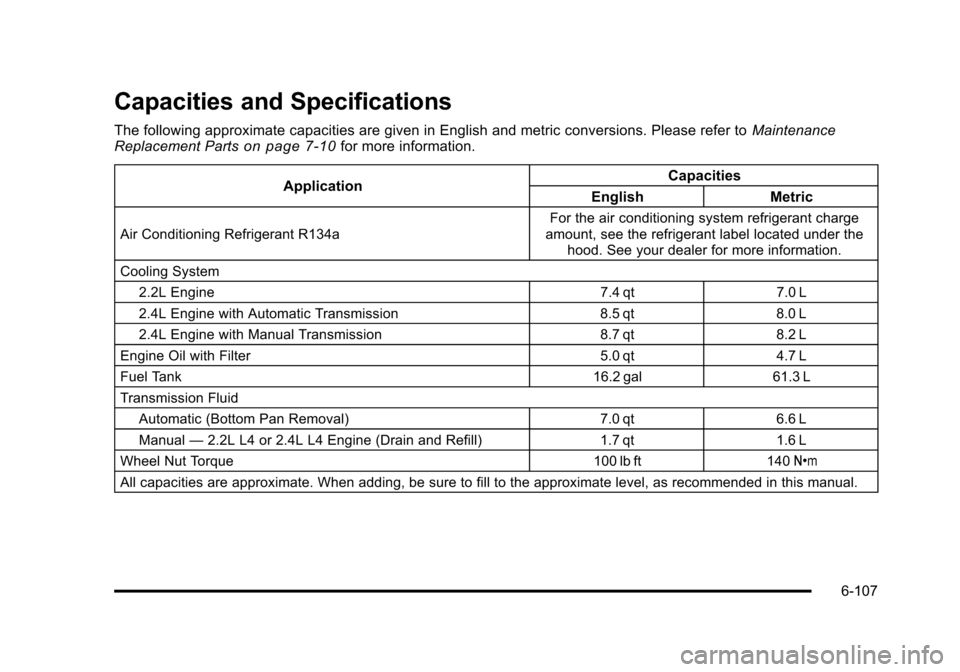
Capacities and Specifications
The following approximate capacities are given in English and metric conversions. Please refer toMaintenance
Replacement Partson page 7‑10for more information.
Application Capacities
English Metric
Air Conditioning Refrigerant R134a For the air conditioning system refrigerant charge
amount, see the refrigerant label located under the hood. See your dealer for more information.
Cooling System 2.2L Engine 7.4 qt7.0 L
2.4L Engine with Automatic Transmission 8.5 qt8.0 L
2.4L Engine with Manual Transmission 8.7 qt8.2 L
Engine Oil with Filter 5.0 qt4.7 L
Fuel Tank 16.2 gal61.3 L
Transmission Fluid
Automatic (Bottom Pan Removal) 7.0 qt6.6 L
Manual —2.2L L4 or 2.4L L4 Engine (Drain and Refill) 1.7 qt1.6 L
Wheel Nut Torque 100 lb ft140Y
All capacities are approximate. When adding, be sure to fill to the approximate level, as recommended in this manual.
6-107
Page 385 of 430

Black plate (1,1)Chevrolet HHR Owner Manual - 2011
Section 7 Maintenance Schedule
Maintenance Schedule. . . . . . . . . . . . . . . . . . . . . . . . . . . . 7-2
Introduction . . . . . . . . . . . . . . . . . . . . . . . . . . . . . . . . . . . . . 7-2
Scheduled Maintenance . . . . . . . . . . . . . . . . . . . . . . . . 7-3
Owner Checks and Services . . . . . . . . . . . . . . . . . . . . 7-6 Recommended Fluids and Lubricants . . . . . . . . . . . 7-8
Maintenance Replacement Parts . . . . . . . . . . . . . . 7-10
Engine Drive Belt Routing . . . . . . . . . . . . . . . . . . . . . . 7-11
Maintenance Record . . . . . . . . . . . . . . . . . . . . . . . . . . . 7-12
7-1
Page 386 of 430
Black plate (2,1)Chevrolet HHR Owner Manual - 2011
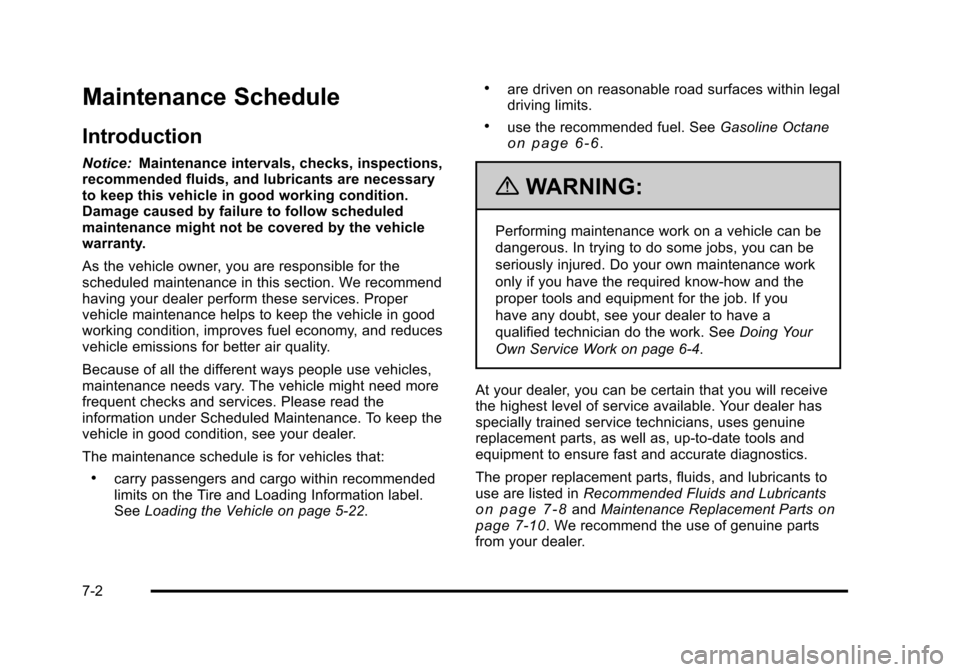
Maintenance Schedule
Introduction
Notice:Maintenance intervals, checks, inspections,
recommended fluids, and lubricants are necessary
to keep this vehicle in good working condition.
Damage caused by failure to follow scheduled
maintenance might not be covered by the vehicle
warranty.
As the vehicle owner, you are responsible for the
scheduled maintenance in this section. We recommend
having your dealer perform these services. Proper
vehicle maintenance helps to keep the vehicle in good
working condition, improves fuel economy, and reduces
vehicle emissions for better air quality.
Because of all the different ways people use vehicles,
maintenance needs vary. The vehicle might need more
frequent checks and services. Please read the
information under Scheduled Maintenance. To keep the
vehicle in good condition, see your dealer.
The maintenance schedule is for vehicles that:
.carry passengers and cargo within recommended
limits on the Tire and Loading Information label.
See Loading the Vehicle on page 5‑22.
.are driven on reasonable road surfaces within legal
driving limits.
.use the recommended fuel. See Gasoline Octaneon page 6‑6.
{WARNING:
Performing maintenance work on a vehicle can be
dangerous. In trying to do some jobs, you can be
seriously injured. Do your own maintenance work
only if you have the required know-how and the
proper tools and equipment for the job. If you
have any doubt, see your dealer to have a
qualified technician do the work. See Doing Your
Own Service Work on page 6‑4.
At your dealer, you can be certain that you will receive
the highest level of service available. Your dealer has
specially trained service technicians, uses genuine
replacement parts, as well as, up‐to‐date tools and
equipment to ensure fast and accurate diagnostics.
The proper replacement parts, fluids, and lubricants to
use are listed in Recommended Fluids and Lubricants
on page 7‑8andMaintenance Replacement Partson
page 7‑10. We recommend the use of genuine parts
from your dealer.
7-2
Page 387 of 430
Black plate (3,1)Chevrolet HHR Owner Manual - 2011
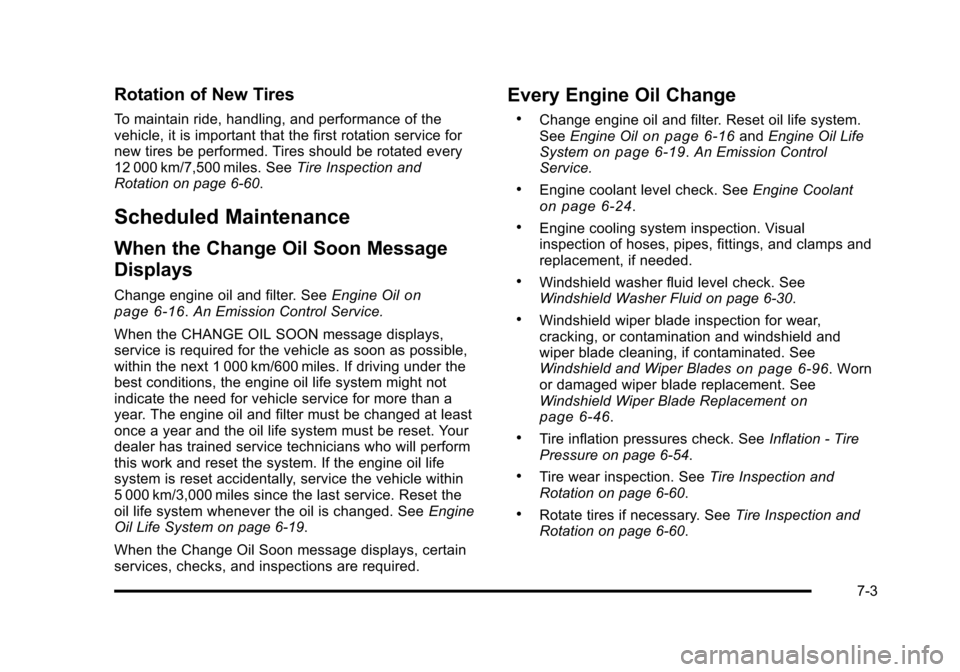
Rotation of New Tires
To maintain ride, handling, and performance of the
vehicle, it is important that the first rotation service for
new tires be performed. Tires should be rotated every
12 000 km/7,500 miles. SeeTire Inspection and
Rotation on page 6‑60.
Scheduled Maintenance
When the Change Oil Soon Message
Displays
Change engine oil and filter. See Engine Oilon
page 6‑16. An Emission Control Service.
When the CHANGE OIL SOON message displays,
service is required for the vehicle as soon as possible,
within the next 1 000 km/600 miles. If driving under the
best conditions, the engine oil life system might not
indicate the need for vehicle service for more than a
year. The engine oil and filter must be changed at least
once a year and the oil life system must be reset. Your
dealer has trained service technicians who will perform
this work and reset the system. If the engine oil life
system is reset accidentally, service the vehicle within
5 000 km/3,000 miles since the last service. Reset the
oil life system whenever the oil is changed. See Engine
Oil Life System on page 6‑19.
When the Change Oil Soon message displays, certain
services, checks, and inspections are required.
Every Engine Oil Change
.Change engine oil and filter. Reset oil life system.
See Engine Oilon page 6‑16andEngine Oil Life
Systemon page 6‑19. An Emission Control
Service.
.Engine coolant level check. See Engine Coolanton page 6‑24.
.Engine cooling system inspection. Visual
inspection of hoses, pipes, fittings, and clamps and
replacement, if needed.
.Windshield washer fluid level check. See
Windshield Washer Fluid on page 6‑30.
.Windshield wiper blade inspection for wear,
cracking, or contamination and windshield and
wiper blade cleaning, if contaminated. See
Windshield and Wiper Blades
on page 6‑96. Worn
or damaged wiper blade replacement. See
Windshield Wiper Blade Replacement
on
page 6‑46.
.Tire inflation pressures check. See Inflation - Tire
Pressure on page 6‑54.
.Tire wear inspection. See Tire Inspection and
Rotation on page 6‑60.
.Rotate tires if necessary. See Tire Inspection and
Rotation on page 6‑60.
7-3