2011 CHEVROLET HHR tow
[x] Cancel search: towPage 81 of 430
Black plate (49,1)Chevrolet HHR Owner Manual - 2011
Notice:Do not let the LATCH attachments rub
against the vehicle’ s safety belts. This may damage
these parts. If necessary, move buckled safety belts
to avoid rubbing the LATCH attachments.
Do not fold the empty rear seat with a safety belt
buckled. This could damage the safety belt or the
seat. Unbuckle and return the safety belt to its
stowed position, before folding the seat.
1. Attach and tighten the lower attachments to the lower anchors. If the child restraint does not have
lower attachments or the desired seating position
does not have lower anchors, secure the child
restraint with the top tether and the safety belts.
Refer to your child restraint manufacturer
instructions and the instructions in this manual.
1. 1. Find the lower anchors for the desired seating position.
1. 2. Put the child restraint on the seat.
1. 3. Attach and tighten the lower attachments on the child restraint to the lower anchors. 2. If the child restraint manufacturer recommends that
the top tether be attached, attach and tighten the
top tether to the top tether anchor, if equipped.
Refer to the child restraint instructions and the
following steps:
2. 1. To secure a child restraint in the rear center
seating position, find the storage
compartment behind the rear seats. You may
have to fold back the cargo mat to access the
storage compartment and the top tether
anchor.
Lift the lid of the storage compartment to
access the top tether anchor for the rear
center seating position.
2. 2. To secure a child restraint in the rear outboard seating positions, find the top tether
anchor located on the cargo floor behind the
rear seats.
Be sure to use an anchor located on the
same side of the vehicle as the seating
position where the child restraint will be
placed.
2-49
Page 86 of 430
Black plate (54,1)Chevrolet HHR Owner Manual - 2011
6. If the child restraint has a top tether, follow thechild restraint manufacturer's instructions regarding
the use of the top tether. See Lower Anchors and
Tethers for Children (LATCH)
on page 2‑43for
more information.
7. Before placing a child in the child restraint, make sure it is securely held in place. To check, grasp
the child restraint at the safety belt path and
attempt to move it side‐to‐side and back‐and‐forth.
When the child restraint is properly installed, there
should be no more than 2.5 cm (1 in) of movement.
To remove the child restraint, unbuckle the vehicle
safety belt and let it return to the stowed position. If the
top tether is attached to a top tether anchor,
disconnect it.
Securing a Child Restraint in the
Right Front Seat Position
This vehicle has airbags. A rear seat is a safer place to
secure a forward-facing child restraint. See Where to
Put the Restraint on page 2‑42.
In addition, the vehicle may have a passenger sensing
system which is designed to turn off the right front
passenger frontal airbag under certain conditions. See
Passenger Sensing System
on page 2‑66and
Passenger Airbag Status Indicatoron page 4‑27for
more information, including important safety information.
2-54
Page 90 of 430
Black plate (58,1)Chevrolet HHR Owner Manual - 2011
7. If the vehicle does not have a rear seat and yourchild restraint has a top tether, follow the child
restraint manufacturer's instructions regarding the
use of the top tether. See Lower Anchors and
Tethers for Children (LATCH)
on page 2‑43for
more information.
8. Before placing a child in the child restraint, make sure it is securely held in place. To check, grasp
the child restraint at the safety belt path and
attempt to move it side‐to‐side and back‐and‐forth.
When the child restraint is properly installed, there
should be no more than 2.5 cm (1 in) of movement.
If the vehicle is equipped with the passenger sensing
system, and the passenger sensing system has turned
off the right front passenger frontal airbag, the off
indicator on the passenger airbag status indicator
should light and say lit when you start the vehicle.
If a child restraint has been installed and the on
indicator is lit, see “If the On Indicator is Lit for a Child
Restraint” underPassenger Sensing System
on
page 2‑66for more information.
To remove the child restraint, unbuckle the vehicle
safety belt and let it return to the stowed position. If the
top tether is attached to a top tether anchor,
disconnect it.
Airbag System
The vehicle has the following airbags:
.A frontal airbag for the driver.
.A frontal airbag for the right front passenger.
The vehicle may have the following airbags:
.A roof-rail airbag for the driver and the passenger
seated directly behind the driver.
.A roof-rail airbag for the right front passenger and
the passenger seated directly behind that
passenger.
All of the airbags in your vehicle will have the word
AIRBAG embossed in the trim or on an attached label
near the deployment opening.
For frontal airbags, the word AIRBAG will appear on the
middle part of the steering wheel for the driver and on
the instrument panel for the right front passenger.
With roof-rail airbags, the word AIRBAG will appear
along the headliner or trim.
Even if you do not have a right front passenger seat in
your vehicle there is still an active frontal airbag in the
right side of the instrument panel. Do not place cargo in
front of this airbag.
2-58
Page 91 of 430
Black plate (59,1)Chevrolet HHR Owner Manual - 2011
{WARNING:
Be sure that cargo is not near an airbag. In a
crash, an inflating airbag might force that object
toward a person. This could cause severe injury
or even death. Secure objects away from the area
in which an airbag would inflate. For more
information, seeWhere Are the Airbags?
on
page 2‑61
and Loading the Vehicleon
page 5‑22
.
Airbags are designed to supplement the protection
provided by safety belts. Even though today's airbags
are also designed to help reduce the risk of injury from
the force of an inflating bag, all airbags must inflate very
quickly to do their job. Here are the most important things to know about the
airbag system:
{WARNING:
You can be severely injured or killed in a crash if
you are not wearing your safety belt
—even if you
have airbags. Airbags are designed to work with
safety belts, but do not replace them. Also,
airbags are not designed to deploy in every crash.
In some crashes safety belts are your only
restraint. See When Should an Airbag Inflate?
on
page 2‑63
.
Wearing your safety belt during a crash helps
reduce your chance of hitting things inside the
vehicle or being ejected from it. Airbags are
“supplemental restraints” to the safety belts.
Everyone in your vehicle should wear a safety belt
properly —whether or not there is an airbag for
that person.
2-59
Page 96 of 430
Black plate (64,1)Chevrolet HHR Owner Manual - 2011
In any particular crash, no one can say whether an
airbag should have inflated simply because of the
damage to a vehicle or because of what the repair costs
were. For frontal airbags, inflation is determined by what
the vehicle hits, the angle of the impact, and how
quickly the vehicle slows down. For roof-rail airbags,
deployment is determined by the location and severity
of the side impact. In a rollover event, roof-rail airbag
deployment is determined by the direction of the roll.
What Makes an Airbag Inflate?
In a deployment event, the sensing system sends an
electrical signal triggering a release of gas from the
inflator. Gas from the inflator fills the airbag causing the
bag to break out of the cover and deploy. The inflator,
the airbag, and related hardware are all part of the
airbag module.
Frontal airbag modules are located inside the steering
wheel and instrument panel. For vehicles with roof-rail
airbags, there are airbag modules in the ceiling of the
vehicle, near the side windows that have occupant
seating positions.
How Does an Airbag Restrain?
In moderate to severe frontal or near frontal collisions,
even belted occupants can contact the steering wheel
or the instrument panel. In moderate to severe side
collisions, even belted occupants can contact the inside
of the vehicle.
Airbags supplement the protection provided by safety
belts. Frontal airbags distribute the force of the impact
more evenly over the occupant's upper body, stopping
the occupant more gradually. Roof-rail airbags distribute
the force of the impact more evenly over the occupant's
upper body.
Rollover capable roof-rail airbags are designed to help
contain the head and chest of occupants in the
outboard seating positions in the first and second rows.
The rollover capable roof-rail airbags are designed to
help reduce the risk of full or partial ejection in rollover
events, although no system can prevent all such
ejections.
But airbags would not help in many types of collisions,
primarily because the occupant's motion is not toward
those airbags. SeeWhen Should an Airbag Inflate?
on
page 2‑63for more information.
Airbags should never be regarded as anything more
than a supplement to safety belts.
2-64
Page 103 of 430
Black plate (71,1)Chevrolet HHR Owner Manual - 2011
Additional Factors Affecting System
Operation
Safety belts help keep the passenger in position on the
seat during vehicle maneuvers and braking, which helps
the passenger sensing system maintain the passenger
airbag status. See“Safety Belts”and“Child Restraints”
in the Index for additional information about the
importance of proper restraint use.
A thick layer of additional material, such as a blanket or
cushion, or aftermarket equipment such as seat covers,
seat heaters, and seat massagers can affect how well
the passenger sensing system operates. We
recommend that you not use seat covers or other
aftermarket equipment except when approved by GM
for your specific vehicle. See Adding Equipment to Your
Airbag-Equipped Vehicle
on page 2‑72for more
information about modifications that can affect how the
system operates.
A wet seat can affect the performance of the passenger
sensing system. Here is how:
.The passenger sensing system may turn off the
passenger airbag when liquid is soaked into the
seat. If this happens, the off indicator will be lit,
and the airbag readiness light on the instrument
panel will also be lit.
.Liquid pooled on the seat that has not soaked in
may make it more likely that the passenger
sensing system will enable (turn on) the passenger
airbag while a child restraint or child occupant is on
the seat. If the passenger airbag is turned on, the
on indicator will be lit.
If the passenger seat gets wet, dry the seat
immediately. If the airbag readiness light is lit, do not
install a child restraint or allow anyone to occupy the
seat. See Airbag Readiness Light
on page 4‑26for
important safety information.
The on indicator may be lit if an object, such as a
briefcase, handbag, grocery bag, laptop or other
electronic device, is put on an unoccupied seat. If this is
not desired, remove the object from the seat.
{WARNING:
Stowing of articles under the passenger seat or
between the passenger seat cushion and
seatback may interfere with the proper operation
of the passenger sensing system.
2-71
Page 126 of 430
Black plate (20,1)Chevrolet HHR Owner Manual - 2011
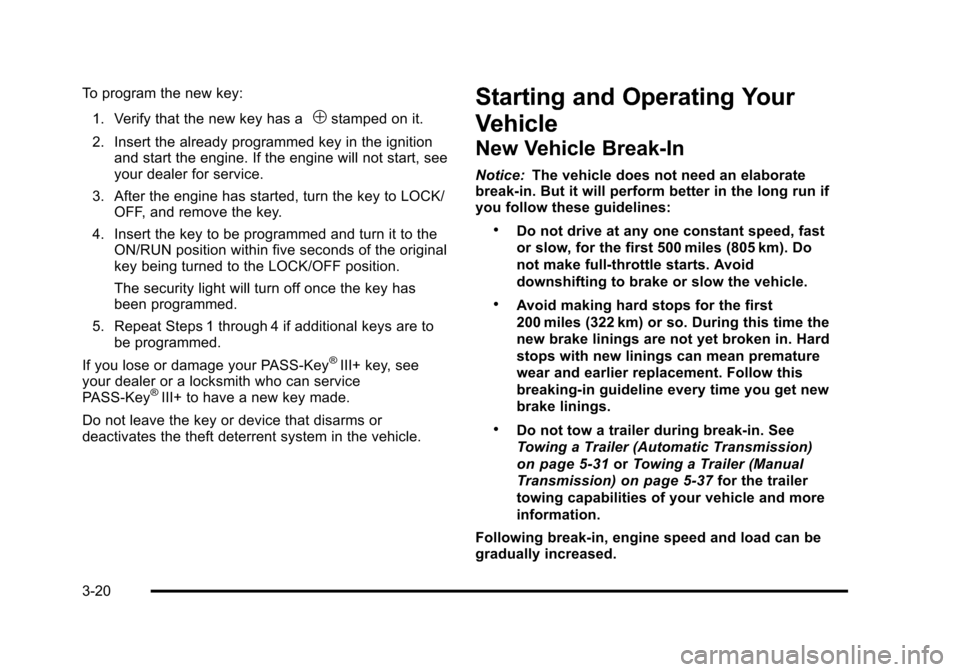
To program the new key:1. Verify that the new key has a
1stamped on it.
2. Insert the already programmed key in the ignition and start the engine. If the engine will not start, see
your dealer for service.
3. After the engine has started, turn the key to LOCK/ OFF, and remove the key.
4. Insert the key to be programmed and turn it to the ON/RUN position within five seconds of the original
key being turned to the LOCK/OFF position.
The security light will turn off once the key has
been programmed.
5. Repeat Steps 1 through 4 if additional keys are to be programmed.
If you lose or damage your PASS-Key
®III+ key, see
your dealer or a locksmith who can service
PASS-Key
®III+ to have a new key made.
Do not leave the key or device that disarms or
deactivates the theft deterrent system in the vehicle.
Starting and Operating Your
Vehicle
New Vehicle Break-In
Notice: The vehicle does not need an elaborate
break-in. But it will perform better in the long run if
you follow these guidelines:
.Do not drive at any one constant speed, fast
or slow, for the first 500 miles (805 km). Do
not make full-throttle starts. Avoid
downshifting to brake or slow the vehicle.
.Avoid making hard stops for the first
200 miles (322 km) or so. During this time the
new brake linings are not yet broken in. Hard
stops with new linings can mean premature
wear and earlier replacement. Follow this
breaking-in guideline every time you get new
brake linings.
.Do not tow a trailer during break-in. See
Towing a Trailer (Automatic Transmission)
on page 5‑31or Towing a Trailer (Manual
Transmission)
on page 5‑37for the trailer
towing capabilities of your vehicle and more
information.
Following break‐in, engine speed and load can be
gradually increased.
3-20
Page 133 of 430
Black plate (27,1)Chevrolet HHR Owner Manual - 2011
WARNING: (Continued)
Do not leave the vehicle when the engine is
running unless you have to. If you have left the
engine running, the vehicle can move suddenly.
You or others could be injured. To be sure the
vehicle will not move, even when you are on fairly
level ground, always set the parking brake and
move the shift lever to P (Park). SeeShifting Into
Park (Automatic Transmission)
on page 3‑31.
If you are pulling a trailer, see Towing a Trailer
(Automatic Transmission)
on page 5‑31or
Towing a Trailer (Manual Transmission)
on
page 5‑37
.
Make sure the shift lever is fully in P (Park) before
starting the engine. The vehicle has an automatic
transmission shift lock control system. You have to fully
apply the regular brakes first and then press the shift
lever button before the vehicle can shift from P (Park)
when the ignition key is in ON/RUN. If the vehicle
cannot shift out of P (Park), ease pressure on the shift
lever and push the shift lever all the way into P (Park)
as you maintain brake application. Then press the shift
lever button and then move the shift lever into another
gear. See Shifting Out of Park (Automatic Transmission)
on page 3‑33. R (Reverse):
Use this gear to back up.
Notice: Shifting to R (Reverse) while the vehicle is
moving forward could damage the transmission.
The repairs would not be covered by the vehicle
warranty. Shift to R (Reverse) only after the vehicle
is stopped.
To rock your vehicle back and forth to get out of snow,
ice, or sand without damaging the transmission, see If
Your Vehicle is Stuck in Sand, Mud, Ice, or Snow
on
page 5‑21.
N (Neutral): In this position, the engine does not
connect with the wheels. To restart the engine when the
vehicle is already moving, use N (Neutral) only. Also,
use N (Neutral) when the vehicle is being towed.
{WARNING:
Shifting into a drive gear while the engine is
running at high speed is dangerous. Unless your
foot is firmly on the brake pedal, the vehicle could
move very rapidly. You could lose control and hit
people or objects. Do not shift into a drive gear
while the engine is running at high speed.
3-27