2011 CHEVROLET CORVETTE fuel
[x] Cancel search: fuelPage 243 of 428
Black plate (13,1)Chevrolet Corvette Owner Manual - 2011
Driving and Operating 9-13
Run the engine for short periods
only as needed to keep warm, but
be careful.
To save fuel, run the engine for only
short periods as needed to warm
the vehicle and then shut the engine
off and close the window most of
the way to save heat. Repeat this
until help arrives but only when you
feel really uncomfortable from the
cold. Moving about to keep warm
also helps.
If it takes some time for help to
arrive, now and then when you run
the engine, push the accelerator
pedal slightly so the engine
runs faster than the idle speed.
This keeps the battery charged to
restart the vehicle and to signal for
help with the headlamps. Do this
as little as possible to save fuel.If the Vehicle is Stuck
Slowly and cautiously spin the
wheels to free the vehicle when
stuck in sand, mud, ice, or snow.
If stuck too severely for the traction
system to free the vehicle, turn the
traction system off and use the
rocking method.
{WARNING
If the vehicle's tires spin at high
speed, they can explode, and
you or others could be injured.
The vehicle can overheat,
causing an engine compartment
fire or other damage. Spin the
wheels as little as possible and
avoid going above 55 km/h
(35 mph) as shown on the
speedometer.
For information about using tire
chains on the vehicle, see Tire
Chains on page 10‑80.
Rocking the Vehicle to Get
it Out
Turn the steering wheel left and
right to clear the area around
the front wheels. Turn off any
traction system. Shift back and forth
between R (Reverse) and a forward
gear, or with a manual transmission,
between 1 (First) or 2 (Second) and
R (Reverse), spinning the wheels
as little as possible. To prevent
transmission wear, wait until the
wheels stop spinning before shifting
gears. Release the accelerator
pedal while shifting, and press
lightly on the accelerator pedal
when the transmission is in gear.
Slowly spinning the wheels in the
forward and reverse directions
causes a rocking motion that could
free the vehicle. If that does not
get the vehicle out after a few
tries, it might need to be towed out.
If the vehicle does need to be towed
out, see Towing the Vehicle on
page 10‑86.
Page 247 of 428
Black plate (17,1)Chevrolet Corvette Owner Manual - 2011
Driving and Operating 9-17
Refer to your vehicle's Tire and
Loading Information label for
specific information about your
vehicle's capacity weight and
seating positions. The combined
weight of the driver, passengers
and cargo should never exceed
your vehicle's capacity weight.
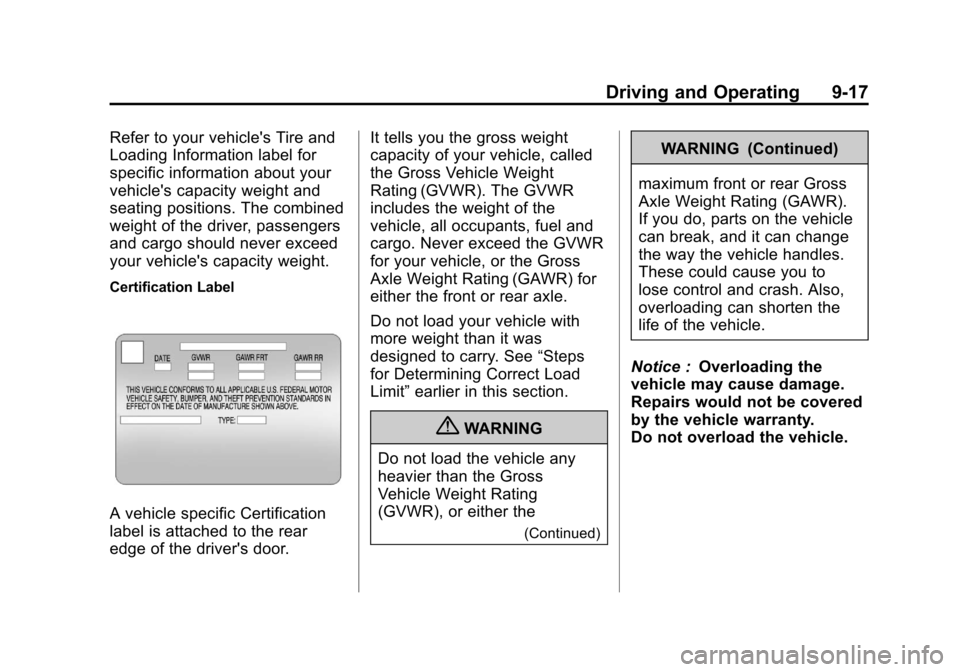
Certification Label
A vehicle specific Certification
label is attached to the rear
edge of the driver's door.It tells you the gross weight
capacity of your vehicle, called
the Gross Vehicle Weight
Rating (GVWR). The GVWR
includes the weight of the
vehicle, all occupants, fuel and
cargo. Never exceed the GVWR
for your vehicle, or the Gross
Axle Weight Rating (GAWR) for
either the front or rear axle.
Do not load your vehicle with
more weight than it was
designed to carry. See
“Steps
for Determining Correct Load
Limit” earlier in this section.
{WARNING
Do not load the vehicle any
heavier than the Gross
Vehicle Weight Rating
(GVWR), or either the
(Continued)
WARNING (Continued)
maximum front or rear Gross
Axle Weight Rating (GAWR).
If you do, parts on the vehicle
can break, and it can change
the way the vehicle handles.
These could cause you to
lose control and crash. Also,
overloading can shorten the
life of the vehicle.
Notice : Overloading the
vehicle may cause damage.
Repairs would not be covered
by the vehicle warranty.
Do not overload the vehicle.
Page 249 of 428
Black plate (19,1)Chevrolet Corvette Owner Manual - 2011
Driving and Operating 9-19
For the first 80 km (500 miles):
.Avoid full throttle starts and
abrupt stops.
.Do not exceed 4,000 rpm.
.Avoid driving at any one
constant speed, fast or slow,
including the use of cruise
control.
.Avoid downshifting to brake
or slow the vehicle when the
engine speed will exceed
4000 rpm.
.Do not let the engine labor.
Never lug the engine in high
gear at low speeds. With a
manual transmission, shift to
the next lower gear. This rule
applies at all times, not just
during the break-in period.For the first 2 414 km (1,500 miles):
.Do not participate in track
events, sport driving schools,
or similar activities during the
first 2 414 km (1,500 miles).
.Check engine oil with every
refueling and add if necessary.
Oil and fuel consumption may be
higher than normal during the
first 2 414 km (1,500 miles).
Front Air Dam
The vehicle is equipped with a front
air dam which has minimal ground
clearance.
Vehicles with the ZR-1 package,
or Z‐06 vehicles with RPO ULZ,
also come with a splitter made from
carbon fiber.
{WARNING
ZR‐1s, and Z‐06s with RPO ULZ,
contain parts made from carbon
fiber.
(Continued)
WARNING (Continued)
When damaged, the exposed
edges can be very sharp.
A person could be injured
by these sharp edges. Use
caution when washing the
vehicle, coming in contact with,
or removing damaged carbon
fiber parts. See your dealer for
replacement.
Under normal operation, these
components will occasionally
contact some road surfaces
(speed bumps, driveway
ramps, etc.). This can be heard
inside the vehicle as a scraping
noise. This is normal and does
not indicate a problem.
Use care when approaching bumps
or objects on road surfaces and
avoid them when possible.
Page 259 of 428
Black plate (29,1)Chevrolet Corvette Owner Manual - 2011
Driving and Operating 9-29
N (Neutral) only. If the vehicle needs
towing, seeTowing the Vehicle on
page 10‑86.
{WARNING
Shifting into a drive gear while the
engine is running at high speed is
dangerous. Unless your foot is
firmly on the brake pedal, the
vehicle could move very rapidly.
You could lose control and hit
people or objects. Do not shift
into a drive gear while the engine
is running at high speed.
Notice: Shifting out of P (Park)
or N (Neutral) with the engine
running at high speed may
damage the transmission.
The repairs would not be covered
by the vehicle warranty. Be sure
the engine is not running at high
speed when shifting the vehicle.
D (Drive): This position is for
normal driving. It provides the best
fuel economy. If you need more power for passing, push the pedal
down to achieve the desired level
of acceleration.
Downshifting the transmission in
slippery road conditions could result
in skidding. See
“Skidding”under
Loss of Control on page 9‑6.
S (Sport Mode): When in
S (Sport Mode), the transmission
will work as an automatic until
you use the Manual Paddle Shift
Controls, which activates driver
manual gear selection. See “Manual
Paddle Shift” in this section. While
in S (Sport Mode), the transmission
will have more noticeable upshifts
for sportier vehicle performance.
Manual Mode
Manual Paddle Shift
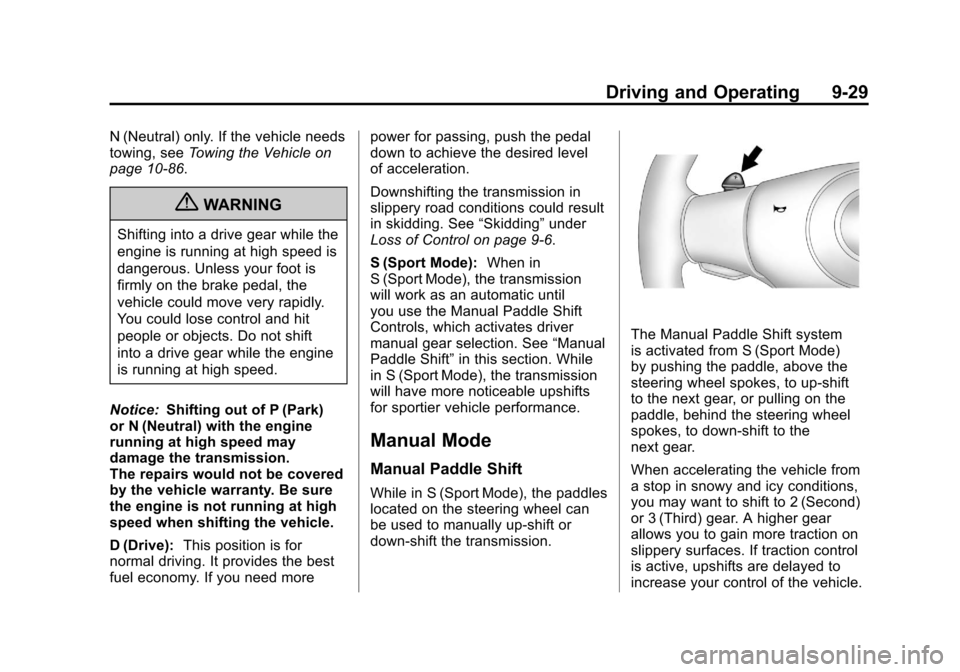
While in S (Sport Mode), the paddles
located on the steering wheel can
be used to manually up-shift or
down-shift the transmission.
The Manual Paddle Shift system
is activated from S (Sport Mode)
by pushing the paddle, above the
steering wheel spokes, to up-shift
to the next gear, or pulling on the
paddle, behind the steering wheel
spokes, to down-shift to the
next gear.
When accelerating the vehicle from
a stop in snowy and icy conditions,
you may want to shift to 2 (Second)
or 3 (Third) gear. A higher gear
allows you to gain more traction on
slippery surfaces. If traction control
is active, upshifts are delayed to
increase your control of the vehicle.
Page 261 of 428
Black plate (31,1)Chevrolet Corvette Owner Manual - 2011
Driving and Operating 9-31
If the vehicle has a HUD, and the
transmission gear does not respond
to a shift change, a chime will sound
and the HUD will momentarily show
an X over the gear display.
Manual Paddle Shift operation
is available for use with Cruise
Control. SeeCruise Control on
page 9‑44 Cruise Control for more
information.
The vehicle speeds required for
Manual Paddle Shift up-shifts
depend on several vehicle inputs,
which will vary the allowed up-shift
speed by a few km/h (mph).
For vehicles with a 2.56:1 Axle
Ratio (RPO GM8)
.Up-shifts to 4 (Fourth) gear
require approximately 35 km/h
(22 mph).
.Up-shifts to 5 (Fifth) gear require
approximately 45 km/h (28 mph).
.Up-shifts to 6 (Sixth) gear
require approximately 65 km/h
(41 mph). To prevent damage to the
powertrain, Manual Paddle
downshifts to a lower gear cannot
be done above certain speeds.
The maximum speed allowed for
downshifting of gears 1 (First)
through 4 (Fourth) are:
.Into 4 (Fourth) gear over
250 km/h (155 mph)
.Into 3 (Third) gear over
188 km/h (117 mph)
.Into 2 (Second) gear over
120 km/h (75 mph)
.Into 1 (First) gear over
68 km/h (42 mph).
For vehicles with a 2.73:1 Axle
Ratio (RPO GU2)
.Up-shifts to 4 (Fourth) gear
require approximately 31 km/h
(19 mph).
.Up-shifts to 5 (Fifth) gear require
approximately 39 km/h (24 mph).
.Up-shifts to 6 (Sixth) gear
require approximately
57 km/h (35 mph). To prevent damage to the
powertrain, Manual Paddle
downshifts to a lower gear cannot
be done above certain speeds.
The maximum speed allowed for
downshifting of gears 1 (First)
through 4 (Fourth) are:
.Into 4 (Fourth) gear over
234 km/h (145 mph)
.Into 3 (Third) gear over
176 km/h (109 mph)
.Into 2 (Second) gear over
113 km/h (70 mph)
.Into 1 (First) gear over
64 km/h (40 mph).
If the driver does not request
an upshift as the engine speed
approaches fuel shut off RPM,
the engine speed will be limited to
protect the engine. See Tachometer
on page 5‑11 Tachometer for more
information.
Page 263 of 428
Black plate (33,1)Chevrolet Corvette Owner Manual - 2011
Driving and Operating 9-33
Shift Speeds
(Manual Transmission)
{WARNING
If you skip a gear when you
downshift, you could lose control
of the vehicle. You could injure
yourself or others. Do not shift
down more than one gear at a
time when you downshift.
This chart shows when to shift to
the next higher gear for the best fuel
economy. Manual Transmission Recommended
Shift Speeds in km/h (mph)
Engine Acceleration Shift Speed
1 to 2 2 to 3 3 to 4 4 to 5 5 to 6
All Engines 24 (15) 40 (25) 64 (40) 72 (45) 80 (50)
If the engine speed drops below
900 rpm, or if the engine is not
running smoothly, you should
downshift to the next lower gear.
You may have to downshift two
or more gears to keep the engine
running smoothly or for good engine
performance.
Notice: When shifting gears, do
not move the shift lever around
unnecessarily. This may damage
the transmission. Shift directly
into the next gear.
One to Four Shift Light
(Manual Transmission)
When this light comes on, you can
only shift from 1 (First) to 4 (Fourth)
instead of 1 (First) to 2 (Second).
See One-to-Four Shift Light (Manual
Transmission) on page 5‑22 for
more information.
Page 278 of 428
Black plate (48,1)Chevrolet Corvette Owner Manual - 2011
9-48 Driving and Operating
Fuel
Use of the recommended fuel
is an important part of the proper
maintenance of this vehicle. To help
keep the engine clean and maintain
optimum vehicle performance, we
recommend the use of gasoline
advertised as TOP TIER Detergent
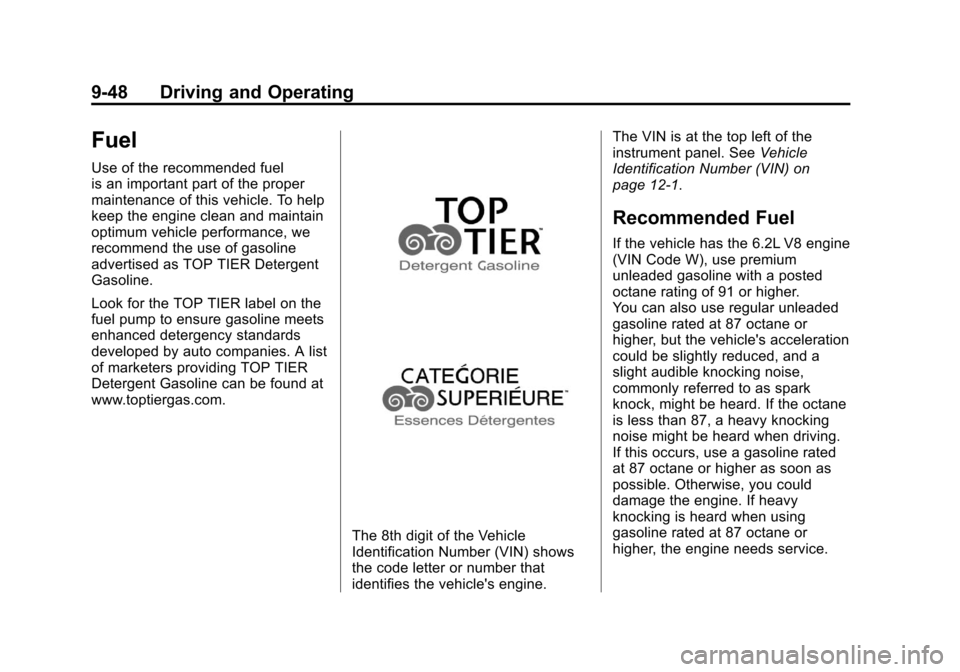
Gasoline.
Look for the TOP TIER label on the
fuel pump to ensure gasoline meets
enhanced detergency standards
developed by auto companies. A list
of marketers providing TOP TIER
Detergent Gasoline can be found at
www.toptiergas.com.
The 8th digit of the Vehicle
Identification Number (VIN) shows
the code letter or number that
identifies the vehicle's engine.The VIN is at the top left of the
instrument panel. See
Vehicle
Identification Number (VIN) on
page 12‑1.
Recommended Fuel
If the vehicle has the 6.2L V8 engine
(VIN Code W), use premium
unleaded gasoline with a posted
octane rating of 91 or higher.
You can also use regular unleaded
gasoline rated at 87 octane or
higher, but the vehicle's acceleration
could be slightly reduced, and a
slight audible knocking noise,
commonly referred to as spark
knock, might be heard. If the octane
is less than 87, a heavy knocking
noise might be heard when driving.
If this occurs, use a gasoline rated
at 87 octane or higher as soon as
possible. Otherwise, you could
damage the engine. If heavy
knocking is heard when using
gasoline rated at 87 octane or
higher, the engine needs service.
Page 279 of 428
Black plate (49,1)Chevrolet Corvette Owner Manual - 2011
Driving and Operating 9-49
If the vehicle has the 6.2L V8 engine
(VIN Code T) or the 7.0L V8 engine
(VIN Code E), use premium
unleaded gasoline with a posted
octane rating of 91 or higher.
For best performance, use premium
unleaded gasoline with a posted
octane rating of 93. In an
emergency, you can use regular
unleaded gasoline with an octane
rating of 87 or higher. If 87 octane
fuel is used, do not perform any
aggressive driving maneuvers such
as wide open throttle applications.
You might also hear audible spark
knock during acceleration. Refill the
tank with premium fuel as soon as
possible to avoid damaging the
engine. If heavy knocking is heard
when using gasoline rated at
91 octane or higher, the engine
needs service.Gasoline Specifications
At a minimum, gasoline
should meet ASTM specification
D 4814 in the United States or
CAN/CGSB‐3.5 or 3.511 in Canada.
Some gasolines contain an
octane-enhancing additive called
methylcyclopentadienyl manganese
tricarbonyl (MMT). We recommend
against the use of gasolines
containing MMT. SeeFuel Additives
on page 9‑50 for additional
information.
California Fuel
Requirements
If the vehicle is certified to meet
California Emissions Standards,
it is designed to operate on fuels
that meet California specifications.
See the underhood emission control
label. If this fuel is not available in
states adopting California emissions
standards, the vehicle will operate
satisfactorily on fuels meeting
federal specifications, but emission
control system performance might be affected. The malfunction
indicator lamp could turn on and the
vehicle might fail a smog‐check test.
See
Malfunction Indicator Lamp on
page 5‑18. If this occurs, return to
your authorized dealer for diagnosis.
If it is determined that the condition
is caused by the type of fuel used,
repairs might not be covered by the
vehicle warranty.
Fuels in Foreign
Countries
If you plan on driving in another
country outside the United States or
Canada, the proper fuel might be
hard to find. Never use leaded
gasoline or any other fuel not
recommended in the previous text
on fuel. Costly repairs caused by
use of improper fuel would not be
covered by the vehicle warranty.
To check the fuel availability, ask
an auto club, or contact a major oil
company that does business in the
country where you will be driving.