Page 278 of 428
Black plate (48,1)Chevrolet Corvette Owner Manual - 2011
9-48 Driving and Operating
Fuel
Use of the recommended fuel
is an important part of the proper
maintenance of this vehicle. To help
keep the engine clean and maintain
optimum vehicle performance, we
recommend the use of gasoline
advertised as TOP TIER Detergent
Gasoline.
Look for the TOP TIER label on the
fuel pump to ensure gasoline meets
enhanced detergency standards
developed by auto companies. A list
of marketers providing TOP TIER
Detergent Gasoline can be found at
www.toptiergas.com.
The 8th digit of the Vehicle
Identification Number (VIN) shows
the code letter or number that
identifies the vehicle's engine.The VIN is at the top left of the
instrument panel. See
Vehicle
Identification Number (VIN) on
page 12‑1.
Recommended Fuel
If the vehicle has the 6.2L V8 engine
(VIN Code W), use premium
unleaded gasoline with a posted
octane rating of 91 or higher.
You can also use regular unleaded
gasoline rated at 87 octane or
higher, but the vehicle's acceleration
could be slightly reduced, and a
slight audible knocking noise,
commonly referred to as spark
knock, might be heard. If the octane
is less than 87, a heavy knocking
noise might be heard when driving.
If this occurs, use a gasoline rated
at 87 octane or higher as soon as
possible. Otherwise, you could
damage the engine. If heavy
knocking is heard when using
gasoline rated at 87 octane or
higher, the engine needs service.
Page 292 of 428

Black plate (8,1)Chevrolet Corvette Owner Manual - 2011
10-8 Vehicle Care
Vehicle Checks
Doing Your Own
Service Work
{WARNING
You can be injured and the
vehicle could be damaged if you
try to do service work on a vehicle
without knowing enough about it.
.Be sure you have sufficient
knowledge, experience,
the proper replacement
parts, and tools before
attempting any vehicle
maintenance task.(Continued)
WARNING (Continued)
.Be sure to use the proper
nuts, bolts, and other
fasteners. English and metric
fasteners can be easily
confused. If the wrong
fasteners are used, parts
can later break or fall off.
You could be hurt.
If doing some of your own service
work, use the proper service
manual. It tells you much more
about how to service the vehicle
than this manual can. To order the
proper service manual, see Service
Publications Ordering Information
on page 13‑15. This vehicle has an airbag system.
Before attempting to do your own
service work, see
Servicing the
Airbag-Equipped Vehicle on
page 3‑34.
Keep a record with all parts receipts
and list the mileage and the date of
any service work performed. See
Maintenance Records on page 11‑9.
Page 303 of 428
Black plate (19,1)Chevrolet Corvette Owner Manual - 2011
Vehicle Care 10-19
SeeEngine Compartment Overview
on page 10‑10 for the location of the
external engine oil tank and fill cap.
Add enough oil to put the level
somewhere in the proper operating
range. Push the dipstick all the way
back into the oil tank when through.
Changing Engine Oil and Filter
(ZO6, ZR1, and Grand Sport)
These vehicles have a
racetrack‐ready dry sump
engine lubrication system.
This high‐performance system
operates differently than a standard
engine lubrication system and
requires a special procedure when
changing the engine oil and filter.
Follow this procedure closely when
changing the engine oil and filter.
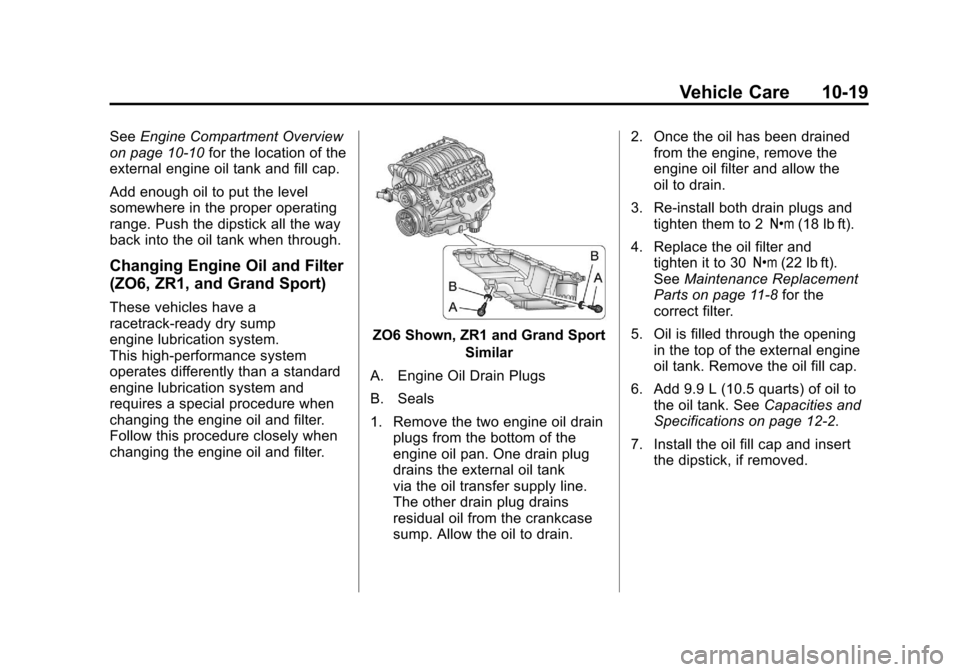
ZO6 Shown, ZR1 and Grand Sport
Similar
A. Engine Oil Drain Plugs
B. Seals
1. Remove the two engine oil drain plugs from the bottom of the
engine oil pan. One drain plug
drains the external oil tank
via the oil transfer supply line.
The other drain plug drains
residual oil from the crankcase
sump. Allow the oil to drain. 2. Once the oil has been drained
from the engine, remove the
engine oil filter and allow the
oil to drain.
3. Re‐install both drain plugs and tighten them to 2 Y(18 lb ft).
4. Replace the oil filter and tighten it to 30 Y(22 lb ft).
See Maintenance Replacement
Parts on page 11‑8 for the
correct filter.
5. Oil is filled through the opening in the top of the external engine
oil tank. Remove the oil fill cap.
6. Add 9.9 L (10.5 quarts) of oil to the oil tank. See Capacities and
Specifications on page 12‑2.
7. Install the oil fill cap and insert the dipstick, if removed.
Page 307 of 428
Black plate (23,1)Chevrolet Corvette Owner Manual - 2011
Vehicle Care 10-23
Automatic Transmission
Fluid
How to Check Automatic
Transmission Fluid
It is not necessary to check
the transmission fluid level.
A transmission fluid leak is the
only reason for fluid loss. If a leak
occurs, take the vehicle to the
dealer service department and have
it repaired as soon as possible.
The vehicle is not equipped with a
transmission fluid level dipstick.
There is a special procedure
for checking and changing the
transmission fluid. Because this
procedure is difficult, this should
be done at the dealer service
department. Contact the dealer
for additional information or theprocedure can be found in the
service manual. To purchase a
service manual, see
Service
Publications Ordering Information
on page 13‑15.
Notice: Use of the incorrect
automatic transmission fluid may
damage the vehicle, and the
damages may not be covered by
the vehicle's warranty. Always
use the automatic transmission
fluid listed in Recommended
Fluids and Lubricants on
page 11‑6.
Change the fluid and filter at the
intervals listed in Scheduled
Maintenance on page 11‑2, and
be sure to use the fluid listed in
Recommended Fluids and
Lubricants on page 11‑6.
Manual Transmission
Fluid
It is not necessary to check the
manual transmission fluid level.
A transmission fluid leak is the
only reason for fluid loss. If a leak
occurs, take the vehicle to the
dealer service department and
have it repaired as soon as
possible. See Recommended Fluids
and Lubricants on page 11‑6 for
the proper fluid to use.
Page 308 of 428
Black plate (24,1)Chevrolet Corvette Owner Manual - 2011
10-24 Vehicle Care
Hydraulic Clutch
It is not necessary to regularly
check clutch fluid unless you
suspect there is a leak in the
system. Adding fluid will not correct
a leak. A fluid loss in this system
could indicate a problem. Have the
system inspected and repaired.
When to Check and What
to Use
The hydraulic clutch fluid reservoir
cap has this symbol on it. See
Engine Compartment Overview on
page 10‑10for reservoir location. Refer to the Maintenance
Schedule for the proper fluid
to use. See
Recommended Fluids
and Lubricants on page 11‑6.
The fluid requires changing every
two years. See Scheduled
Maintenance on page 11‑2.
How to Check and Add Fluid
Visually check the clutch fluid
reservoir to make sure the fluid level
is at the MIN (minimum) line on the
side of the reservoir. The hydraulic
clutch fluid system should be closed
and sealed.
Do not remove the cap to check
the fluid level or to top‐off the fluid
level. Remove the cap only when
necessary to add the proper fluid
until the level reaches the MIN line.
Engine Air Cleaner/Filter
See Engine Compartment Overview
on page 10‑10 for the location of the
engine air cleaner/filter.
Notice: If you spray water into
the engine air cleaner/filter intake
and water enters the engine air
cleaner/filter housing, you could
damage your vehicle's engine.
The repairs would not be covered
by your warranty. Do not spray
water into the engine air cleaner/
filter intake and/or housing.
If cleaning the vehicle with the hood
open, take care not to spray water
directly near the filter opening of
the air cleaner, as shown in the
illustration, as this could damage
the vehicle's engine.
Page 309 of 428
Black plate (25,1)Chevrolet Corvette Owner Manual - 2011
Vehicle Care 10-25
When to Inspect the Engine Air
Cleaner/Filter
Inspect the air cleaner/filter
at the scheduled maintenance
intervals and replace them at
the first oil change after each
80 000 km (50,000 mile) interval.
SeeScheduled Maintenance on
page 11‑2 for more information.
If driving in dusty/dirty conditions,
inspect the filter at each engine oil
change. How to Inspect the Engine Air
Cleaner/Filter
To inspect the air cleaner/filter,
remove the filter from the vehicle
and lightly shake the filter to release
loose dust and dirt. If the filter
remains caked with dirt, a new filter
is required.
To inspect or replace the engine air
cleaner/filter:
1. Open the hood. See
Hood on
page 10‑9.
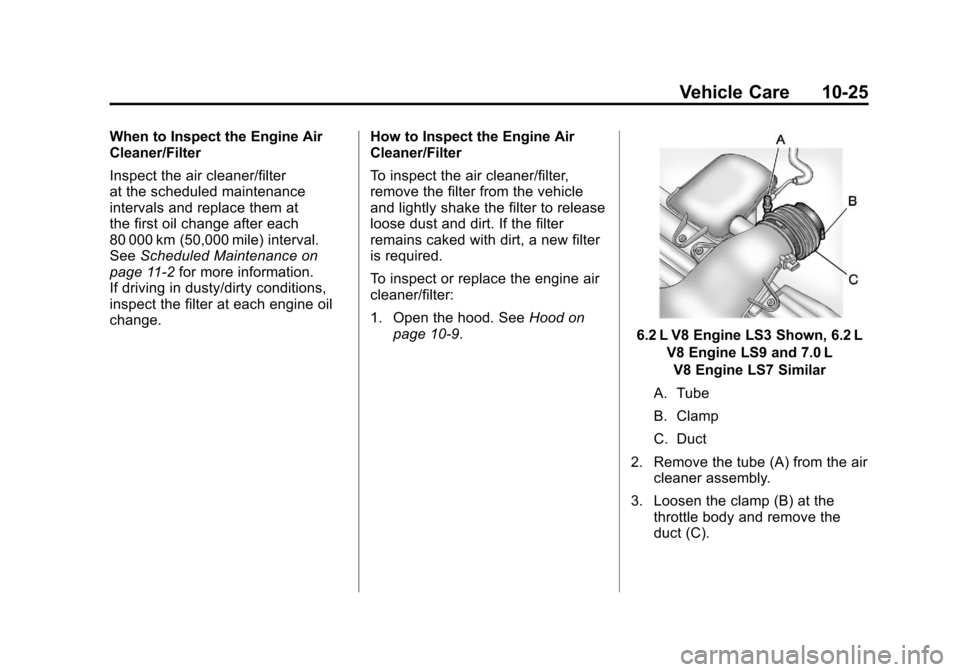
6.2 L V8 Engine LS3 Shown, 6.2 L
V8 Engine LS9 and 7.0 LV8 Engine LS7 Similar
A. Tube
B. Clamp
C. Duct
2. Remove the tube (A) from the air cleaner assembly.
3. Loosen the clamp (B) at the throttle body and remove the
duct (C).
Page 311 of 428
Black plate (27,1)Chevrolet Corvette Owner Manual - 2011
Vehicle Care 10-27
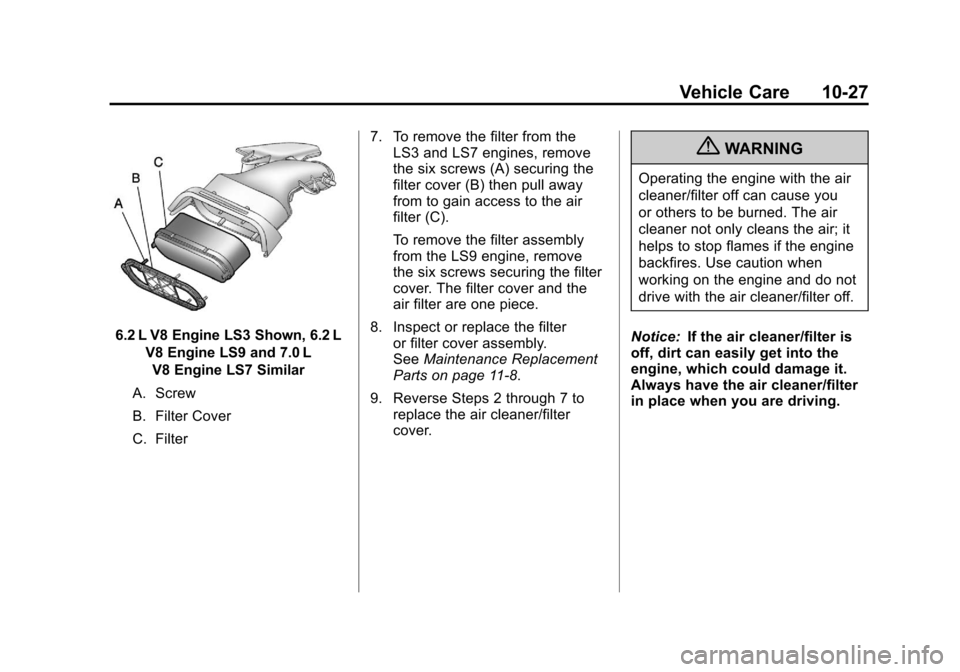
6.2 L V8 Engine LS3 Shown, 6.2 LV8 Engine LS9 and 7.0 LV8 Engine LS7 Similar
A. Screw
B. Filter Cover
C. Filter 7. To remove the filter from the
LS3 and LS7 engines, remove
the six screws (A) securing the
filter cover (B) then pull away
from to gain access to the air
filter (C).
To remove the filter assembly
from the LS9 engine, remove
the six screws securing the filter
cover. The filter cover and the
air filter are one piece.
8. Inspect or replace the filter or filter cover assembly.
See Maintenance Replacement
Parts on page 11‑8.
9. Reverse Steps 2 through 7 to replace the air cleaner/filter
cover.
{WARNING
Operating the engine with the air
cleaner/filter off can cause you
or others to be burned. The air
cleaner not only cleans the air; it
helps to stop flames if the engine
backfires. Use caution when
working on the engine and do not
drive with the air cleaner/filter off.
Notice: If the air cleaner/filter is
off, dirt can easily get into the
engine, which could damage it.
Always have the air cleaner/filter
in place when you are driving.
Page 326 of 428
Black plate (42,1)Chevrolet Corvette Owner Manual - 2011
10-42 Vehicle Care
Add or remove brake fluid, as
necessary, only when work is done
on the brake hydraulic system.
{WARNING
If too much brake fluid is added, it
can spill on the engine and burn,
if the engine is hot enough. You
or others could be burned, and
the vehicle could be damaged.
Add brake fluid only when work
is done on the brake hydraulic
system. See“Checking Brake
Fluid” in this section.
Refer to the Maintenance Schedule
to determine when to check the
brake fluid. See Scheduled
Maintenance on page 11‑2.
Checking Brake Fluid
Check brake fluid by looking at the
brake fluid reservoir. See Engine
Compartment Overview on
page 10‑10.
The fluid level should be above
the MIN mark on the reservoir.
If it is not, have the brake hydraulic
system checked to see if there is
a leak.
After work is done on the brake
hydraulic system, make sure the
level is between the MIN and MAX
marks. What to Add
Use only new DOT 3 brake
fluid from a sealed container.
See
Recommended Fluids and
Lubricants on page 11‑6.
Always clean the brake fluid
reservoir cap and the area around
the cap before removing it. This
helps keep dirt from entering the
reservoir.
{WARNING
With the wrong kind of fluid in
the brake hydraulic system, the
brakes might not work well. This
could cause a crash. Always use
the proper brake fluid.