2011 AUDI TT ROADSTER light
[x] Cancel search: lightPage 200 of 260

198 Tires and whe els
Cold tire inflation pressure
Tire pressure affects the overall handling, performance and safety of a vehicle .
Fig. 14 6 Tire p ress ure labe l: loca ted on dr iver 's side B ·
p ill ar
Tire pressure generally refers to the amount
of air in a t ire that it needs it to do its job and
safely carry the combined load of the entire
vehicle and its contents . Tire pressure is
measured in kilopasca ls (kPa), the interna·
tional measuring unit and in pounds per
squa re inch (PSI). Tire pressure is based in
part o n the vehicle's design and load limit
the greatest amount of weight that the vehi·
cle can carry safe ly and the t ire size. The prop·
er tire pressure is freq uently referred to as the
"recommended cold tire inflation pressure."
A ir in the tires expands when the tire heats up
because of internal frict ion when it flexes in
use . The t ire p ressure is higher when the tire
has warmed up than when it is "cold ." It is the
i n flat ion pressure in a "cold " tire that counts.
Therefore, you shou ld neve r let air ou t of a
warm tire to match " co ld tir e infla tion p res
sure" recommendations . The tires wo uld then
be underinflated and could fail su ddenly .
M aintaining p roper t ire press ure is one o f the
most impo rtan t things you can do to he lp
avoid sudden tire failure. Underinflated ti res
are a major cause of s udden tire failure. Keep
ing tires at the right pressure is also impor
tant for safe and responsive vehicle handling,
traction, braking and load carrying .
Tir e pres
s ur es are part icularly important wh en th e
vehicl e is being driven at higher speed s, and
then es pecially wh en heav ily loaded even
w ithin th e permis sible load -carrying capa ci
tie s approv ed for y our vehi cle.
,;
•(=~: I : I :,.. I)@ ~
The~-----~---w-o- ....... -e.....i -·· - u ........ -.-..,.0, ... -....,.,...tot~---....... ._.,. -..
....
-..... ...........
- KPA. a PSI
- KPA.
a PSI
- KPA.
a PSI
Fig . 14 7 Tir e pressure labe l
SEE OWNER'S MANUAl FOR
A DOMlONAL
T10N VOl!ILEMANU£1. DU _,...,
POUR P\.US DE
REHSEKiloiEMENTS
The recommended tire pressures for your Audi
depend on the kind of tires on your veh icle
and the number of passengers and/or amount
of luggage you w ill be transporting .
The tire pressure label is located on the driv
er's side B-pillar . The tire pressure label lists
the recommended cold t ire inflat io n pressures
for the vehicle at its maxim um capac ity
we ight and tires that were on your veh icle at
the time it was manufa ctu red .
If you wish to impro ve comfort when operat
ing the v ehicle at normal lo ad (no luggag e)
up to 2 occupant s, you can adju st ti re pr es
sures to tho se spe cified f or normal vehi cle
load. Before oper ating th e vehicl e at maxi
mum load, yo u must increase the tire pr es
sure s to tho se spe cified f or ma ximum vehicle
load ~.&. .
Bear in mind that the tire pressure mon itor ing
system c an only moni to r the tire pressu res
you have stored. The sys tem does not recog
nize the load condition of your veh icle.
T he effec tiveness of the t ire press ure monitor
i ng system will be impaire d if you store nor
mal load pressures but then operate the vehi
cle at its maximum load
~ .&. .
See the ill ustration ~ fig. 146 fo r the locat io n
of the label on d river 's s ide B-pillar (colo r of
the actual label and exact location on the ve-
hicle will vary slight ly) .
IJi,,
Page 215 of 260

the !CHECK I button @c:> page 10, fig. 3. If on
l y one tire is affected, the display will indicate
its pos ition.
The tire p ress ure moni to ring m ust be reset in
the menu display each time the pressures are
adjusted (e .g. when switc hing between parti
a l and full load pressure) or after chang ing or
replac ing a tire on your vehicle
c:> page 214.
You can find the recommended tire pressures
for your vehicle on the label on the driver's
door p illar
c:> page 198.
Tire tread circumference and vibration charac
ter istics can change and cause a tire pressure
warn ing if:
- the tire pressure in one or more t ires is too
low,
- the tire has structural damage,
- the tire pressure was changed, whee ls rotat -
ed or replaced but the TPMS was not reset
c:> page 214 .
Warning symbol s
[@] Loss of pressure in at least one tire c:> ,&..
Check the ti re or tires and rep lace or repair if
necessary . The indicator light
RI] in the instru
ment cluster also illuminates
r=:>page 13.
Check/correct the pressures of all four tires
and reset TPMS in the menu display.
11@1@1 < T ire Pressure Monitoring Sys tem) Tire
p re ss ure! Sy stem malfunction. JfllAl@ ap
pears after switching the ignition on or while
driving
r=:> fig. 152 and the indicator light RI] in
the instrument cluster blinks for approxi
mately one minute and then stays on, there is
a system malfunction . See your author ized
Aud i dealer as soon as possible.
.&, WARNING
- If the t ire pressure indicator appea rs in
the instrument cl uster d isplay, one or
more o f you r tires is s ignificantly under
inflated. Reduce your speed immediately
and avoid any hard steering or bra king
maneuvers. Stop as soon as possible and
check the t ires and the ir pressures. In
flate the tire pressure to the proper pres-
.
Tire s an d wheel s 213
sure as indicated on the vehicle's tire
pressure labe l
r=:>page 198. Driving on a
significantly under-inflated tire causes
the t ire to overheat and can lead to tire
fa ilure . Unde r-inflation also is l ikely to
impair the vehicle's handling and stop
ping ability.
- The d rive r is respons ib le for maintaining
the co rrect tire pressures. You must
check the tire pressures regularly.
- Unde r ce rtain conditions (such as a spo r
ty driving style, winter conditions or u n
p aved roads), the pressu re monitor indi
ca tor may be delayed.
- Ask you r authorized Aud i dea le r i f run
f lat tires may be used on your vehicle.
Your vehicle registration becomes invalid
if you use these t ires when not perm it
ted. Damage to your vehicle or accidents
could a lso result.
- If you switch between standard and run
flat tires, an autho rized Audi dealer o r
qualified workshop must reprogram the
contro l modu le.
(D Tips
- The tire pressure monitor ing system
stops work ing when there is an ESP/ABS
ma lfunction.
- Us ing snow c hains may res ult in a system
ma lfunction.
- Tires wit h the identification "AO" or "RO"
have been specially matched with yo ur
Audi. We recommend using on ly these
tires because they meet the highest
standards regarding safety and dr iv ing
character istics when used correctly. Your
authorized Audi dealer wi ll gladly pro
vide you with more information .
•
•
Page 218 of 260

216 Tires and wheels
Run-flat tires have special characteristics
and requirements, that are very different
from conventiona l tires. Run-flat tires re
quire special rims for run-flat use and can
not be used on conventional wheel rims.
(D Tips
- If you are not able to continue driving
with run-flat tires, please seek professio
nal assistance .
- Please contact your authorized Audi
dealer or Audi of America, Inc. if you
have questions about tires and r ims.
Driving with run-flat tires
App lies to vehicles: with Run -flat tires
Handling characteristics change when tire
pressure is low .
Driving on tires with low tire pressure changes
the way a vehicle handles, particularly when
cornering and braking . The handling charac
teristics of run-flat tires do not seem to
change a lot even when dr iving on low pres
sure or in the run-flat mode . Nevertheless you
must still take special precautions when oper
ating a vehicle on run-flat tires when tire pres
sure is low or the tire(s) is fla t:
"'The Electronic Stabilization Program (ESP)
must be switched on.
> Never drive faste r than 50 mph (80 km/h)
¢,& .
"'Plan ahead when driving and anticipate
what you will have to do considering traffic
and road conditions up ahead.
"' Accelerate carefully.
"' Avoid unnecessary and sudden steer ing and
braking maneuvers .
"' Reduce your speed in plenty of time before
i ntersections, curves and other places where
you may have to react quickly.
Please see:
¢ page 215, When it is not possi
ble to continue driving, even with run-flat
tires?
Handling characteristics change when
driving with low air pressure or with flat
tires even with special run-flat tires
A low pressure or flat front tire affects vehicle
handling characterist ics by pulling the vehicle
slightly to the side whe re the tire is mounted
and reduces braking performance .
A low pressure or flat
rear tire also affects
driving characteristics by pulling to the s ide
where the tire is mounted and also reduces
braking performance . The effect on vehicle
handling is most noticeable when driving
aro und curves .
A WARNING
Changed vehicle hand ling characteristics
when driving in the run-flat mode can
cause loss of vehicle control, a crash and
serious personal injury.
- Driving on special run-flat tires in the
run-flat mode will change vehicle han
dling characterist ics dur ing braking,
when cornering and under heavy acceler
ation .
- Never drive faster than the max imum
rated speed of 50 mph (80 km/h) when
driving in the run-flat mode.
- Always adjust vehicle speed to traff ic,
road and weather conditions and drive
slower than the maximum rated speed if
necessary weathe r and road cond it ion s
are taken into account.
- Always obey speed limits and other traf
f ic laws.
(D Note
We always recommend driving with even
more care when using these special tires in
the run-flat mode. Always avoid sudden
maneuve rs.
Page 222 of 260
220 What do I do now?
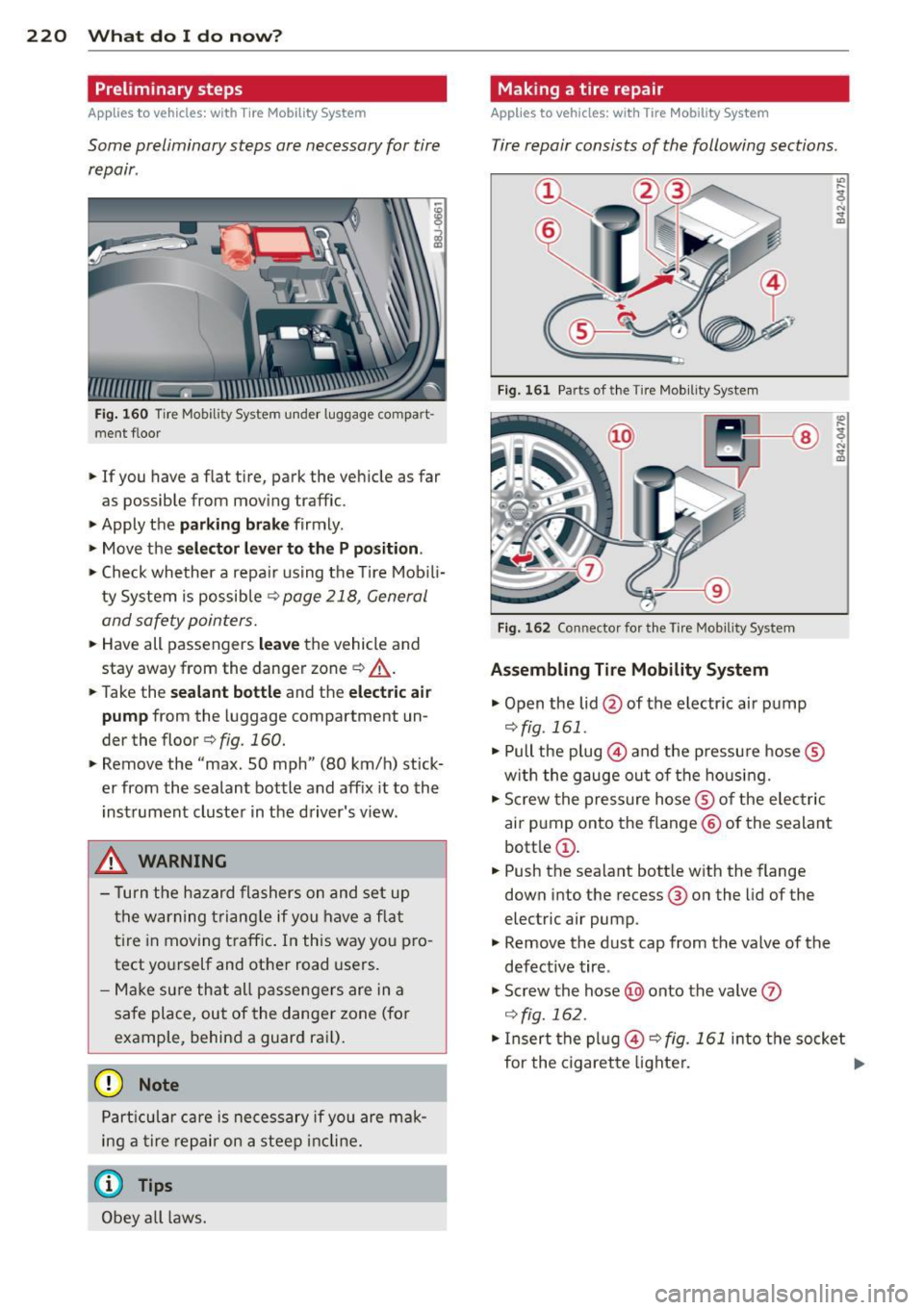
Preliminary steps
Applies to vehicles: with T ire Mobility System
Some preliminary steps are necessary for tire
repair .
Fig. 160 Tire Mobili ty System under luggage co mpart
men t floor
• If you have a flat tire, park the vehicle as far
as possible from mov ing traffic .
• Apply the
park ing brake firmly .
• Move the
selector lever to the P position .
• Check whether a repa ir using the Tire Mobili
ty System is possible
¢ page 218, General
and safety pointers.
• Have all passengers leave the vehicle and
stay away from the danger zone ¢
_A.
• Take the sealant bottle and the electric air
pump
from the luggage compartment un
der the floor
c> fig. 160.
• Remove the "max. 50 mph" (80 km/h) stick
er from the sealant bottle and aff ix it to the
instrument cluster in the driver's view .
..&, WARNING
- Turn the hazard flashers on and set up
the warning triangle if you have a flat
tire in moving t raff ic. In this way you pro
tect yo u rs elf and other road users .
- Make sure that all passengers are in a
safe place, out of the danger zone (for
example, behind a guard rail).
(D Note
Particular care is necessary if you are mak
ing a tir e repair on a steep incline.
@ Tips
Obey all laws.
Making a tire repair
Applies to vehicles: with Tire Mob ility System
Tire repair consists of the following sections .
Fig. 161 Parts of the Tire Mob ility System
Fig . 1 62 Con nector for the Tire Mob ility System
Assembling Tire Mobility System
• Open the lid @of the electr ic air pump
c>fig . 161 .
• Pull the plug@) and the pressu re hose ®
w ith the gauge out of the housing.
• Screw the pressure hose® of the electric
air pump onto the flange@ of the sealant
bott le @ .
• Push the sealant bott le with the flange
down into the recess @ on the lid of the
electric air pump.
• Remove the dust cap from the valve of the
defective tire .
• Screw the hose @) onto the valve
• In sert the plug @ c> fig. 161 into the socket
for the cigarette lighter. .,.
Page 223 of 260

Inflating tire
"' Move the switch @¢ fig. 162 on the elec
tric air pump
ll to posit ion I. After 5 mi
nutes, tire pressure must have reached at
l east 1.8 bar .
"' Switch the electric a ir pump off - switch in
position
0 . If the required tire pressure of at
least 1.8 bar has not been reached, follow
the instructions in the section Re-inflating
tire .
Re-infl ating tire
"' Remove the hose from the valve and pu ll the
plug out of the socket.
"' Drive the vehicle slow ly 10 meters backward
or forward. This helps to distribute the seal
ant better.
"' Remove the empty inflat ion bottle and
screw the hose®¢ fig. 161 from the elec
tric pump directly onto the va lve.
"' Insert the plug @¢ fig. 161 into the socket
for the cigarette lighter .
"' Move the switch@¢ fig. 162 on the elec
tric a ir pump
l) to posit ion I. After 5 mi
nutes, t ire pressure must have reached at
least 1.8 bar .
"' Switch the electric a ir pump off - switch in
pos ition
0 . If the requ ired tire p ressure of at
least 1.8 bar has not been reached, it is not
poss ib le to make a repa ir with the tire seal
ant . Seek pro fessional ass istance .
Disassembling Tire Mobility System
"'Remove the hose from the valve and pull the
plug out of the socket.
"' Screw th e dust cap onto the va lve.
"' Place the empty sealant bottle back in the
o riginal packaging and clip it in p lace under
the floor so that no tire sealant can run out
into the vehicle.
"' Place the electric air pump in the luggage
compartment for the time being .
"' Start driving r ight away so t hat the sealant
is d istributed in the tire .
l) The e lectr ic a ir pu m p sh oul d never r un for long er than
8 m in utes.
What do I do now? 221
A WARNING
- Follow the manufacturer's safety instruc
tions on the decal for the air pump and
the sealant bottle.
- If a tire pressure of 1.8 bar cannot be
achieved after pumping for 5 minutes,
the t ire is too severely damaged . Do not
continue to dr ive.
- Seek professional ass istance if it is not
possible to repa ir the tire w ith the t ire
sealant.
(D Tips
- Do not operate the electric air pump for
more than 8 minutes witho ut stopping,
otherwise it can overheat . When the a ir
pump has coo led down, you can continue
to use it.
- I f sea lant has escaped, allow it to dry,
t hen yo u can peel it off.
Final check
Applies to vehicles: wit h Tire Mobility System
Aft er driv ing for a short distance, tire
pre ssure must be chec ked
"' After driving for about 10 min utes, stop and
check the tire pressure.
"' If tire pressure is st ill at least 1.3 bar, in
flate the tire to specified pressure (see dr iv
er's side B-pillar), drive to the next repa ir
shop and have the tire and the sealant bot
tle replaced .
"'I f ti re pressu re is less than 1.3 ba r, the t ire
is too severely damaged. Do not con tinue to
drive . See k professiona l assist ance.
A WARNING
= -
If tire press ure is less than 1.3 bar after
d riving for 10 minutes, the ti re is too se
verely damaged. Do not cont in ue to drive.
Seek professional ass istance.
•
•
Page 227 of 260

~ Use the hexagonal socket in the screwdriver
handle to screw in and tighten all wheel
bo lts
slightly .
~ Unscrew the alignment pin and insert and
t ighten the remaining wheel bolt s light ly
like the rest.
~ T urn the jack handle counter-clockw ise to
l ower the vehicle unti l the jack is fully re
leased .
~ Use the whee l bolt w rench to t ighten al l
whee l bolts firmly <=>
page 222 . Tighten
them
crosswise, from one bolt to the (ap
proximate ly) opposite one, to keep the
whee l cente red.
Q;) Note
When removing or installing the wheel,
the rim could hit the brake rotor and dam
age the rotor. Work carefully and have a
second person help you.
(D} Tips
Never use the hexagonal socket in the han
dle of the screwdriver to loosen or t ighten
the wheel bolts .
- Pull the reversib le b lade from the screw
driver before yo u use the hexagonal
socket in the handle to t urn the whee l
bo lts .
- When mounting tires with
unid irectional
tread design
make su re the tread pat
te rn is poi nted the r ight way
<=> page 226.
- The wheel bolts should be clea n and easy
to tu rn . Check for d irt and corrosion on
the mat ing s urfaces of both the wheel
and the hub. Rem ove a ll dirt from these
su rfaces before rem ounting the wheel.
Notes on wheel change
Please read the information <=> page 205 , New
tires and replacing tires and wheels ,
if you are
going to use a spare t ire which is different
from the tires on your ve hicle.
Afte r you change a tire :
What do I do now? 225
-Check the tire pre ssure on the spare imme
diately after mounting.
- Have the whe el bolt tightening torque
checked with a torque wrench as soon a s
possible by your authorized Audi dealer or
a qualified service station.
- With steel and alloy wheel rim s, the wheel
bolt s are cor rectly tightened at a torque of
90 ft lb (120 Nm ).
- If you noti ce while changing a tire that the
wheel bolts are corroded and difficult to
turn , then they should be replaced before
you check the tightening to rque.
- Replace the flat tire w ith a new one and
have it installed on your vehicle as soon as
possible. Remount the whee l co ver.
Until then , dr ive with extra care and at re
duced speeds.
A WARNING
- If you are going to equ ip your vehicle
w it h tires o r rims which differ from those
which were factory installed, then be
sure to rea d the information
¢ page 205,
New tire s and replacing tires and
wheels.
- Always sto re the too ls secu rely in lug
gage com partmen t. Othe rwise , in a n ac
cident or s udden m aneuver they cou ld fly
forwa rd, causing inj ury to passengers in
the vehicle.
(D Note
D o not use comme rcially ava ilab le tire
se alants . Ot herwise, t he e lectr ic al c ompo
nen ts of the tire pressu re monitoring sys
tem will no lo nger work p roperly and the
sensor fo r the tire pressure mon itor ing
system will have to be rep laced by a quali
fied workshop. •
•
Page 230 of 260

228 Fuses and bulbs
Fuse Location, Instrument Panel left
0
Fig. 172 Fuse ca rrier be hind the inst rum ent pan el end
fa ce, cover rem oved
Some of the equipment i tems lis ted are op
tional or only available on certain model con
figurations.
Note that the following table is accurate at
the time of going to press and is subject to
change. In the event of discrepancies, the la
bel on the inside of the cover always takes
precedence.
The power seats are protected by circuit
breakers,
which automatically reset after a
few seconds after the overload has been rem
edied .
No. Equipment
1
I 2
Engine relay, fuel tank control
unit , Airbag Off light, light
switch (switch illumination), di-
agnostic connector
ABS, ASR, ESP, brake light switch
3 AFS headlight (left)
Amps
10
5
s
No.
4
5
6
7
Equipment
Oil level sensor (extended main-
tenance interval)
(WIV), tire
pressure monitoring system,
switch for Electronic Stability Program (ESP), AFS headlights
(control unit), A/C system (pres-
sure sensor), backup light
switch
Automatic headlight range con
trol, AFS headlight (right)/
manual headlight range con
trol, halogen headlights
Control unit for CAN data trans
fer (gateway), electromechani
cal steering, automatic trans mission shift gate
Acoustic Park Assist, automatic
dipping interior rear
view mir-
ror, garage door opener, heata
ble windshield washer nozzles,
washer pump, wind deflector
relay (Roadster)
--r-
Amps
5
5/10
5
5
8 Haldex clutch 5
9 Control unit Audi magnetic ride 5
10 Airbag control unit 5
Mass airflow sensor, crankcase
11 5/10
heating
Door control unit (central lock-
12 10
ing driver/passenger)
--
13 Diagnostic connector 10
Rain sensor, automatic trans-
14 5
mission shift gate
15 Roof light (interior lighting) 5
16 A/C system (control unit) 10
17 Tire pressure monitoring sys-
5
tern (control unit)
l
I
18 Notused -
19 Not used
20 Not used
21 Fuel injectors (gasoline engine)
Wind deflector (Roadster)
Horn
24 Transmission (control unit) 10
30
20
15
..,.
Page 231 of 260

No.
25
Heater rear window Coupe/
heated rear window Roadster
26 Driver's side power window
27 Passenger's side power window
28 Not used
29 Washer pump
30 Cigarette lighter
31 Starter
32 Steering column module
33 Instrument cluster
34 Radio navigation system, radio
35 Audio amplifier
Engine (control unit)
37 CAN (Gateway)
38 Cigarette lighter
39 Not used
40 Not used
41 Not used
42 Not used
43 Not used
44 Not used
45 Not used
46 Not used
47 SOARS tuner, cell phone p ack-
age, TV tuner
48 VOA interface
49 N ot used
Fuse location, left side of engine
compartment Amps
30/20
30 15
40
30 10 5
20
-
5
5
F ig. 173 Illustrat ion of fuse holder on left side of en
g ine co mpa rtment : fuses (without fuse cover)
Fuse s and bulb s 229
Some of the equipment items listed are op
tiona l or only avai lab le on certain model con
figurations.
Note tha t the foll owing table i s ac cur ate at
the time of going t o press and is subject to
change . In the event of di screpancie s, the la·
bel on the inside of the cover always takes
precedence.
No . Equipment Amps
Fuse holder (black )
1 Notused -
----------'
2 Not used
3 Not used
4 Not used
Anti-theft warning system (sen-
5 sor), anti-theft wa rning system
(horn)
6 H eadlamp washer system
7
Electric fuel pumps (supply)/
volume control valve
8 W indshield wipers
9
Heated seats (driver and pas-
senger)
10
L umbar support (driver a nd
passenger)
11 Not used
12 Vent ilation blower
Fuse holder (brown )
1
2
3
4
5
6
7
9 N
ot used
Not used
Not used
Not used
Relay coil relay volume contro l
va lve
Position ing valves pre-wired en
g ine harness
I gnition coils
Eng ine (control unit)
10 Water pump delayed-off
5
30
15/10
30
25
10
40
-
5
10
10
20
25 10
1111-