2011 AUDI TT ROADSTER warning light
[x] Cancel search: warning lightPage 193 of 260

must be disconnected. If you are just go
ing to replace a light bulb, then it is
enough to switch off the lights.
- Before disconnecting the battery, switch
off the anti-theft alarm system! Other
wise you will set off the alarm.
- When disconnecting the battery, first
disconnect the negative cable and then
the positive cable.
- Before reconnecting the battery, make
sure all electrical consumers are switch
ed off. Reconnect the positive cable first
and then the negative cable. Never inter
change the cables -this could start a fire!
- Never charge a frozen or a thawed-out battery. It could explode! If a battery has
frozen, then it must be replaced. A dis
charged battery can freeze over at 32 °F
(0 oc).
-Make sure the vent hose is always attach
ed to the opening on the side of the bat
tery.
- Never use batteries which are damaged.
Danger of explosion! Always replace a
damaged battery.
A WARNING
California Proposition 65 Warning:
- Battery posts, terminals and related ac
cessories contain lead and lead com
pounds, chemicals known to the State of
California to cause cancer and reproduc
tive problems. Wash hands after han
dling.
CD Note
- Do not disconnect the vehicle battery
when the ignition is switched on or when
the engine is running, otherwise, you will
damage electronic components in the
electrical system.
- If your vehicle is going to stand for a
long period of time without being driven,
protect the battery from "freezing", oth
erwise it will be damaged and will then have to be replaced.
Checking and filling 191
Checking the battery acid level on magic
eye batteries*
The battery acid level in the battery can be
checked through the clear inspection window .
Fig. 144 Luggage compartment: Battery With magic
eye.
On top of the battery, there is a round "win
dow". This window (magic eye) changes color
as the battery charge and acid level change.
.. Read and heed all WARNINGS
c::> &_ in
Working on the battery on page 190
.. Read the acid level from the window on the
battery
c:> fig. 144.
Air bubbles in the window can cause an inac
curate reading . Carefully tap on the side of
the window.
- If the window is
green, the battery acid level
is correct.
- If the window has no color or is bright yel
low ,
the battery acid level is too low . Have
the battery tested by your authorized Audi
dealer or a qualified workshop.
- If the window is
black , then the battery is
insufficiently charged . Recharge the battery
as soon as possible
r:::, page 192 .
CD Note
Do not overfill the battery, otherwise bat
tery acid will overflow through the vent
opening. This can damage the paint and
cause corrosion .
Page 194 of 260

192 Checking and filling
Charging of battery
Starting the engine requires a well charged battery.
,. Always read and heed all W ARNIN GS be
low
c> A and c> A in Working on the bat
tery on page 190.
,. Switch off the ignitio n and all electrical con
s u mers.
,. Make sure the area is well vent ilated when
yo u charge the battery.
,. Connect charger cables.
ALWAY S co nnect
ch arg er ca ble s PO SITIV E
G) to POSITIVE
G) ; NE GATI VE Q to NEGATI VE Q .
,. Switch on the charger.
,. Make sure the charging rate is not over
6 amps.
,. Turn off the charger¢.&_.
,. Disconnect the charger cables .
,. Connect both battery cables to the battery if
necessary-
first plus, then m inus.
It is not necessary to remove the battery from
the luggage compartment, and it is also not
necessa ry to disconnect the cables.
Normally, a battery should be charged at no
more than 10 percent of its rated capacity.
For example, a charging current of 4.5 amps
wou ld be used on a battery rated at 45 Ah.
Rated capacity of the battery in your veh icle is
listed on the battery housing .
The battery caps should
not be opened when
charging a battery.
&,. WARNING
-
Charging a battery can be dangerous.
- Never charge a frozen battery . It may ex
plode because of gas trapped in the ice.
Allow a frozen battery to thaw out first.
- Do not reuse batteries which were fro
zen. The battery housing may have
c racked and weakened whe n the battery
froze.
- Charge the battery in a we ll ventilated
area . Keep away from open f lame o r elec
t ric al spa rk . Do not smoke. Hydrogen gas
gene rate d by the b attery is exp losive. -
To reduce the danger of explosion, never
connect or d isconnect charger cab les
while the charger is operating .
- Fast charging a battery is dangerous and
should only be attempted by a compe
tent tech nician with the proper equip
ment .
- Battery acid that may spill during charg
ing should be washed off with a solution
of wa rm water and bak ing soda to neu
tralize th e ac id .
(D Note
Never use a fast charger as a booster to
start the eng ine . Th is w ill seriously dam
age sensit ive electronic components, such
as cont ro l units, re lays, radio, etc., as well
as the battery charger.
{1) Tips
The vehicle batte ry must not be charged
with a standa rd small charger that p lugs
i nto the cigarette lig hter or outlet.
Windshield/head Light
washer container
Fig . 14 5 Fender, left: Windshie ld washer fluid reser·
vo ir
T he washer fluid container is marked with the
symbol
O on its cap.
,. Before you check any thing in the engine
compa rtme nt,
a lwa ys read and heed all
WARNINGS ¢
A in Working in the engine
compartment on page 178 .
,. Lift the filler cap tongue to add washer flu-
id. You can fill the container to the top.
111>
Page 215 of 260

the !CHECK I button @c:> page 10, fig. 3. If on
l y one tire is affected, the display will indicate
its pos ition.
The tire p ress ure moni to ring m ust be reset in
the menu display each time the pressures are
adjusted (e .g. when switc hing between parti
a l and full load pressure) or after chang ing or
replac ing a tire on your vehicle
c:> page 214.
You can find the recommended tire pressures
for your vehicle on the label on the driver's
door p illar
c:> page 198.
Tire tread circumference and vibration charac
ter istics can change and cause a tire pressure
warn ing if:
- the tire pressure in one or more t ires is too
low,
- the tire has structural damage,
- the tire pressure was changed, whee ls rotat -
ed or replaced but the TPMS was not reset
c:> page 214 .
Warning symbol s
[@] Loss of pressure in at least one tire c:> ,&..
Check the ti re or tires and rep lace or repair if
necessary . The indicator light
RI] in the instru
ment cluster also illuminates
r=:>page 13.
Check/correct the pressures of all four tires
and reset TPMS in the menu display.
11@1@1 < T ire Pressure Monitoring Sys tem) Tire
p re ss ure! Sy stem malfunction. JfllAl@ ap
pears after switching the ignition on or while
driving
r=:> fig. 152 and the indicator light RI] in
the instrument cluster blinks for approxi
mately one minute and then stays on, there is
a system malfunction . See your author ized
Aud i dealer as soon as possible.
.&, WARNING
- If the t ire pressure indicator appea rs in
the instrument cl uster d isplay, one or
more o f you r tires is s ignificantly under
inflated. Reduce your speed immediately
and avoid any hard steering or bra king
maneuvers. Stop as soon as possible and
check the t ires and the ir pressures. In
flate the tire pressure to the proper pres-
.
Tire s an d wheel s 213
sure as indicated on the vehicle's tire
pressure labe l
r=:>page 198. Driving on a
significantly under-inflated tire causes
the t ire to overheat and can lead to tire
fa ilure . Unde r-inflation also is l ikely to
impair the vehicle's handling and stop
ping ability.
- The d rive r is respons ib le for maintaining
the co rrect tire pressures. You must
check the tire pressures regularly.
- Unde r ce rtain conditions (such as a spo r
ty driving style, winter conditions or u n
p aved roads), the pressu re monitor indi
ca tor may be delayed.
- Ask you r authorized Aud i dea le r i f run
f lat tires may be used on your vehicle.
Your vehicle registration becomes invalid
if you use these t ires when not perm it
ted. Damage to your vehicle or accidents
could a lso result.
- If you switch between standard and run
flat tires, an autho rized Audi dealer o r
qualified workshop must reprogram the
contro l modu le.
(D Tips
- The tire pressure monitor ing system
stops work ing when there is an ESP/ABS
ma lfunction.
- Us ing snow c hains may res ult in a system
ma lfunction.
- Tires wit h the identification "AO" or "RO"
have been specially matched with yo ur
Audi. We recommend using on ly these
tires because they meet the highest
standards regarding safety and dr iv ing
character istics when used correctly. Your
authorized Audi dealer wi ll gladly pro
vide you with more information .
•
•
Page 218 of 260

216 Tires and wheels
Run-flat tires have special characteristics
and requirements, that are very different
from conventiona l tires. Run-flat tires re
quire special rims for run-flat use and can
not be used on conventional wheel rims.
(D Tips
- If you are not able to continue driving
with run-flat tires, please seek professio
nal assistance .
- Please contact your authorized Audi
dealer or Audi of America, Inc. if you
have questions about tires and r ims.
Driving with run-flat tires
App lies to vehicles: with Run -flat tires
Handling characteristics change when tire
pressure is low .
Driving on tires with low tire pressure changes
the way a vehicle handles, particularly when
cornering and braking . The handling charac
teristics of run-flat tires do not seem to
change a lot even when dr iving on low pres
sure or in the run-flat mode . Nevertheless you
must still take special precautions when oper
ating a vehicle on run-flat tires when tire pres
sure is low or the tire(s) is fla t:
"'The Electronic Stabilization Program (ESP)
must be switched on.
> Never drive faste r than 50 mph (80 km/h)
¢,& .
"'Plan ahead when driving and anticipate
what you will have to do considering traffic
and road conditions up ahead.
"' Accelerate carefully.
"' Avoid unnecessary and sudden steer ing and
braking maneuvers .
"' Reduce your speed in plenty of time before
i ntersections, curves and other places where
you may have to react quickly.
Please see:
¢ page 215, When it is not possi
ble to continue driving, even with run-flat
tires?
Handling characteristics change when
driving with low air pressure or with flat
tires even with special run-flat tires
A low pressure or flat front tire affects vehicle
handling characterist ics by pulling the vehicle
slightly to the side whe re the tire is mounted
and reduces braking performance .
A low pressure or flat
rear tire also affects
driving characteristics by pulling to the s ide
where the tire is mounted and also reduces
braking performance . The effect on vehicle
handling is most noticeable when driving
aro und curves .
A WARNING
Changed vehicle hand ling characteristics
when driving in the run-flat mode can
cause loss of vehicle control, a crash and
serious personal injury.
- Driving on special run-flat tires in the
run-flat mode will change vehicle han
dling characterist ics dur ing braking,
when cornering and under heavy acceler
ation .
- Never drive faster than the max imum
rated speed of 50 mph (80 km/h) when
driving in the run-flat mode.
- Always adjust vehicle speed to traff ic,
road and weather conditions and drive
slower than the maximum rated speed if
necessary weathe r and road cond it ion s
are taken into account.
- Always obey speed limits and other traf
f ic laws.
(D Note
We always recommend driving with even
more care when using these special tires in
the run-flat mode. Always avoid sudden
maneuve rs.
Page 222 of 260
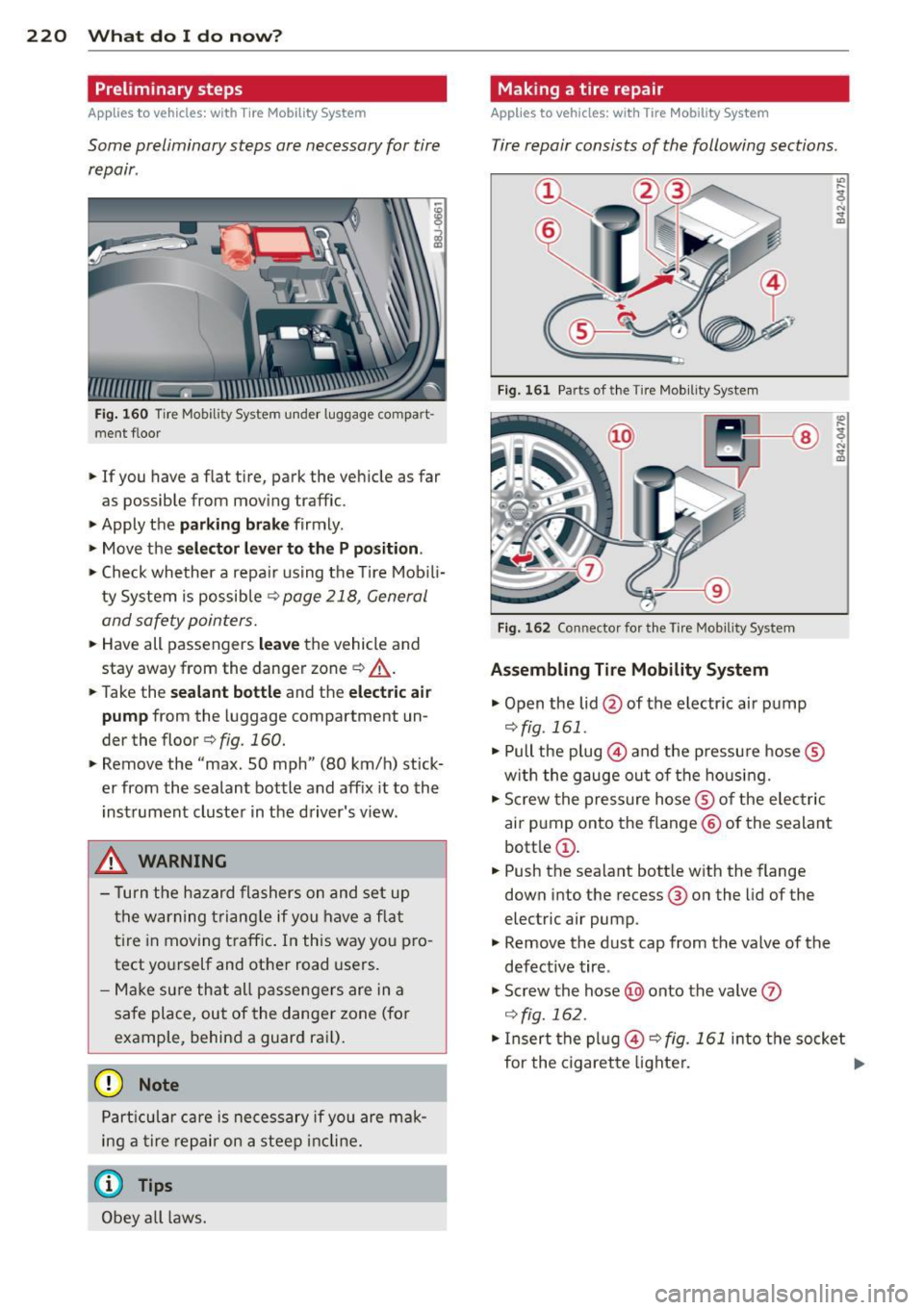
220 What do I do now?
Preliminary steps
Applies to vehicles: with T ire Mobility System
Some preliminary steps are necessary for tire
repair .
Fig. 160 Tire Mobili ty System under luggage co mpart
men t floor
• If you have a flat tire, park the vehicle as far
as possible from mov ing traffic .
• Apply the
park ing brake firmly .
• Move the
selector lever to the P position .
• Check whether a repa ir using the Tire Mobili
ty System is possible
¢ page 218, General
and safety pointers.
• Have all passengers leave the vehicle and
stay away from the danger zone ¢
_A.
• Take the sealant bottle and the electric air
pump
from the luggage compartment un
der the floor
c> fig. 160.
• Remove the "max. 50 mph" (80 km/h) stick
er from the sealant bottle and aff ix it to the
instrument cluster in the driver's view .
..&, WARNING
- Turn the hazard flashers on and set up
the warning triangle if you have a flat
tire in moving t raff ic. In this way you pro
tect yo u rs elf and other road users .
- Make sure that all passengers are in a
safe place, out of the danger zone (for
example, behind a guard rail).
(D Note
Particular care is necessary if you are mak
ing a tir e repair on a steep incline.
@ Tips
Obey all laws.
Making a tire repair
Applies to vehicles: with Tire Mob ility System
Tire repair consists of the following sections .
Fig. 161 Parts of the Tire Mob ility System
Fig . 1 62 Con nector for the Tire Mob ility System
Assembling Tire Mobility System
• Open the lid @of the electr ic air pump
c>fig . 161 .
• Pull the plug@) and the pressu re hose ®
w ith the gauge out of the housing.
• Screw the pressure hose® of the electric
air pump onto the flange@ of the sealant
bott le @ .
• Push the sealant bott le with the flange
down into the recess @ on the lid of the
electric air pump.
• Remove the dust cap from the valve of the
defective tire .
• Screw the hose @) onto the valve
• In sert the plug @ c> fig. 161 into the socket
for the cigarette lighter. .,.
Page 223 of 260

Inflating tire
"' Move the switch @¢ fig. 162 on the elec
tric air pump
ll to posit ion I. After 5 mi
nutes, tire pressure must have reached at
l east 1.8 bar .
"' Switch the electric a ir pump off - switch in
position
0 . If the required tire pressure of at
least 1.8 bar has not been reached, follow
the instructions in the section Re-inflating
tire .
Re-infl ating tire
"' Remove the hose from the valve and pu ll the
plug out of the socket.
"' Drive the vehicle slow ly 10 meters backward
or forward. This helps to distribute the seal
ant better.
"' Remove the empty inflat ion bottle and
screw the hose®¢ fig. 161 from the elec
tric pump directly onto the va lve.
"' Insert the plug @¢ fig. 161 into the socket
for the cigarette lighter .
"' Move the switch@¢ fig. 162 on the elec
tric a ir pump
l) to posit ion I. After 5 mi
nutes, t ire pressure must have reached at
least 1.8 bar .
"' Switch the electric a ir pump off - switch in
pos ition
0 . If the requ ired tire p ressure of at
least 1.8 bar has not been reached, it is not
poss ib le to make a repa ir with the tire seal
ant . Seek pro fessional ass istance .
Disassembling Tire Mobility System
"'Remove the hose from the valve and pull the
plug out of the socket.
"' Screw th e dust cap onto the va lve.
"' Place the empty sealant bottle back in the
o riginal packaging and clip it in p lace under
the floor so that no tire sealant can run out
into the vehicle.
"' Place the electric air pump in the luggage
compartment for the time being .
"' Start driving r ight away so t hat the sealant
is d istributed in the tire .
l) The e lectr ic a ir pu m p sh oul d never r un for long er than
8 m in utes.
What do I do now? 221
A WARNING
- Follow the manufacturer's safety instruc
tions on the decal for the air pump and
the sealant bottle.
- If a tire pressure of 1.8 bar cannot be
achieved after pumping for 5 minutes,
the t ire is too severely damaged . Do not
continue to dr ive.
- Seek professional ass istance if it is not
possible to repa ir the tire w ith the t ire
sealant.
(D Tips
- Do not operate the electric air pump for
more than 8 minutes witho ut stopping,
otherwise it can overheat . When the a ir
pump has coo led down, you can continue
to use it.
- I f sea lant has escaped, allow it to dry,
t hen yo u can peel it off.
Final check
Applies to vehicles: wit h Tire Mobility System
Aft er driv ing for a short distance, tire
pre ssure must be chec ked
"' After driving for about 10 min utes, stop and
check the tire pressure.
"' If tire pressure is st ill at least 1.3 bar, in
flate the tire to specified pressure (see dr iv
er's side B-pillar), drive to the next repa ir
shop and have the tire and the sealant bot
tle replaced .
"'I f ti re pressu re is less than 1.3 ba r, the t ire
is too severely damaged. Do not con tinue to
drive . See k professiona l assist ance.
A WARNING
= -
If tire press ure is less than 1.3 bar after
d riving for 10 minutes, the ti re is too se
verely damaged. Do not cont in ue to drive.
Seek professional ass istance.
•
•
Page 227 of 260

~ Use the hexagonal socket in the screwdriver
handle to screw in and tighten all wheel
bo lts
slightly .
~ Unscrew the alignment pin and insert and
t ighten the remaining wheel bolt s light ly
like the rest.
~ T urn the jack handle counter-clockw ise to
l ower the vehicle unti l the jack is fully re
leased .
~ Use the whee l bolt w rench to t ighten al l
whee l bolts firmly <=>
page 222 . Tighten
them
crosswise, from one bolt to the (ap
proximate ly) opposite one, to keep the
whee l cente red.
Q;) Note
When removing or installing the wheel,
the rim could hit the brake rotor and dam
age the rotor. Work carefully and have a
second person help you.
(D} Tips
Never use the hexagonal socket in the han
dle of the screwdriver to loosen or t ighten
the wheel bolts .
- Pull the reversib le b lade from the screw
driver before yo u use the hexagonal
socket in the handle to t urn the whee l
bo lts .
- When mounting tires with
unid irectional
tread design
make su re the tread pat
te rn is poi nted the r ight way
<=> page 226.
- The wheel bolts should be clea n and easy
to tu rn . Check for d irt and corrosion on
the mat ing s urfaces of both the wheel
and the hub. Rem ove a ll dirt from these
su rfaces before rem ounting the wheel.
Notes on wheel change
Please read the information <=> page 205 , New
tires and replacing tires and wheels ,
if you are
going to use a spare t ire which is different
from the tires on your ve hicle.
Afte r you change a tire :
What do I do now? 225
-Check the tire pre ssure on the spare imme
diately after mounting.
- Have the whe el bolt tightening torque
checked with a torque wrench as soon a s
possible by your authorized Audi dealer or
a qualified service station.
- With steel and alloy wheel rim s, the wheel
bolt s are cor rectly tightened at a torque of
90 ft lb (120 Nm ).
- If you noti ce while changing a tire that the
wheel bolts are corroded and difficult to
turn , then they should be replaced before
you check the tightening to rque.
- Replace the flat tire w ith a new one and
have it installed on your vehicle as soon as
possible. Remount the whee l co ver.
Until then , dr ive with extra care and at re
duced speeds.
A WARNING
- If you are going to equ ip your vehicle
w it h tires o r rims which differ from those
which were factory installed, then be
sure to rea d the information
¢ page 205,
New tire s and replacing tires and
wheels.
- Always sto re the too ls secu rely in lug
gage com partmen t. Othe rwise , in a n ac
cident or s udden m aneuver they cou ld fly
forwa rd, causing inj ury to passengers in
the vehicle.
(D Note
D o not use comme rcially ava ilab le tire
se alants . Ot herwise, t he e lectr ic al c ompo
nen ts of the tire pressu re monitoring sys
tem will no lo nger work p roperly and the
sensor fo r the tire pressure mon itor ing
system will have to be rep laced by a quali
fied workshop. •
•
Page 231 of 260

No.
25
Heater rear window Coupe/
heated rear window Roadster
26 Driver's side power window
27 Passenger's side power window
28 Not used
29 Washer pump
30 Cigarette lighter
31 Starter
32 Steering column module
33 Instrument cluster
34 Radio navigation system, radio
35 Audio amplifier
Engine (control unit)
37 CAN (Gateway)
38 Cigarette lighter
39 Not used
40 Not used
41 Not used
42 Not used
43 Not used
44 Not used
45 Not used
46 Not used
47 SOARS tuner, cell phone p ack-
age, TV tuner
48 VOA interface
49 N ot used
Fuse location, left side of engine
compartment Amps
30/20
30 15
40
30 10 5
20
-
5
5
F ig. 173 Illustrat ion of fuse holder on left side of en
g ine co mpa rtment : fuses (without fuse cover)
Fuse s and bulb s 229
Some of the equipment items listed are op
tiona l or only avai lab le on certain model con
figurations.
Note tha t the foll owing table i s ac cur ate at
the time of going t o press and is subject to
change . In the event of di screpancie s, the la·
bel on the inside of the cover always takes
precedence.
No . Equipment Amps
Fuse holder (black )
1 Notused -
----------'
2 Not used
3 Not used
4 Not used
Anti-theft warning system (sen-
5 sor), anti-theft wa rning system
(horn)
6 H eadlamp washer system
7
Electric fuel pumps (supply)/
volume control valve
8 W indshield wipers
9
Heated seats (driver and pas-
senger)
10
L umbar support (driver a nd
passenger)
11 Not used
12 Vent ilation blower
Fuse holder (brown )
1
2
3
4
5
6
7
9 N
ot used
Not used
Not used
Not used
Relay coil relay volume contro l
va lve
Position ing valves pre-wired en
g ine harness
I gnition coils
Eng ine (control unit)
10 Water pump delayed-off
5
30
15/10
30
25
10
40
-
5
10
10
20
25 10
1111-