2011 AUDI S8 lights
[x] Cancel search: lightsPage 228 of 302

226 Check ing and filling
temperatures stay below freezing point for
long periods.
Detergent add it ives in the o il w il l make fresh
oil look dark after the eng ine has been run
ning for a short time . This is norma l and is not
a reason to change the oi l more often than
recommended.
Dam age or ma lf u ncti ons du e to lack of
m ainten ance
It
is essential that you change your oil at the
recommended in tervals using only engine o il
that complies with Audi oi l standard
VW 502 00. You r Limited New Vehicle War
ranty does not cover damage or malfunctions
due to fail ure to fo llow recommended mainte
nance and use requ irements as set forth in
the Audi Owner's Manual and Warranty&
Maintenance book let . Your dealer will have to
deny warranty coverage unless you present to
the dea ler proof in the form of Service or Re
pa ir Orders that all scheduled maintenance
was performed in a t imely manner.
Eng ine oil consumption
The engine in your vehicle depends on an ade
quate amount of oil to lubricate and cool all
of its moving parts.
In order to provide effective lubrication and
cool ing of internal engine components, a ll in
ternal comb ustion eng ines consume a certa in
amount of oil. O il consumption varies from
engine to engine and may change significantly
over the life of the engine. Typica lly, engines
with a specif ied break-in period (see
¢
page 197) consume more oil during the
break-in period than they consume after oil
consumption has stabilized.
Under norma l conditions, the rate of oil con
sumpt ion depends on the quality and viscosity
of the oil, the RPM (revolutions per m inute) at
which the engine is operated, the ambient
temperature and road condit ions . Further fac
tors are the amount of oil d ilution from water
condensat ion or fuel residue and the ox ida
tion level of the oi l. As any engine is subject to wear as mi
leage builds up, the oil consump
tion may increase over time until replacement
of worn components may become necessary.
With a ll these variab les coming into play, no
standard rate of oil consumption can be es
tablished or specified. There is no alternative
to regu lar and frequent check ing of the o il lev
el, see
Note .
If
the yellow engine oil leve l warning symbo l
in the instrument cluster
m lights up, yo u
shou ld check the oil leve l as soon as possib le
¢
page 22 7. Top off the oil at your earliest
convenience ¢
page 22 7.
A WARNING '"---
Before you check anything in the engine
compartment, always read and heed all
WARNINGS¢
A in Working in the engine
comportment on page 222.
(D Note
Driving w ith an insufficient o il level is like
ly to cause severe damage to the engine .
(D Tips
-The oil pressu re warn ing display. is
not an indicator of the oil le vel. Do not
r el y on it . In ste ad, ch eck the oil lev el in
y our engin e at regular inter vals , pref
erably ea ch time you r efu el, and alway s
before going on a long trip .
-If you have t he impression yo ur engine
cons umes ex cessive amoun ts of o il, we
recommend that you consu lt your Aud i
dea ler to have the cause of your concern
properly diagnosed. Keep in mind that
the accurate meas urement of oi l con
sumption requ ires great care and may
take some t ime. Your Audi dea ler has in
structions about how to measure oil con
sumption accurately.
-
Page 235 of 302

@ For the sake of the environment
Because of the problem of proper disposa l
of brake fl uid as we ll as the special tools
requ ired and the necessary expert ise, we
recommend that you have t he brake fluid
changed by your author ized Audi dealer .
Battery
General information
Under normal operating conditions, the bat
tery in your Audi does not need any mainte
nance. With
high outside temperatures or
long daily dr ive s we recommend that you have
the electro lyte level checked by a service fa
cility . The electrolyte level shou ld a lso be
checked each time the battery is charged
¢ page 235.
Have the battery checked when you take your
ve hicle in for service . Yo u are well adv ised to
replace a battery that is older than 5 yea rs .
W ith certa in types of a irbag deployment, t he
b attery is d isconnected from the vehicle elec
tr ica l system for safety reasons¢.&.
in Re
pair, care and disposal of the airbags on
page 159.
Disconnecting the battery terminals
Some vehicle functions (power w indow regu
lators , for example) are lost if the battery ter
m inals a re d isconnected. These func tions have
to be re lea rned after the batte ry term inals a re
connected agai n. T o prevent this , the bat tery
should only be d isconnec ted from the vehicle
e lec tric al system when absolu tely necessa ry
for repairs .
Vehicles not driven for long periods
If you do not drive you r vehicle over a period
of severa l days or weeks, elec trical compo
nen ts are gr adually cut b ack o r swi tched off .
This redu ces energy cons umption and main
tains starting capab ility over a longer per io d
¢ page 195.
Be aw are tha t when you unlock yo ur vehicle ,
some of the conven ien ce f unct ions may no t
Checkin g and fillin g 233
opera te , such as the Conven ience key*, the re
mote control or the power seat adjustment .
T he convenience functions will be ava ilab le
again when you switch on the ign ition and
start the eng ine.
Winter operat ion
D uring the w inte r mon ths, bat tery capacity
tends to dec rease as temperatures drop . This
is beca use more power is a lso consumed wh ile
starting, and the headlights, rear window de
fogger, etc., are used more often.
Avoid unnecessary powe r consum ptio n, pa r
ticu lar ly in city traffic or when traveling only
short distances. Let your autho riz ed Audi
dealer check the capacity of the vehicle bat
te ry before w inter sets in¢
page 235 . A well
c h arged battery will not on ly prevent s tarti ng
problems w hen the weather is cold, but wi ll
also last longer.
(D Tips
If you r vehicle is left s tandi ng for seve ral
weeks at extremely low temperatures, the
vehicle ba ttery s hould be removed an d
s to red w here i t w ill not fr eeze . T his w ill
p revent it from be in g damaged and having
to be replaced.
Working on the battery
Be especially careful when working on or near
the bat tery.
T he battery is lo cated in the l uggage compa rt
ment unde r the floo r. B efo re you che ck a ny
thi ng in the luggage com partmen t,
read and
heed all WARNINGS
¢ .&, .
Alw ays heed t he safety warning s, when work
ing on the vehicle b atte ry or the vehicle e lec -
t rical system to prevent i njury. .,..
•
•
Page 236 of 302

234 Check ing and filling
Th e following WARNINGS are very
impo rtant when w ork ing on the b att ery :
Alwa ys hee d the fo llo w ing WARNING SYM
BOLS and safety precaution s when working
o n the battery .
®
@
®
Always w ear eye prot ection.
Batter y acid cont ain s sulfu ric acid.
Alwa ys wear glo ves and e ye p rote c
tion.
No
• sparks
-flames
- smoking.
When a batt ery is charged, it produ
ces hydrog en ga s whi ch i s e xplo sive
a nd could cau se p ers on al injury .
Always keep the battery well out of reach of children .
.8, WARNING
Whenever working on the battery or on
the electrical system, there is the r is k of
inju ry, acc ident and even fire. Read and
heed the following WARNINGS:
- Always wea r eye protection. Do not let
battery acid or any lead particles get on
yo ur skin or clothing. Shield your eyes.
Explosive gases can cause blindness or
other injury .
- Battery acid contains sulfuric acid. Sulfu
ric acid can cause blindness and severe
burns.
- Always wear gloves and eye p rotection .
Do not tilt the battery because ac id
could lea k out of the vent ilation open
ings.
- I f you get battery acid in your eyes or
on your sk in , immediately rinse with
cold water for severa l m inutes and get
medical attention.
- If you should ingest any battery acid ,
seek medical attention immediately .
- Do not expose the battery to an open
flame, electric sparks or an open light .
- Do not smoke. -
Do not interchange the positive and neg
ative cables.
- When working on the battery, be s ure
not to short-circu it the terminals with
too ls or other metal objects. This would
cause the battery to heat up very quickly,
which could lead to damage or explosion and pe rsonal injury.
- When a battery is charged, it produces
hydrogen gas which is explosive and
could cause personal in jury.
-Always keep the battery well out of the reach of children .
- Before work is done on the electrical sys
tem, disconnect the negat ive ground ca
b le .
- Before performing any work on the e lec
tr ical system, switch off the engine and
ignit ion as well as any electrical equip
ment. The negative cable on the battery
m ust be disconnected.
If yo u are just go
ing to replace a light bulb, then it is
enough to switch off the lights .
- Before disconnec ting the bat tery, switch
off the anti -theft alarm system! Other
wise you wi ll set off the alarm.
- When disconnecting the battery, f irst
disconnect the negative cab le and then
the positive cab le .
- Before reconnecting the batte ry, ma ke
sure all e lectr ica l consumers are sw itch
ed off . Reconnect the positive cable first
and then the negative cable . Never inter
change the cables - this could start a fire!
- Never charge a frozen or a thawed-out
battery . It could exp lode! If a battery has
frozen, then it must be replaced. A dis
charged batte ry can freeze over at 32 °F
(0 °() .
-Make sure the vent hose is always attach
ed to the opening on the s ide of the bat
tery .
- Never use batteries which are damaged.
There is the danger of an explosion! Al ways rep lace a damaged battery .
Page 271 of 302
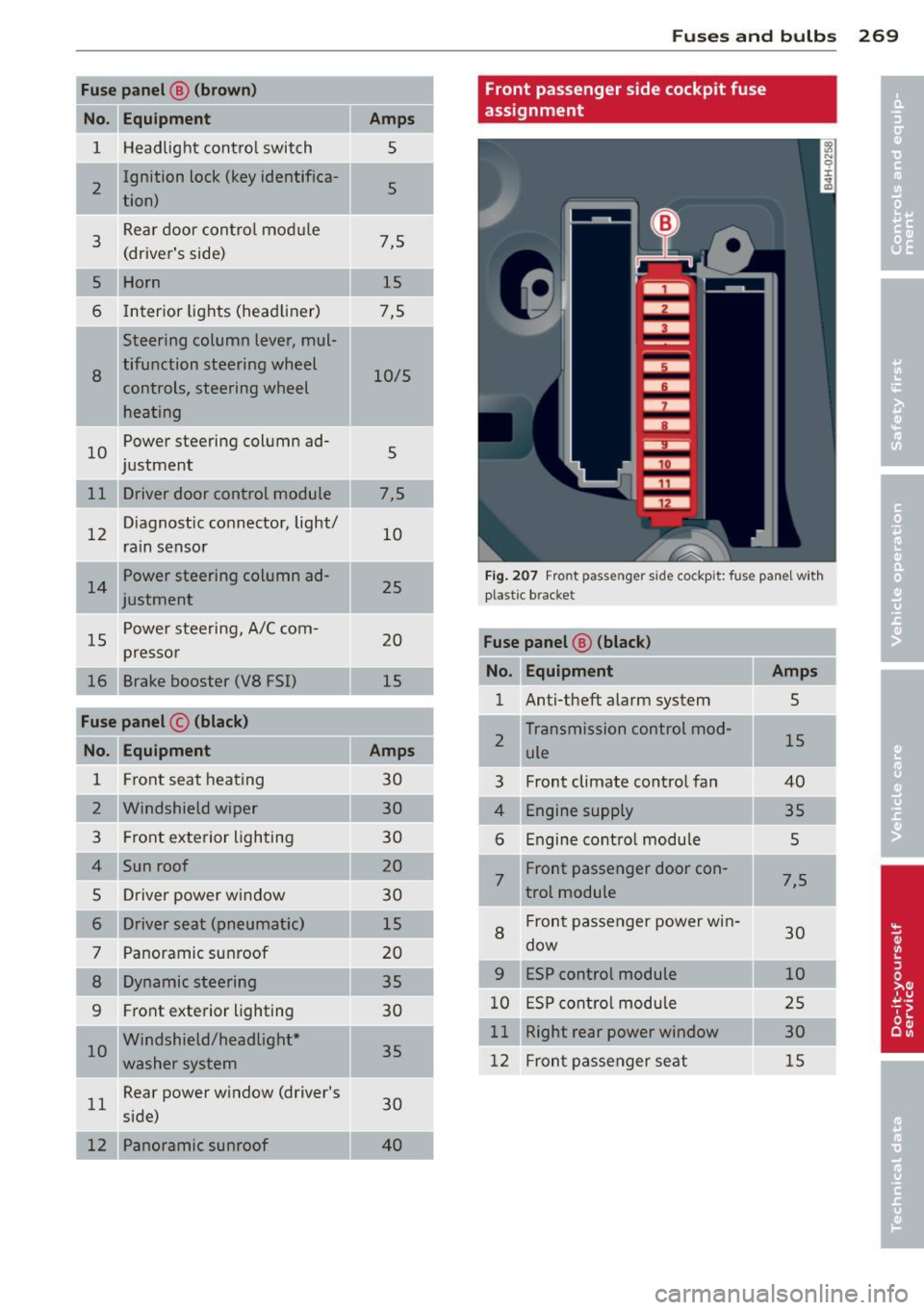
Fuse panel@ (brown)
No. Equ ipment
1 H eadlight contro l switch
I 2
Ignition lock (key identifica-
tion)
3
Rear door control mod ule
(driver's side)
5 Horn
6 Interior lights (head liner)
Steering column lever, mul-
8
tifunction steering wheel
controls, steering wheel
heating
10
Power steering column ad-
j ustment
11 Driver door control module
12
D iagnostic co nnector, light/
rain sensor
Power steering column ad-
justment
15
P ower stee ring, A/C com-
pr esso r
16 Brake booster (VS FSI)
Fuse panel © (black )
No. Equipment
1 F ront seat heating
2 Windshield wiper
3 Fr ont exterior lighting
4 Sun roof
5 Dr iver power window
6 Driver seat (pneumatic)
7 Panoramic sunroof
8 Dynamic steering
9 Fr
ont exterior lighting
I 10
Windshield/headlight *
washe r system
11
Rear power w indow (driver's
side)
12 Panoramic sunroof
Amp s
5
5
7,5 15
7,5
10/5
5
7,5 10
25
20
15
Amps
30 30
30
20
30
15
20 35
30
35
30
4 0
Fu se s and bulb s 269
Front passenger side cockpit fuse
assignment
Fi g. 2 07 Fro nt passe nger s id e co ckpit: f use pa nel w it h
plast ic brac ket
Fuse panel ® (black)
No . Equipment Amps
1 Anti-theft alarm system 5
2
Transmission control mod-
15 ule
3 Front climate control fan 40
4
Engine supply 35
6
Engine cont ro l module 5
7
Front passenger door con-7,5
t rot module
8
Fron t passe nger power w in-
30 dow
9 ESP control module 10
1 0
E S P cont ro l modu le 2 5
11
Right rear power window 30
12
Fron t passe nger seat 15
Page 274 of 302

272 Fuses and bulbs
Fuse panel ® (brown)
No. Equipment
= 11 Radio receiver Cell phone adapter, cell
12 phone/telephone charging
cradle, chip card reader (not
i n all countries)
Bulbs
Replacing light bulbs Amps
= 7,5
5
For
your safety, we recommend that you have
your authorized Audi dealer replace burned
out bulbs for you.
It is becoming increasingly more and more
difficult to replace vehicle light bulbs since in
many cases, other parts of the car must first
be removed before you are able to get to the
bulb . This applies especially to the light bulbs
in the front of your car which you can only
reach through the engine compartment .
Sheet metal and bulb ho lders can have sharp
edges that can cause serious cuts, and parts must be correctly taken apart and then prop
erly put back together to help prevent break
age of parts and long term damage from wa
ter that can enter hous ings that have not been
properly resealed.
For your safety, we recommend that you have
your author ized Audi dealer replace any bulbs
for you, since your dealer has the proper tools,
the correct bulbs and the expertise.
Gas discharge lamps (Xenon lights):
Due to the high electrical vo ltage, have the
bulbs replaced by a qualified technician.
H eadlights with Xenon light can be identified
by the high voltage sticker.
LED headlights* require no maintenance .
Please contact your authori zed Audi dealer if a
bulb needs to be replaced.
A WARNING
Contact with high-voltage components of
the electrical system and improper re- placement
of gas discharge (Xenon) head
light bulbs can cause serious personal in
jury and death.
- Xenon bulbs are pressurized and can ex
plode when being changed.
- Changing Xenon lamps requires the spe
cial training, instructions and equip ment.
- Only an authorized A udi dealer or other
qualified workshop should change the bulbs in gas discharge lamps.
A WARNING
There are parts with sharp edges on the
openings and on the bulb holders that can
cause ser ious cuts.
- If you are uncertain about what to do,
have the work performed by an author
ized Audi dealer or other qualified work
shop. Serious personal injury may result
from imprope rly performed wo rk.
(D Tips
- If you must replace the light bulbs your
self, a lways remember that the eng ine
compartment of any vehicle is a hazard
ous area to work in. A lways read and
heed all WARNINGS¢
page 216, Engine
compartment¢ &..
-It is best to ask your authorized Audi
dealer whenever you need to change a
bulb.
Page 276 of 302

2 7 4 Emergency situations
@ Tips
-The discharged battery must be properly
connected to the vehicle's electrical sys
tem. When jump starting or charging the
battery, never connect the negative
ground cable to the battery negative
post because the battery manager sys
tem must be able to detect the battery 's
state of charge. Always connect the neg
ative g round cable to the negative
ground post of the battery manager con
trol unit .
Use of jumper cables
Make sure to connect the jumper coble
clomps in exactly the order described below!
Fig . 209 Engine compartme nt: connecto rs for jump
start cab les and a charger
Fig. 210 Jump starting w ith the battery of another ve
h icle: A - boos ter battery, B - discharged veh icle battery
The procedure described below for connecting
jumper cables is intended to provide a jump
start for your veh icle.
Vehicle with discharged battery :
.. Turn off lights and accessories, move lever
of automatic transmission to
N (Neutral) or
P (Park) and set parking brake.
Connect POSITIVE(+) to POSITIVE(+)
(red)
.. Open the red cover on the positive terminal
¢fig. 209 .
1. Connect one end of the red positive cable
on the
jump start bolt ¢ fig. 210@ (bolt
under the red cover = "positive") of the ve
hicle to be started @.
2 . Connect the other end to the positive ter-
mi nal @of the booster battery@.
Connect NEGATIVE (-) to NEGATIVE (-)
(black)
3. Connect one end of the black negative ca
ble to the negat ive terminal @ of the
booster battery @.
4. Connect the other end to the
jump start
pin © (bolts with hex head bolt= "nega
tive") of the vehicle to be started @.
Starting the engine
.. Start the engine of the veh icle w ith the
booster battery @. Ru n the engine at a
moderate speed .
.. Start engine with discharged vehicle battery
@ in the usual manner .
.. If the engine fails to start, do not keep the
starter crank ing for longer than 10 seconds.
Wait for about 30 seconds and then try aga in .
.,. With engine running, remove jumper cables
from both vehicles in the exact
reverse or
de r .
.. Close the red cover on the positive term inal.
T he battery is vented to the outside to prevent
gases from entering the vehicle inter ior. Make
s ur e that the jumper clamps are well connect
ed with their meta l parts in full contact with
the battery terminals.
_& WARNING
To avoid se rious personal injury and dam
age to the vehicle, heed all warnings and
in structions of the jumper cable manufac
turer. If in doubt, call for road service .
- Jumper cables must be long enough so
that the veh icles do not touch.
-
Page 289 of 302

A
A/C (automatic climate control) .... .. .. 75
Accessories .. ... .. .. ..... ... .. .. .. . 285
Adaptive a ir suspension/sport .. .. .. .. . 106
adaptive cruise control Stop-and-go traffic . . . . . . . . . . . . . . . . . 89
Adapt ive cruise control ................ 86
C lean ing sensors/cameras ........... 208
Messages . . . . . . . . . . . . . . . . . . . . . . . . . 93
Request for drive r in tervention .. .. .. .. 90
Adapt ive Light (defective) ... .. .. .. ... . 21
Adding Engine coolant ........ ... ... ... ... 230
Eng ine oi l .. .. ........... .. .. .. ... 227
W indshield washer fluid ... .. .. .. .. . 236
Addit ives
Engine oi l .. .... .. .... ... .. .. .. ... 227
Adjustab le steer ing colum n ............ 78
Ad justing
A ir distribution (automatic climate con-
trol) . . . . . . . . . . . . . . . . . . . . . . . . . . . . . . 76
Front seats . . . . . . . . . . . . . . . . . . . . . . . . 54
I nstrument illum inat ion . ..... .... ... 47
S teer ing colum n .......... .. .. .. .. .. 78
Temperatu re (automat ic climate co ntrol) 76
Airbag system . . . . . . . . . . . . . . . . . 145, 164
Advanced A irbag System ............ 149
Advanced Airbag System components . 152
Ca re . .... .. ................. .. ... 158
C hi ldren . .. .. ........... .. .. .. ... 170
Ch ild restra ints .................... 171
Components (front airbags) . ... .. .. . 152
Danger of fitting a child seat on the front
passenger seat . . . . . . . . . . . . . . . . . . . . 147
Disposal . . . . . . . . . . . . . . . . . . . . . . . . . 158
Front airbags . . . . . . . . . . . . . . . . 149, 150
H ow do the front airbags work? ... .. . 154
H ow many airbags does my vehicle
have? ... ..... ........... ...... .. 152
H ow the Advanced Airbag System com -
po nents work together ............. 153
I mportan t safety instructions on the
knee airbag system .... ... .. .. .. .. . 162
Important things to know .... .. .. .. . 145
Knee airbags ............. .... .. ... 161
Mon itoring . . . . . . . . . . . . . . . . . . . . . . . 156
PASSENGER AIR BAG OFF light .. .. .. . 156
Inde x 287
Repairs ... .. .... ... .. .. ..... ... .. 158
Safety instructions . .. ... .... ... .. .. 158
S ide a irbags ... .. .. . .. ... .... ... .. 163
S ide curtain airbags ................ 166
Warning/ind icator lights ............ . 18
Warning/Indicator lights ........... 156
We ight-sensing mat ... .. ..... ... .. 170
When must the system be inspected? 156
Aircraft Transporting your vehicle ........... 277
A lloy wheels . . . . . . . . . . . . . . . . . . . . . . . 211
All Wheel Drive . . . . . . . . . . . . . . . . . . . . . 194
Winter tires . .. .. .... ........... .. 253
Ambience lighting ..... ............. . 46
Anti-freeze
refer to Engine coolan t ...... ... .. .. 229
Anti- lock b raking system ............ . 190
Warning/ind icator lights .......... .. . 19
Anti-slip regulation ............. .... 190
Anti -theft systems
E lectronic immob ilizer .. .. ..... ... .. . 30
Audi braking guard
refer to b ra ki ng g uard .............. . 86
Audi drive select
refer to drive select 106
Audi Service Repair Manuals and Litera-
ture .............................. 283
A UTO
A utomat ic climate control ............ 75
A utomatic head lights .. .. ..... ... .. . 43
Auto Lock . . . . . . . . . . . . . . . . . . . . . . . . . . 31
Automat ic belt retractor . . . . . . . . . . . . . 140
A utomat ic car wash .... ........... .. 207
Automat ic climate control
Air vents . . . . . . . . . . . . . . . . . . . . . . . . . . 76
Automat ic recircu lation .............. 77
Operation . .. .. .. .... ............. . 75
Setup ............................ 77
synchronizing . . . . . . . . . . . . . . . . . . . . . . 76
Automat ic transm iss ion (t iptro nic) . .... 112
Emergency mode . .. ............... 115
K ick-down . .. .. .. ... ............ .. 115
Manua l shift ing . . . . . . . . . . . . . . . . . . . 115
Parking lock eme rgency release .. .. .. 116
Se lector lever positions . .. ..... ... .. 112
Automat ic w ipers ......... ........... 48
Auto Safety Hotline ................. 135
•
•
Page 290 of 302

288 Index
Average consumption ........ ... .... .. 24
Average speed . . . . . . . . . . . . . . . . . . . . . . . 24
Avoid damaging the vehicle .. .. .. .. .. . 198
B
Battery 233
Charging ................... ..... . 235
Important warnings ...... .. .. .. .. . 233
Location . ................. .. .... . 233
low . .. .... .......... ...... ... .. . 195
Replacing the battery ...... ..... .. . 236
State of charge ............... .. ... 195
W inter operation ....... .. .. .. .. .. . 233
Working on the battery .... .. .. .... . 233
Before driving .. ... .... .... .. .. .. .. . 127
Blended gasoline .................. . 218
Blower (automatic climate control) . . . . . . 76
Body cavity sealing ......... .. .. .... . 211
Booster seats
Brake fluid 177
Changing the brake fluid ....... .. .. . 232
Check ing the brake fluid level . .. .. .. . 232
What is the cor rect brake flu id level? . . 232
What should I do if the brake fluid warn-
ing light comes on?
........ .... ... . 232
Brake system Anti-lock braking system . . . . . . . . . . . . . 19
Brake assist system ....... .. .. .... . 190
Brake booster ............ .. .. .. .. . 193
Brake fluid ............... ... .... . 232
Brake fluid specifications for refill and re-
placement ............... ... .... . 232
Brake light defective ...... .. .. .. .. .. 21
Brake pads ... ........... .. .. .... . 197
Electromechanical park ing brake .. .. . . 81
Fluid reservoir ............... .. ... 232
H ow does moisture or road salt affect the
brakes? .. ............... .. .. .... . 192
Warn ing/ indicator lights ... .. .. .... . . 14
Worn brake pads symbol ... .. .. .. .. . . 19
braking guard Messages
Sett ings
. .. ... .......... .. .. .. .. ..
86
93
93
Break-in period . ........... .. .. .... . 197
Brake pads . ... ....... ... .. .. .. .. . 197
Tires 197
Bulbs ..... .. ................ ..... . 272
C
California Proposition 65 Warning ... .. 223
Battery specific . ................. . 235
Capacities .. .. .. .. .... ...... ... .. . .
Engine oil ... .. . .. ............ .. . .
Car care .... .... .................. . 282
224
206
Exterior ....... .. .......... ...... . 206
Interior ..... .. .. ....... ...... .. .. 212
Car carrier Transporting your vehicle ....... .. .. 277
Catalytic converter .............. ... . 198
Center armrest Cockpit ....... .. ..... ........... .. 57
Rear . .. .. .. .. .. ............. .. .. . 63
Central locking . . . . . . . . . . . . . . . . . . . . . . 31
Emergency locking ............. .... . 35
Certification . . . . . . . . . . . . . . . . . . . . . . . 286
Changing a wheel .. ................ . 262
Changing engine oil ............. .... 228
Chassis (undercoat ing) ........... .. . .
Check ing
Engine coolant level ...... ...... .. . -
Tire pressure . .. .. ............. .. . .
Child restraints Danger of using child restraints in the
front seat ..... .. .......... ...... .
Where can I get additional information
about child restraints and their use? ..
Child restraint system anchors .... .. . .
Child safety ... .. .. ................ .
Convertible locking retractor ........ .
Guidance fixtures for lower anchorages
I mportant safety instructions for using
child safety seats .............. ... .
Important things to know when driving
with children . ... ....... .... --. - . - 212
229
244
14
7
187
181
169
178
183
172
169
Tether anchors . .. .......... ...... . 185
Tether straps .. .. ... .. ..... ... .. .. 185
Child safety lock Rear doors (mechanical) ........ .... . 38
Rear doors (power) ...... ...... .. . - - 38
Child safety seats . . . . . . . . . . . . . . . . . . . 17 4
Booster seats . . . . . . . . . . . . . . . . . . . . . 177
Convertible child seats ......... .... 175
Convertible locking retractor ..... .... 178