2011 AUDI R8 SPYDER lock
[x] Cancel search: lockPage 107 of 244

For example, in a frontal collision at a speed
of 30 mph (48 km/h), the forces acting on a 10- lb (4.5 kg) object are about 20 times the
norma l weight of the item. This means that
the we ight of the item would suddenly be
about 200 lbs . (90 kg) . You can imagine the
in juries that a 200 lbs. (90 kg) item flyi ng
freely throug h the pass enge r compartment
could cause in a collision li ke t his.
_& WARNING
Imprope rly stored luggage or other items
can fly through the vehicle ca using se rious
personal in jury in the event of har d brak
ing or an acc ident . To help reduce the r is k
of serious personal injury :
- Always put objects, for examp le, luggage
o r othe r heavy items in the luggage com
partment.
_& WARNING
Heavy loads will influence the way your ve
hicle handles. To help reduce the r isk of a
loss of control leading to ser ious personal
injury:
- Always keep in m ind whe n transporting
heavy objects, t hat a change in t he cen
ter of g ravity can also cause c hanges in
vehicl e handling.
- Never exceed the G ross Ax le Weight Ra t
ing or t he Gross Veh icle Weight Rating
spe cified on t he safety compliance stic k
er on t he left door jamb. Exceeding pe r
missib le we igh t standa rds can cause the
vehicle to s lide and handle differently.
- Please observe info rm atio n on s afe driv
ing
C? page 99.
_& WARNING , ~ ~
Always make su re that the doors, all win
dows and the front lid are securely closed
an d locked to red uce the risk of in jury
when the veh icle is not being used .
- After closing the front lid, a lways make
s u re that it is properly closed and locked .
- Never leave you r vehicle unatten ded es
pecially with the front lid left open . A
Dr iving S afel y 105
child cou ld craw l into the luggage com
pa rtment and close the front lid becom
ing trapped and unable to get out. Be ing
trapped in a veh icle can lead to se rious
pe rsonal injury .
- Never let ch ildren play i n or around the
veh icle .
- Never let passengers ride in t he luggage
compartment . Vehicle occupants must
always be prope rly restra ined in one of
the vehicle 's seating pos it ions .
(D Tips
The t ire pressure must correspond to the
l oad. The t ire press ure is show n on the tire
p ressure label. The tire pressure label is lo
cated on the d river 's s ide B-pillar. The t ire
pressure label lists the recommended cold
tire inflation pressures for the vehicle at
it s m aximum c apac ity we igh t a nd the tires
that we re on your vehicle at the t ime it
was manufacture d. For recommended tire
pressures fo r normal load cond it ions,
please see chapter c::> page 193.
Reporting Safety
Defects
Applicable to U.S.A.
If you believe that your vehi cle
ha s a defect which could cau se
a crash or could caus e injury or
death, you should immediately inform the National Highway
Traffic Safety Administration (NHTSA) in addition to notify
ing Audi of Amer ica , Inc .
If NHTSA receives similar com plaints, it may open an investi
gation , and if it finds that a
safet y defect s exists in a group .,.
•
•
Page 115 of 244

.. Hold the be lt by the tongue and pull it even
l y across the chest and pelvis
c::> &_.
.. Insert the tongue into the correct buckle of
your seat until you hear it latch securely
c::>fig. 118.
.. Pull on the belt to make sure that it is se-
c u rely latched in the buckle.
Automatic safety belt retracto rs
Every safety belt is equipped with an automat
ic belt retractor on the shoulder belt. This fea
ture locks the belt when the belt is pulled out
fast, dur ing hard braking and in an accident.
The belt may also lock when you drive up or
down a steep hill or through a sharp curve.
During normal driving the belt let s you move
freely.
Switchable locking feature
Every safety belt except the one on the driver
seat is equ ipped w ith a switchable locking fea
ture that
must be used w hen the safety belt is
used to atta ch a chi ld seat. Be sure to read the
i mportant information about this fea ture
c::> page 146.
A WARNING
Imprope rly positioned safety belts can
cause serious injury in an accident
c::> page 113, Safety belt position.
- Safety belts offer optimum protection
only when the seatback is upright and
belts are properly positioned on the
body.
-
- Never attach the safety belt to the buck
le for another seat. Attach ing the belt to
the wrong buckle w ill reduce safety belt
effect iveness and can cause serious per
sonal inj ury.
- A passenger who is not properly restrain
ed can be seriously in jured by the safety
belt itself whe n it moves from the stron
ger parts of the body into c ritical a reas
like the abdomen.
- Always lock the convert ible lock ing re
tra ctor when yo u are secur ing a chi ld
sea t in the vehicle
c::> page 148.
Safety belts 113
@ Tips
Depending on veh icle equipment, micro
phones * are located on the safety be lt to
i mprove hands-free call quality. For addi
tional information about safety belt m icro
phones, refer to the infotainment system
owner's manual.
Safety belt position
Correct belt position is the key to getting
maximum protection from safety belts.
Fi g. 119 Head restraint and safety belt position as
seen from the side
"' ra q
"' ., m
Use the height adjustment to change the posi
tion of the shoulder straps of the front seat
safety belts.
A WARNING
Imp roperly posit ioned safety belts can
cause ser ious persona l inju ry in an acci-
dent.
- The s houlder belt portion of the safety
be lt must be positioned over the midd le
of the occupant's shoulder and never
across the neck o r throat.
- The safe ty be lt mus t lie flat and snug on
the occupant's upper body
c::>fig. 119.
Pull on the belt to tighten if necessary.
-
- The lap be lt po rtion of the safety belt
m ust be posit ioned as low as possib le
across pelvis and never over the abdo
men. Make sure the belt lies flat and
snug
r:!) fig. 119. Pu ll on the belt to tight
en if necessary.
- A loose-f itting safety belt can ca use seri
ous injuries by shifting its posit ion on
your body from the strong bones to more
~
Page 131 of 244

Vehicle Safety Standard 208 with which the
Advanced Airbag System in your vehicle was
certified.
I f the front passenger seat is not occ upied,
the front airbag will not deploy, and the
PA S
SENGER A IR BAG OF F
light will stay on. Nev
er insta ll a rearward-fac ing ch ild restra int on
the front passenger seat
c:> page 119, Child
restraints on the front seat -some important
things to know
and c:> page 138, Child Safety.
If the PASSENGER AIR BAG OFF light c om es
on
when one of the conditions listed above is
met, be sure to check the light regularly to
make certa in that the
PA SS ENG ER AIR BAG
OFF
light stays on cont inuously whenever the
ign it ion is on. If the
PA SSENGER AIR BA G
OFF
l ight does not appear on and stay on a ll
the t ime, stop as soon as it is safe to do so
and
- react ivate the system by turning the ignition
off and then tu rning it on again;
- remove and reinstall the chi ld restraint .
Make sure that the child restraint is properly
insta lled and that the safety be lt fo r the
front passenger seat has been correct ly
ro uted through the child restraint as descri
bed in the chi ld restraint man ufacturer's in
structions;
- make su re that the convertible locking fea
ture on the safety be lt for the front passen
ger seat has been activated and that the
safety belt has been pulled tight. The belt must not be loose or have loops of slack so
t h at the sensor below the safety belt latch
on the seat can do its job
c:> page 146;
- make sure that th ings that may increase the
weight of the ch ild and child safety seat are
not being transported on the front passen
ger seat;
- make sure that the safety belt tension sen
sor is not b locked. Shake the safety belt
latch on the front passenge r seatbac k and
forth;
- If a st rap or tether is being used to tie the
c hild safety seat to t he fro nt passenger
seat, make s ure t hat i t is no t so tight that it
A irbag system 129
causes the weight -sensing mat to measure
more weight than is act ually on the seat.
If th e PASSENGER AIR BAG OFF li ght s till
d oes not come on
and does not stay on con
tin uous ly (when the ignition is switched on),
- take the child rest ra int off the front passen-
ge r seat and have the a irb ag sys tem inspect
ed by yo ur authorized Aud i dealer. Do not
transport children witho ut a c hil d safety
seat.
T he
PASSENGER AIR BAG OFF lig ht sho uld
NOT come on when the ignit ion is on and an
adult is s itting in a proper seating position on
the front passenger seat . If the
PASSENGER
AIR BAG OFF
light comes on and stays on or
flashes for about 5 seconds wh ile driving, un
der these c ircumstances, make sure that:
- the adult on the front passenger seat is
properly seated on the center of the seat
cushion with his or her back up aga inst the
backrest and the backrest is not recl ined
c:> page 100, Proper occupant seating posi
tions,
- the adult is not tak ing weight off the seat by
holding on to the passenger assist handle
above the front passenger door or support
ing their weight on the armrest,
- the safety belt is be ing properly worn and
that there is not a lot of s lack in the safety
be lt webbing,
- accesso ry seat covers or cushions or other
things that may cause an inco rrect reading
or impression on the weight-sensing mat
under t he upho ls tery of the sea t have been
removed from the front passenger sea t,
- a safety belt extender has not been left in
the sa fe ty belt latch for the fron t passenger
seat.
In add ition to the
PASSENGER AIR BAG OFF
l igh t in the center of the instrument panel,
the message
PASSENGER AIR BAG OFF or
PASSENGER AIR BAG ON w ill briefly appear
i n the instrument cluster disp lay. This is to in
form the dr iver of the current front passenger
airbag status.
•
•
Page 143 of 244
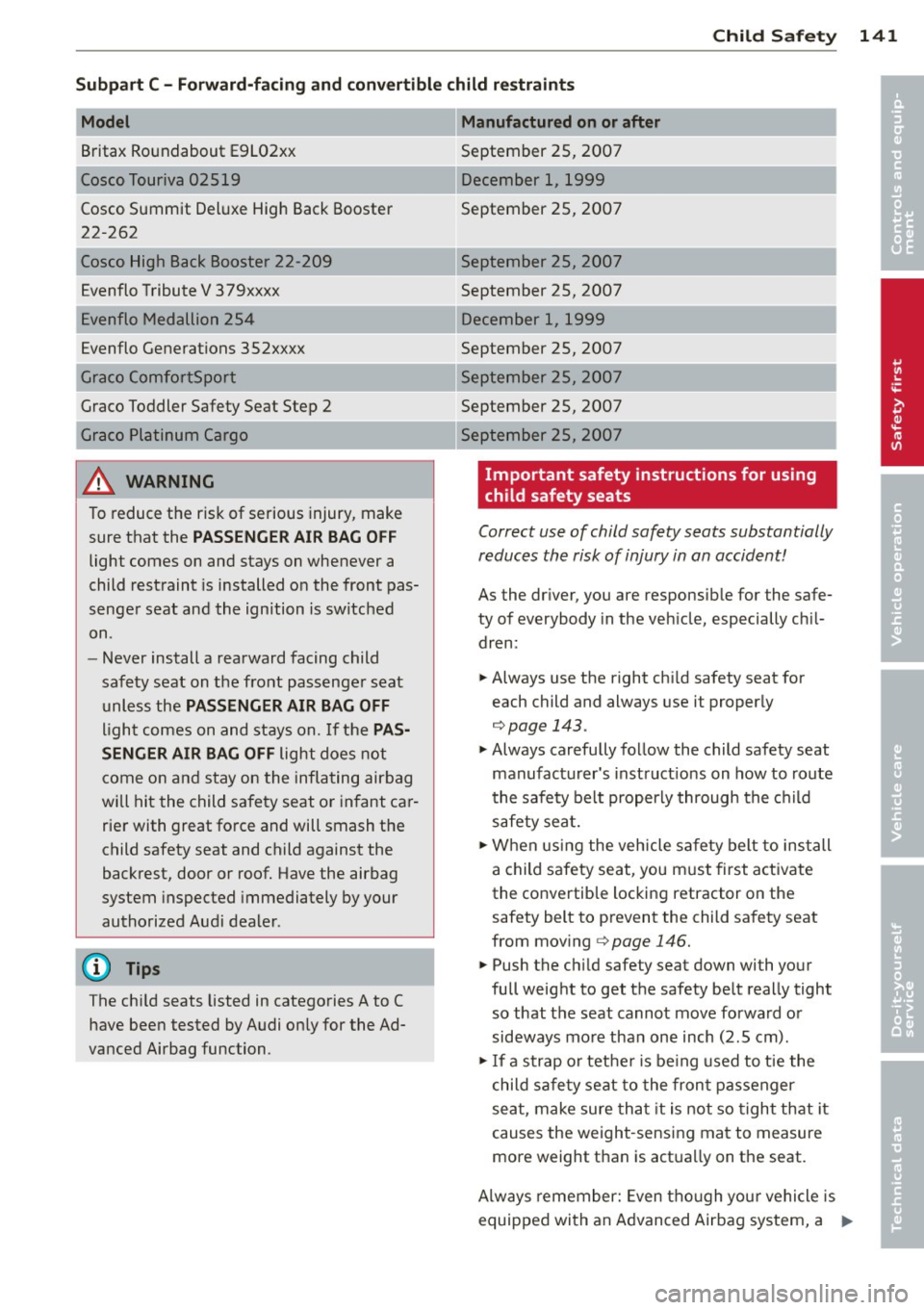
Child Safety 141
Subpart
C -Forward-facing and convertible child restraints
Model
Britax Roundabout E9L02xx
Cosco Touriva 02519
Cosco Summit Deluxe High Back Booster
22-262
Cosco High Back Booster 22-209
Manufactured on or after
September 25, 2007
December 1, 1999
September 25, 2007
September 25, 2007
September 25, 2007
Evenflo Tribute V 379xxxx
E venflo Medallion 254
----------
Evenflo Generations 352xxxx
Graco ComfortSport
----~-,
December 1, 1999
September 25, 2007
September 25, 2007
September 25, 2007
Graco Toddler Safety Seat Step 2
Graco Platinum Cargo
-------
& WARNING
To reduce the risk of serious injury, make
sure that the
PASSENGER AIR BAG OFF
light comes on and stays on whenever a
child restraint is installed on the front pas
senger seat and the ignition is switched
on .
- Never install a rearward facing child
safety seat on the front passenger seat
unless the
PASSENGER AIR BAG OFF
light comes on and stays on. If the PAS
SENGER AIR BAG OFF
light does not
come on and stay on the inflating airbag
will hit the child safety seat or infant car
rier with great force and will smash the
child safety seat and child against the
backrest, door or roof. Have the airbag
system inspected immediately by your
authorized Audi dealer .
(D Tips
The child seats listed in categories A to C
have been tested by Audi only for the Ad
vanced Airbag function. September 25, 2007
Important safety instructions for using
child safety seats
Correct use of child safety seats substantially
reduces the risk of injury in an accident!
As the driver, you are responsible for the safe
ty of everybody in the veh icle, especially ch il
dren:
.., Always use the right chi ld safety seat for
each child and always use it properly
¢page 143.
.., Always carefully follow the child safety seat
manufacturer's instruct ions on how to route
the safety belt properly through the child
safety seat.
.., When using the vehicle sa fety belt to install
a child safety seat, you must first activate
the convertib le locking retractor on the
safety belt to prevent the child safety seat
from moving ¢
page 146.
.., Push the ch ild safety seat down with your
full weight to get the safety belt really tight
so that the seat cannot move forward or
sideways more than one inch (2 .5 cm).
"'If a strap or tethe r is being used to tie the
child safety seat to the front passenger
seat , make sure that it is not so tight that it
causes the weight-sensing mat to measure
more weight than is actua lly on the seat.
Always remember: Even though your vehicle is
equipped with an Advanced Airbag system, a .,..
•
•
Page 145 of 244

-Always buc kle the c hild safety seat firmly
in place even if a child is not s itting in it.
A loose ch il d safety seat can fly ar ound
dur ing a su dden stop or in a col lisio n.
- Always read and heed all WARNINGS
whenever using a child restrained in ave
hicle is being used
<=> page 109, Safety
belts,
c> page 117, Airbag system and
¢ page 138, Child Safety.
A WARNING
To reduce the risk of serious injury, make
sure that the
PASSENGER AIR BAG OFF
light comes on and stays on whe never a
child rest rain t is installed on the front pas
senger seat and the ignition is switched
on.
- Never install a rearward facing child safety seat on the front passenger seat
unless the
PASS ENGER AIR BAG OFF
light comes on and stays on. If the PAS
SENGER AIR BAG OFF
light does not
come o n and stay on the inflating airbag
w ill hit the child safety seat o r infant car
rier with great fo rce and will smash the
child safety seat and child again st the
backrest, door or roo f. Have the airb ag
system inspected immedia tely by your
authorized Audi dea ler.
Child safety seats
Infant seats
.
Babies and infants up to about one year old
and 20 lbs. or 9 kg need special rearward-fac
ing child restraints that support the back,
neck and head in a crash.
Fi g. 1 30 Rearward -fac ing infa nt seat , prope rly in sta l
le d on t he p asse nger seat
Child S afety 143
.. When using the vehicle sa fet y belt to install
a child safety seat , you must first activate
the convertible locking retractor on the
safety belt to prevent the child safety seat
from mov ing
c> page 146.
.. Push the ch ild safety seat down with you r
full weig ht to get t he safety be lt really tight
so that the seat cannot move forwa rd o r
sideways mo re tha n one inch ( 2.5 cm).
Infants up to about one year
(20 lbs . or 9 kg)
are best protec ted in spec ial infant carriers
and ch ild safety seats designed for thei r age
gro up. Ma ny exper ts believe that infants and
sm all chi ld ren s hou ld r ide o nly in speci al re
stra ints in which the child faces the back of
the ve hicle . These infant seats sup port the ba
by's back, neck and head in a c rash
c> fig . 130 .
A WARNING
Not using a child safety seat, using t he
wrong child safety seat or improperly in
stalling a ch ild restrai nt increases the risk
of ser ious personal inju ry and death in a
crash.
- Never i nstall a rear -fac ing ch ild restrai nt
in the forward-facing d irect ion . Such re
straints are designed for the special needs of infants and very small chi ldren
and cannot pro te ct them properly if the
seat is forward- facing.
-
- Never install a rearward facing child
safe ty sea t on the fron t passenger sea t
unless t he
PASSENGER AIR BAG OFF
light comes on and stays on. If the PAS·
SENGER AIR BAG OFF
li ght does not
come on and stay on the inf lating a irbag
wi ll hit the child safety seat or infant car
rier w ith great f orce and w ill smash the
child safety seat and child agai nst t he
backrest, door or roof. Hav e the a irbag
sy stem in spected immediately by your
a uthor ized A udi de aler.
- Always rea d and heed all WAR NIN GS
wheneve r us ing a child res traine d in ave
hicle is be ing used
c> p age 109, Safety
belts, ¢page 117, Airbag system
and
c> page 138, Important things to know .
Page 146 of 244

144 Child Safet y
Convertible child safety seats
Properly used convertible child safety seats
can help protect toddlers and children over
age one who weigh between
20 and 40 lbs. (9
and 18 kg) in a crash.
Fig . 13 1 Schematic overv iew: in stallat ion of t he seat
us ing the ve hicle's safety belt system
~ When using the vehicle safety belt to install
a ch ild safety seat, you must first activate
the convertible locking retractor on the safety belt to prevent the c hild safety seat
from movi ng
Qpage 146.
~ Push the child safety seat down with your
full weight to get the safety belt rea lly tight
so that the seat cannot move forward or
sideways more than one inch (2.5 cm)
Qpage 146.
A toddler or child is usually too large for an in
fant restraint if it is more than one year old
and weighs more than 20 lbs. (9 kg) .
Toddlers and c hildren who are o lder than one
year up to about 4 years o ld and weigh more
than 20 lbs. (9 kg) up to 40 lbs. (18 kg) must
a lways be properly restrained in a child safety
seat certified for their size and weight
Qfig. 131 .
&_ WARNING
Not using a ch ild safety seat, us ing the
w rong ch ild safety seat or improperly in
stal ling a child re straint increases the risk
o f se rious persona l injury and de ath in a
co llision or othe r eme rgency s ituation.
- Children on t he front seat of a ny car,
even w ith Advanced A irbags, can be seri
ous ly injured or even killed when an air -bag inflates. A chi
ld in a rearward-facing
child safety seat installed on the front
passenger seat will be serious ly injured
and can be killed if the front airbag in
flates -even with an Advanced Airbag
System .
- The inflating airbag will h it the ch ild
safety seat or infant carrie r with great
for ce and will smash the child saf ety seat
and child aga inst the ba ckrest, doo r or
roof.
- Neve r install a rearward facing child
safety sea t on the fron t passenger sea t
un less t he
PASSENGER AIR BAG OFF
light comes on and stays on. If the PAS
SENGER AIR BAG OF F
light does not
come on and stay on have the airbag sys
tem inspected immediately by your au
thorized Audi dealer.
- Always read and heed all WARNINGS
whenever us ing a child restrained in ave
h icle is being used
¢ page 109, Safety
belts,
Q page 117, Airbag system and
Q page 138, Important things to know .
&_ WARNING
--
If exceptional circumstances require the
use of a fo rward-facing child restraint on
the front pa ssenger 's sea t, the child's safe
ty and we ll-bei ng req uire t hat the fo llow
i ng spec ial precautions be taken:
- Make sure the forward- facing seat has
been designed and cert ified by its man u
facturer for use on a front seat with a
passenger front and side airbag.
- Always follow the manufacturer 's in
structions p rovided with the chi ld safety
seat or carrie r.
- A lways move the front passenger seat in
to the rearmost position of the passen ger seat's fore and aft adjustment range,
and as far away from the airbag as possib le before installing t he ch ild restraint.
- Always make sure that nothing prevents
the front passenger 's seat from being
moved to the rearmost position in its
fore and aft adjustment range .
Page 147 of 244

-Always make sure the backrest 1s in an
upr ight position .
- Make sure that the
PASSENGER AIR BAG
OFF
light comes on and stays on all the
t ime whenever the ignition is switched
on.
- If the light does not stay on, perform the
checks
c;, page 128, Monitoring the Ad
vanced Airbag System.
- If the PASSENGER AIR BAG OFF light
does not come on and stay on have the
airbag system inspected immed iate ly by
your authorized Aud i dealer .
Booster seats and safety belts
Properly used booster seats can help protect
children weighing between about 40 lbs. and
80 lbs. (18 kg and 36 kg) who are less than 4
ft. 9 in. (57 inches/1 .45 meters) tall .
Fig. 132 Passenger seat : child proper ly rest ra in ed in a
booster seat
The vehicle's safety belts alone will not fit
most children until they are at least 4
ft. 9 in.
(57 inches/1.45 meters) tall and weigh about
80 lbs. (36 kg). Booster seats raise these chil
dren up so that the safety belt will pass prop
e rly over the stronger parts of their bodies
and the safety belt can help protect them in a
crash .
• Do not use the convertible locking retractor
when using the vehicle's safety belt to re
strain a child on a booster seat.
• Always position the shou lder portion of the
safety belt midway over the child's shoulder .
• Always make sure that the shoulder portion
of the safety belt never rests against or
across the ch ild's neck.
Child Safety 145
• Always make sure that the chi ld can properly
wear the lap portion of the belt low across
the th ighs or pelvis and
never over the
stomach or abdomen.
Children up to at least 8 years old (over 40
lbs. or
18 kg) are best protected in child safe
ty seats designed for their age and weight . Ex
perts say that the skeletal structure , particu
larly the pelvis, of these children is not fully
developed, and they must not use the vehicle
safety belts without a suitable ch ild restra int.
It is usually best to put these children in ap
propr iate booster seats . Be sure the booster
seat meets all applicable safety standards .
Booster seats raise the seating position of the
child and reposition both the lap and shoulder
parts of the safety belt so that they pass
across the ch ild's body in the right places . The
routing of the belt over the child's body is very
im portant for the child's protect ion, whether
or not a booster seat is used.
Children who are at least 4
ft. 9 in . (57 in
ches/1.45 meters) tall can generally use the
vehicle 's three point lap and shoulder belts.
Never use the lap belt port ion of the vehicle's
safety belt alone to restra in any child, regard
less of how big the chi ld is. A lways remember
that children do not have the pronounced pel
vic structure required for the proper function
of lap belt portion of the vehicle's three point
lap and shoulder belts. The child's safety ab
solutely requires that a lap belt portion of the
safety belt be fastened snugly and as low as
poss ible around the pelvis. Never let the lap
belt portion of th e safety be lt pass over the
child's stomach or abdomen.
In a crash, a irbags must inflate within a blink
of an eye and with considerable force . In order
to do its job, the airbag needs room to inflate
so that it will be there to protect th e occupant
as the occupant moves forwa rd into the air
bag .
A vehi cle occupant who is out of position and
too close to the airbag gets in t he way of an
inflating airbag. When an occupa nt is too
close, he or she will be struck violently and
Ill-
Page 148 of 244

146 Child Safety
will receive serious or possibly even fata l in
jury.
I n o rder for the airbag to offe r protection, it is
important that all vehicle occupants, especia l
l y any children, who must be in the front seat
because of exceptional circumstances, be
properly restrained and as far away from the
a irbag as poss ible. By keep ing room between
the child's body and the front of the passen
ger compartment, the airbag can inflate com
pletely and provide supplemental protection
in certain frontal collisions.
_& WARNING
Not using a booster seat, us ing the boos
ter sea t imprope rly, incorre ct ly ins talling a
booste r seat or using the vehicle safety
belt improperly increases the risk of seri
ous personal injury and death in a collision
or other emergency s ituation. To help re
duce the risk of ser ious persona l injury
and/or death:
-Always make sure to position the should
er port ion of the three-po int belt over
the midd le of ch ild's shou lder .
- Never let the shoulder port ion of the belt
rest against or across the neck, face,
chin , or throat of the child .
- Always make sure the lap belt portion of
the three-po int be lt is worn snug and
passes as low as possib le across the
child's pelvis. Neve r let the belt pass over
the soft abdomen .
- Failure to properly route safety belts
over a ch ild 's body will cause severe inju
ries in an ac ciden t or other emergency
situa tion
9 page 109 .
-Children on the front seat of any car,
even w ith Advanced A irbags, can be seri
o usly injured or even killed when an air
bag inf lates .
- Never le t a child sta nd or knee l on the
sea t.
- Never let a child ride in the ca rgo a rea of
yo ur vehicle .
- Always remember that a ch ild lean ing
forward, si tting s ideways or out of posi-
.
tion in any way d uring an accident can be
struck by a dep loying a irbag. This will re
sult in ser ious personal injury or death.
- If you must install a booster seat on the
front passenger seat because of excep
tional circumstances the
PASSENGER
AIR BAG OFF
li ght m ust come on and
stay on, whenever the ignition is switch
ed on.
- If the
PASSENGER AIR BAG OFF light
does not come on and stay on, pe rform
the che cks descr ibed
9 page 128, Moni
toring the Advan ced Airbag System.
- If the PASSENGER AIR BAG OFF li ght
does not come on and stay on whenever
the igni tion is switched on the infla ting
a ir bag w ill hi t the child sa fety seat or in
fant car rier with g reat force an d will
smash the child safety seat and child
aga inst the backrest, door or roof. Have
the airbag system inspected immed iately
by your Audi dea ler.
- Always read and heed all WAR NINGS
whenever using a child restrained in ave
h icle is being used
¢ page 109, Safety
belts, ~page 117, Airbag system
and
~ page 138, Important things to know.
Installing a child safety
seat
' Securing a child safety seat using a
safety belt
Safety belts for the front passenger con be
locked with the convertible locking retractor
to properly secure child safety seats .
The safety belts emergency locking retractors
for the front passenger's seat safety belt have
a convertible locking retracto r fo r ch ild re
st ra ints . The safety be lt must be loc ked so
that be lt webb ing ca nnot unree l. The retrac
tor can be act ivated to lock the safety belt and
prevent the safety be lt webb ing from loosen
ing up during norma l dr iv ing. A chi ld safety
seat can only be properly insta lled when t he
safety belt is locked so that the child and child
safety seat will stay in place. .,.