2011 AUDI R8 SPYDER instrument panel
[x] Cancel search: instrument panelPage 113 of 244
-Always keep feet in the footwell in front
of the seat while the vehicle is being driv
en .
- Never let any person ride with feet on
the instrument panel or sticking out the
window or on the seat.
- Never remove a safety belt while the ve hicle is moving. Doing so will increase
your risk of being injured or killed .
- Never wear belts twisted.
- Never wear belts over rigid or breakable
objects in or on your clothing, such as
eye glasses, pens, keys, etc., as these
may cause injury.
- Never wear the shoulder part of the belt
under your arm or otherwise out of posi
t ion .
- Several layers of heavy clothing may in
terfere with correct positioning of belts
and reduce their effectiveness .
- Always keep belt buckles free of anything
that may prevent the buckle from latch
ing securely .
- Never use comfort clips or devices that
create slack in the shoulder belt. Howev
er, special clips may be required for the
correct use of some chi ld restraint sys
tems.
- Never allow safety belts to become dam
aged by being caught in door or seat
hardware.
- Torn or frayed safety belts can tear and
damaged belt hardware can break in an
accident. Inspect belts regularly.
If web
bing, bindings, buckles, or retractors are
damaged, have belts replaced by an au
thorized Audi dea ler or qualified work
shop.
- Safety belts that have been worn and
loaded in an accident must be replaced
with the correct replacement safety belt
by an authorized Audi dealer or qualified
workshop . Replacement may be necessa
ry even if damage cannot be clearly seen.
Anchorages that were loaded must also
be inspected .
- Never remove, modify, disassemble, or
try to repair the safety belts yourself.
Safety belts 111
-Always keep the belts clean. Dirty belts
may not work properly and can impair
the function of the inertia reel
c:> page 168, Safety belts .
Illustrating the
principle of an accident
Frontal collisions and the law of physics
Frontal crashes create very strong forces for
p eople riding in vehicles .
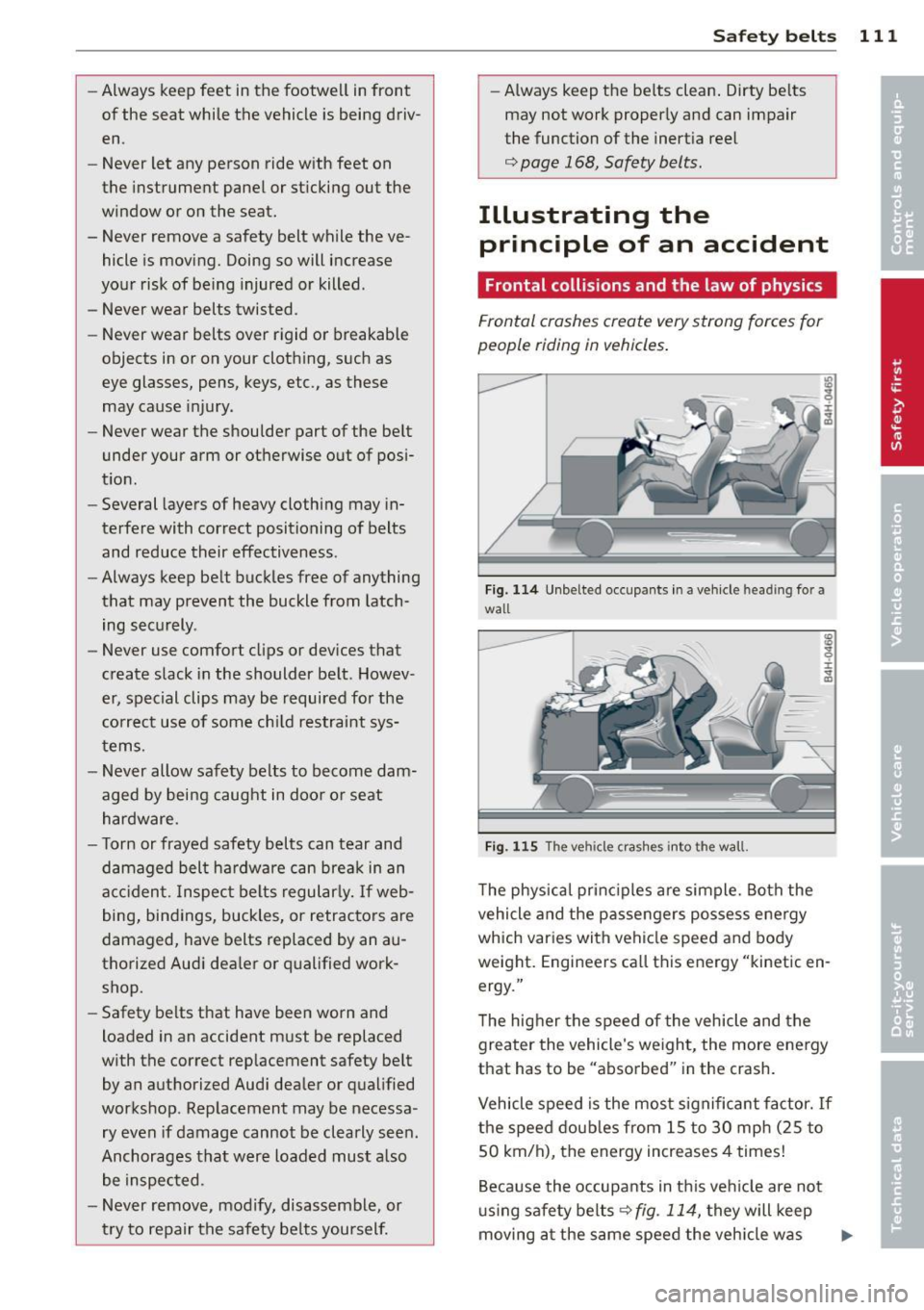
Fig. 114 Unbelted occupants in a vehicle heading for a
wa ll
Fig. 11S The ve hicle c rashes in to the wal l.
The physical principles are simple. Both the
vehicle and the passengers possess energy
which vari es with vehicle speed and body
weight. Eng ineers call this energy "k inetic en
ergy."
The higher the speed of the vehicle and the
greater the vehicle's weight, the more energy
that has to be "absorbed" in the crash.
Vehicle speed is the most significant factor.
If
the speed doubles from 15 to 30 mph (25 to
50 km/h), the energy increases 4 times!
Because the occupants in this vehicle are not
using safety belts
c:>fig . 114, they will keep
moving at the same speed the veh icle was .,,_
Page 114 of 244

112 Safet y belt s
movin g ju st before the crash, unti l something
stops them· here, the wall
r::!;> fig. 115.
The same pr inc iples apply to people sitting in
a veh icle that is involved in a fronta l co llision .
Even at city speeds of 20 to 30 mph (30 to 50
km/h), the forces acting on the body can
reach one ton (2,000 lbs., or 1,000 kg) or
more. At higher speeds, these forces are even
greater .
Peop le who do not use safety be lts are a lso
not attached to their vehicle. In a fronta l colli
sion they will also keep mov ing forward at the
speed their vehicle was trave lling just before
the crash . Of course, the laws of physics don't
just apply to frontal coll is ions, they determ ine
what happens in all kinds of accidents and col·
lisions.
What happens to occupants not wearing
safety belts?
In crashes, unbelted occupants cannot stop themselves from flying forward and being in
jured or killed. Always wear your safety belts!
Fi g. 11 6 A driver not wear ing a safety belt is violently
t h rown forward
Unbe lted occupants are not able to res ist the
tremendous fo rces of impact by holding tight
or brac ing themselves. Without the benef it of
safety restraint systems, the unrestrained oc·
cupant w ill slam vio lent ly into the steering
wheel, instrument panel, windshield, or what eve r else is in the way¢
fig. 116. This impac t
with the veh icle inter ior has all the energy
they had just before the crash.
Neve r rely on airbags a lone for p rotection.
E ven when they deploy, airbags provide only
addit ional p rotec tion. A irbags are no t sup- posed to deploy in all k
inds of accidents . Al
though your Audi is equipped with airbags, all
vehicle occupants, includ ing the driver, must
wear safety belts correctly in order to mini
mize the risk of severe injury or death in a
crash .
Remember too, that airbags will deploy only
once and that your safety belts are always
there to offer protection in those accidents in
which airbags are not supposed to dep loy or
when they have already dep loyed. Unbelted
occupants can a lso be th rown out of the veh i
cl e where even more severe or fatal injuries
ca n occ ur.
How are safety belts
worn correctly?
Fastening safety belts
Seat first · everybody buckle up!
Fig . 11 7 Head restraint adjustment and belt position
Fig. 11 8 Belt buck le an d tongue on the dri ver's seat
To p rov ide max imum protect ion, safety belts
must a lways be posi tioned co rrec tly on the
wea rer's body.
.. Adjust the front seat and head rest raint
p rope rly
r::!;> page 66, Seats and storage.
Page 120 of 244

118 Airbag sys te m
Since the cir cumstances will vary considerab ly
between one collision and anot her, it is not
possib le to def ine a range of vehicle speeds
that will cover every possible k ind and angle
of impact that will always trigger the airbags.
Important factors include, for example, the
nature (hard or soft) of the object which the
car h its, the ang le of impact, vehicle speed,
etc. The front airbags will also not inflate in
side or rea r collisions, or in ro ll-overs .
Always remember : Airbags will deploy only
once, and only in certa in kinds of co llisions.
Your safety belts are always there to offer pro
tection in those s ituations in which airbags
are not supposed to deploy, or when they have
a lready deployed; for example, when your ve
hicle strikes or is struck by another vehic le af
ter the first co llision.
This is just one of the reasons why an airbag is
a supplementary restraint and is not a substi
tute for a safety belt . The airbag system
works most effect ively when used with the
safety belts. Therefore, always wear your safe
ty belts properly
c;, page 109.
A WARNING
Sitting too close to the steer ing wheel or
instrument panel will dec rease the effec
tiveness of the airbags and will increase
t he risk of personal injury in a co llision .
- Never sit closer than 10 inches (2S cm)
to the stee ring wheel or instrument pan
el.
- If you cannot sit more than 10 inches
( 2 5 cm) from the steer ing whee l, investi
ga te whethe r adaptive equipmen t may
be available to help you reach the pedals
and increase your seating distance from
the steering wheel.
- If you are unrestrained, lean ing fo rward,
sitting sideways or out of position in any
way, your risk of in jury is much higher.
- You will also receive serio us inj uries and
cou ld even be killed if you are up against
the airbag or too close to it when it in
flates - even with an Advanced Airbag. -
To reduce the risk of injury when an a ir
bag inflates, always wear safety be lts
properly ¢
page 112, How are safety
belts worn correctly? .
-Never let children ride unrestrained or
improperly restrained in the vehicle. Ad
just the front seats properly . If children
are not p roperly restrained, they may be
seve rely in ju red or killed when an a irbag
infla tes.
- Never ride with the back rest reclined.
-Always sit as far as possible from the steer ing whee l or the instrument pane l
c;, page 100, Prop er occupant seating
positions.
- Always sit up right with your back against
the backres t of your seat.
- Never p lace your feet on the instrument
panel or on the seat. Always keep both
feet on the f loor in front of the sea t to
he lp preven t serio us in juries to the legs
and h ips if the airbag infla tes .
- Never re cline the front passenger's sea t
to tr anspor t ob jec ts. Items c an al so
move into the a rea of the s ide airbag or
the front airbag during braking or in a
sudden maneuver . Objects near the air
bags can become projectiles and cause
in ju ry when an airbag inflates.
A WARNING
Airbags that have deployed in a crash must
be replaced.
- Use on ly orig inal equipment airbags ap
proved by Aud i and installed by a trained
technician who has the necessary tools and d iagnost ic equipment to properly re
p lace any airbag in your vehicle and as
sure sy stem effe ctive ness in a crash.
- Never permit salvaged or recycled air
bags to be installed in you r vehicle.
Page 121 of 244

Child restraints on the front seat - some
important things to know
.. Be sure to read the important informat ion
and heed the WARNINGS for important de
tai ls about chi ldren and Advanced Airbags
i=> page 138.
Even though your vehicle is equipped with an
Advanced Airbag System, make certain that
a ll chi ldren, especially those 12 years and
younger, are properly restrained for their age and s ize. The airbag on the passenger side
makes the front seat a potentially dangerous
p lace for a child to ride . The front seat is not
the safest place for a child in a forward-facing
chi ld safety seat. It can be a very dangerous
p lace for an infant or a c hild in a rearward-fac
ing seat.
The Advanced Airbag System i n your veh icle
h as been cert ified to comp ly with the require
men ts of Uni ted States Federa l Mo to r Veh icle
Safety Standard
208 as applicable at the time
your ve hicle was manufactured.
The Standard requires the fron t air bag on the
passenger side to be turne d off ("sup
p ressed") if a chi ld up to about one year of
age restrained in one of the rear -facing or for
ward -facing infant restraints listed i n Federal
Motor Vehicle Safety Standard
208 with wh ich
the Advanced Airbag System in your vehicle
was certified has been installed o n the front
passenger seat . For a listing of the child re
straints that we re used to certify compliance
w ith the US Safety Sta ndard
c> page 140.
T he PASSENGER AIR BAG OFF light in the in
strument panel te lls you when the front Ad
vanced A irbag on the passenger side has been
turned off by the e lectronic control u nit.
Each t ime you tur n on the ignition, the
PAS
SENGER AIR BAG OFF
l ight w ill come on for a
few seconds a nd:
- will stay on if the front passenger seat is not
occup ied ,
- will stay on if there is a small child or ch ild
restraint on the front passenger seat,
A irbag sys tem 119
- will go off if the front passenger seat is oc
cupied by an adult as registered by the
weight -sensing mat
c> page 128, Monitor
ing the Advanced Airbag System.
T he PASSENGER AIR BAG OFF light comes on
whe n the contro l unit detects a tota l weight
on the front passenger seat that req uires the
front a irbag to be turned off.
If the total weight on the front passenge r
seat is more than that of a typical
1 year-o ld
c h il d but less than the weight of a small
adult, the front airbag on the passenger side can deploy (the
PASSENGER AIR BAG OFF
li ght does not come on). If the PASSENGER
AIR BAG OFF
light does not come on, the
front a irbag on the passenger side has not
been turned off by the elect roni c con trol unit
and can deploy if the control unit se nses an
impact that meets the cond it ions stored i n its
memory .
For example, th e airb ag may deplo y if:
- a small ch ild that is heav ie r than a typical 1
year-old ch ild is o n the front passenger seat
(regard less of whether the child is in one of
the ch ild safety seats listed
c> page 140), or
- a child who has outgrown chi ld restraints is
on the front passenge r seat.
If the front passenger airbag is turned off, the
PASSENGER AIR BAG OFF light in the center
of the instrument panel will come on and stay
o n.
The front airbag on the passenger side may
not deploy (t he PASSENGER AIR BAG OFF
light does not illum inate and stay lit) ev en if a
small ad ult o r teenager, or a passenge r who is
not si tt ing upr ight w ith their b ack against a
non -recli ned ba ck rest w ith their feet on the
vehicle floor in front of the sea t is on t he front
passenger seat
c> page 100, Proper seating
position for the driver.
If t he fron t passenger airbag dep loys, the
Federa l Standar d requ ires the airbag to meet
the "low risk" dep loyment criteria to red uce
the risk of injury th ro ugh interaction with the
airbag. "Low risk" dep loyment occurs in those .,.. •
•
Page 123 of 244

-Improper installation of child restraints
can reduce their effectiveness or even
prevent them from providing any protec
tion .
- An improperly installed child restraint
can interfere with the airbag as it de
ploys and seriously injure or even kill the
child -even with an Advanced Airbag
System.
-Always follow the manufacturer's in
structions provided with the child safety
seat or carrier carefully.
- Never place additional items on the seat
that can increase the total weight regis
tered by the weight-sens ing mat and can
cause injury in a crash .
Front airbags
Description of front airbags
The airbag system con provide supplemental
protection to properly restrained front seat occupants.
Fig. 122 Location of drive r airbag : in steerin g wheel
Fig. 123 Locat ion of front passenger 's a irbag: in the in
s trum ent panel
Your vehicle is equipped with an "Advanced
Airbag System" in compliance with United
States Federal Motor Vehicle Safety Standard
Airbag system 121
(FMVSS) 208 as applicable at the time your
vehicle was manufactured . The safety belts
for the front seats have "pretensioners" that help to take slack out of the belt system. The
pretensioners are also activated by the elec
tronic control unit for the airbag system .
The front safety belts also have load limiters
to help reduce the forces applied to the body
in a crash.
The a irbag for the driver is in the steer ing
wheel hub<=)
fig. 122 and the airbag for the
front passenger is in the instrument panel
r:::> fig . 123. The general location of the airbags
is marked '' AIRBAG" .
There is a lot you need to know about the air
bags in your vehicle. We urge you to read the
detailed information about airbags, safety
belts and child safety in this and the other
chapters that make up the owner's literature.
Please be sure to heed the WARNINGS - they
are extremely important for your safety and
the safety of your passengers, especially in
fants and small children.
& WARNING
=
Never rely on airbags alone for protection.
- Even when they deploy, airbags provide
only supplementa l protection .
- Airbag work most effectively when used
with properly worn safety belts.
- Therefore, always wear your safety belts
and make sure that everybody in your
ve
hicle is properly restrained .
A WARNING
A person on the front passenger seat, es
pecially infants and small children, will re
ceive serious injuries and can even be kil
led by being too close to the airbag when
it inflates.
- Although the Advanced Airbag System in
your vehicle is designed to turn off the
front passenger airbag if an infant or a
small child is on the front passenger
seat, nobody can absolutely guarantee
-
-
that deployment under these special 11-
Page 126 of 244

124 Airbag sys te m
- Always move the passenger seat into its
rearmost position in the seat's fore and
aft adjustment range, as far away from
the a irbag as poss ible, before insta lling
the forward-facing child restraint. The backrest must be adjusted to an upr ight
posit io n.
- Make sure that the
PASSENGER AIR BAG
OFF
light comes on and stays on all the
t ime w henever the ignition is switched
on.
Advanced Airbag System components
The fron t passenger sea t in your vehicle h as a
lot of very important par ts of the Advanced
Airbag System in it. These parts include t he
weight -sensing mat, sensors, wiring, brack
ets, and more. The function of the system in
the front passenger seat is checked by the
e lectronic control u nit when the ignit ion is on.
The control unit mon itors the Advanced Air
bag System and turns the airbag indicator
l ight on when a ma lfunction in t he system
components is detected. The func tion of the
a ir bag ind icator light is described in greater
detai l be low . Because the fro nt passenger
seat contains important parts of the Ad
vanced A irbag System, you m ust take care to
prevent it from be ing damaged. Damage to
the seat may prevent the Advanced Airbag for
the front passenger seat from doing its job in
a crash .
The front Advanced Airb ag System
consists of the following:
- Crash sensors in the front of the veh icle that
measure veh icle acceleration/decele ration
to provide information to the Advanced Air
bag System abou t the seve rity of the crash.
- An e lectron ic co ntrol unit, with integ rated
c rash sensors for front and side impacts .
T he cont rol unit "dec ides " w het her to fire
the front airbags based on the information
received from the crash senso rs . The contro l
unit a lso "decides" whethe r the safety be lt
pretensioners should be activated . -
An Advanced Ai rbag w ith gas generator for
the driver inside the steering w heel hub.
- An Advanced A irbag w ith gas gene rato r in
side the inst rument panel for the front pas
senger.
- A we ight -sensing mat unde r th e upho lstery
pa dding of the front passenger seat cushion
that measures the total weight on the seat .
The informat ion registered is sent continu
ously to the electronic control unit to regu late deployment of the front Advanced Air
bag on the passenger side .
- An airbag monitoring sys tem and indicator
light in t he instrument cluster
c:> page 128 .
-The PASSENGER AIR BAG OFF light comes
on and stays on in the center of the instru
ment panel
c::> page 128, fig. 125 and tells
you when the front Advanced Airbag on the passe nger side has been tu rned off.
- A sensor below the safety be lt latch fo r the
front seat passenger to measure the t ension
on t he safety be lt. T he tension o n the safety
be lt a nd the weight regis tered by the
weigh t-sensing mat he lp the cont rol uni t
"decide" whether the front airbag for the
front passenger seat should be turned off or
not
c:> page 119, Child restraints on the
front seat -some important things to
know.
-A sensor in the safety belt latch for the driv er and for the front seat passenger that
senses whether t hat safety belt is latched or
not and transmits this information to the
electronic control un it .
_&. WARNING
D amage to the fron t passenger seat can
p revent t he fro nt airbag from wor king
proper ly.
- I mp roper repai r or d isassembly of the
front passenge r and dr ive r sea t w ill pre
vent the Advanced Air bag System from
functioning p roperly.
- Repairs to the front passenge r seat m ust
be pe rformed by qualifie d and p roperly
trained workshop person nel.
- Never remove the front passenger o r
d river seat from t he vehicle .
-
Page 129 of 244

electronic control unit (the PA SS ENGE R AIR
BAG OFF
light comes on and stays on).
A WARNING
Sitting in the wrong position can increase
the risk of serious injury in crashes.
- To reduce the risk of injury when the air
bags inflate, the driver and passengers
must always sit in an upright posit ion,
must not lean against or place any part
of the ir body too close to the area where
the a irbags are located .
- Occupants who are unbelted, out of posi
t ion or too close to the airbag can be se
riously injured by an airbag as it unfolds
with great force in the blin k of an eye
¢ page 119.
A WARNING
A child in a rearward-facing child safety
seat insta lled on the front passenger seat
wi ll be seriously injured and can be k illed if
the front ai rbag inflates -even with an Ad
vanced Airbag System.
-
-The inflating airbag will hit the child
safety seat or infant carrier w ith great
force and w ill smash the ch ild safety seat
and child against the backrest, center
armrest , door or roof.
- Never install a rearward facing child
safety seat on the front passenger seat
unless the
PASSENGER A IR BAG OFF
light comes on and stays on . If the PAS
SENGER AIR BAG OFF
light does not
come on and stay on, the inflating airbag
will hit the child safety seat o r infant car
rier wi th great force and will smash the
child safety seat and child against the
backrest, door or roof . Have the airbag
system inspected immediately by your
authorized Audi dealer .
A WARNING
Objects between you and the a irbag will
increase the risk of in ju ry in a c rash by in
terfering with the way the airbag unfolds
A irbag system 127
or by be ing p ushed into you as the airbag
inflates.
- Never hold things in you r hands o r on
your lap when the veh icle is in use.
- Never transport items on or in the area
of the front passenger seat . Objects
could move into the area of the front air
bags during braking or other sudden ma
neuvers and become dangerous projec
tiles that can cause ser ious personal in
jury if the a irbags inflate .
- Never p lace or attach accessories or oth
er objects (such as cup holders, te le
phone b rac kets, large, heavy or bulky ob
jects) on the doors, ove r o r near the area
marked "AIRBAG " on the steering wheel,
instrument panel, seat bac krests or be
tween those areas and yo urself. These
objects could cause injury in a crash, es
pecially when the airbags inflate .
- Never recline the front passenger's seat
to transport objects . Items can a lso
move into the area of the s ide a irbag or
the front a irbag during braking or in a
sudden maneuver. Objects near the air bags can become projec tiles and cause
in ju ry, partic ula rly when the seat is re
clined.
A WARNING
T he fine dust created when airbags deploy
can cause breathing prob lems fo r people
with a history of as thma or other breath
ing cond itions.
- T o reduce t he risk of bre ath ing problems,
those wi th asthma o r other respiratory
conditions shou ld get fresh air right
away by getting o ut of the vehicle or
open ing windows or doors.
- If you are in a collision in which airbags
deploy, wash your hands and face with
mild soap and water before eating .
- Be ca reful not to get the dust into your
eyes, or into any c uts or scratches.
- If the resi due should get into your eyes,
f lush them w ith wate r.
•
•
Page 130 of 244

128 Airbag system
Monitoring the
Advanced Airbag
System
I Airbag monitoring indicator light
Two separate indicators monitor the function
of the Advanced Airbag System: the airbag
monitoring indicator light and the
PASSEN
GER AIR BAG
OFF light.
The Advanced Airbag System (includ ing the
electronic control unit, sensor circuits and sys
tem wiring) is monitored continuously to
make sure that it is functioning properly
whenever the ignit ion is on. Each time you
turn on the ignition, the airbag monitoring in
dicator light
I will come on for a few seconds
(self diagnostics) .
The system must be inspected when the
indicator light
I :
- does not come on when the ignit ion is
switched on,
- does not go out a few seconds after you
have switched on the ignition, or
- comes on while driving.
If an airbag system malfunction is detected,
the indicator light will first start flashing to
catch the driver's attention and then stay on
continuously to serve as a constant reminder
to have the system inspected immediately.
If a malfunction occurs that turns the front
a ir bag on the passenger side off, the
PASSEN
GER AIR BAG
OFF light will come on and stay
on whenever the ignition is on.
_& WARNING
An airbag system that is not funct ioning
properly cannot provide supplemental pro
tection in a frontal crash.
-If the airbag indicator light comes on, it
means that there may be something
wrong with the Advanced Airbag System.
It is possible that the airbag will inflate
when it is not supposed to, or will not in
flate when it should.
-
- Have the airbag system inspected imme
diately by your authorized Audi dea ler.
PASSENGER AIR BAG OFF light
Fig. 125 Sect ion from the instrument panel: PASSEN
GER AIR BAG O FF light
The PASSENGER AIR BAG OFF light is located
in the center of the instrument panel
<=> fig . 125.
The
PASSENGER AIR BAG OFF light will come
on and stay on to tell you when the front Ad
vanced Airbag on the passenger s ide has been
turned off by the electron ic control unit. Each
t ime you turn on the ignition, the
PASSEN
GER AIR BAG
OFF light will flash for a few
seconds and:
- w ill stay on if the front passenger seat is not
occupied,
- will stay on if there is a small child or child
restraint on the front passenger seat,
- will go out if the front passenger seat is oc
cupied by an adult as registered by the
weight-sensing mat.
The
PASSENGER AIR BAG OFF light must
come on and stay on
if the ignition is on and
- a car bed has been installed on the front
seat, or
- a rearward-facing child restraint has been
installed on the front passenger seat, or
- a forward-facing chi ld restraint has been in
stalled on the front passenger seat, or
- the weight reg istered on the front passen
ger seat is equal to or less than the com
bined weight of a typical 1 year-o ld restrain
ed in one of the rear-facing or forward-fac-
ing infant restraints listed in Federal Motor ..,.