2011 AUDI R8 SPYDER ECU
[x] Cancel search: ECUPage 56 of 244

54 Convertible top
Step 9: Extend the rear window
Fig. 62 Upper storage compartment between the seat
backrests: extending the rear window
~ Press the Allen wrench from the vehicle tool
kit firmly into the opening until it clicks into
place
~ fig. 62.
~ Turn the bolt counterclockwise until the rear
window is extended. Press the rear window
back lightly while doing this.
0 Note
To prevent damage to the vehicle, make
sure the rear window is in the guide in the
convertible top when extending the win
dow and the fins are secured on the body.
Page 100 of 244

98 Homelink®
Erasing the programming of the
Homelink® transmitter
Appl ies to vehicles: with Home Link® unive rsa l remote
co ntrol
When you erase the programming, the pro
gramming on all three of the transmitter channels with be lost!
., Perform steps 1 to 4 as described on
c> page 96, Phase 1: programming the over
head keypad .
When completed, the Homel ink ® system will
be in the programming mode and is then
ready to learn the codes for remote controlled
devices .
@ Tips
-Programmed buttons cannot be erased
individua lly.
- For security reasons you are advised to
erase the prog ramming of the Home
Link ® system before you sell your vehicle .
Page 101 of 244

Driving Safely
General notes
Safe driving habits
Please remember -safety first!
This chapter contains important information,
tips, instructions and warnings that you need
to read and observe for your own safety, the
safety of your passengers and others . We have
summarized here what you need to know
about safety belts, airbags, child restraints as
well as child safety. Your safety is for us
priori
ty number 1.
Always observe the information
and warnings in this section - for your own
safety as well as for that of your passengers.
The information in this section applies to all
model versions of your vehicle . Some of the
features described in this sections may be
standard equipment on some models, or may
be optional equipment on others. If you are
not sure, ask your authorized Audi dealer.
A WARNING
- Make certain that you follow the instruc
tions and heed the WARNINGS in this
Manual. It is in your interest and in the
interest of your passengers.
- Always keep the complete owner's litera
ture in your Audi when you lend or sell
your vehicle so that this important infor
mation will always be available to the
driver and passengers.
- Always keep the owner's literature handy
so that you can find it easily if you have
questions.
Safety equipment
The safety features are part of the occupant
restraint system and work together to help
reduce the risk of injury in a wide variety of
accident situations .
Your safety and the safety of your passengers
should not be left to chance. Advances in
technology have made a variety of features
available to help reduce the risk of injury in an
Driving Safely 99
accident. The following is a listing of just a
few of the safety features in your Audi:
- sophisticated safety belts for driver and all
passenger seating positions,
- safety belt pretensioners ,
- front airbags,
- knee airbags,
- side airbags in the seats
- adjustable head restraints,
- adjustable steering column.
These individual safety features can work to
gether as a system to help protect you and
your passengers in a wide range of accidents.
These features cannot work as a system if
they are not always properly adjusted and
properly used!
Safety is everybody's responsibility!
Important things to do before driving
Safety is everybody's job! Vehicle and occu
pant safety always depends on the informed and careful driver.
For your safety and the safety of your passen
gers,
before driving always:
~ Make sure that all lights and signals are op
erating correctly .
~ Make sure that the tire pressure is correct.
~ Make sure that all windows are clean and af
ford good visibility to the outside.
~ Secure all luggage and other items carefully
r=:> page 70.
~ Make sure that nothing can interfere with
the pedals.
~ Adjust front seat, head restraint and mirrors
correctly for your height .
~ Instruct passengers to adjust the head re
straints according to their height .
~ Make sure to use the right child restraint
correctly to protect children¢
page 138,
Child Safety.
~ Sit properly in your seat and make sure that
your passengers do the same¢
page 66,
Seats and storage. .,..
•
•
Page 106 of 244

104 Driving Safel y
Pedal area
The pedals must always be free to move and
must never be interfered with by a floor mat
or any other object.
• Make sure that all pedals move freely w ith
out interference.
• Make sure that noth ing prevents all pedals
from returning to their orig inal positions.
Only use floor mats that leave the pedal area
free and can be secured w ith floor mat fasten
e rs .
If a brake circuit fails, increased brake pedal
travel is required to bring the vehicle to a full
stop .
A WARNING ,_
Pedals that cannot move freely can cause
loss of vehicle control and increase the r is k
of serious injury.
- Never place any objects in the driver's
footwell. An object could get into the
peda l area and interfere w ith pedal func
tion . In case of sudden braking or an ac
cident, you would not be able to brake or
accelerate!
-Always make sure that nothing can fa ll
or move into the driver's footwell.
Floor mats on the driver side
Always use floor mats that can be securely attached to the floor mat fasteners and do
not interfere with the free movement of the
pedals.
• Make sure that the f loor mats are proper ly
secured and cannot move and interfere with
the pedals
q .&_ .
Use only floor mats that leave the pedal area
unobstructed and that are firmly secured so
that they cannot s lip out of position. You can
obtain suitable floor mats from your author ized Audi dealer .
A WARNING
Pedals that cannot move free ly can result
in a loss of vehicle control and increase the
risk of ser ious personal injury.
- Always make sure that floor mats are
properly secured.
- Never p lace or install floor mats or other
floor coverings in the vehicle that cannot be properly secured in place to prevent
them from slipping and interfer ing with
the peda ls or the ab ility to control the
veh icle.
- Never p lace or install floor mats or other
f loor coverings on top of al ready instal
led floor mats. Add itiona l floor mats and
other coverings will red uce the size of
the peda l area and interfere w ith the
pedals.
- Always properly reinstall and secure floor
mats that have been taken out for clean
ing.
- Always make sure that objects cannot
fall into the driver footwell while the ve
h icle is moving. Objects can become
trapped under the brake pedal and accel
erator pedal causing a loss of vehicle
control.
Stowing luggage
Loading the luggage compartment
All luggage and other objects must be prop erly stowed and secured in the luggage com
partment.
Loose items in the luggage compa rtment can
shift suddenly, changing vehicle handling
charac teristics. Loose items can also increase
the risk of serious personal injury in a sudden
vehicle maneuver or in a collision.
In a collision, the laws of physics mean that
even smaller items that are loose in the vehi
cle will become heavy missi les that can cause
serious injury. Items in the vehicle possess en
ergy which vary with vehicle speed and the
weight of the item. Vehicle speed is the most
significant factor.
Page 107 of 244

For example, in a frontal collision at a speed
of 30 mph (48 km/h), the forces acting on a 10- lb (4.5 kg) object are about 20 times the
norma l weight of the item. This means that
the we ight of the item would suddenly be
about 200 lbs . (90 kg) . You can imagine the
in juries that a 200 lbs. (90 kg) item flyi ng
freely throug h the pass enge r compartment
could cause in a collision li ke t his.
_& WARNING
Imprope rly stored luggage or other items
can fly through the vehicle ca using se rious
personal in jury in the event of har d brak
ing or an acc ident . To help reduce the r is k
of serious personal injury :
- Always put objects, for examp le, luggage
o r othe r heavy items in the luggage com
partment.
_& WARNING
Heavy loads will influence the way your ve
hicle handles. To help reduce the r isk of a
loss of control leading to ser ious personal
injury:
- Always keep in m ind whe n transporting
heavy objects, t hat a change in t he cen
ter of g ravity can also cause c hanges in
vehicl e handling.
- Never exceed the G ross Ax le Weight Ra t
ing or t he Gross Veh icle Weight Rating
spe cified on t he safety compliance stic k
er on t he left door jamb. Exceeding pe r
missib le we igh t standa rds can cause the
vehicle to s lide and handle differently.
- Please observe info rm atio n on s afe driv
ing
C? page 99.
_& WARNING , ~ ~
Always make su re that the doors, all win
dows and the front lid are securely closed
an d locked to red uce the risk of in jury
when the veh icle is not being used .
- After closing the front lid, a lways make
s u re that it is properly closed and locked .
- Never leave you r vehicle unatten ded es
pecially with the front lid left open . A
Dr iving S afel y 105
child cou ld craw l into the luggage com
pa rtment and close the front lid becom
ing trapped and unable to get out. Be ing
trapped in a veh icle can lead to se rious
pe rsonal injury .
- Never let ch ildren play i n or around the
veh icle .
- Never let passengers ride in t he luggage
compartment . Vehicle occupants must
always be prope rly restra ined in one of
the vehicle 's seating pos it ions .
(D Tips
The t ire pressure must correspond to the
l oad. The t ire press ure is show n on the tire
p ressure label. The tire pressure label is lo
cated on the d river 's s ide B-pillar. The t ire
pressure label lists the recommended cold
tire inflation pressures for the vehicle at
it s m aximum c apac ity we igh t a nd the tires
that we re on your vehicle at the t ime it
was manufacture d. For recommended tire
pressures fo r normal load cond it ions,
please see chapter c::> page 193.
Reporting Safety
Defects
Applicable to U.S.A.
If you believe that your vehi cle
ha s a defect which could cau se
a crash or could caus e injury or
death, you should immediately inform the National Highway
Traffic Safety Administration (NHTSA) in addition to notify
ing Audi of Amer ica , Inc .
If NHTSA receives similar com plaints, it may open an investi
gation , and if it finds that a
safet y defect s exists in a group .,.
•
•
Page 110 of 244

108 Driving Safely
retract them without special tools. The sys
tem is ready for use again once they are re
tracted.
"" Remove the wind deflector, if necessary
¢ page 48.
""Low er the rear window, if necessary
¢page 49.
""Pull the loop upward in the direction of the
arrow and hold it in place
(D ¢ fig. 110.
"" Slide the rollbar down@¢ _A.
"" Release the loop just before the rollbar
reaches its end position 1-2 in. (3-5 cm) .
""Press the rollbar down firmly until it stops.
"" Make sure the rollbar is secure before re
leasing it.
""Close the cover @¢
fig. 111.
"" Repeat the procedure on the other rollbar.
A WARNING
-
-Make sure your head or other parts of
your body are not located in the area
above the rollbar when pressing the roll
bar down. If the rollbar is not secured
correctly,
it could deploy again as soon as
you release it and cause injuries.
- Have the rollover protection system
checked by your authorized Audi dealer if
it malfunctions. Otherwise the system
may not deploy correctly in a collision .
- Modifying the rollover protection system
or individual components is not permit
ted.
- Work on the rollover protection system
should only be performed by your au
thorized Audi dealer. Otherwise the sys
tem may not function correctly in a colli
sion or it could deploy unexpectedly.
- Have the system inspected at service in
tervals. This ensures the system will al
ways be ready for use. Have your author ized Audi dealer check the rollover pro
tection system every two years at the lat
est.
If the rollbars deploy when the convertible
top is closed, do not open the top. Doing so could result in damage to the vehicle.
Please see your authorized Audi dealer for
assistance.
Page 113 of 244
-Always keep feet in the footwell in front
of the seat while the vehicle is being driv
en .
- Never let any person ride with feet on
the instrument panel or sticking out the
window or on the seat.
- Never remove a safety belt while the ve hicle is moving. Doing so will increase
your risk of being injured or killed .
- Never wear belts twisted.
- Never wear belts over rigid or breakable
objects in or on your clothing, such as
eye glasses, pens, keys, etc., as these
may cause injury.
- Never wear the shoulder part of the belt
under your arm or otherwise out of posi
t ion .
- Several layers of heavy clothing may in
terfere with correct positioning of belts
and reduce their effectiveness .
- Always keep belt buckles free of anything
that may prevent the buckle from latch
ing securely .
- Never use comfort clips or devices that
create slack in the shoulder belt. Howev
er, special clips may be required for the
correct use of some chi ld restraint sys
tems.
- Never allow safety belts to become dam
aged by being caught in door or seat
hardware.
- Torn or frayed safety belts can tear and
damaged belt hardware can break in an
accident. Inspect belts regularly.
If web
bing, bindings, buckles, or retractors are
damaged, have belts replaced by an au
thorized Audi dea ler or qualified work
shop.
- Safety belts that have been worn and
loaded in an accident must be replaced
with the correct replacement safety belt
by an authorized Audi dealer or qualified
workshop . Replacement may be necessa
ry even if damage cannot be clearly seen.
Anchorages that were loaded must also
be inspected .
- Never remove, modify, disassemble, or
try to repair the safety belts yourself.
Safety belts 111
-Always keep the belts clean. Dirty belts
may not work properly and can impair
the function of the inertia reel
c:> page 168, Safety belts .
Illustrating the
principle of an accident
Frontal collisions and the law of physics
Frontal crashes create very strong forces for
p eople riding in vehicles .
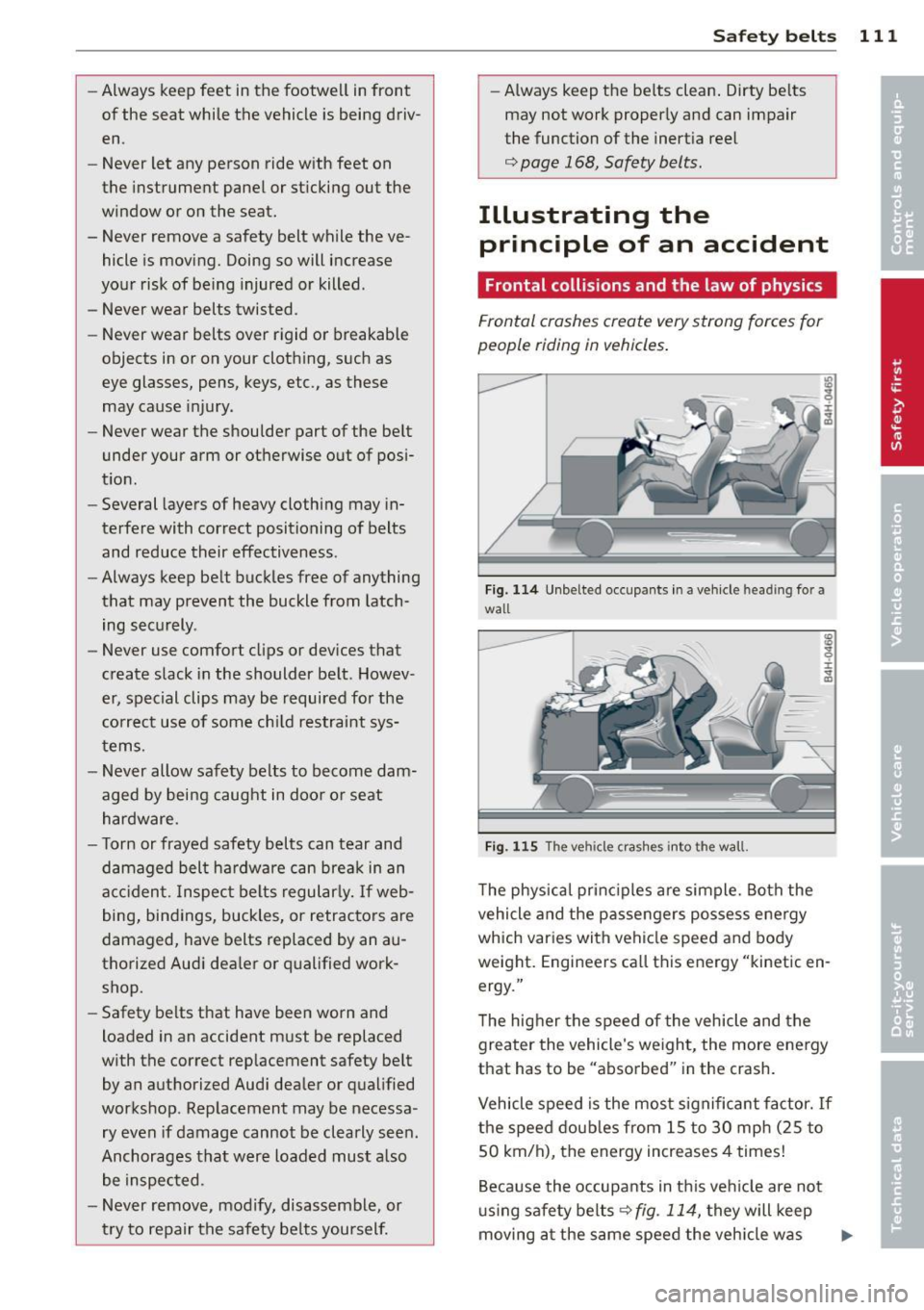
Fig. 114 Unbelted occupants in a vehicle heading for a
wa ll
Fig. 11S The ve hicle c rashes in to the wal l.
The physical principles are simple. Both the
vehicle and the passengers possess energy
which vari es with vehicle speed and body
weight. Eng ineers call this energy "k inetic en
ergy."
The higher the speed of the vehicle and the
greater the vehicle's weight, the more energy
that has to be "absorbed" in the crash.
Vehicle speed is the most significant factor.
If
the speed doubles from 15 to 30 mph (25 to
50 km/h), the energy increases 4 times!
Because the occupants in this vehicle are not
using safety belts
c:>fig . 114, they will keep
moving at the same speed the veh icle was .,,_
Page 115 of 244

.. Hold the be lt by the tongue and pull it even
l y across the chest and pelvis
c::> &_.
.. Insert the tongue into the correct buckle of
your seat until you hear it latch securely
c::>fig. 118.
.. Pull on the belt to make sure that it is se-
c u rely latched in the buckle.
Automatic safety belt retracto rs
Every safety belt is equipped with an automat
ic belt retractor on the shoulder belt. This fea
ture locks the belt when the belt is pulled out
fast, dur ing hard braking and in an accident.
The belt may also lock when you drive up or
down a steep hill or through a sharp curve.
During normal driving the belt let s you move
freely.
Switchable locking feature
Every safety belt except the one on the driver
seat is equ ipped w ith a switchable locking fea
ture that
must be used w hen the safety belt is
used to atta ch a chi ld seat. Be sure to read the
i mportant information about this fea ture
c::> page 146.
A WARNING
Imprope rly positioned safety belts can
cause serious injury in an accident
c::> page 113, Safety belt position.
- Safety belts offer optimum protection
only when the seatback is upright and
belts are properly positioned on the
body.
-
- Never attach the safety belt to the buck
le for another seat. Attach ing the belt to
the wrong buckle w ill reduce safety belt
effect iveness and can cause serious per
sonal inj ury.
- A passenger who is not properly restrain
ed can be seriously in jured by the safety
belt itself whe n it moves from the stron
ger parts of the body into c ritical a reas
like the abdomen.
- Always lock the convert ible lock ing re
tra ctor when yo u are secur ing a chi ld
sea t in the vehicle
c::> page 148.
Safety belts 113
@ Tips
Depending on veh icle equipment, micro
phones * are located on the safety be lt to
i mprove hands-free call quality. For addi
tional information about safety belt m icro
phones, refer to the infotainment system
owner's manual.
Safety belt position
Correct belt position is the key to getting
maximum protection from safety belts.
Fi g. 119 Head restraint and safety belt position as
seen from the side
"' ra q
"' ., m
Use the height adjustment to change the posi
tion of the shoulder straps of the front seat
safety belts.
A WARNING
Imp roperly posit ioned safety belts can
cause ser ious persona l inju ry in an acci-
dent.
- The s houlder belt portion of the safety
be lt must be positioned over the midd le
of the occupant's shoulder and never
across the neck o r throat.
- The safe ty be lt mus t lie flat and snug on
the occupant's upper body
c::>fig. 119.
Pull on the belt to tighten if necessary.
-
- The lap be lt po rtion of the safety belt
m ust be posit ioned as low as possib le
across pelvis and never over the abdo
men. Make sure the belt lies flat and
snug
r:!) fig. 119. Pu ll on the belt to tight
en if necessary.
- A loose-f itting safety belt can ca use seri
ous injuries by shifting its posit ion on
your body from the strong bones to more
~