2011 AUDI Q7 change time
[x] Cancel search: change timePage 318 of 392

•--=C:.:.h.:.. e=. c=.:..:: k .:.:in ..:. g ~ a::..:..: n~d .:...:.. f:....:il ..:.li :.:.n.;.: g~ ------------------------------------------
& WARNING (continued)
• To reduce the danger of explosion, never connect or disconnect
charger cables while the charger is operating.
• Fast charging a battery is dangerous and should only be
attempted by a competent technician with the proper equipment.
• Battery acid that may spill during charging should be washed
off with a solution of warm water and baking soda to neutralize
the acid.
CD Note
Never use a fast charger as a booster to start the engine. This will seri
ously damage sens it ive electronic components, such as control units,
relays, radio, etc ., as well as the battery charger.•
Battery replacement
The new battery must have the same specifications and
dimensions as the original equipment battery.
Intelligent energy management in your veh icle is responsible for
distributing the electrical energy throughout your vehicle
~ page 263. The intelligent energy management system will keep
the engine battery charged better then vehicles without this system .
To make sure the additional electrical energy is available once again
after you have changed the battery, we recommend that you install
batteries of the same type and manufacture only (the same as those
installed at the time your vehicle was delivered). Specifications are
listed on the battery housing. Your authorized dealer must code the
battery in the energy manageme nt system to enable you to use the
energy management functions correctly after replacing the battery.
If it is not possible to use a battery of this type, the new battery must
have the same capacity, voltage (12 volts), amperage, construction
and plug sea ling. When
installing the battery, make sure the ignition and all electrical
consumers are turned off.
CD Note
Make sure the vent ilation hose on the side of the battery is
connected, otherwise fumes or battery acid can leak out.
~ For the sake of the environment
Because of the prob lem of proper disposal of a battery, we recom
mend your authorized Audi dealer change the battery for you.
Batteries contain sulfu ric acid and lead and must always be disposed
of properly in compliance w ith all environmental regulations.
Disposing of vehicle batteries imprope rly is very dangerous to the
environment. •
Windshield/headlight washer
container
Fig. 240 Engine
compartment: Wind
shield and headlight*
wa sher fluid container
The washer fluid container is marked with the symbol Q on
its cap. .,
Page 322 of 392

-~_T_ i_ re _ s_ a_n _ d_ w_ h _e_ e_ ls _________________________________________________ _
Groove
means the space between two adjacent tread ribs.
Load rating (code)
means the maximum load that a tire is rated to carry for a given infla
tion pressure. You may not find this information on all tires because
it is not required by law.
Maximum load rating
means the load rating fo r a tir e at the maximum permissible inflation
pressure for that tire.
Maximum loaded vehicle weight
means the sum of:
(a) Curb weight
(b) Accessory weight
(c) Vehicle capacity weight, and
(d) Production options weight
Maximum (permissible) inflation pressure
means the maximum cold inflation pressure to which a tire may be
inflated. Also called "maximum inflation pressure."
Normal occupant weight
means 150 lbs. (68 kilograms) times the number of occupants seated
in the vehicle up to the total seating capacity of your vehicle.
Occupant distribution
means distr ibution of occupants in a vehicle .
Outer diameter
means the overall diameter of an inflated new tire.
Overall width
means the linear distance between the exteriors of the sidewalls of
an inflated tire, including elevations due to labeling, decorations, or
protective bands or ribs.
Ply
means a layer of rubber -coated paralle l cords.
Production options weight
means the combined weight of those installed regular production
options weigh ing over 5 lbs. (2.3 kg) in excess of those standard
items which they replace, not previously considered in curb weight or
accessory weight, including heavy duty brakes, ride levelers, roof
rack, heavy duty battery, and special trim.
Radial ply tire
means a pneumatic tire in which the ply cords that extend to the
beads are laid at substantially 90 degrees to the centerline of the
tread .
Recommended inflation pressure
see=> page 319, "Cold tire inflation pressure".
Reinforced tire
means a tire design to operate at higher loads and at higher inflation
pressures than the corresponding standard tire. Reinforced t ires may
be identified as "XL ", "x l", "EXTRA LOAD", or "RF" on the sidewall.
Rim
means a metal support for a tire or a tire and tube assembly upon
wh ich the tire beads are seated .
Rim diameter
means nominal diameter of the bead seat . If you change your wheel
size, you w ill have to purchase new tires to match the new rim diam
eter .
Rim size designation
means rim diameter and width.
Rim width
means nom inal distance between rim flanges.
Page 325 of 392
Tires and wheels -________________ f!ffl
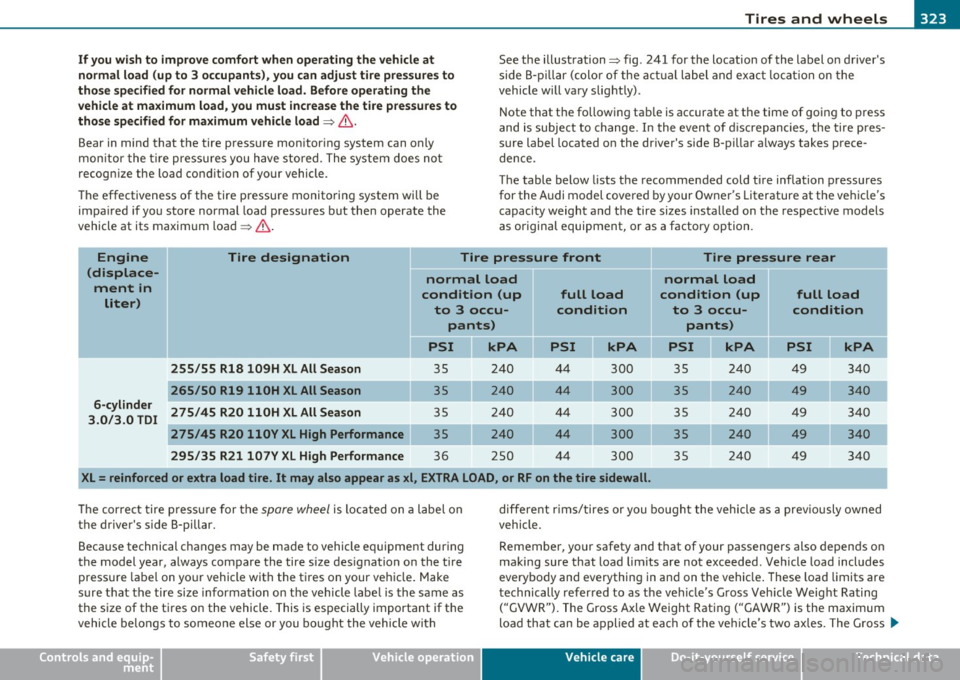
If you wish to improve comfort when operating the vehicle at
normal load (up to 3 occupant s), you can adjust tire pres sures to
those specified for normal vehicle load . Before operating the
vehicle at maximum lo ad, you must increase the tire p res sures to
those specified for maximum vehicle load=>& .
Bear in mind that the tire press ure monitor ing system can only
mon itor the t ire pressu re s you h ave sto red . T he sys tem does no t
recogn ize the load cond it ion of your vehicle.
Th e effectiveness of t he tire pressu re monitoring system will be
impa ired if you store normal load pressu res but then operate the
vehicle at its maxim um loa d=> & . See the
illustration=> fig. 241 for the location of the label on driver's
side B- pillar (colo r of the act ual la bel and ex act l ocation on the
vehicle will vary slig htly).
N ote that the fo llow ing tab le is accurate at the time of going to press
and is subjec t to change. I n the even t of discrepancies , the tire pres
sure label located on the dr iver's side B-pi llar a lways takes prece
dence .
T he table below lists the recommended cold t ire inflation pressures
for the Audi model covered by your Owne r's Literature at t he ve hicle's
capac ity weight and the tire sizes insta lled on the respective models
as original equipment, or as a factory option .
Engine Tire designation Tire pressure front Tire pressure rear
(displace- normal load normal load
ment in
liter) condition
(up
full load condition (up
full load
to
3 occu- condition to 3 occu- condition
pants) pants)
PSI kPA PSI PSI kPA PSI kPA
255/55 R18 109H XL All Season
35 240 44 300
35 240 49 340
265
/50 R19 110H XL All Season 35 240 44
300 35 240 49 340
6-cylinder 275/45 R20 110H XL All Season 35 24 0 44 3 00 35 240 4 9 340
3.0/3.0 TDI
275 /45 R20 llOY XL High Performance 35 240
44 300
35 240 49 340
295
/35 R2110 7Y XL High Performance 36 250 44
300 35 240 49 340
XL= reinforced or extra load tire
. It may also appear as xl , EXTRA LOAD, or RF on the tire sidewall .
The correct tire p ress ure for t he spare wheel is loca ted on a labe l o n
the driver 's s ide B-pillar.
Beca use technical c hanges may be made to vehicle equipment dur ing
the model year, always compare the tire size des ignation on the t ire
pressu re labe l on yo ur vehicle with the t ires on your vehicle. Make
sure that the tire size informat ion on t he v ehicle labe l is the same as
the size of the t ires o n the vehicle. This is especially important if the
vehicle belo ngs to so meone else or you bo ug ht the vehicle with
Safety first
differe nt r im s/ tires or you bo ugh t the vehicle as a prev iously owned
vehicle.
Remember, yo ur safety and t hat of your passengers also depends o n
making sure that load limits are not exceeded. Vehicle load includes
everybody and everything in an d on the vehi cle. These load limits are
t e chnically refer red to as the veh icle's G ross Veh icle Weig ht Rating
("GVW R"). The Gross Axle Weight Rati ng ("GAWR") is the maximum
load tha t can be applied at ea ch of the ve hicle's two ax les . T he G ross ..
Vehicle care Technical data
Page 340 of 392

___ T_ i_ r_e _s_ a_ n_ d _ w _h _e_e_ l_ s _______________________________________________ _
Tire pressure indicator appears
The tire pressure indicator in the instrument cluster
informs you if the ti re pressure is too low or if there is a
system malfunction.
Fig. 2 46 Disp la y:
u nd erinfl ation
warni ng
Fi g. 2 47 Dis play:
Syst em m alf un ction
Us ing the ABS sensors, the tire pressure monitoring system compares
t he t ire tread c ircumference and vibrat ion characte rist ics o f the indi
vidual tires. If the pressure decreases in one or more tires, this is indi
cated in the ins trument cl uste r wi th a warning symbol
1 and a
message=> fig. 246 . The dr iver message in the display goes o ut after
5 seconds . T he driver message can be disp layed again by p ressing the
[ CHECK ] button. If only one t ire is affected , the display will ind icate
its position . The tire press
ure monitoring must be reset via MMI each time the
pressu res are adju sted (e.g. when sw itching between partial and full
load pressure) or after chang ing or replacing a t ire on your veh icle
=>
page 339. You can find the recommended tire pressures fo r your
vehicle on the label o n the dr iver's door pillar=>
page 322.
Ti re tread circumference and v ibration characterist ics can change and
c ause a tire p ress ure warning if:
• the tire pressure in one or more tires is too low,
• t he ti re has s tructur al damage,
• the t ire pressure was changed, wheels rotated or rep laced but the
T PM S w as no t rese t=>
page 339.
Warning symbols
' ' Loss of press ure in at least one tir e=> .&. Chec k the t ire or t ires
and rep lace or repair if necessary. The indicator light in the instru-
me nt cluster a lso illumina tes=>
page 14. C heck/co rrect t he p res
sures of all four ti res and reset TPMS via MMI.
( T ire Pressure Monitor ing System)
Tire pre ssure! System
malfunction .
If appears afte r sw itch ing the ignition o n or while
dr iv ing =>
page 338, fig. 2 47 and the indicator ligh t in the ins tru
me nt clus ter blinks for approx imately one minu te and then s tays on,
there is a system ma lfunction . See your a uthorized Audi dealer as
soon as poss ible.
& WARNING
• If the tire pressure indicator appear s in the instrument cluster
display, one or more of your tires is significantly under-inflated.
Reduce your speed imm ediately and avoid any hard steering or
brak ing maneuvers . Stop as soon as possible and check the tires
and their pres sures. Inflate the tire pre ssure to the proper pres
s u re as indicated on the vehicle 's tire pressure label=>
page 322.
Driving on a significantly under-inflated tire cau ses the tire to
overheat and can lead to tire failure . Under-inflat ion also is l ikely
to impair the vehicle 's handling and stopping ability .
~
Page 365 of 392

________________________________________________ G_e_ n_e_ r _a_ l_i_n _f_ o_ r_m _ a_t_ i_ o _ n __ _
The safety compliance sticker
is your assurance that yo ur new vehicle complies with all applicable
Fede ral Motor Veh icle Safe ty Standards which were i n effect at the
time the vehicle was manufact ured . Yo u can fi nd this sticker on the
left doo r jamb.
It shows the mont h and year of prod uct io n and the
vehicle identification number of your veh icle (perforation) as well as
the Gross Vehicle Weight Rating (GV WR) and the Gross Axle Weight
Rating (GAWR).
The high voltage warning label
is located o n the loc k carrier.
The spark ignition system complies with the
Canadian standard ICES-002. •
Weights
Gross Vehicle Weight Rating
The Gross Vehicle Weight Rating (GVWR), and the Gross Axle Weight
Rating (GAWR) for front and rear are listed on a sticker on the left
door jamb.
T he Gross Vehicle Weight Rating includes the weight of the basic
vehicle pl us f ull f uel tank, oil and coo la nt, plus max im um load, whi ch
includes passenger we ight (150 lbs/68 kg per des ignated seating
position) and luggage weight~& .
Gross Axle Weight Rating
The Gross Axle Weight Ra ting is the maximum lo ad that can be
applied at each axle of the vehicle~&.
Vehicle capacity weight
The vehicle capacity weight (max. load) is listed on the dr iver's side B
pillar.
Safety first
Roof weight
Th e maxim um permiss ib le roof weight is 220 lb (100 kg ). T he roof
we ight is made up of the weight of the roof rac k system and t he
we ight of the o bject being transported ~
page 103, "Loading the
roof rack" .
& WARNING
• The Gross Vehicle Weight Rating for your Audi Q7 vehicle,
found on the safety compliance label on the driver's side B-pillar,
must never be exceeded under any circumstances . Exceeding the
Gross Vehicle Weight Rating of your vehicle is likely to damage
your vehicle, and such damage will not be covered by your Limited
New Vehicle Warranty. E xceeding the Gross Vehicle Weight
Rating will also change the performance and handling character
istics of your vehicle, which could cause a crash resulting in serious
injury or death.
• The Gross Vehicle Weight Rating fo r your Audi Q7 would be
exceeded if your vehicle is simultaneously equipped with
Panoramic sl iding sunroof; third -row seating ; trailer towing
equipment (factory or dealer-in stalled), and running boards
( dealer-installed). UNDER NO CIRCUMSTANCES MAY ALL SUCH
ITEMS BE INSTALLED ON THE SAME VEHICLE.
• The actual Gross Axle Weight Rating at the front and rear a xles
s hould not exceed the permis sible weights , and their combination
must not exceed the Gross Vehicle We ight Rat ing.
• Exceeding permissible weight ratings can result in vehicle
damage, accidents and personal injury .
0 Note
• The vehicle capac ity we ight figures apply when the load is dist rib
u ted evenly i n the vehicle (p assenge rs and luggage). When trans
porting a heavy load i n the luggage compartment, carry the load as
ne ar to the rear ax le as possible so th at th e ve hicle's hand ling is not
impaired. -.,
Do-it,yourself service Technical data
Page 391 of 392

It has always been A ud i's policy to contin uously improve its p roduc ts.
Audi, therefore, reserves the right to make changes in design and
spec ifica tions, and to make addi tions o r improvements in its prod
ucts, without incurr ing a ny obligation to install them o n products
previo usly man ufactu red.
T ext, illust rations a nd specifications in th is manua l are based on the
most up-to-date information available at the time of printing .
All righ ts reserved. May not be reproduced or t ransl ated in whole o r
in part without the written consent of AUDI AG. Specifications are
subjec t to c ha n ge wi thout notice. "A
udi ", "q uattro " and t he fo ur rings em blem a re reg istered trade
marks of AUDI AG.
"QT' is trademark of AUDI AG .
Editorial deadline: 04/16/2010
For the sake of the environment
Printed on environmen tally frien dly p ape r (bl eac hed wi thout chlo
r in e, recyclable) .
Printed in Germany
© 2 01 0 A UDI AG