2011 AUDI A5 COUPE ECU
[x] Cancel search: ECUPage 232 of 362
...,. Child Safety P#J'I ____ _,.__ __________________________ _
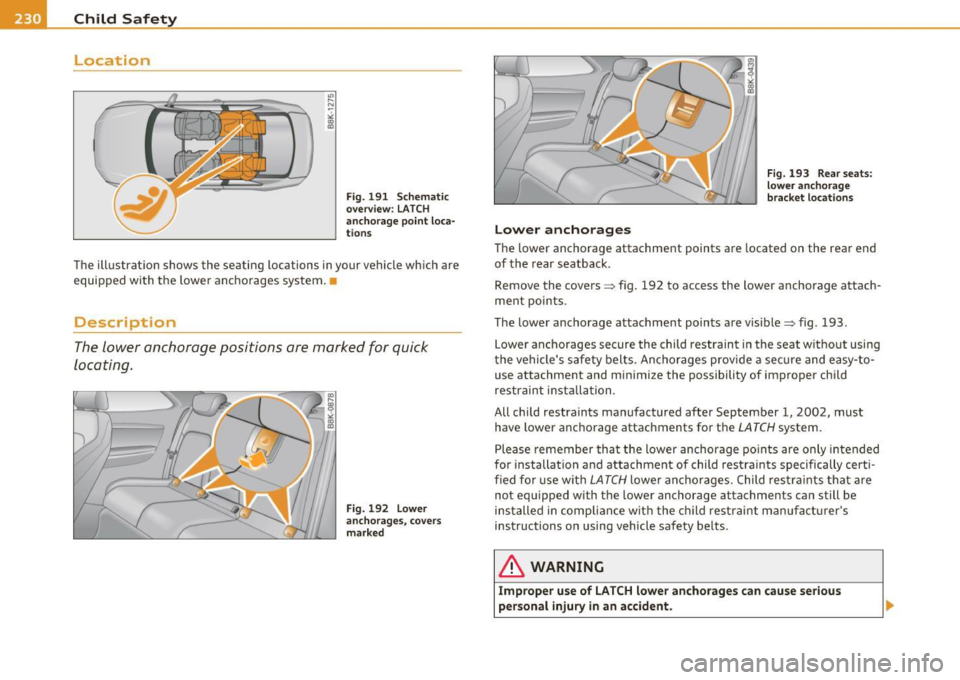
Location
Fig. 191 Schematic
overview: LATCH
anchorage point loca
tions
The illustration shows the seating locations in your vehicle which are
equipped with the lower anchorages system. •
Description
The lower anchorage positions are marked for quick
locating.
Fig. 192 Lower
anchorages,covers
marked
Lower anchorages
Fig. 193 Rear seats:
lower anchorage
bracket locations
Th e lower anchorage attachment points are located on the rear end
of the rear seatback.
Remove the covers=> fig. 192 to access the lower anchorage attach
ment points .
The lower anchorage attachment points are visible=> fig. 193.
Lower anchorages secure the child restraint in the seat without using
the vehicle's safety belts. Anchorages provide a secure and easy-to
use attachment and minimize the possibility of improper child
restraint installation .
All child restraints manufactured after September 1, 2002, must have lower anchorage attach men ts for the
LATCH system.
Please remember that the lower anchorage points are only intended
for installation and attachment of child restraints specifically certi
fied for use with
LATCH lower anchorages. Child restraints that are
not equipped with the lower anchorage attachments can still be
installed in compliance with the child restraint manufacturer's
instructions on using vehicle safety belts .
& WARNING
Improper use of LATCH lower anchorages can cause serious
personal injury in an accident.
Page 233 of 362

Child Safety -
-------------------"'---
& WARNING (continued)
• Always carefully follow the child restraints manufacturer's
instructions for proper installation of the child restraint and
proper use of the lower anchorages or safety belts in your vehicle.
• Never secure or attach any luggage or other items to the
LATCH
lower anchorages.
• Always read and heed the important information about child
restraints in this chapter and WARNINGS~ page
215, "Child
Safety ".•
Installing a child restraint with LATCH
Lower anchorages
Whenever you install a child restraint always follow the
child restraint manufacturer's instructions.
Mounting
Fig. 194 Lower
anchorages : proper
mounting
- Make sure the seatback of the rear seat bench is in the
upright position and securely latched in place.
Controls and equip
ment Safety first Vehicle operation
-
Attach both hook-on connectors with the spring catch
release on the child safety seat onto the LATCH lower
anchorage so that the connectors lock into place
=> fig. 194.
-Pull on the connector attachments to make sure they are
properly attached to the LATCH lower anchorage.
- Pull straps tight following the child restraint manufac
turer's instructions .
Releasing
-Loosen the tension on the straps following the child
restraint manufacturer's instructions.
- Depress the spring catches to release the anchorage hooks
from the lower anchorages.
Remember: Use tether straps to help keep the child restraint firmly
in place.
& WARNING
Improper use of the LATCH system can increase the risk of serious
personal injury and death in an accident.
• These anchors were developed only for child safety seats using
the "LATCH" system.
• Never attach other child safety seats, belts or other objects to
these anchors.
• Always make sure that you hear a click when latching the seat
in place. If you do not hear a click the seat is not secure and could
fly forward and hit the interior of the vehicle, or be ejected from
the vehicle.
l)l,
Vehicle care Do-it-yourself service Technical data
Page 234 of 362

lffll.,___C_h_ i_ ld _ S_ a_ f_ e_ t...:: y ;....__ _________________________________________ _
in. WARNING
Improper installation of child restraints will increase the r isk of
injury in an accident.
• Always follow the child restraint system manufacture r's
instructions for proper in stallation of the child restraint sy stem
and proper use of tether straps as well as the lower anchorages or
s afety belts in your vehicle .
• Always read and heed the important informat ion and WARN·
INGS about child safety and the installation of child restraint
systems ~
page 215, "Child Safety ".•
Tether anchors and tether straps
Fig . 1 9 5 T ether
a n ch ors : rece ss fl aps
behind th e rear seat
bac ks
The tether anchors for the rear seat ing pos itions are located i n
recesses in the rear win dow sh elf ~ fig. 195 .
A tet he r i s a st raight o r V-shaped strap t hat attac hes the top pa rt of
a ch ild restraint to spec ia l anchorage points in the vehicle .
T he p urpo se of the tethe r is to reduce t he f orwar d movemen t of the
child restraint in a crash, in order to help reduce t he risk of head injury
t ha t could be caused by st riking the ve hicle in terior .
Forward fac ing ch ild restraints manufactured after September 1,
1 999, are required by U.S . federa l reg ulations to comply with child head movement performance req
uirements . T hese new performance
re qu iremen ts m ake a tet he r ne cessa ry on most new child sa fe ty
seats.
in. WARNING
Improper installation of child restraints will inc rease the risk of
injury and death in a cra sh .
• Alw ays follow the instructions pro vided by the manuf acturer
of the child restraint you intend to install in your Audi.
• Improper use of child re straint anchors (including tether
anchors) can lead to injury in a collision. The anchor s are designed
to withstand only those loads imposed by co rrectly fitted child
restraint s.
• Never mount two child restraint systems on one LATCH lower
anchor point .
• Never attach two child restraint systems to one tether strap or
tether anchorage.
• Never attach a tether strap to a tie-down hook in the luggage
compartment .
• Never u se child restraint tether anchorage s to secure safety
belts or other kinds of occupant rest raints.
• Never secure or atta ch any luggage or other items to the LATCH
lower anchorages or to the tethe r ancho rs.
• If a tether or other strap is used to attach a child restraint to
the front passenger seat , make sure that it is not so tight , that it
causes the weight -sensing mat to mea sure more weight than is
actually on the seat.
• The heavier weight register ed can make the Advanced Airbag
System work as though an adult were on the seat and deploy the
Advanced Airbag when it must be suppre ssed causing serious or
even fatal injury to the child.
• If you must install a rearward facing child safety seat on the
front passenger seat because of e xcept ional circumstances and
the PASSENGER AIR BAG OFF light does not come on and stay on,
~
Page 253 of 362

Trailer towing
Driving with a trailer
General information
Your Audi was designed primarily for passenger transpor
tation.
If yo u plan to tow a t rai ler, p lease rem emb er that the add itiona l load
wi ll affect durab ility, economy and performance.
T railer tow ing not on ly p laces mo re s tress on the vehicle, it a lso calls
for more concentrat ion from the driver.
For this reason, a lways follow the ope rating and dr iv ing instr uctions
prov ided and use common sense .
Technical requirements
Trailer hitch
Use a weight-carrying hitch conforming to the gross trailer weig ht.
Th e hitch mus t be suitable for yo ur vehicle a nd tra ile r and mus t be
mounted secure ly on the vehicle's chassis at a
technically sound l oca
t ion. Use only a trailer hitch wi th a remov ab le b all m ount. Alw ays
check w ith the tra iler hitch manufacturer to make sure that you are
using t he cor re ct hi tch.
Do not use a bumper hitch.
The h itch must be installed in such a way t hat it does not interfere
w ith the impa ct-absorbing b umper system. No mod ifi cat ions sho uld
be made to the vehicle exhaust and brake systems. From time to
ti me, chec k tha t all hitc h mou ntin g bol ts rem ain secure ly f aste n ed.
When you a re not tow ing a tra iler, remove the tra iler hitch ba ll
mount. This prevents the hitc h from caus ing damage should yo ur
vehicle be struck from behind=> &.
Controls and equip
ment Safety first Vehicle operation
Trailer brakes
If your trailer is eq
uipped with a braking system, check to be s ure that
i t confo rm s to all regula tions.
The tra iler hydraulic brake system must not be directly connected to
the vehicle's hydraulic brake system=>& .
Safety chains
Alw ays use safety chains be twee n your vehicle and the trai ler.
Trailer lights
Tr ailer l ights m ust meet all reg ulat io ns. Be su re to check with your
author ized Audi deale r for correct wir ing, switches, and re lays.
Mirrors
If you are unab le to see the traffic behind you us ing the regular
outside m irro rs, then you
must install extended m irro rs. It is impor
tant that yo u
always have clear vision to the rear.
& WARNING
• If a trailer has electrical b rake s please note that these brakes
are not activated by the factory-fitted control unit -ri sk of acci
dent!
• After removing the trailer hitch , do not store it in your vehicle.
In case of sudden braking, the hitch could fly fo rward and injure
you or your passengers. •
Operating instructions
Maximum trailer we ight
A trailer for your vehicle is limited to a typical class 1 or class 2 trailer . .,.
Vehicle care Do-it-yourself service Technical data
Page 254 of 362

Trailer towing
"-------------------------------------------------
Trailer load distribution
Be sure the load in the trailer is held securely in pla ce to prevent it
from shifting forward, backward or s ideways.
Never allow a passenger to ride in a trailer => & in "Driving instruc
tions" on
page 252.
Engine cooling system
Towing a trailer makes the eng ine work harde r. It is important that
the cooling system's performance is up to the additional load. Make
sure that the cooling system has enough fluid.
Tire pressure
When towing a trailer, inflate the tires of your vehicle to the cold tire
pressure listed under "Full load" on the label located either on the
dr iver's side B-pillar (visible when the door is open) or inside the fuel
filler flap . Inflate trailer tires to trailer and tire manufacturers' spec
ifications.
Lights
The headl ight settings should be checked w ith the trailer attached
before driving off. Check to make sure both vehicle and trai ler lights
are working properly.
Safety chains
Be sure trailer safety cha ins are properly connected from the trailer
to the hitch on the vehicle. Leave enough s lack in the chains to permit
turning corners. When you install safety chains, make sure they will
not drag on the road when you are driving.
T he chains should cross under the trailer tongue to p revent it from
dropping in case of separation from the hitch.
Driving instruct!ons
Driving with a trailer always requires extra care and
consideration.
To obtain the best possible handling of vehicle and trailer,
please note the following:
- Do not tow a loaded trailer when your car itself is not
loaded.
- Be especially careful when passing other veh icles .
- Observe speed limits.
- Do not drive at the maximum permissible speed.
- Always apply brakes early.
- Monitor the temperature gauge .
Weight distribution
Towing a loaded trailer w ith an empty car results in a highly unstable
distr ibution of weight. If this cannot be avoided, drive at very low
speeds only to avo id the r isk of losing steer ing control.
A "balanced" rig is easier to operate and control. Th is means that the
tow vehicle should be loaded to the extent possible and permissible,
wh ile keeping the trailer as light as possible under the c ircumstances.
Whenever possible, trans fer some cargo to the luggage compart
ment of the tow vehicle while observing tongue load requirements
and vehicle loading considerations.
Speed
Th e higher the speed, the more difficult it becomes for the driver to
control the r ig . Do not drive at the maximum permiss ible speed.
Reduce your speed even more if load, weather or wind conditions are
unfavorable -part icularly when go ing downhill.
Reduce vehicle speed
immediately i f the trailer shows the slightest
sign of swaying.
Do not try to stop the swaying by accelerating. _,
Page 277 of 362

Checking and filling Ill
-------------~--
Closing the engine hood
- Pull the hood down until the pressure from the struts is
reduced.
- Let the hood
drop down and latch in place. Do not try to
push it shut;
it may fail to engage=:> &.
& WARNING
A hood that is not completely latched could fly up and block your
view while driving.
• When you close the engine hood, check it to make sure the
safety catch has properly engaged. The hood should be flush with
the surrounding vehicle body parts.
• If you notice while driving that the hood is not secured prop
erly, stop at once and close it. •
Working in the engine compartment
Be especially careful whenever you work in the engine
compartment.
Whenever you must perform any work in the engine compartment,
for example checking and filling different fluids, there is a risk of injury, burns and accidents. To prevent personal injury always
observe the following WARNINGS. The engine compartment of any
vehicle is a hazardous area=>& .
& WARNING
To help avoid injury, before you check anything under the hood:
• Turn off the engine.
• Remove the ignition key.
• Apply the parking brake.
Safety first
& WARNING (continued)
• Move selector lever of automatic transmission to "P" (Park);
put manual transmission in Neutral.
• Always let the engine cool down. Hot components will burn
skin on contact.
• To reduce the risk of being burned, never open the hood if you
see or hear steam or coolant escaping from the engine compart
ment. Wait until no steam or coolant can be seen or heard before
carefully opening the hood.
• Keep children away from the engine compartment.
• Never spill fluids on hot engine components. They can cause a
fire.
• Never touch the radiator fan. The auxiliary electric fan is
temperature controlled and can switch on suddenly.
• Never open the coolant reservoir cap when the engine is still
warm. The coolant system is pressurized and hot coolant could
spray out.
• Protect your face, hands and arm from steam or hot engine
coolant by placing a thick rag over the cap when you open the
coolant reservoir.
• If work on the fuel system or the electrical system is necessary:
-Always disconnect the battery.
- Never smoke or work near heaters or open flames. Fluids in
the engine compartment could start a fire.
- Keep an approved fire extinguisher immediately available.
• To avoid electrical shock and personal injury while the engine is
running or being started, never touch:
-Ignition cables
- Other components of the high voltage electronic ignition
system.
• If you must perform a check or repair with the engine running: ..,
Vehicle care Technical data
Page 282 of 362

-~_C_ h_e _c_ k_ i_ n ....: g:::e._ a_ n _ d_ f_il _l _in _ g =- --------------------------------------------
- Unscrew the cap~ to the engine oil filling hole
=>
page 279, fig . 207.
- Carefully top off with the app ropriate oil in 0.5 liter doses.
- Check the oil le v e l again after two minutes=>
page 2 79.
- Top off the oil aga in , if necessary .
- S crew the cap bac k on th e fi lling hole.
& WARNING
• While topping off, the oil must not come in contact with hot
engine parts -fire hazard!
• The oil filler cap must be properly secured to prevent oil from
being sprayed on the hot engine and e xhaust system when the
engine i s running · fire hazard!
• If your skin has come in contact with the engine oil , you mu st
s ub sequently cleanse it thoroughly .
0 Note
• Check the oil level using the radio or MMI*. If the message Please
reduce oil level
appears, contact your authorized Audi dealer or other
qualified wo rkshop to have excess o il extra cted if necessary.
• Audi does not recommend the use of oil additives. They may
damage the engine and adversely affect your New V ehicl e
Warranty.
<£> For the sake of the environment
• Under no circumstances can the o il come in contact with the
sew age netwo rk or the so il.
• Observe and fo llow legal reg ulat ions when dispos ing of empty oil
conta iners. •
Changing the engine oil
We reco mmend tha t ha ve your oil chan ged by an auth o
ri zed Audi deal er or a qualified s erv ic e sta tion.
Before you check anything in the engine compartment, always read
and heed all WARNINGS=>
& in "Working in the engine compart
ment" on
page 275.
Th e en gine oi l must be changed a ccording to the i nte rvals spe cifi ed i n
your Warranty
& Maintenance booklet. This is very important because
the lubricating prope rties of oil diminis h gradually during normal
veh icle use.
Under some circumstances the engine o il should be changed more
frequently . Change o il more often if yo u drive most ly sho rt dista nces,
operate the vehicle in dusty areas or under predom inant ly stop-and
go tra ffic condi tions , or have your vehi cle where tempera tures rem ain
be low freezing for extended per iods.
Detergent ad ditives in the oi l will make fresh oil look dark after the
eng ine has bee n ru nning fo r a short t ime . This is normal a nd is not a
reason to change the oil mo re often than recommen ded .
B eca u se of the prob lem of pro per disposal, along with the s peci al
too ls and necessary expertise required, we strong ly recommend that
you have your o il changed by a n autho rized
Audi dealer or a qualified
serv ice stat io n.
If you choo se to change your oil yourself , please note the following
i m po rtant informat ion:
& WARNING
To reduce the risk of personal injury if you must change the engine
oil in your vehicle yourself :
• Wear eye protection.
• To reduce the risk of burns from hot engine oil, let the engine
cool down to the touch.
~
Page 301 of 362

________________________________________________ T_i_r _e _s _ a_n _ d_ w_ h_ e _ e_l_s __ _
& WARNING (co ntinued )
• Only when all tire s on the vehicle are filled to the correct pre s
sure, the tire pressure monitoring sy stem* can work correctly .
• The u se of incorrect tire pressure values can lead to accidents or
other damage. Therefore it is essential that the driver observe the
specified tire pressure values for the tires and the correct pres
sures for the function of the tire pre ssure monitoring system *.
• Always inflate tires to the recommended and correct ti re pre s
sure before driving off.
• Driving with underinflated tire s bend more , letting them get
too hot resulting in tread separat ion, sudden tire failure and loss
of control.
• Excessive speed and /overload ing can cause heat build-up ,
sudden tire failure and loss of control.
• If the tire pressure is too low or too high , the tires will wear
prematurely and the vehicle will not handle well.
• If the tire is not flat and you do not have to change a wheel
immediately, drive at reduced speed to the neare st service station
to check the tire pressure and add air as requ ired.
0 Note
Dr iv ing without valve stem caps can cause damage to the tire valves.
T o preven t this, a lways make su re t hat fac tory ins talle d va lve stem
caps on all wheels a re securely mo unted on the valve.
'£> For the sake of the environment
Under inflated t ires will a lso increase the fuel consumption .•
Tires and vehicle Load Limits
T here are lim its to the amount of load or we ight that any vehicle a nd
any t ire can c arry . A veh icle t hat is over loaded w ill not hand le well an d
Safety first
is more difficult to stop . Overloading can not only lead to loss of
veh icle co ntro l, bu t ca n also d amage important p art s o f the ve hicl e
and can lead to sudden ti re failure, including a blowout and sudden
deflation that can cause the vehicle to crash.
Your safety a nd tha t of you r passe ngers also depe nds o n mak ing s ure
that load limits are not exceeded. Vehicle load incl udes everybody
and everyt hing in and on t he ve hicle. T hese lo ad lim its are techn ic a lly
referred to as the vehicle's
Gross Vehicle Weight Rating ("GVWR").
Th e "GVWR" includes the weight of the basic vehi cle, all facto ry
installed accessories, a fu ll tank of fue l, o il, coo la nt and other fluids
plus maxim um loa d. Th e maxim um loa d includes t he nu mber of
passeng ers th at t he ve hicl e is intended to car ry ("sea ting capa city ")
with an ass umed weig ht of 150 lbs . (68 kg) for each passenger at a
design ated seating posit ion a nd the to tal weig ht of any luggage in
the vehicle. If yo u tow a tra iler, the weight of the trailer hitch and the
t ongue weig ht of the lo ad ed t railer mus t be include d as pa rt of the
vehicle load.
Th e
Gross Axle Weight Rating ("GAWR") is the maximum load that
can be a pplied at each of t he ve hicle's two axles .
The Gross Vehicle We ight Rating and the Gross Ax le We ight Rating
are li sted on the safety comp lia nce s tick er label loca ted either on the
dr ive r's side B-pilla r o r on the inside of the fuel filler flap . Aud i has
4 se ating posi tions, 2 in the fron t and 2 in the rea r for tot al s eating
capacity of 4. Each seating position has a seat belt~
page 181,
"Safety be lts".
Th e fact t hat there is an upper lim it to your v eh icle 's Gross Vehicle
Weight Rating means that t he tota l weight of whatever is being
c a rried in th e veh icle ( in cl ud ing the w eight of a t railer hitch and the
tongue weight of the loaded tra iler) is limited. The mo re passengers
in the veh icle or p assengers who are heavier th an the sta ndar d
we ights assumed mean that less we ight can be carried as luggage.
Th e ti re pressure label on yo ur Audi also lis ts th e maxim um combined
we ight of all of the occupants and luggage or other cargo that the
vehicle can car ry. For the location o f the labe l~
p age 2 95, fig . 21 2. ~
Vehicle care Technical data