2011 AUDI A5 COUPE warning
[x] Cancel search: warningPage 232 of 362
...,. Child Safety P#J'I ____ _,.__ __________________________ _
Location
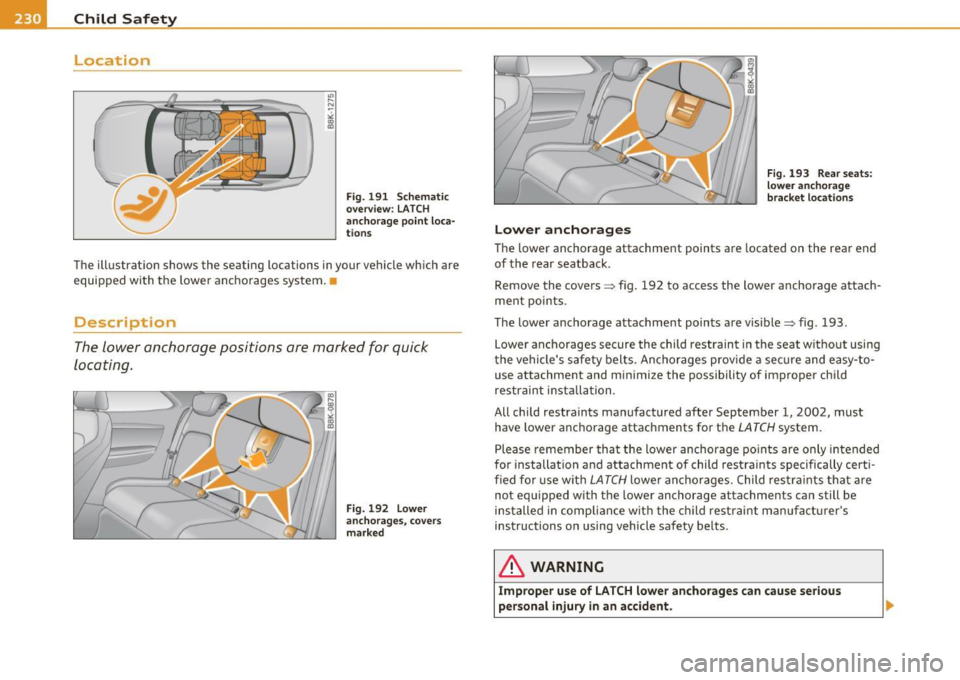
Fig. 191 Schematic
overview: LATCH
anchorage point loca
tions
The illustration shows the seating locations in your vehicle which are
equipped with the lower anchorages system. •
Description
The lower anchorage positions are marked for quick
locating.
Fig. 192 Lower
anchorages,covers
marked
Lower anchorages
Fig. 193 Rear seats:
lower anchorage
bracket locations
Th e lower anchorage attachment points are located on the rear end
of the rear seatback.
Remove the covers=> fig. 192 to access the lower anchorage attach
ment points .
The lower anchorage attachment points are visible=> fig. 193.
Lower anchorages secure the child restraint in the seat without using
the vehicle's safety belts. Anchorages provide a secure and easy-to
use attachment and minimize the possibility of improper child
restraint installation .
All child restraints manufactured after September 1, 2002, must have lower anchorage attach men ts for the
LATCH system.
Please remember that the lower anchorage points are only intended
for installation and attachment of child restraints specifically certi
fied for use with
LATCH lower anchorages. Child restraints that are
not equipped with the lower anchorage attachments can still be
installed in compliance with the child restraint manufacturer's
instructions on using vehicle safety belts .
& WARNING
Improper use of LATCH lower anchorages can cause serious
personal injury in an accident.
Page 233 of 362

Child Safety -
-------------------"'---
& WARNING (continued)
• Always carefully follow the child restraints manufacturer's
instructions for proper installation of the child restraint and
proper use of the lower anchorages or safety belts in your vehicle.
• Never secure or attach any luggage or other items to the
LATCH
lower anchorages.
• Always read and heed the important information about child
restraints in this chapter and WARNINGS~ page
215, "Child
Safety ".•
Installing a child restraint with LATCH
Lower anchorages
Whenever you install a child restraint always follow the
child restraint manufacturer's instructions.
Mounting
Fig. 194 Lower
anchorages : proper
mounting
- Make sure the seatback of the rear seat bench is in the
upright position and securely latched in place.
Controls and equip
ment Safety first Vehicle operation
-
Attach both hook-on connectors with the spring catch
release on the child safety seat onto the LATCH lower
anchorage so that the connectors lock into place
=> fig. 194.
-Pull on the connector attachments to make sure they are
properly attached to the LATCH lower anchorage.
- Pull straps tight following the child restraint manufac
turer's instructions .
Releasing
-Loosen the tension on the straps following the child
restraint manufacturer's instructions.
- Depress the spring catches to release the anchorage hooks
from the lower anchorages.
Remember: Use tether straps to help keep the child restraint firmly
in place.
& WARNING
Improper use of the LATCH system can increase the risk of serious
personal injury and death in an accident.
• These anchors were developed only for child safety seats using
the "LATCH" system.
• Never attach other child safety seats, belts or other objects to
these anchors.
• Always make sure that you hear a click when latching the seat
in place. If you do not hear a click the seat is not secure and could
fly forward and hit the interior of the vehicle, or be ejected from
the vehicle.
l)l,
Vehicle care Do-it-yourself service Technical data
Page 234 of 362

lffll.,___C_h_ i_ ld _ S_ a_ f_ e_ t...:: y ;....__ _________________________________________ _
in. WARNING
Improper installation of child restraints will increase the r isk of
injury in an accident.
• Always follow the child restraint system manufacture r's
instructions for proper in stallation of the child restraint sy stem
and proper use of tether straps as well as the lower anchorages or
s afety belts in your vehicle .
• Always read and heed the important informat ion and WARN·
INGS about child safety and the installation of child restraint
systems ~
page 215, "Child Safety ".•
Tether anchors and tether straps
Fig . 1 9 5 T ether
a n ch ors : rece ss fl aps
behind th e rear seat
bac ks
The tether anchors for the rear seat ing pos itions are located i n
recesses in the rear win dow sh elf ~ fig. 195 .
A tet he r i s a st raight o r V-shaped strap t hat attac hes the top pa rt of
a ch ild restraint to spec ia l anchorage points in the vehicle .
T he p urpo se of the tethe r is to reduce t he f orwar d movemen t of the
child restraint in a crash, in order to help reduce t he risk of head injury
t ha t could be caused by st riking the ve hicle in terior .
Forward fac ing ch ild restraints manufactured after September 1,
1 999, are required by U.S . federa l reg ulations to comply with child head movement performance req
uirements . T hese new performance
re qu iremen ts m ake a tet he r ne cessa ry on most new child sa fe ty
seats.
in. WARNING
Improper installation of child restraints will inc rease the risk of
injury and death in a cra sh .
• Alw ays follow the instructions pro vided by the manuf acturer
of the child restraint you intend to install in your Audi.
• Improper use of child re straint anchors (including tether
anchors) can lead to injury in a collision. The anchor s are designed
to withstand only those loads imposed by co rrectly fitted child
restraint s.
• Never mount two child restraint systems on one LATCH lower
anchor point .
• Never attach two child restraint systems to one tether strap or
tether anchorage.
• Never attach a tether strap to a tie-down hook in the luggage
compartment .
• Never u se child restraint tether anchorage s to secure safety
belts or other kinds of occupant rest raints.
• Never secure or atta ch any luggage or other items to the LATCH
lower anchorages or to the tethe r ancho rs.
• If a tether or other strap is used to attach a child restraint to
the front passenger seat , make sure that it is not so tight , that it
causes the weight -sensing mat to mea sure more weight than is
actually on the seat.
• The heavier weight register ed can make the Advanced Airbag
System work as though an adult were on the seat and deploy the
Advanced Airbag when it must be suppre ssed causing serious or
even fatal injury to the child.
• If you must install a rearward facing child safety seat on the
front passenger seat because of e xcept ional circumstances and
the PASSENGER AIR BAG OFF light does not come on and stay on,
~
Page 235 of 362

& WARNING (co ntinued )
immediately install the rear -facing child safety seat in a rear
s eating position and have the airbag sy stem in spected by your
Audi deale r.•
Installing the upper tether strap on the
anchorage
(
Installing the tether strap
Fig . 1 9 6 Te ther st rap :
prop er routi ng and
mounting
- Release or dep loy the tet her strap on the ch ild rest raint
acco rd ing to the ch ild restra int ma nufacturer's instruc
tions.
- Guide t he upper tet her st rap
under t h e rear head restraint
:::;, fig. 196 (raise t he head restra int if necessary).
- Tilt the recess fla p up to expose the anchor bracket.
- Attac h the t ether st rap anchora ge h ook in to the op ening
o f th e tet her anchorage .
- Pull on the tethe r strap hook so that the spring catch of
t h e hoo k engages.
Safety first Vehicle OP-eration
Child Safety
-Tig hten t he tether strap firmly fo llowi ng th e ch ild
restra int man ufacturer 's ins tructions .
Releasing the tether strap
- Loosen t he tension following t he chil d restrai nt manufac
turer's i nstructions.
- D epress t he spr ing catc h on the hoo k and release it f rom
t h e anchorage.
0 Note
If you leave the child restra int wit h the tether st rap firmly installed
for several days, t his could leave a mark on t he up holstery on t he seat
c u shi on and backrest in the area whe re the tether strap was insta lled .
Th e up ho lstery would also be permanent ly stretched a round the
tether st rap. This appli es especially to leather seats. •
Using tether straps on rearward-facing
child restraints
Currently, few rearward-facing child restraint systems come wit h a
t e ther. Please read and heed the ch ild restraint system ma nufac
t u rer 's instructions care fully to determine how to properly install the
t ether.
& WARNING
A child in a rearward-facing child safety seat installed on the front
passenger seat will be seriously injured and can be killed if the
front airbag inflates -even with an Ad vanced Airbag System.
• The inflating airbag will hit the ch ild safety seat or infant
carrier with great force and will sma sh the child safety seat and
child against the bac krest, center armrest , or door . •
Vehicle care Do-it-yourselt service iTechnical data
Page 239 of 362

Intelligent technology
--------------------------------------------------' "---.L==--
The system operates across the entire speed range in combination
w ith the ABS sys tem. If the A nti-L o ck Brak e System (A BS) mal fun c
tions, the ESP will also shut down.
How the system works
The Anti-Lock Brake System (ABS), Elect ronic D ifferential Lock (EDL)
and the Anti-Slip Regul ation System (AS R) are in teg rated in the e lec
tronic stab ilizat ion program . In addition to the data prov ided by
th ese fun ctions, the ESP control unit re quires addi tional meas ure
ment data provided by hig h pe rformance senso rs . The ro tat ional
speed of the vehicle about its vertical axis, veh icle acceleration in the
fore-and-a ft and lateral d irect ions, the brake pressure , a nd the
steerin g ang le are all measured .
Th e d irec tion in whi ch the driver w ishes to tra ve l is d ete rm ined wi th
the a id of the steering a ngle and ve hicle speed and is con tinually
c omp ared wi th the a ctu al b ehavior o f the ve hicl e. If t he two do no t
match, for example, when the vehicle starts hydroplani ng on a wet
roa d, E SP w ill automatica lly bra ke the approp riate whee l to correct
the problem.
Th e ve hicle is t hen stab ilized by the fo rces acting on the whee l during
bra king .
If the ve hicl e is oversteering (the vehicle tu rns too s harp ly
and the rear whee ls slide toward the outside of a curve), the brakes
a re mainly a pplied on the whee l tha t is o n the o uts ide of t he curve. In
the case of a vehicle that is
understeering (the vehicle does not turn
shar ply enough and push es out o f a curve), the b rakes are ap plied as
needed on the whee l th at is on the inside of the curve or additionally
on the ot her wheels . An acoustic s ignal indicates w hen ESP bra ke
applica tion cuts in=> &.
T he system operates across the entire speed range in combination
w ith the A BS system =>
page 241. If the A nti-Lo ck Br ake Sys tem
(ABS) ma lfunctions, the ESP w ill be o ut of act ion as we ll.
Activating
When you turn on the engine, ESP wi ll automatica lly be activated and
w ill pe rfor m a self- tes t. As soo n as t he tes t is co mplete d, th e sys tem
is in normal operating mo de.
Controls and equip
ment Safety first Vehicle operation
Yo
u can activate a deactivated ESP or deactivated ESP/ ASR if required
b y pressi ng the =>
page 236, fi g. 1 9 8 => page 236, fig . 19 7 bu tton.
Wh en they are activated, the message
Stabilisation program on
appears briefly in t he di sp lay .
Deactivating
The ES P shoul d no rma lly be acti va te d a ll the tim e. I f necess ary, y ou
can deact ivate A nti-Slip Reg ulat io n (ASR) or th e Electro nic Sta biliza
t ion Progr am ( ES P) by p ress ing the button =>
page 23 6, fig. 198.
• Deactivating ASR: Tap th e button . In cer tain exceptional s itua
t ions (e.g. driving with tire chains), the Anti -Slip Reg ulation (ASR) can
be dea ct iva te d =>
page 238. The m ess age ASR off Caution! Limited
driving stability
a pp ears in the d isp lay as well.
• Deactivating ESP/ASR Press the but ton for mor e tha n 3 seconds .
With the ESP/ ASR deactivated, the indicator light comes on, see
=>
p age 15. The m ess age Warning! Restri cted stability ap pears in
the display as we ll.
& WARNING
The Electronic Stabilization Program is nevertheless subje ct to the
laws of physics . It is particularly important to pay attention to
this fact on wet and slippery roads. It is therefore important that
you always adapt your driving to the condition of the road and
traffic conditions . Do not allow the increased safety provided by
the Electronic Stabilization Program system to lull you into accepting additional safety risks .
u
Vehicle care Do-it-yourself service Technical data
Page 240 of 362

Intelligent t echnology
'-----------------------------------------------
Electronic differential lock (EDL)
The elec tronic differen tial lock monitors the rotational
speed of the drive wheels.
G en era l not es
The electronic differentia l lock (EDL) helps the ca r to sta rt moving,
accelerate and climb a gradient on surfaces provid ing poor or almost
no grip . W ithout ED L, this would be d iff icu lt, if not impossible.
How the sy stem works
The EDL operates automatically. It mo nitors the rota tional speed of
wheels with the help of the ABS sensors~
page 241. If a not iceab le
slip is detected at the wheels (e.g . on slippery g round on one side),
the spinn ing wheels are braked and power is transferred to the other
wheels . This is done up to a speed of about 60 mph (100 km/h).
No ises from the brake system signal that wheel sp in is being
controlled.
Driv ing off
When d riving off, always be s ure to keep road conditions in mind as
you accelerate. If one drive wheel spins because it is on a surface with
less grip, apply
plenty of throttle until the car starts to move.
O verheating of bra kes
To prevent the disc b rake of the bra ked wheel from ove rhea ting if
subjected to excessive loads on this wheel, the EDL cuts out tempo
ra rily. The vehicle remains operat io nal and be haves in the same way
as a veh icle without EDL.
As soon as the brake has coo led down, EDL switches on again auto
matically.
& WARNING
• When ac ce le rating on s lippery surfa ce s, su ch as on ic e or snow,
alwa ys be ca reful when depre ssing the accele rator pedal. Even
& W ARNING (continue d)
with the EDL working , the dri ve wheels c an spin and reduce your
ability to contr ol your car . Ri sk of cra sh!
• The inc reased s afety afforded by E DL does not me an that you
can take safety ri sks. Alwa ys adapt your d rivin g style to the r oad
conditions and t raffic situation .
[ i ] Tips
If a fau lt occurs in the ABS, the EDL is also not funct ion ing. This is
ind ic a ted by the ABS warn ing light ~
page 17. •
Anti-Slip Regulation System (ASR)
The Anti-Slip Regulation System prevents the driven
wheels from spinning when the car is accelerating.
General notes
The Anti-Sl ip Regu lation System (ASR) is integrated in the electronic
stabiliza tion prog ram ( ESP) . When the ve hicle s tarts up and acceler
ates, the wheels are prevented from sp inning by adjusting the engine
powe r to match the amount of g rip available from the road surface .
How the system works
ASR performs au toma tic a lly, i.e. witho ut the dr ive r's intervent ion.
With the aid of the ABS sensors~
page 241, ASR monitors the speed
of the driven wheels. If the whee ls start to spi n, eng ine torq ue is
reduced automatically unti l the tires find enough grip to lock onto
t he road s urface . The system is active across the en tire spee d range.
Th e ASR works in con ju nction with the ABS .
If a malfunction shou ld
occur in the ABS, the ASR wi ll also be out of action.
Act ivating
T he ESP is automatica lly activated when the engine is started and it
performs a self-test . You can act ivate a deact ivated ASR if required by _,,
Page 241 of 362

Intelligent technology
--------------------------------------------------' '----'----
pressing the=> page 236, fig. 198 button. When it is activated, the
message
ESP/ASR on appears briefly in the display.
Deactivating
You can deactivate the ASR if req uired by press ing the button (for less
than 3 seconds) =>
page 236, fig. 198. With the ASR deactivated, the
ESP check light comes on, see=>
page 15. The message ASR off
appears in the display as well. The ASR can be deactivated at any
speed.
The ASR should normally be activated all the time . Only in certain
exceptional situations when some slip is desirable does it make sense
to deactivate the ASR. Examp les:
• when driving with tire chains
• when driving in deep snow or on loose ground and
• when rocking the vehicle loose after it has become stuck .
When the abnormal situation is over, you sho uld activate the ASR
again.
& WARNING
The increased safety afforded by ASR does not mean that you can
take safety risks. Always adapt your driving style to the road
conditions and traffic situation.
(I) Tips
To ensure that the ASR works properly, all four whee ls must be fitted
with ident ical tir es . Any differences in rolling radius of the tir es can
cause the system to reduce eng ine power when this is not desired .
See also =>
page 303, "New tires and replacing tires and wheels".
Controls and equip
ment Safety first Vehicle operation
Braking
General information
What
affects braking efficiency?
Operating conditions and driving habits
The brakes on today's automobiles are still subject to wear,
depending la rgely on ope rating conditions and driving habits=>& .
On vehicles that are either driven mostly in stop-and-go city traffic or
are driven hard, the brake pads should be checked by your authorized
Audi dealer more often than specified in the
Warranty & Mainte
nance booklet.
Failure to have your b rake pads inspected can result
in reduced brake performance .
On steep slopes, you should use the braking effect of the engine. This
way, you prevent unnecessary wear on the brake system. If you must
use your brakes, do not hold the brakes down continuously. Pump the
brakes at intervals.
Noises may occur when b rak ing depending on the speed, braking
force and outside cond itions such as temperatu re and humid ity.
Moisture or road salt
If you are driving faster than 31 mph (50 km/h) and the windshield
wipers are on, the brake pads will briefly touch the brake discs in
regula r interva ls so as to improve reaction time when braking on wet
surfaces. You, the driver, will not not ice anything.
Under certain condit ions, for example, when driving through water or
very heavy rai n, or even after washing your vehicle, the braking effect
can be reduced due to moisture (o r in free zing conditions ice) on the
bra ke pads. A few careful brake applications should dry off the brake
pads or remove any ice coatings.
Th e effectiveness of the brakes can be reduced when the vehicle is
dr iven on a salt-covered road and the brakes are not used. H ere too,
you should clean off accumu lated salt coating from brake discs and
pads with a few careful applications of the brake=>&,.
Vehicle care Do-it-yourself service Technical data
Page 242 of 362

Intelligent technology
'-------------------------------------------------
Corrosion
T he re may be a te ndency fo r d irt to build u p on the bra ke pads and
co rrosion to form on the d iscs if the car is not dr iven reg ularly o r only
for short trips with litt le use of the bra kes .
If the brakes a re not used freq uen tly, or if co rrosion has formed o n
the discs, it is advisable to clean off the pads and discs by braking
fir mly a few times from a mode rat ely h igh spee d~ & .
Faults in the brake system
If yo u sh ou ld noti ce a sudden increase in b rake peda l trave l, then one
of the two brake circu its may have failed~& .
Low brake fluid level
Ma lfunctions can occ ur in t he brake system if the brake fluid level is
t oo low. The bra ke f lu id level is moni tore d elec tron ically.
Brake lin ing wear status
Brake lin ing wear may be checked by v isua l inspect ion of the condi
tion of the brake pads throu gh the open ings in the whee l.
If neces
sary, the whe el may be removed fo r thi s insp ection~
page 3 16,
"Changing a w hee l".
& WARNING
• You should perform braking maneuvers for the purpose of
cleaning the brake system only if road conditions permit. Other
road users must not be put at risk - you may cau se an accident!
• Before descending a steep grade, reduce speed and shift trans
mission into a lower gear or lower driving range. Do not ride the
brakes or hold the pedal down too long or too often . This could
cause the brakes to get hot and diminish braking efficiency.
• Do not "ride the brakes " by resting your foot on the pedal when
you do not intend to brake . This may cause the brakes to overheat ,
premature wear and increased stopping distance.
• Under certain climatic and operating condition s such as
passing through water , driving in heavy rain or after washing the
& WARNING (co ntinued )
vehicle, the effectiveness of the brakes can be reduced . In winter,
ice can ac cumulate on the brake pads, linings, dis cs and drums.
Carefully apply brakes for a test. Brakes will dry and ice coatings
will be cleaned off after a few careful brake appli cations.
• Driving for an extended period of time on salt-covered roads
without u sing your brakes can also affect braking efficiency . Clean
off accumulated salt coating from b rake discs and pads with a few
careful brake applic ations.
• If you damage the front spoiler, or if you install a different
spoiler, be sure the air flow to the front brakes i s not obstructed .
Otherwise the brake system could overheat reducing the effective
ness of the entire brake system.
• Failure of one brake circuit will impair the braking capability
resulting in an increased stopping di stance. Avoid driving the
vehicle and have it towed to the nearest authorized Audi dealer or
qualified workshop.
n
Brake booster
The b roke boost er odds extra broking po wer.
The bra ke boos ter wor ks wi th v acuum pressure whi ch is crea ted o nly
when the eng ine is ru nning~ &.
& WARNING
• Never let the vehicle roll to a stop with the engine shut off.
• If the brake booster is not working, for example when towing
your vehicle , or because the brake booster has somehow been
damaged, the brake pedal mu st be pressed considerably harder to
make up for the lack of booster assistance. •