2011 AUDI A3 starting
[x] Cancel search: startingPage 109 of 320

_________________________________________________ O_ n_ t_ h_ e_ r _o_ a_d _ __.fflll
Starting and stopping the engine
Starting the engine
The engine can only be started with your original Audi
key.
N ... q
i
Vehicles with a gasoline engine:
Fig . 10 8 Ignition key
p osit ion s
- Move the selector lever to the neutra l position (automatic
transmission): selector lev er in P or N) =>
& .
- On vehicles with manual transmission, fully depress the
clutch pedal.
- Turn the ignition key to position@ =>
page 106, fig. 10 7
- do not depress the gas pedal when star ting t he engine!
- Let go of the key as soon as the engine starts .
Vehicles with a diesel engine:
- Set the park ing b rake .
- Move the selector lever to the neutral position (automatic
transmission): selector lever in P or N) =>
& .
Con tro ls a nd e quip
m en t Vehicle
OP-eration
- On vehicles with manual transmission , fu lly depress the
cl utch peda l.
- Turn the ignition key to posi tion
(D => fig . 108. The g low
plug warning light lights up whi le the glow plugs are
warming u p.
- When the warning light goes out, turn the ig nition key to
posi tion @to start the engine @ =>
page 106, fig. 107 .
Do not depress t he gas pedal when starting t he engine!
- Let go o f the key as soon as the engi ne starts.
A cold engine may sound loud after it has been started . Th is is due to
t he hydra ulic valves buil ding up oil p ress ure. This is normal and is not
a need for concern.
If the engine does not start immediately, stop try ing after 10 seconds
and then try to restart the engine about 30 seconds later .
Glow plug system*
Diesel engines are equipped with a glow p lug system whose
preheating t ime is con trolled by the coo la nt and outs ide tempera
t u re . Start the engine
immediately af ter the glow p lug ind icator light
sw itches off .
Th e g low pl ug indica tor light w ill only ill uminate fo r approximately 1
second when the engine is warm or the outs ide temperature is higher
than 46 °F (8 °C). Tha t means yo u ca n sta rt the engi ne
immediately.
To start the diesel engine after the fuel tank has
been run dry
If the fue l tank was run complete ly dry, the start ing process after
refueling with diesel fuel can take longe r than usual -up to one
minute. This is because the fuel system first has to be vented of air
wh ile starting. _,.
Vehicle care Do-it-yourselt service Technical data
Page 110 of 320
ffl..__O_ n_ t_ h_e _ ro_ a_d _______________________________________________ _
& WARNING
Never start or let the engine run in a confined or enclosed area.
Exhau st fume s from the engine contain carbon monoxide, a color
less and odorless gas. Carbon monoxid e can be fatal if inhal ed.
• Never leave the engine idling unattended . An unattended
vehicle with a runn ing engine poses a danger of personal injury or
theft .
0 Note
• Avoid high engine speeds, fast acceleratio n or heavy engine loads
w hile the engine is still cold. This cou ld damage the eng ine .
• Th e engine c annot be sta rted by p ush ing or tow ing the veh icle .
~ For the sake of the environment
To avoid unnecessary engine wear and to reduce e xhaust emissions,
do not let your vehicle stand and warm up . Be ready to dr ive off imme
diately after starting your vehicle. Maintain moderate speed unti l the
eng ine is comp letely warm . Remember, the engine performs best at
operat ing temperature. •
Stopping the engine
-Turn the ignition key to position @~poge 106, fi g. 107 .
& WARNING
• Nev er turn off the engine until the vehicle has come to a
c omplete stop.
• The brake booster and servotronic only work when the eng ine
i s running . With the ignition turned off , you have to apply more
force when steering or bra king. Since you cannot st eer and stop
normally , thi s can lead to accident s and serious injuries.
& WARNING (contin u ed )
• The radiator fan can continue to run for up to 10 minute s even
a fter you have turned off the engine and removed the ignition key.
The radi ator fan can also tur n on agai n if the engine coolant heats
up be cause of intense sunlight or heat build-up in the engine
compartment.
0 Note
Do not stop the engine immed iately after hard or extended driving.
Keep t he engine run ning for approximate ly two minutes to prevent
excessive hea t build-up. •
Parking brake
Parking brake
When the parking brake is set, it prevents the vehicle
from rolling a way unintentionally .
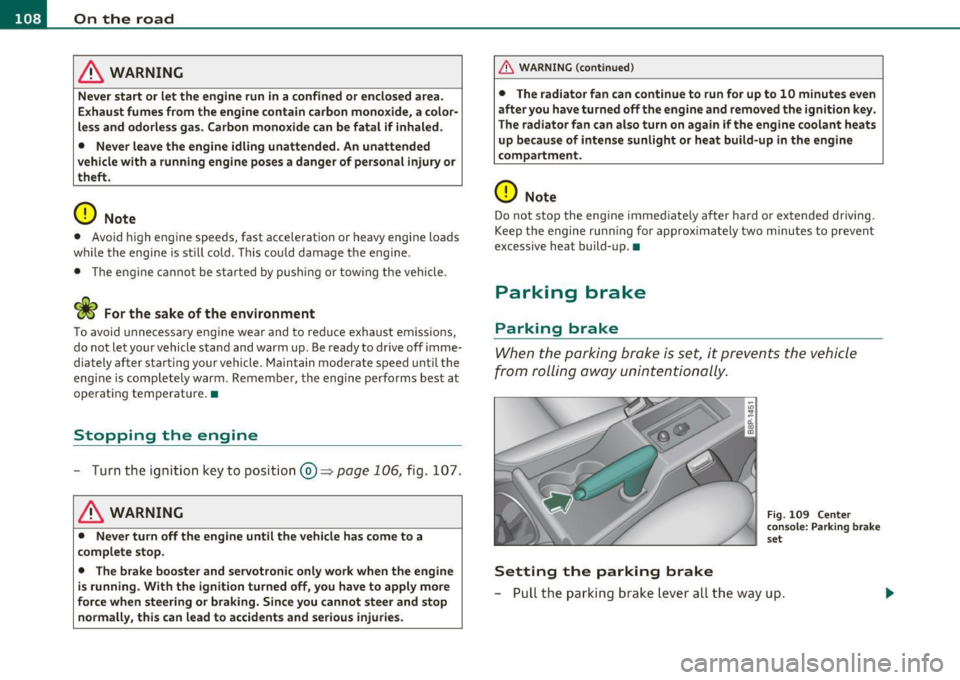
Setting the parking brake
Fig. 109 Cente r
c o ns ole : Pa rk ing brak e
s et
- Pull t he park ing b rak e l eve r all the way up .
Page 112 of 320

ffl..__O_ n_ t_h _e_ r_o _ a_ d _________________________________________________ _
& WARN ING (con tinu ed)
• Never allow anyone - e speciall y small children - to remain in
the vehicle when it is locked . Locked doors make it more d ifficult
for rescuers to acces s the passenger compa rtment in the e vent of
an emergency. Danger to life!
• Never leave children unsupervi sed in the vehicle . Children
could release the parking brake or mo ve the gearshift leve r out of
gear . The vehicle could start to roll away and cause an accident.
• No matter what the season is, the temperature in a park ed
vehicle can reach dangerous levels. •
Applie s to vehicles : w it h h ill h old ass is t
Starting on hills
H ill hold assist makes it easier to s tart on hill s.
T he system is activated whe n the brake peda l is depressed for a few
s econd s.
After releasing the b rake pedal, the bra ke power is held fo r a
brief
moment to prevent the vehicle from rolling back when star ting. At
t his time , you can eas ily begin to move your veh icle .
& WARNING
• If you did not beg in moving immediately after releasing the
brake pedal , under certain circumstances , the vehicle would begin
to roll backward. Depre ss the brake pedal immediately or engage
the hand brake.
• Should the engine st all , depress the brake pedal immed iately
or engage the hand brake.
• In order to prevent the veh icle from rolling back unintention
ally when starting in stop-and-go traffi c, keep the brake pedal
depressed for a few seconds before d riving off.
[I] Tips
You can find out if your vehicle is equipped with "H ill hold as sist " at
an authorized Audi dea lersh ip. •
Cruise control
Switch ing the sy stem on
The crui se c ontrol system m akes it possible to drive a t a
constant s peed start ing a t 20 mph (3 0 km/h).
Fig . 110 Controllev er
w ith set butt on
Fig. 111 Di splay:
Se lec ted spee d
- Pull the lev er to posi tio n (D => fig . 110 to sw itch t he
system on.
Page 119 of 320
____________________________________________________ T _r_a _n_ s_m _ i_s _s_ i_ o _ n _ ___.fflll
The selector lever lock is effective only when the vehicle is stationary
and at speeds below 5 km/h. At highe r speeds, the lock in the N posi
tion is automatically switched off.
The selector lever is not locked when rapid shifts are made through
the N position (e.g . from R to D) . T h is allows you to "rock" the vehicle
if it becomes stuck. If the lever is in the N position for more than
1 second with the brake pedal not depressed, the selector lock
engages automatically.
Release button
The release button in the selector lever handle prevents accidental
shifts into certain selector lever pos itions. When you press the
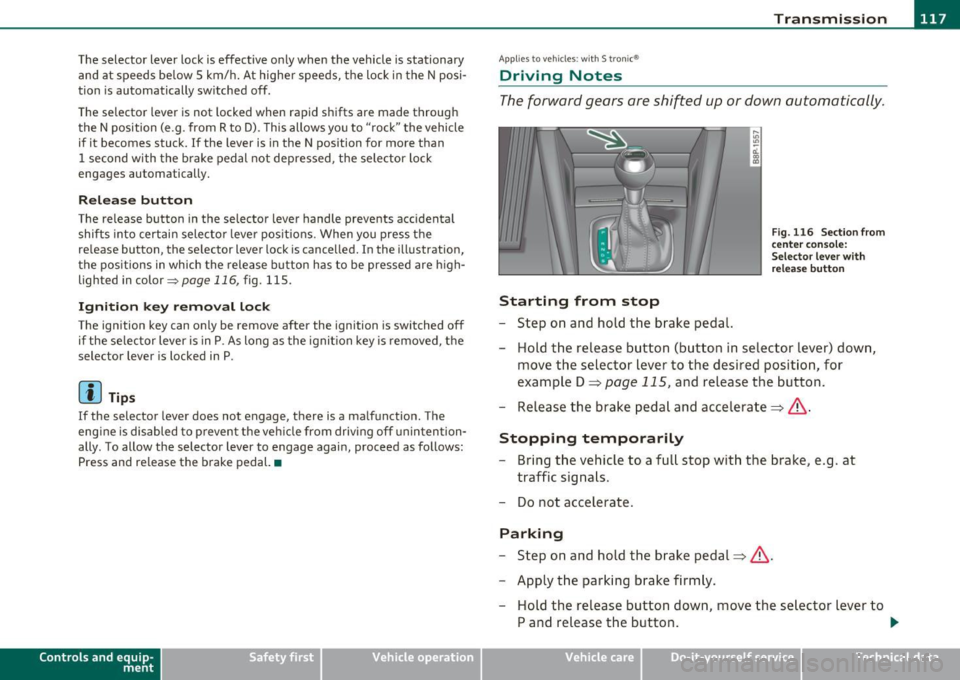
release button, the selector lever lock is cancelled. In the illustration,
the positions in which the release button has to be pressed are h igh
lighted in color::::>poge
116, fig . 115 .
Ignition k ey remo val l ock
The ignition key can only be remove after the ignition is switched off
if the selector lever is in P. As long as the ignit ion key is removed, the
selector lever is locked in P.
[ i ) Tips
If the selector lever does not engage, there is a malfunction . The
eng ine is disabled to prevent the vehicle from driv ing off unintention
ally. To allow the selector lever to engage again, proceed as follows:
Press and release the brake pedal.•
Contro ls a nd e quip
m en t Vehicle
OP-eration
Applies to vehicles : w ith S tronic®
Driving Notes
The forward gears are shifted up or down automatically .
Starting from stop
-Step on and hold the brake pedal.
Fig. 116 Section from
ce nter conso le:
Selector lever with
r elease button
- Hold the release button (button in selector lever) down,
move the selector lever to the desired position, for
example D =:;,
page 115, and relea.se the button.
- Release the brake pedal and accelerate=:;,& .
Stopping temporarily
-Bring the vehicle to a full stop with the brake, e.g . at
traffic signals.
- Do not accelerate .
Parking
-Step on and hold the brake pedal=:;,&.
- Apply the parking brake firmly.
- Hold the release button down, move the selector lever to
P and release the button. .,.
Vehicle care Do-it-yourselt service iTechnical data
Page 120 of 320
lffll.___T_ r_a _n_ s_m _ i_s _s _ i_o _n ___________________________________________________ _
Stopping on an incline
- Always
hold t he vehicle with the footbrake or parking
b rake in order to preve nt "ro llback "=> & . Do not try to
p reve nt t he v ehicle from ro lli ng back by re vving th e e ngine
whi le it is in gea r.
Starting on a hill
- Apply the hand bra ke fi rmly.
- With t he eng ine in gear , gra dually acce lerate a nd release
the hand bra ke.
T he eng ine c an only be started with the selector leve r in P or N
=>
page 107 . At low amb ient temperatures (14 °F /-10 °(), it i s only
possible to start the engine with the selector lever in P.
W hen pa rking on leve l grou nd , it is suff ic ient to p lace the se lector
lever in P. On a steeply sloping road, you shou ld f irst app ly the
par king brake firmly and then p lace t he selecto r leve r in P. T his way,
you do not overload the paw l mechanism and it is easier to move the
selector lever out of P.
& WARNING
• Never leave your vehicle with the engine running while in ge ar.
If you must lea ve your vehicle with the engine running, set the
parking brake and engage the park lo ck .
• When the eng ine i s running and the transmi ssio n is in gear (D ,
Sor R ) or in "tiptronic " mode, it is ess ential that you stop the
v ehicle with the footbrake. When idling , the transmiss ion of
power doe s not stop completely -the vehicle "creeps".
• Do not a ccelerate when you change the selector leve r position
with th e vehicle stationary and the engine runn ing -risk of an acci
dent!
• Never place the selector lever in the R or N position wh ile the
v ehicle is moving -risk of a n accident!
& WARNING (continued )
• If you have to bring your vehicle to a stop while on an incline ,
keep the foot brake depressed all the way down so that the vehicle
does not start to roll backward. You should never hold the veh icle
using the clutch if you are going to b e stopped on an incline. If you
do , the clutch will start to slip when it o verheats c aused by the
c onstant overload . Thi s is danger ous be cau se if the vehicl e start s
to roll backward , you could cause an accident. If the clutch should
s tart to slip, you will fee l the vehicle "jerk " and the selector lever
d isplay w ill start blinking.
• Befor e driving down a st eep slope, reduc e your speed and shift
i nto a lower gear w ith "tipt ronic ".
• Do not ride the brakes or apply the brake pedal too often or too
long . Constant b raking causes the brakes to overheat and
s ub stantially reduces braking performan ce, in creases braking
d istance or causes complete failure of the b rake system . •
A pplie s to v eh icl es: wit h S tro nic transm iss ion and Hi ll De scen t A ss ist
Hill Descent Assist
Hill Descent Assist helps the driver when driving down
inclines.
H ill Descent Assist is activated by pressing the brake while
descending when the se lector lever is in
D /S . The S tronic transmis
sion a utomat ically s hifts down to a gear s uitable fo r the in cl ine. H ill
Descent Assist attempts to mainta in the cu rrent vehicle speed when
t he br aking oc curs, as far as physical and technical l imi ts allow.
It
may be necessary to adjust the speed using the brakes .
Hi ll Descent Assist switches off w hen the incline levels out or when
the gas pedal is pressed.
On vehicles with cruise control*=>
page 110, Hill Descent Assist is
also activa ted when the speed is set.
~
Page 196 of 320

Intelligent technologyL _______________________________________ _
• If the power steering system is not funct ioning properly, contact
your au thori zed A ud i dea le r i mmediately. •
Applies to ve hicl es: wit h A ll Whe el D rive
Driving with your quattro®
With All Wheel Drive, all four wheels are driven.
General information
With All Wheel Drive, power is distributed to all fo ur whee ls. This
happens automatically depending on you r driving s tyle a nd the road
conditions at the time. See also =>
page 189, "Electronic differential
lo ck (E DL)".
W inter tires
W hen d riving in the winter, your vehicle with A ll Whee l Drive has an
advantage, even with reg ular t ires . In winter road cond it ions it may
be advisab le to mou nt w inte r ti res (or all-se aso n t ires) for imp roved
dr iveability and braking: these tires must be mounted on
all four
wheel s.
See also => page 261, "Win ter tires".
Snow chains
W he re snow c ha ins are mand atory on certain roads, this norm ally
also app lies to veh icles with all-wheel drive=>
page 262, "Snow
c hains".
Replacing wheels/tires
Veh icles with All Wheel Drive m ust always have t ires of the same s ize.
Also avoid tires with different tread depths. For details see page
=>
page 257, " N ew tires and replac ing ti res and wheels".
Off-Road driving?
Your Audi does not have enough ground clearance to be used as a n
off-road vehicle. It is therefore best to avoid rough tracks and uneven
te rrain as much as poss ib le. Also refe r to=>
page 199.
& WARNING
Always adjust your driving to road and traffic conditions . Do not
let the extra safety afforded by the all-wheel drive tempt you into
taking extra risk s.
• Although the quattro ®all -wheel drive is very effective, always
remember that braking capacity is limited by t ire traction. You
should therefore not drive at exce ssive speed s on icy or slippery
road surfaces .
• On wet road surfa ces, be careful not to drive too fast becau se
the front wheels could begin to slide on top of the water (hydro
planing ). If this should occur, you will have no warning from a
sudden increase in engine speed as with a front -wheel drive
vehicle. Always dr ive at speed s which are adjusted to the road
conditions -risk of crash! •
Energy management
Starting ability is optimized
Energy managemen t controls the distribution of elec
trical energy and thus optimizes the availability of elec
t r ical ene rgy for s tarting the en gin e.
If a vehicle w ith a convent ional energy sys tem is not d riven fo r a long
period of time, t he battery is discha rged by idling cur rent consumers
(e .g. immob ilizer). In ce rtain c ircumstances it can result i n there
being insufficient energy availab le to start the engine .
Inte lligent ene rgy m anageme nt in yo ur vehicle h andles the dis tribu
tion of electrical energy. Starting ability is markedly improved and
t he life of the bat tery is ex tende d.
Bas ically, energy management consis ts of
battery d iagnosis, idling
current management
and dynamic energy management . ~
Page 197 of 320

_________________________________________ I_ n_ t_ e_ ll_,igent technology ,__E~-
Battery diagnosis
Battery diagnosis continuously determines the state of the battery.
Sensors determine battery voltage, battery current and battery
temperature. This determines the current state of charge and the
power of the battery .
Idling current management
Idling current management reduces energy consumption while the
vehicle is standing. With the ignition switched off, it controls the
energy supply to the various electrical components. Data from
battery diagnosis is considered.
Depending on the battery's state of charge , individual consumers are
gradually turned off to prevent excessive discharge of the battery and
thus maintain starting capability.
Dynamic energy management
While the vehicle is being driven, dynamic energy management
distributes the energy generated according to the needs of the indi
v idual components. It regulates consumption, so that more electrical
energy is not being used than is being generated and ensures an
optimal state of charge for the battery.
[ i] Tips
• But even energy management cannot negate the limits of physics.
Consider that the power and life of a battery are limited.
• If starting ability is threatened, you are informed by a warning
=> page 196, "Driver notification in the instrument cluster display". •
What you should know
The highest priority is given to maintaining starting capa
bility.
The battery is severely taxed in short-distance driving, in city traffic
and during the cold time of year. Abundant electrical energy is
Controls and equip
ment Safety first Vehicle operation
required, but only a little is generated. It is also critical if the engine
is
not running and electrical components are turned on. In this
instance energy is being consumed but none is being generated .
It is in precisely these situations that you will notice energy manage
ment actively regulating the distribution of energy.
Vehicle stands for an extended period
If you do not drive your vehicle over a period of several days or weeks,
electrical components are gradually cut back or switched off. This
reduces energy consumption and maintains starting capability over a
longer period.
Take into consideration that when you unlock your vehicle, some
convenience functions, such as the remote key or power seat adjust
ment, may not be available. The convenience functions will be avail
able again when you turn on the ignition and start the engine .
With the engine turned off
If you listen to the radio, for example, with the engine turned off, the
battery is being discharged.
If starting capability is jeopardized due to energy consumption, a
message appears in the driver information display.
You have to start the engine to charge the battery.
With the engine running
Although electrical energy is generated when the vehicle is being
driven, the battery can become discharged. This happens mostly
when little energy is being generated and a great deal consumed and
the battery's state of charge is not optimal.
To bring the energy balance back into equilibrium, consumers which
require especially large amounts of energy are temporarily cut back
or switched off. Heating systems in particular require a great deal of
energy . If you notice, for example , that the heated seats* or the
heated rear window are not heating, they have been temporarily cut
back or switched off. These systems will be available again as soon as
the energy balance has been restored. .,
Vehicle care Do-it-yourself service Technical data
Page 202 of 320

Driving and environment
This is especially true for vehicles with low-slung chassis (sports
chassis) and fully loaded vehicles. •
Operate your vehicle economically
and minimize pollution
General
Your personal style of driving will determine the economy
of your vehicle, as well as exhaust and noise levels.
Fuel economy, env ironmental impact, and wear on your eng ine,
brakes and tires largely depend on three factors:
• your personal driving style
• operat ing conditions
• technical lim itations
If you anticipate what you need to do next and drive economically,
you can easily cut your fuel consumpt ion by 10-15 percent. This
sect ion wi ll g ive you some tips on how you can help the environment
and your pocketbook.
[I) Tips
The consumption estimates as published by ENVIRONMENTAL PROTECTION AGENCY (EPA) and Transport Canada may not co rre
spond to your actual consumption on the road, which will vary
depending upon vehicle load and speed, road and weather conditions,
trip length, etc. •
Drive smoothl} and keep a lookout ahead
Vehicles use the most fuel when they are accelerating.
Avoid unnecessary accelerating and braking .
Vehicles use the most fuel when they are accelerating. If you antici
pate what is go ing to happen next, you will need to brake less and,
thus, accelerate less. Let the vehicle coast whenever possible - for example when you see that the next traffic light is red.
Avoid full throttle
Driving at moderate speeds saves fuel and improves your
mileage.
- Try and keep well below your car's maximum speed.
Accelerating gently reduces fuel consumption, engine wear, and does
not d isturb the env ironment.
Fuel consumption, exhaust emissions and engine noise increase
disproportionately at high speeds. If you drive at approximately three
quarters of top speed, fuel consumption will be reduced by one half.
Never drive faster than the posted speed limit and weather condi
tions perm it. •
Reducing unnecessary idling
Even when your car is just idling it burns up fuel.
- Shut the engine off when you are not driving the vehicle .
- Do not warm up the vehicle by letting the engine run at idle .
It makes sense to shut off the engine in traffic jams, when waiting for
trains to pass at railroad crossings, or at traffic lights that have long
wa its on red. Turn ing the eng ine off for just 30-40 seconds saves
more fuel than is burned starting the engine again.
It takes a long time for the engine to warm up fully when it is running
at idle. However, wear and noxious emissions are espec ially high
when the engine is warming up . So you shou ld drive away as soon as .,_