Page 36 of 146
4-11
1
2
34
5
6
7
8
9
10
11
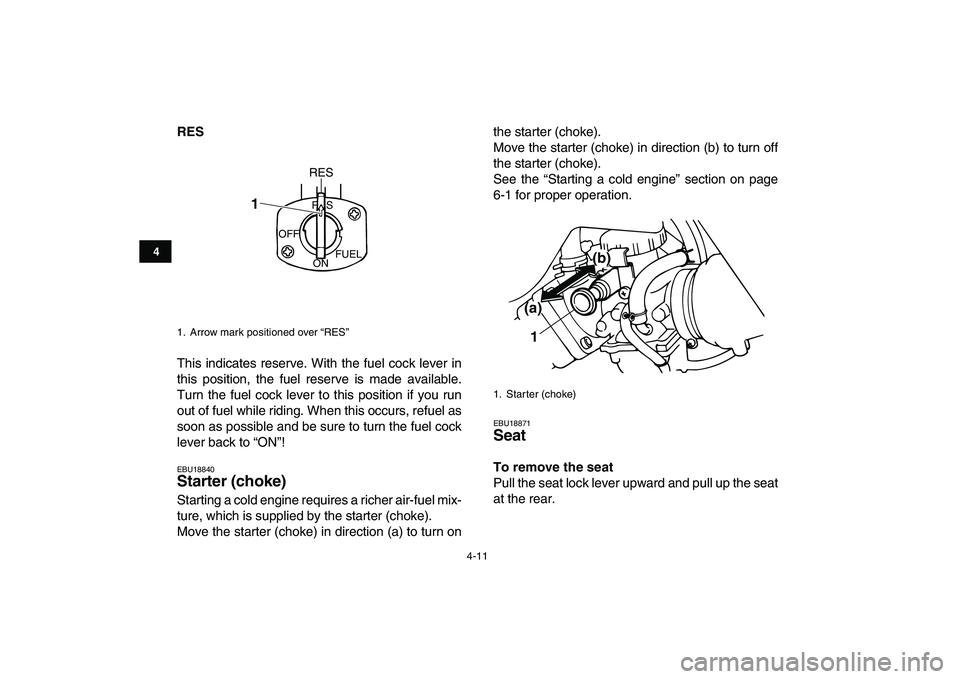
RES
This indicates reserve. With the fuel cock lever in
this position, the fuel reserve is made available.
Turn the fuel cock lever to this position if you run
out of fuel while riding. When this occurs, refuel as
soon as possible and be sure to turn the fuel cock
lever back to “ON”!
EBU18840
Starter (choke)
Starting a cold engine requires a richer air-fuel mix-
ture, which is supplied by the starter (choke).
Move the starter (choke) in direction (a) to turn onthe starter (choke).
Move the starter (choke) in direction (b) to turn off
the starter (choke).
See the “Starting a cold engine” section on page
6-1 for proper operation.
EBU18871
Seat
To remove the seat
Pull the seat lock lever upward and pull up the seat
at the rear.
1. Arrow mark positioned over “RES”
OFF
ONFUEL RES
RES
1
1. Starter (choke)1 (a)(b)
✦✯��✬�✩✧�✤✲✣ ✤✤ ��
����������������������
Page 43 of 146
5-1
1
2
3
45
6
7
8
9
10
11
EBU19201
PRE-OPERATION CHECKS
EBU19224
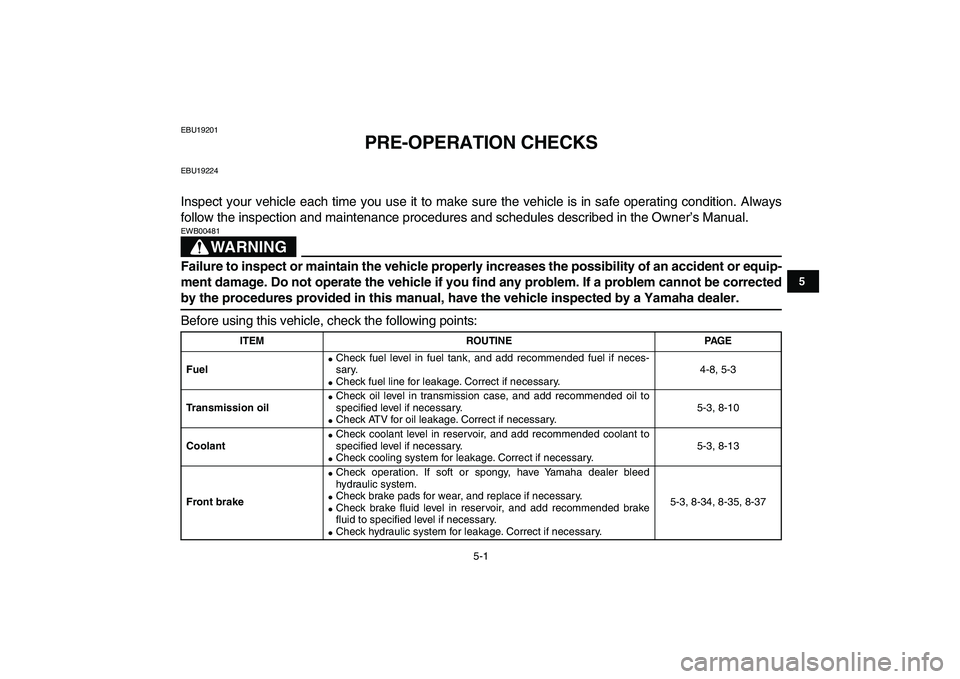
Inspect your vehicle each time you use it to make sure the vehicle is in safe operating condition. Always
follow the inspection and maintenance procedures and schedules described in the Owner’s Manual.
WARNING
EWB00481
Failure to inspect or maintain the vehicle properly increases the possibility of an accident or equip-
ment damage. Do not operate the vehicle if you find any problem. If a problem cannot be corrected
by the procedures provided in this manual, have the vehicle inspected by a Yamaha dealer.
Before using this vehicle, check the following points:
ITEM ROUTINE PAGE
Fuel
�
Check fuel level in fuel tank, and add recommended fuel if neces-
sary.
�
Check fuel line for leakage. Correct if necessary.4-8, 5-3
Transmission oil
�
Check oil level in transmission case, and add recommended oil to
specified level if necessary.
�
Check ATV for oil leakage. Correct if necessary.5-3, 8-10
Coolant
�
Check coolant level in reservoir, and add recommended coolant to
specified level if necessary.
�
Check cooling system for leakage. Correct if necessary.5-3, 8-13
Front brake
�
Check operation. If soft or spongy, have Yamaha dealer bleed
hydraulic system.
�
Check brake pads for wear, and replace if necessary.
�
Check brake fluid level in reservoir, and add recommended brake
fluid to specified level if necessary.
�
Check hydraulic system for leakage. Correct if necessary.5-3, 8-34, 8-35, 8-37
✦✯��✬�✩✧�✤✲✣ ✤ ��
����������������������
Page 45 of 146
5-3
1
2
3
45
6
7
8
9
10
11
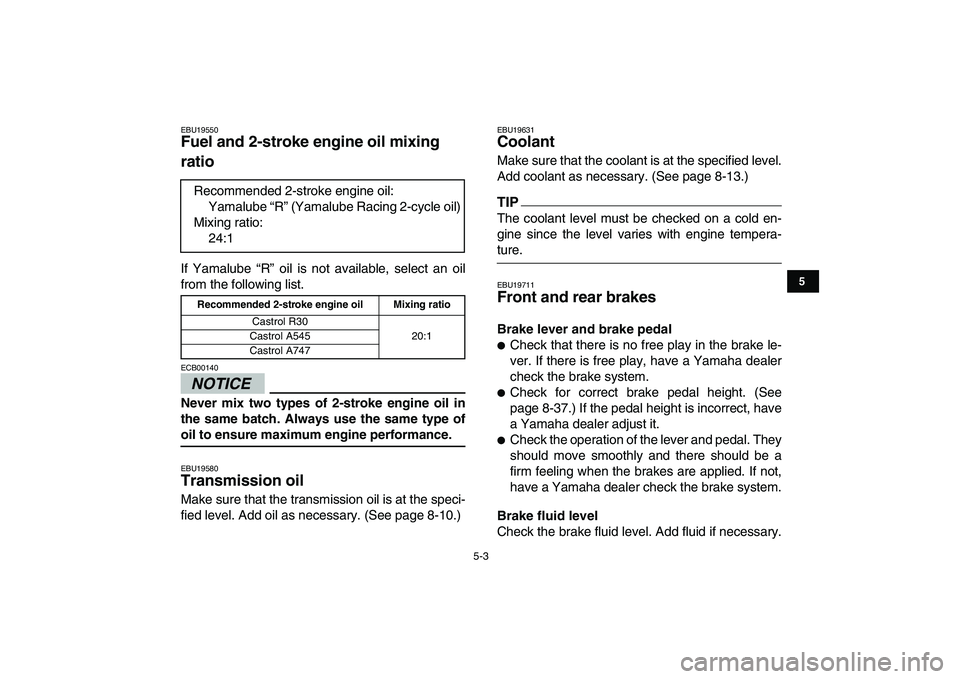
EBU19550
Fuel and 2-stroke engine oil mixing
ratio
If Yamalube “R” oil is not available, select an oil
from the following list.
NOTICE
ECB00140
Never mix two types of 2-stroke engine oil in
the same batch. Always use the same type of
oil to ensure maximum engine performance.
EBU19580
Transmission oil
Make sure that the transmission oil is at the speci-
fied level. Add oil as necessary. (See page 8-10.)
EBU19631
Coolant
Make sure that the coolant is at the specified level.
Add coolant as necessary. (See page 8-13.)
TIP
The coolant level must be checked on a cold en-
gine since the level varies with engine tempera-
ture.
EBU19711
Front and rear brakes
Brake lever and brake pedal
�
Check that there is no free play in the brake le-
ver. If there is free play, have a Yamaha dealer
check the brake system.
�
Check for correct brake pedal height. (See
page 8-37.) If the pedal height is incorrect, have
a Yamaha dealer adjust it.
�
Check the operation of the lever and pedal. They
should move smoothly and there should be a
firm feeling when the brakes are applied. If not,
have a Yamaha dealer check the brake system.
Brake fluid level
Check the brake fluid level. Add fluid if necessary. Recommended 2-stroke engine oil:
Yamalube “R” (Yamalube Racing 2-cycle oil)
Mixing ratio:
24:1
Recommended 2-stroke engine oil Mixing ratio
Castrol R30
20:1 Castrol A545
Castrol A747
✦✯��✬�✩✧�✤✲✣ ✦ ��
����������������������
Page 50 of 146

6-1
1
2
3
4
56
7
8
9
10
11
EBU19880
OPERATION
EBU19901
Read the Owner’s Manual carefully before riding
the ATV. If there is a control or function you do not
understand, ask your Yamaha dealer.
WARNING
EWB00631
Read the Owner’s Manual carefully to become
familiar with all controls in order to help pre-
vent any loss of control, which could cause an
accident or injury.
EBU29341
Starting a cold engine
NOTICE
ECB00150
See the “Engine break-in” section on page 6-4
prior to operating the engine for the first time.
1. Set the parking brake.
2. Turn the fuel cock to “ON”.
3. Turn the key to “ON” and the engine stop
switch to “”.
4. Shift the transmission into neutral.5. Use the starter (choke) in reference to the fig-
ure:
Position (1):
Cold engine start with ambient temperature below
5 °C (40 °F).
Position (2):
Cold engine start with ambient temperature be-
tween 0 °C (30 °F) and 30 °C (90 °F).
Position (3):
Cold engine start with ambient temperature above
25 °C (80 °F).
✦✯��✬�✩✧�✤✲✣ ✤ ��
����������������������
Page 54 of 146
6-5
1
2
3
4
56
7
8
9
10
11
gine overheating must be avoided.
0–160 km (0–100 mi) or 0–10 hours
Avoid prolonged operation above 1/2 throttle. Vary
the speed of the ATV regularly. Do not operate it at
one set throttle position.
160–320 km (100–200 mi) or 10–20 hours
Avoid prolonged operation above 3/4 throttle. Rev
the engine through the gears freely, but do not use
full throttle at any time.
320 km (200 mi) or 20 hours and beyond
The ATV can now be operated normally.
NOTICE
ECB00220
If any engine trouble should occur during the
engine break-in period, immediately have a
Yamaha dealer check the ATV.
EBU20722
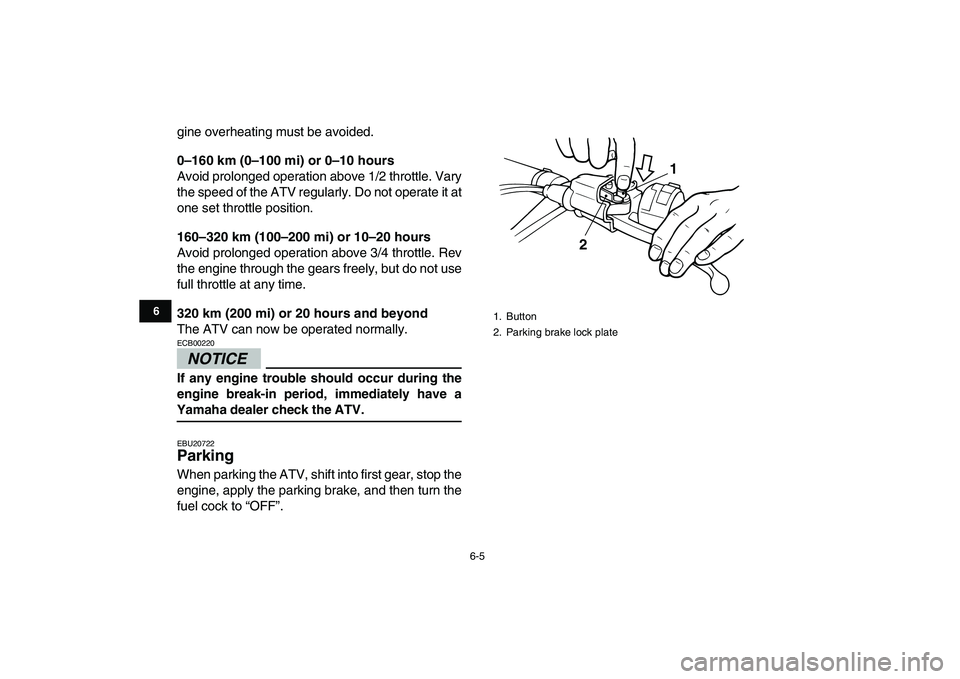
Parking
When parking the ATV, shift into first gear, stop the
engine, apply the parking brake, and then turn the
fuel cock to “OFF”.
1. Button
2. Parking brake lock plate
1
2
✦✯��✬�✩✧�✤✲✣ � ��
����������������������
Page 81 of 146
8-3
1
2
3
4
5
6
78
9
10
11
EBU21743
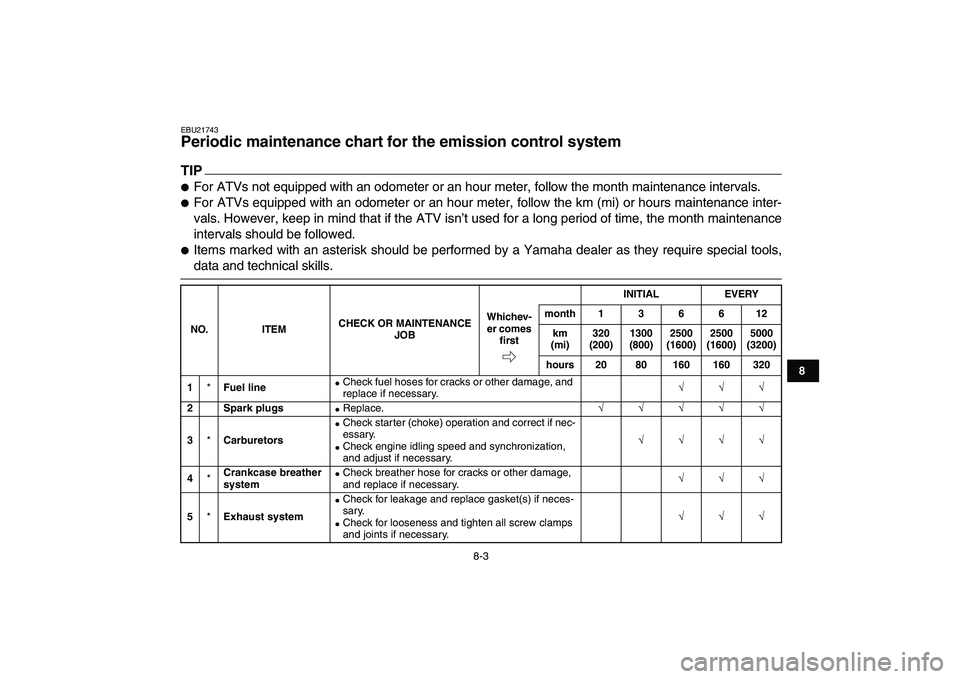
Periodic maintenance chart for the emission control system
TIP
�
For ATVs not equipped with an odometer or an hour meter, follow the month maintenance intervals.
�
For ATVs equipped with an odometer or an hour meter, follow the km (mi) or hours maintenance inter-
vals. However, keep in mind that if the ATV isn’t used for a long period of time, the month maintenance
intervals should be followed.
�
Items marked with an asterisk should be performed by a Yamaha dealer as they require special tools,
data and technical skills.
NO. ITEMCHECK OR MAINTENANCE
JOBINITIAL EVERY
Whichev-
er comes
firstmonth136612
km
(mi)320
(200)1300
(800)2500
(1600)2500
(1600)5000
(3200)
hours 20 80 160 160 3201
*
Fuel line
�
Check fuel hoses for cracks or other damage, and
replace if necessary.
√√√
2 Spark plugs
�
Replace.
√√√√√
3
*
Carburetors
�
Check starter (choke) operation and correct if nec-
essary.
�
Check engine idling speed and synchronization,
and adjust if necessary.
√√√√
4
*
Crankcase breather
system
�
Check breather hose for cracks or other damage,
and replace if necessary.
√√√
5
*
Exhaust system
�
Check for leakage and replace gasket(s) if neces-
sary.
�
Check for looseness and tighten all screw clamps
and joints if necessary.
√√√
✦✯��✬�✩✧�✤✲✣ ✦ ��
����������������������
Page 101 of 146
8-23
1
2
3
4
5
6
78
9
10
11
WARNING
EWB02340
Do not start the engine when cleaning the
spark arrester, otherwise it could cause injury
to the eyes, burns, carbon monoxide poison-
ing, possibly leading to death, and start a fire.
Always let the exhaust system cool prior to
touching exhaust components.
EBU23993
Changing the carburetor settings
In extremely cold weather, it is necessary to
change the carburetor settings to maintain opti-
mum engine performance and to prevent engine
damage.
WARNING
EWB01990
�
Improperly servicing or adjusting the carbu-
retors could cause them to malfunction with
the possibility of an accident, or the carbure-
tors could leak fuel, which would be a fire
hazard.
�
Carburetor adjustments should only be per-
formed by a Yamaha dealer. Do not attempt
to perform these procedures unless you
have mechanical knowledge and the neces-sary tools.
�
Do not perform this procedure while the en-
gine is hot. Place a rag under each carbure-
tor to catch any fuel. Wipe up any spilled fuel
completely.
�
After servicing the carburetors, always
check the throttle lever operation before op-
erating the ATV to make sure it is working
correctly.
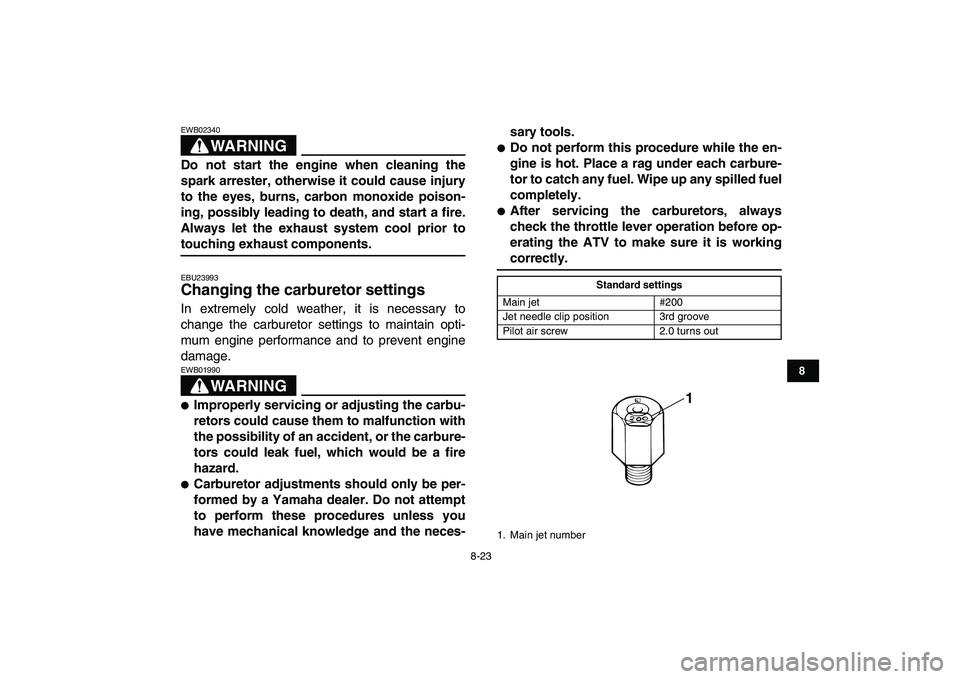
Standard settings
Main jet #200
Jet needle clip position 3rd groove
Pilot air screw 2.0 turns out
1. Main jet number
1
✦✯��✬�✩✧�✤✲✣ ✥✦ ��
����������������������
Page 103 of 146
8-25
1
2
3
4
5
6
78
9
10
11
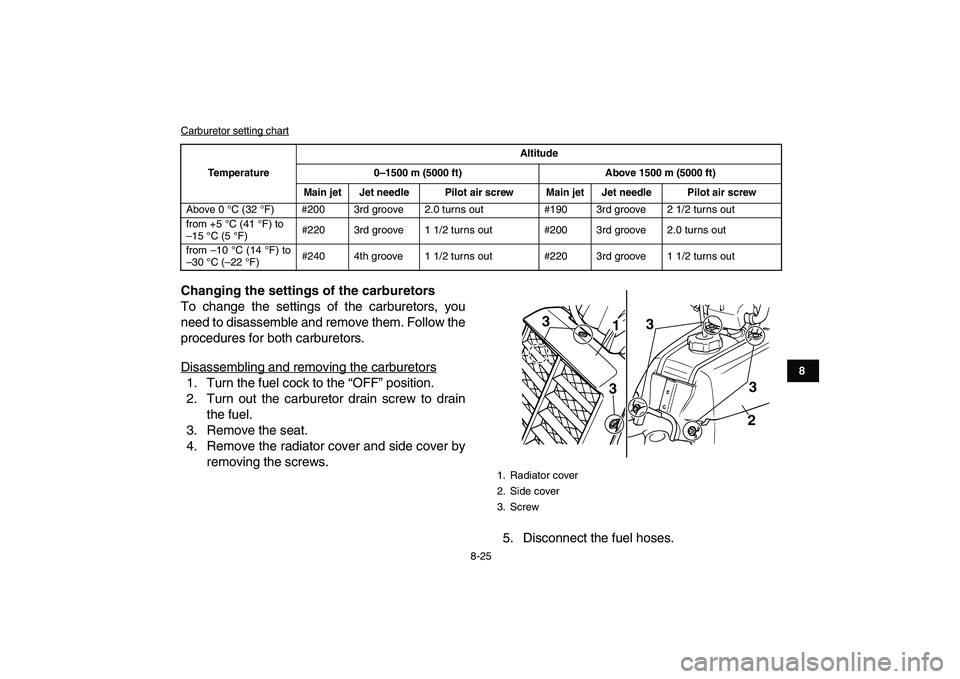
Carburetor setting chart
Changing the settings of the carburetors
To change the settings of the carburetors, you
need to disassemble and remove them. Follow the
procedures for both carburetors.
Disassembling and removing the carburetors
1. Turn the fuel cock to the “OFF” position.
2. Turn out the carburetor drain screw to drain
the fuel.
3. Remove the seat.
4. Remove the radiator cover and side cover by
removing the screws.
5. Disconnect the fuel hoses.
TemperatureAltitude
0
–1500 m (5000 ft) Above 1500 m (5000 ft)
Main jet Jet needle Pilot air screw Main jet Jet needle Pilot air screw
Above 0 °C (32 °F) #200 3rd groove 2.0 turns out #190 3rd groove 2 1/2 turns out
from +5 °C (41 °F) to
–15 °C (5 °F)#220 3rd groove 1 1/2 turns out #200 3rd groove 2.0 turns out
from –10 °C (14 °F) to
–30 °C (–22 °F)#240 4th groove 1 1/2 turns out #220 3rd groove 1 1/2 turns out
1. Radiator cover
2. Side cover
3. Screw
1
2 3 3
3
3
✦✯��✬�✩✧�✤✲✣ ✥� ��
����������������������