Page 133 of 386
120
2-1. Driving procedures
Hor n
nAfter adjusting the steering wheel
Make sure that the steering wheel is securely locked.
The horn may not sound if the steering wheel is not securely locked.
(→P. 51)
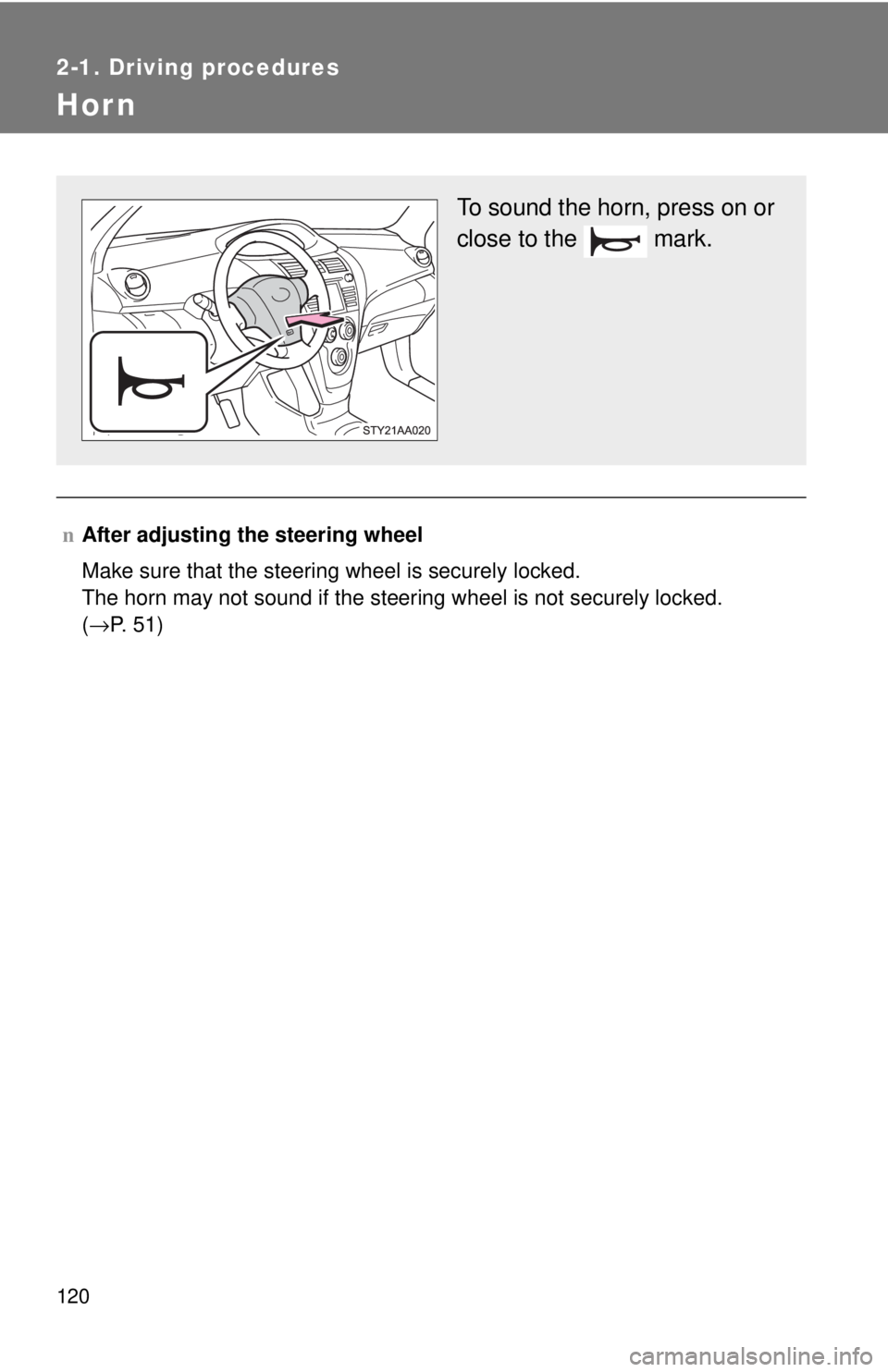
To sound the horn, press on or
close to the mark.
Page 152 of 386
139
2-4. Using other driving systems
2
When driving
Driving assist systems
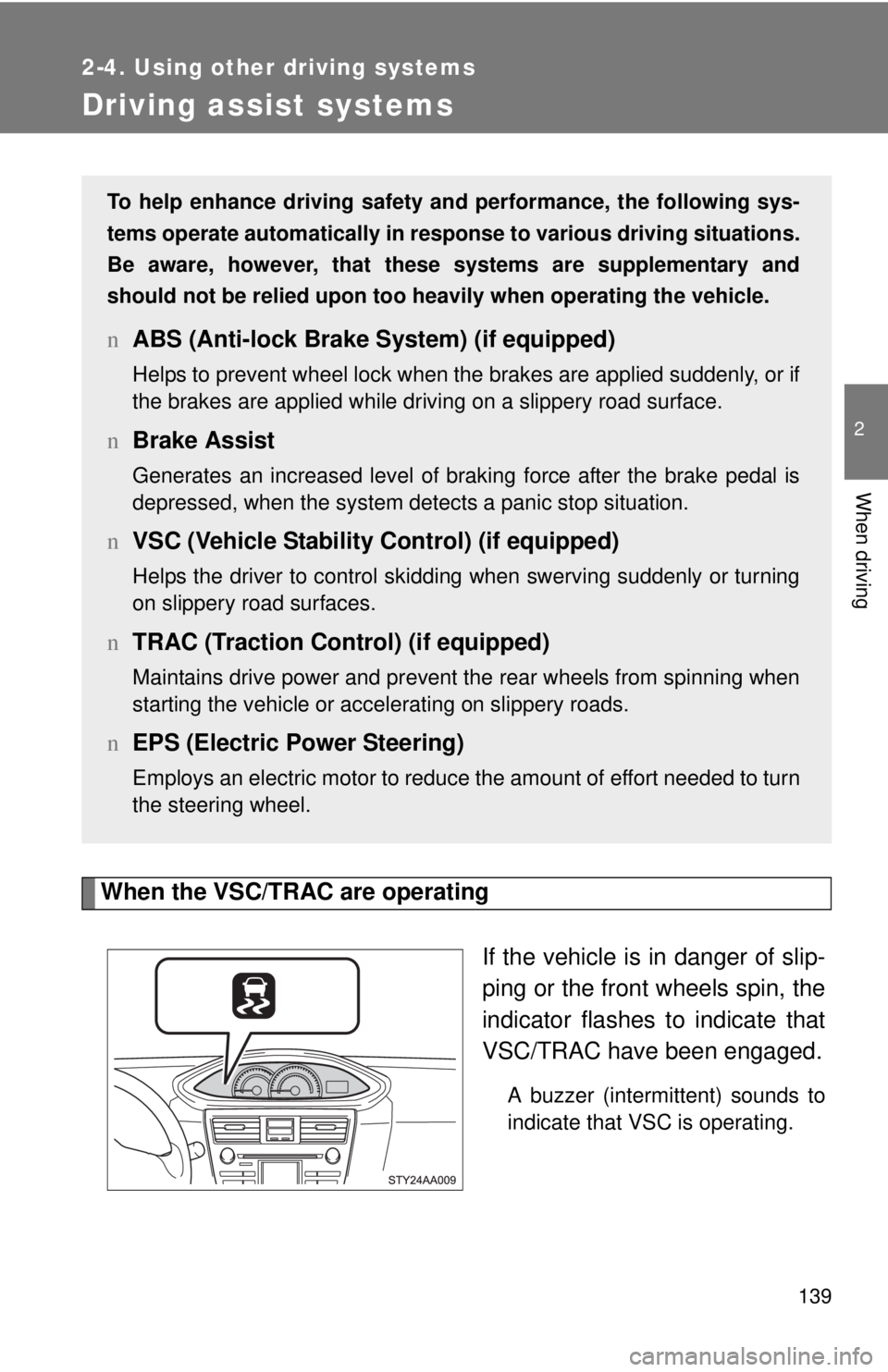
When the VSC/TRAC are operatingIf the vehicle is in danger of slip-
ping or the front wheels spin, the
indicator flashes to indicate that
VSC/TRAC have been engaged.
A buzzer (intermittent) sounds to
indicate that VSC is operating.
To help enhance driving safety and performance, the following sys-
tems operate automatically in res ponse to various driving situations.
Be aware, however, that these systems are supplementary and
should not be relied upon too heavi ly when operating the vehicle.
nABS (Anti-lock Brake System) (if equipped)
Helps to prevent wheel lock when the brakes are applied suddenly, or if
the brakes are applied while driving on a slippery road surface.
nBrake Assist
Generates an increased level of braking force after the brake pedal is
depressed, when the system detects a panic stop situation.
nVSC (Vehicle Stability Control) (if equipped)
Helps the driver to control skidding when swerving suddenly or turning
on slippery road surfaces.
nTRAC (Traction Control) (if equipped)
Maintains drive power and prevent the rear wheels from spinning when
starting the vehicle or accelerating on slippery roads.
nEPS (Electric Power Steering)
Employs an electric motor to reduce the amount of effort needed to turn
the steering wheel.
Page 155 of 386
142 2-4. Using other driving systems
nAutomatic reactivation of TRAC and VSC
Turning the engine switch OFF after turning off the TRAC and VSC systems
will automatically re-enable them.
n Automatic TRAC reactivation
If only the TRAC system is turned off, the TRAC system will turn on when
vehicle speed increases.
n Automatic TRAC and VSC reactivation
If the TRAC and VSC systems are turned off, the systems will not turn on
even when vehicle speed increases.
n If the slip indicator light up
There is a malfunction in the TRAC and VSC systems. Contact your Toyota
dealer and have your Toyota inspected.
n EPS operation sound
When the steering wheel operates, a motor sound (whirring sound) may be
heard.
This does not indicate a malfunction.
n Reduced effectiveness of EPS
The effectiveness of EPS is reduced to prevent the system from overheating
when there is frequent steering input over an extended period of time. The
steering wheel may feel heavy as a result. Should this occur, refrain from
excessive steering input or stop the vehicle and turn the engine off. The sys-
tem should return to normal within 10 minutes.
CAUTION
nThe ABS does not operate effectively when
lTires with inadequate gripping ability are used (such as excessively worn
tires on a snow covered road).
l The vehicle hydroplanes while driving at high speed on the wet or slick
road.
Page 170 of 386

157
2-5. Driving information
2
When driving
l
Reversing with a trailer attached is difficult and requires practice.
Grip the bottom of the steering wheel and move your hand to the
left to move the trailer to the left. Move your hand to the right to
move the trailer to the right. (Thi s is generally opposite to reversing
without a trailer attached.) Avoid sharp or prolonged turning. Have
someone guide you when reversing to reduce the risk of an acci-
dent.
l As stopping distance is increased when towing a trailer, vehicle-to-
vehicle distance should be increased. For each 10 mph (16 km/h)
of speed, allow at least o ne vehicle and trailer length.
l Avoid sudden braking as you may skid, resulting in jackknifing and
loss of control. This is especiall y true on wet or slippery surfaces.
l Avoid jerky starts or sudden acceleration. Vehicles with a manual
transmission, prevent excessive cl utch slippage by keeping engine
rpm low and not racing the engine. Always start out in first gear.
l Avoid jerky steering and sharp turns, and slow down before mak-
ing a turn.
l Note that when making a turn, th e trailer wheels will be closer than
the vehicle wheels to the inside of the turn. Compensate by making
a larger than normal turning radius.
l Crosswinds and rough roads will adversely affect handling of your
vehicle and trailer, causing sway . Periodically check the rear to
prepare for being passed by large trucks or buses, which may
cause your vehicle and trailer to sway. If swaying occurs, firmly grip
the steering wheel, reduce speed immediately but gradually, and
steer straight ahead. Never increase speed. If you make no
extreme correction with the stee ring or brakes, your vehicle and
trailer will stabilize.
l Take care when passing other vehicles. Passing requires consider-
able distance. After passing a vehicle, do not forget the length of
your trailer, and be sure you hav e plenty of room before changing
lanes.
Page 236 of 386
225
4-2. Maintenance
4
Maintenance and care
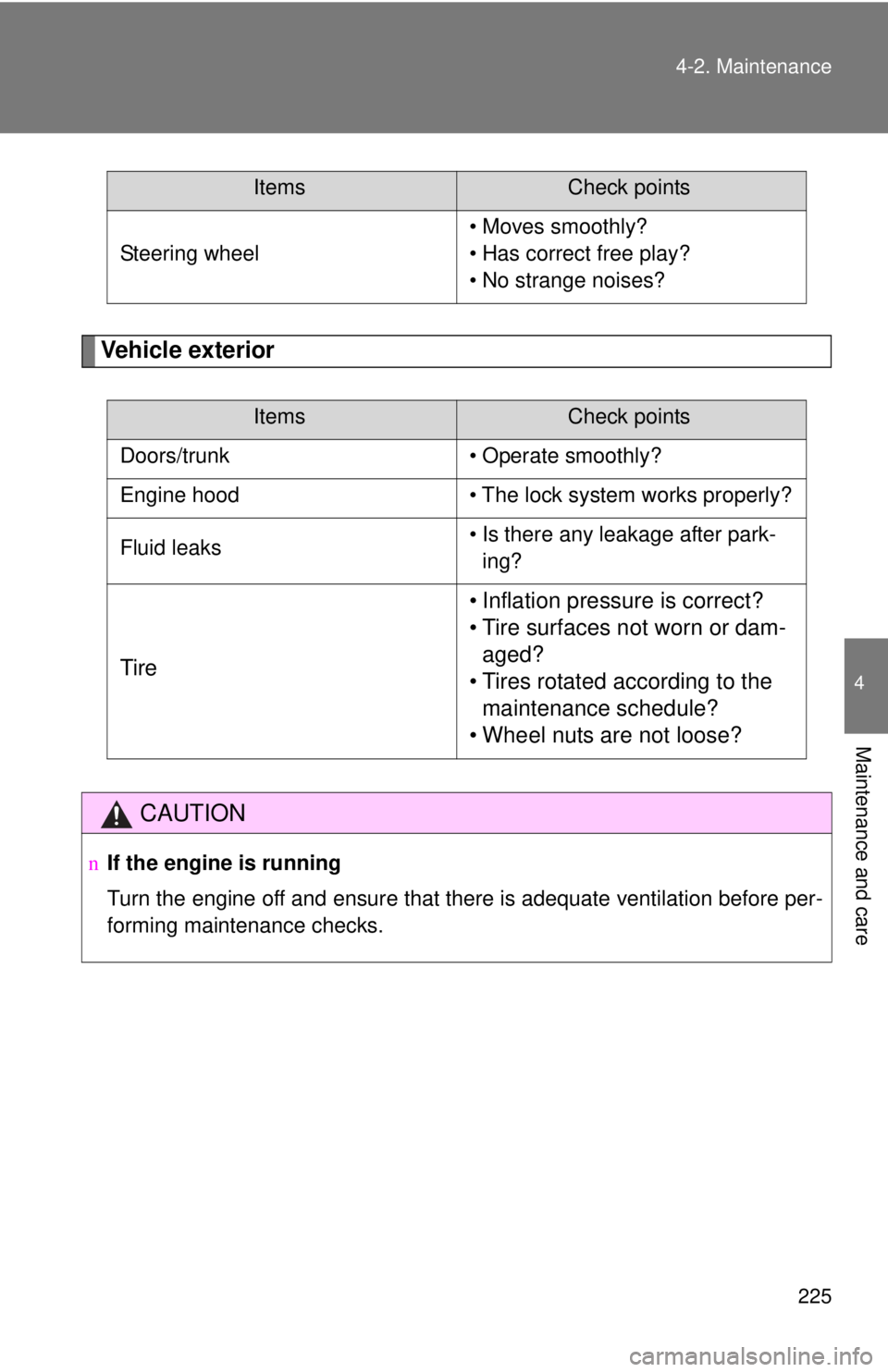
Vehicle exterior
Steering wheel
• Moves smoothly?
• Has correct free play?
• No strange noises?
ItemsCheck points
Doors/trunk • Operate smoothly?
Engine hood • The lock system works properly?
Fluid leaks • Is there any leakage after park-
ing?
Tire • Inflation pressure is correct?
• Tire surfaces not worn or dam-
aged?
• Tires rotated according to the maintenance schedule?
• Wheel nuts are not loose?
CAUTION
n If the engine is running
Turn the engine off and ensure that there is adequate ventilation before per-
forming maintenance checks.
ItemsCheck points
Page 297 of 386

5
When trouble arises
287
5-1. Essential information
If your vehicle needs to be towed
Before towingThe following may indicate a problem with your transmission. Contact
your Toyota dealer before towing.
l The engine is running, but the vehicle will not move.
l The vehicle makes an abnormal sound.
Emergency towing
If a tow truck is not available, in an emergency your vehicle may be
temporarily towed using a cable or chain secured to the emergency
towing eyelet. This should only attempted on hard, surfaced roads for
short distances at low speeds.
A driver must be in the vehicle to steer and operate the brakes. The
vehicle’s wheels, drive train, axles, steering and brakes must be in
good condition.
Towing eyelet
If towing is necessary, we recommend having your vehicle towed by
your Toyota dealer or a commerci al towing service, using a lift-type
truck or a flat bed truck.
Use a safety chain system for all to wing, and abide by all state/pro-
vincial and local laws.
If towing from the front, the vehic le’s rear wheels and axles must be
in good condition. (→P. 290)
If they are damaged, use a towing dolly or flat bed truck.
Page 298 of 386
288 5-1. Essential information
nEmergency towin g procedure
Release the parking brake.
Put the transmission in N.
Turn the engine switch to the ACC (engine off) or ON (engine run-
ning) position.
CAUTION
n Caution while towing
lUse extreme caution when towing the vehicle.
Avoid sudden starts or erratic driving maneuvers which place excessive
stress on the emergency towing eyelet and the cables or chains. Always
use caution for the surroundings and other vehicles while towing.
l If the engine is not running, the power assist for the brakes and steering
will not function, making steering and braking more difficult.
NOTICE
nTo prevent causing serious dama ge to the transmission
(vehicles with an automatic transmission)
Never tow this vehicle from the rear with the front wheels on the ground.
This may cause serious damage to the transmission.
n When towing a vehicle without using a towing dolly
(vehicles with a manual transmission)
Do not tow with the key removed or in the LOCK position.
Page 301 of 386
5
When trouble arises
291
5-1. Essential information
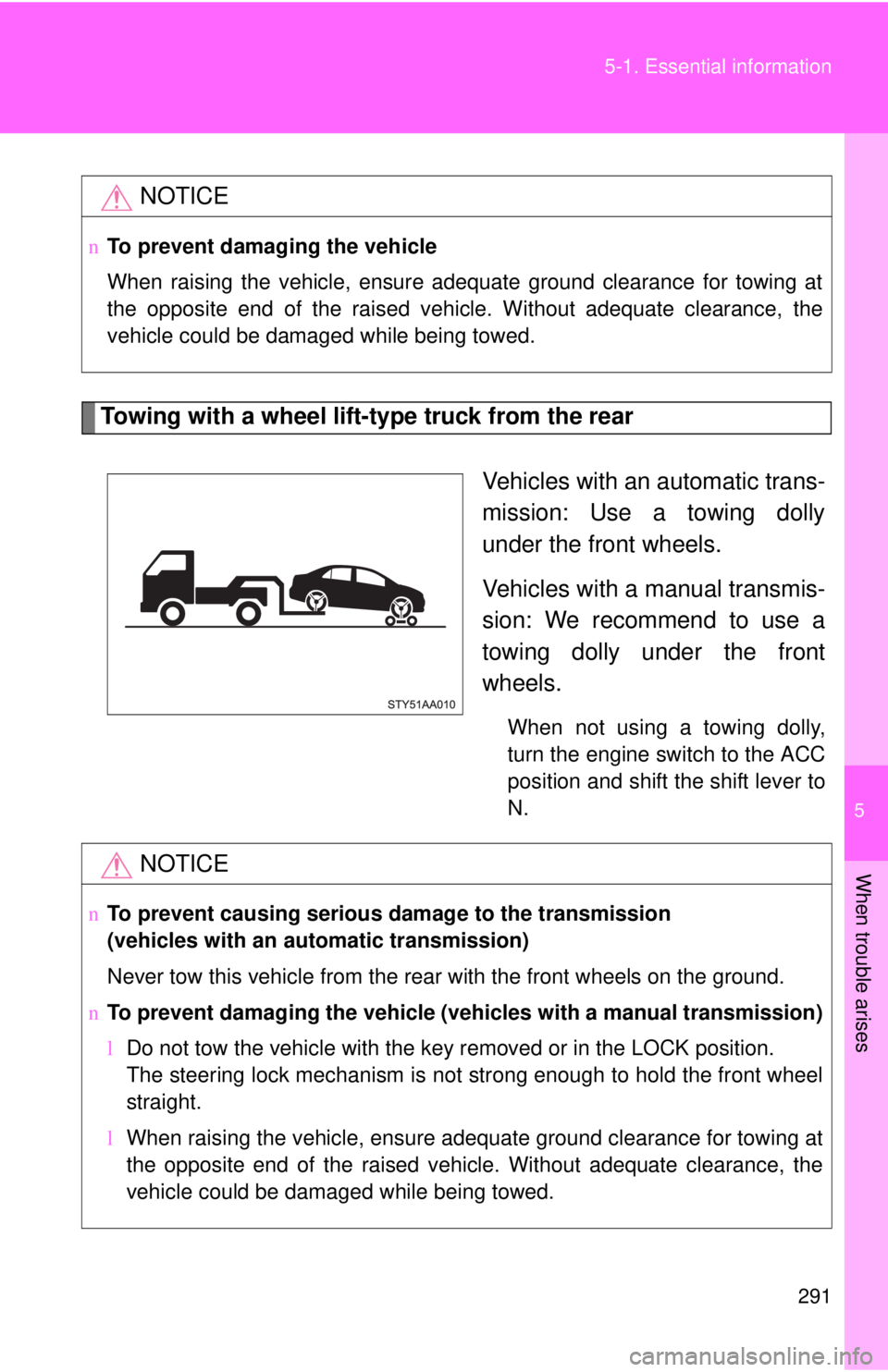
Towing with a wheel lift-type truck from the rear
Vehicles with an automatic trans-
mission: Use a towing dolly
under the front wheels.
Vehicles with a manual transmis-
sion: We recommend to use a
towing dolly under the front
wheels.
When not using a towing dolly,
turn the engine switch to the ACC
position and shift the shift lever to
N.
NOTICE
nTo prevent damaging the vehicle
When raising the vehicle, ensure adequate ground clearance for towing at
the opposite end of the raised vehicle. Without adequate clearance, the
vehicle could be damaged while being towed.
NOTICE
nTo prevent causing serious da mage to the transmission
(vehicles with an automatic transmission)
Never tow this vehicle from the rear with the front wheels on the ground.
n To prevent damaging the vehicle (vehicles with a manual transmission)
lDo not tow the vehicle with the key removed or in the LOCK position.
The steering lock mechanism is not strong enough to hold the front wheel
straight.
l When raising the vehicle, ensure adequate ground clearance for towing at
the opposite end of the raised vehicle. Without adequate clearance, the
vehicle could be damaged while being towed.