2010 TOYOTA TUNDRA parking brake
[x] Cancel search: parking brakePage 2 of 724

TABLE OF CONTENTSIndex
2
1-1. Key informationKeys ..................................... 42
1-2. Opening, closing and locking the doors
Wireless remote control ....... 44
Side doors ............................ 47
Tailgate ................................ 52
1-3. Adjustable components (seats, mirrors, steering
wheel)
Front seats ........................... 60
Rear seats (Double Cab and CrewMax models) ....... 65
Driving position memory (driver’s seat) ..................... 70
Head restraints ..................... 73
Seat belts ............................. 77
Steering wheel (manually adjustable type) .................. 85
Steering wheel (power-adjustable type)...... 87
Anti-glare inside rear view mirror .................................. 88
Outside rear view mirrors ..... 91
1-4. Opening and closing the windows and moon roof
Power windows .................... 96
Back window ...................... 100
Power back window ........... 101
Moon roof ........................... 104 1-5. Refueling
Opening the fuel tank cap... 109
1-6. Theft deterrent system Engine immobilizer system .............................. 114
Alarm .................................. 116
1-7. Safety information Correct driving posture ....... 118
SRS airbags ....................... 120
Front passenger occupant classification system ......... 136
Child restraint systems ....... 143
Installing child restraints ..... 149
2-1. Driving procedures Driving the vehicle .............. 174
Engine (ignition) switch....... 183
Automatic transmission ...... 186
Turn signal lever ................. 191
Parking brake ..................... 192
Horn .................................... 193
2-2. Instrument cluster Gauges and meters ............ 194
Indicators and warning lights ................................. 200
Multi-information display ..... 204
Accessory meter ................. 210
1Before driving
2When driving
Page 28 of 724
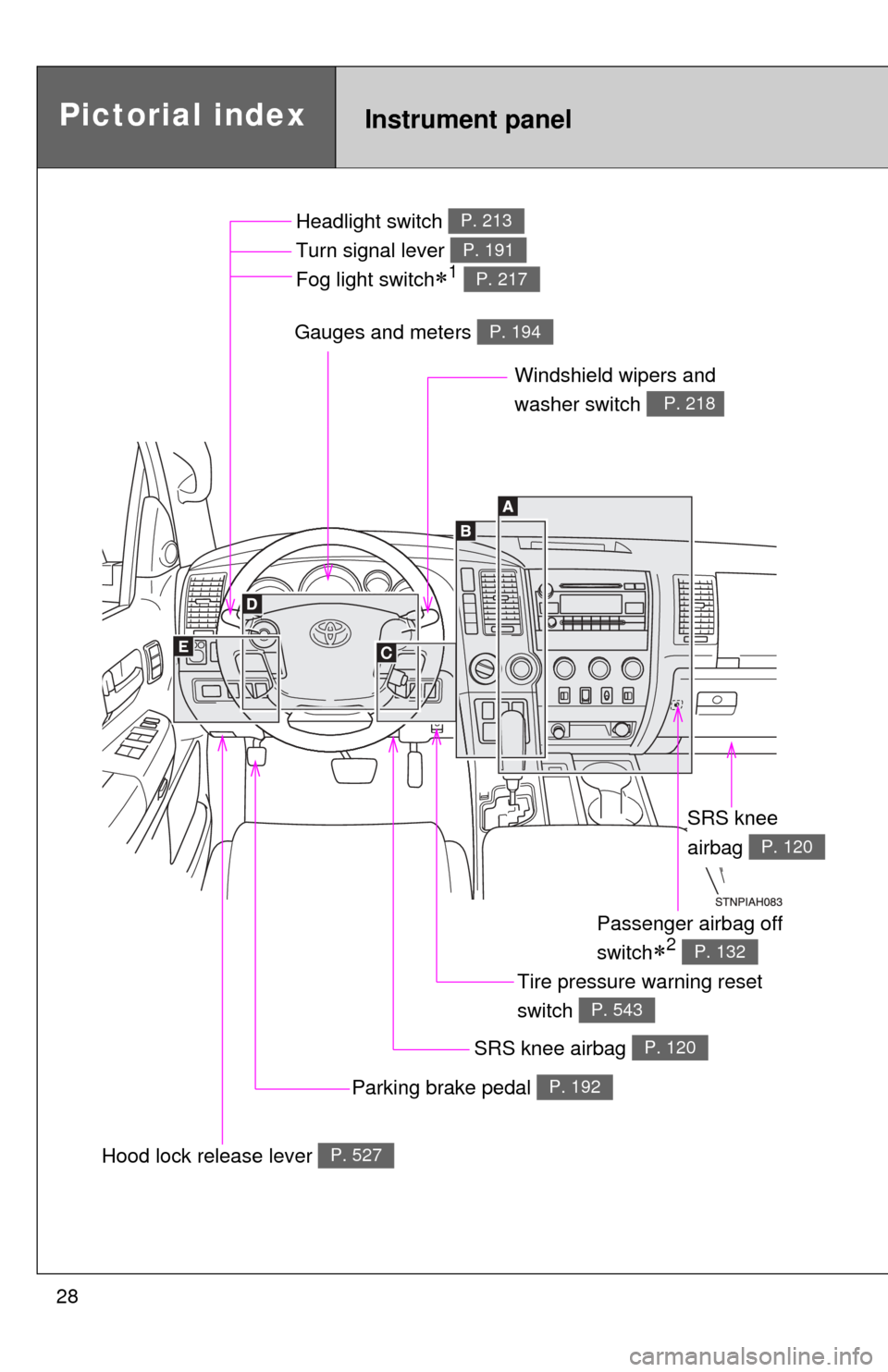
28
Pictorial indexInstrument panel
Headlight switch
Turn signal lever
Fog light switch
1
P. 213
P. 191
P. 217
Windshield wipers and
washer switch
P. 218
Parking brake pedal P. 192
Gauges and meters P. 194
Hood lock release lever P. 527
Tire pressure warning reset
switch
P. 543
Passenger airbag off
switch
2 P. 132
SRS knee
airbag
P. 120
SRS knee airbag P. 120
Page 173 of 724
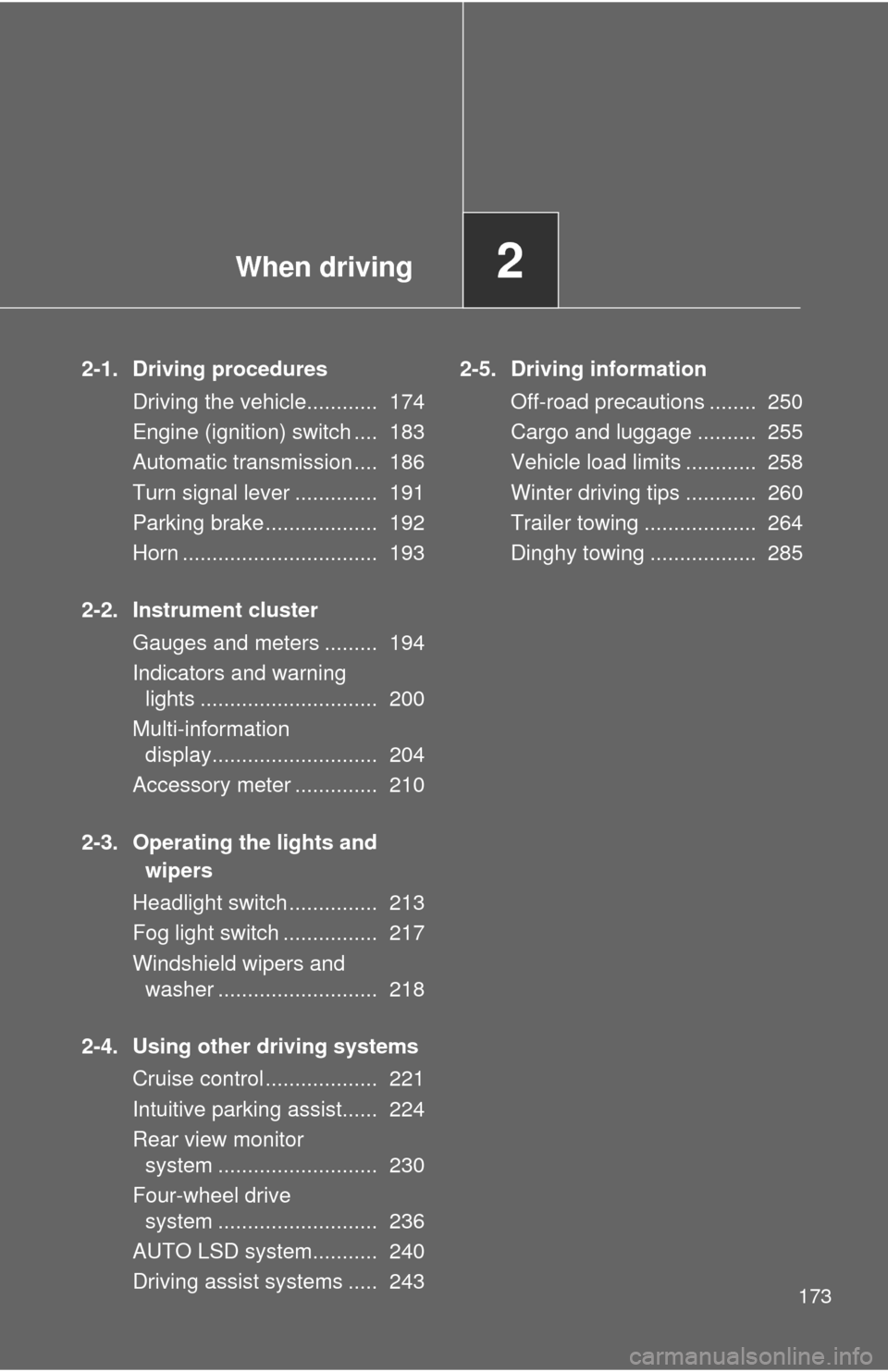
When driving2
173
2-1. Driving proceduresDriving the vehicle............ 174
Engine (ignition) switch .... 183
Automatic transmission .... 186
Turn signal lever .............. 191
Parking brake ................... 192
Horn ................................. 193
2-2. Instrument cluster Gauges and meters ......... 194
Indicators and warning lights .............................. 200
Multi-information display............................ 204
Accessory meter .............. 210
2-3. Operating the lights and wipers
Headlight switch ............... 213
Fog light switch ................ 217
Windshield wipers and washer ........................... 218
2-4. Using other driving systems Cruise control ................... 221
Intuitive parking assist...... 224
Rear view monitor system ........................... 230
Four-wheel drive system ........................... 236
AUTO LSD system........... 240
Driving assist systems ..... 243 2-5. Driving information
Off-road precautions ........ 250
Cargo and luggage .......... 255
Vehicle load limits ............ 258
Winter driving tips ............ 260
Trailer towing ................... 264
Dinghy towing .................. 285
Page 174 of 724
174
2-1. Driving procedures
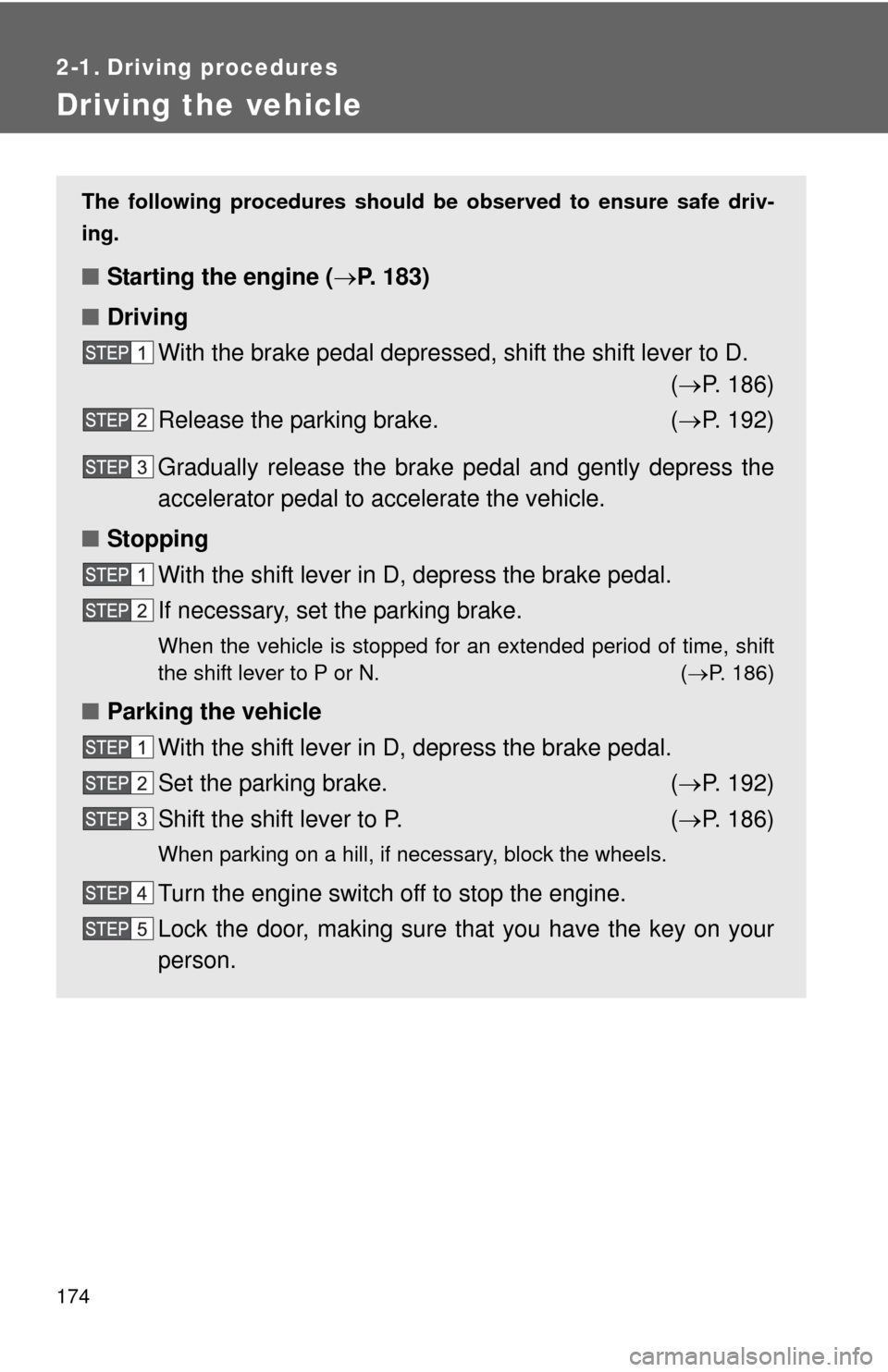
Driving the vehicle
The following procedures should be observed to ensure safe driv-
ing.
■ Starting the engine ( P. 183)
■ Driving
With the brake pedal depressed, shift the shift lever to D. ( P. 186)
Release the parking brake. ( P. 192)
Gradually release the brake pedal and gently depress the
accelerator pedal to accelerate the vehicle.
■ Stopping
With the shift lever in D, depress the brake pedal.
If necessary, set the parking brake.
When the vehicle is stopped for an extended period of time, shift
the shift lever to P or N. ( P. 186)
■Parking the vehicle
With the shift lever in D, depress the brake pedal.
Set the parking brake. ( P. 192)
Shift the shift lever to P. ( P. 186)
When parking on a hill, if necessary, block the wheels.
Turn the engine switch off to stop the engine.
Lock the door, making sure that you have the key on your
person.
Page 175 of 724

175
2-1. Driving procedures
2
When driving
Starting on a steep uphill
With the brake pedal depressed, firmly set the parking brake
and shift the shift lever to D.
Gently depress the accelerator pedal.
Release the parking brake.
■Driving in the rain
●Drive carefully when it is raining, because visibility will be reduced, the
windows may become fogged-up, and the road will be slippery.
● Drive carefully when it starts to rain, because the road surface will be
especially slippery.
● Refrain from high speeds when driving on an expressway in the rain,
because there may be a layer of water between the tires and the road
surface, preventing the steering and brakes from operating properly.
■ Breaking in your new Toyota
To extend the life of the vehicle, the following precautions are recommended
to observe:
●For the first 200 miles (300 km):
Avoid sudden stops.
● For the first 500 miles (800 km):
Do not tow a trailer.
● For the first 1000 miles (1600 km):
• Do not drive at extremely high speeds.
• Avoid sudden acceleration.
• Do not drive continuously in the low gears.
• Do not drive at a constant speed for extended periods.
■ Drum-in disc type parking brake system
Your vehicle has a drum-in-disc type parking brake system. This type of
brake system needs bedding-down of the brake shoes periodically or when-
ever the parking brake shoes and/or drum are replaced. Have your Toyota
dealer perform the bedding down.
Page 177 of 724

177
2-1. Driving procedures
2
When driving
CAUTION
■
When driving the vehicle
●Do not shift the shift lever to P while the vehicle is moving.
Doing so can damage the transmission and may result in a loss of vehicle\
control.
● Do not shift the shift lever to R while the vehicle is moving forward.
Doing so can damage the transmission and may result in a loss of vehicle\
control.
● Do not shift the shift lever to D while the vehicle is moving backward.
Doing so can damage the transmission and may result in a loss of vehicle\
control.
● Moving the shift lever to N while the vehicle is moving will disengage the
engine from the transmission. Engine braking is not available when N is
selected.
● During normal driving, do not turn off the engine. Turning the engine off
while driving will not cause loss of steering or braking control, but the
power assist to these systems will be lost. This will make it more difficult to
steer and brake, so you should pull over and stop the vehicle as soon as it
is safe to do so.
However, in the event of an emergency, such as if it becomes impossible
to stop the vehicle in the normal way: P. 595
● Use engine braking (downshift) to maintain a safe speed when driving
down a steep hill.
Using the brakes continuously may cause the brakes to overheat and lose
effectiveness. ( P. 186)
● When stopped on an inclined surface, use the brake pedal and parking
brake to prevent the vehicle from rolling backward or forward and causing
an accident.
● Do not adjust the position of the steering wheel, the seat, or the inside or
outside rear view mirrors while driving.
Doing so may result in a loss of vehicle control that can cause accidents
that may result in death or serious injury.
● Always check that all passengers’ arms, heads or other parts of their bod-
ies are not outside the vehicle, as this may result in death or serious injury.
Page 178 of 724

178 2-1. Driving procedures
CAUTION
●Do not drive in excess of the speed limit. Even if the legal speed limit per-
mits it, do not drive over 85 mph (140 km/h) unless your vehicle has high-
speed capability tires. Driving over 85 mph (140 km/h) may result in tire
failure, loss of control and possible injury. Be sure to consult a tire dealer
to determine whether the tires on your vehicle are high-speed capability
tires or not before driving at such speeds.
■ When driving on slippery road surfaces
●Sudden braking, acceleration and steering may cause tire slippage and
reduce your ability to control the vehicle, resulting in an accident.
● Sudden changes in engine speed, such as engine braking caused by up-
shifting or down-shifting, may cause the vehicle to skid, resulting in an
accident.
● After driving through a puddle, lightly depress the brake pedal to make
sure that the brakes are functioning properly. Wet brake pads may prevent
the brakes from functioning properly. If the brakes on only one side are wet
and not functioning properly, steering control may be affected, resulting in
an accident.
■ When shifting the shift lever
Be careful not to shift the shift lever with the accelerator pedal depressed.
This may lead to unexpected rapid acceleration of the vehicle that may
cause an accident and result in death or serious injury.
■ When the vehicle is stopped
●Do not race the engine.
If the vehicle is in any gear other than P or N, the vehicle may accelerate
suddenly and unexpectedly, and may cause an accident.
● Do not leave the vehicle with the engine running for a long time.
If such a situation cannot be avoided, park the vehicle in an open space
and check that exhaust fumes do not enter the vehicle interior.
● In order to prevent accidents due to the vehicle rolling away, always keep
depressing the brake pedal while the engine is running, and apply the
parking brake as necessary.
● If the vehicle is stopped on an incline, in order to prevent accidents caused
by the vehicle rolling forward or backward, always depress the brake pedal
and securely apply the parking brake as needed.
Page 179 of 724

179
2-1. Driving procedures
2
When driving
CAUTION
●
Avoid revving or racing the engine.
Running the engine at high speed while the vehicle is stopped may cause
the exhaust system to overheat, which could result in a fire if combustible
material is nearby.
■ When the vehicle is parked
●Do not leave glasses, cigarette lighters, spray cans, or soft drink cans in
the vehicle when it is in the sun.
Doing so may result in the following.
• Gas may leak from a cigarette lighter or spray can, and may lead to a
fire.
• The temperature inside the vehicle may cause the plastic lenses and plastic material of eye glasses to deform or crack.
• Soft drink cans may fracture, causing the contents to spray over the interior of the vehicle, and may also cause a short circuit in the vehi-
cle’s electrical components.
● Always apply the parking brake, shift the shift lever to P, stop the engine
and lock the vehicle.
Do not leave the vehicle unattended while the engine is running.
● If the shift lever is moved before the 4LO indicator turns on/off, the transfer
mode may not be shifted completely. The transfer mode disengages both
the front and rear driveshafts from the powertrain and allows the vehicle to
move regardless of the shift position. (At this time, the indicator blinks and
the buzzer sounds.)
Therefore, the vehicle is free to roll even if the automatic transmission is in
P. You or someone else could be seriously injured. You must complete the
shifting of the transfer mode. ( P. 238)
● Do not touch the exhaust pipe while the engine is running or immediately
after turning the engine off.
Doing so may cause burns.
● Do not leave the engine running in an area with snow build-up, or where it
is snowing. If snowbanks build up around the vehicle while the engine is
running, exhaust gases may collect and enter the vehicle. This may lead
to death or a serious health hazard.