Page 123 of 476
When driving2
123
AVALON_U (OM41437U)
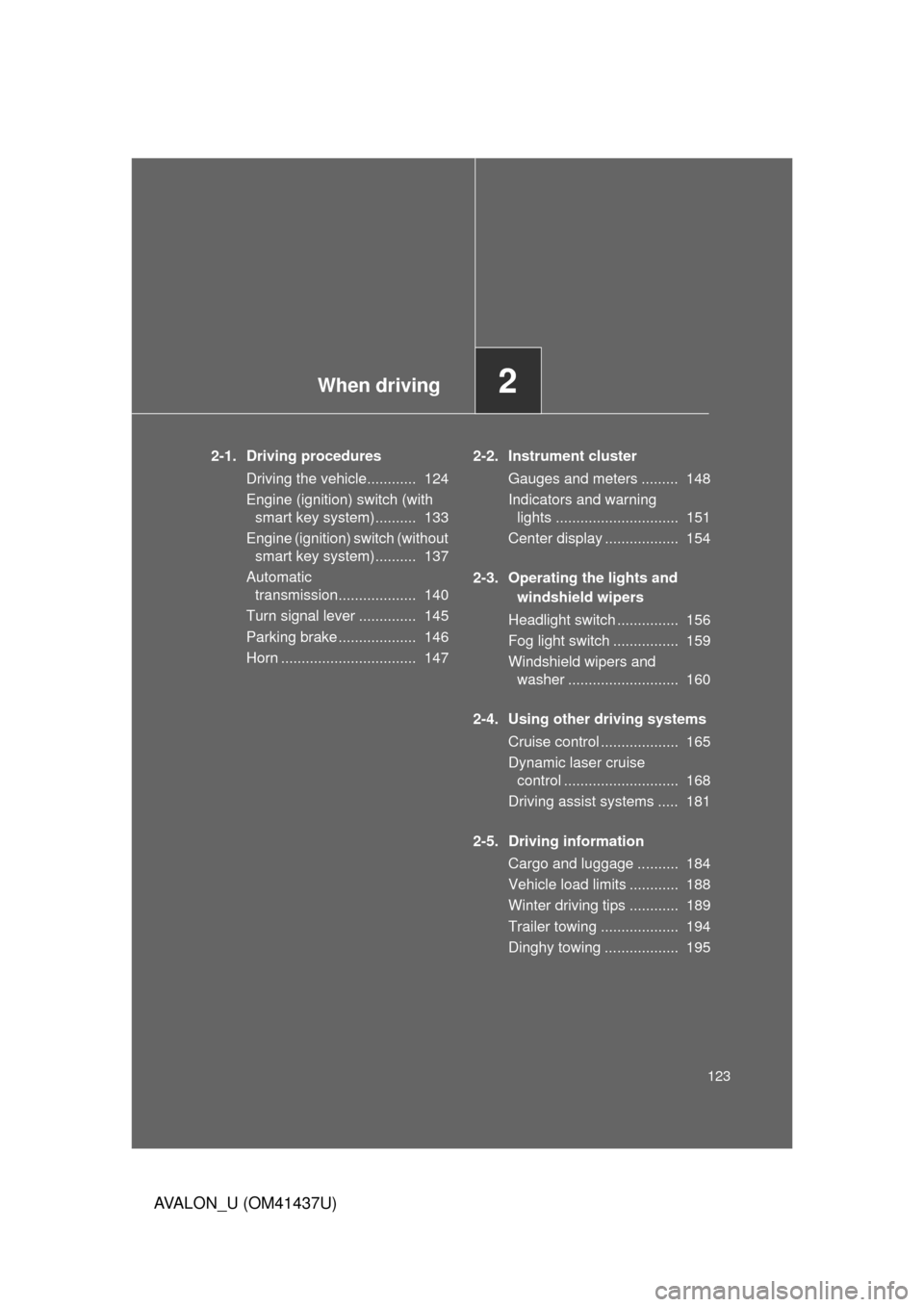
2-1. Driving proceduresDriving the vehicle............ 124
Engine (ignition) switch (with smart key system).......... 133
Engine (ignition) switch (without smart key system).......... 137
Automatic transmission................... 140
Turn signal lever .............. 145
Parking brake ................... 146
Horn ................................. 147 2-2. Instrument cluster
Gauges and meters ......... 148
Indicators and warning lights .............................. 151
Center display .................. 154
2-3. Operating the lights and windshield wipers
Headlight switch ............... 156
Fog light switch ................ 159
Windshield wipers and washer ........................... 160
2-4. Using other driving systems Cruise control ................... 165
Dynamic laser cruise control ............................ 168
Driving assist systems ..... 181
2-5. Driving information Cargo and luggage .......... 184
Vehicle load limits ............ 188
Winter driving tips ............ 189
Trailer towing ................... 194
Dinghy towing .................. 195
Page 143 of 476

143
2-1. Driving procedures
2
When driving
AVALON_U (OM41437U)
■
Shift ranges and their functions
●You can choose from 6 levels of engine braking force.
● A lower shift range will provide greater engine br aking force than
a higher shift range, and the engine speed will also increase.
■S mode
● When the shift range is “5” or lower, holding the shift lever toward “+” sets
the shift range to “6”.
● To prevent excessive engine speed, a function was adopted that auto-
matically selects a higher shift range before engine speed becomes too
high.
● To protect the automatic transmission, a function is adopted that auto-
matically selects a higher shift range when the fluid temperature is high.
■ Down shifting restrictions warning buzzer (in the S mode)
To help ensure safety and driving performance, downshifting operation may
sometimes be restricted. In some circumstances, downshifting may not be
possible even when the shift lever is operated. (The warning buzzer will
sound twice.)
Page 157 of 476

157
2-3. Operating the lights and windshield wipers
2
When driving
AVALON_U (OM41437U)
Turning on the high beam headlights
With the headlights on, push
the lever forward to turn on the
high beams.
Pull the lever back to the center
position to turn the high beams
off.
Pull the lever toward you to
turn on the high beams.
Release to turn them off. You can
flash the high beams with the
headlights on or off.
■Daytime running light system (if equipped)
To make your vehicle more visible to other drivers, the headlights turn on
automatically (at a reduced intensity) whenever the engine is started and the
parking brake is released. Daytime running lights are not designed for use at
night.
■ Headlight control sensor
The sensor may not function properly if
an object is placed on the sensor, or any-
thing that blocks the sensor is affixed to
the windshield.
Doing so interferes with the sensor
detecting the level of ambient light and
may cause the automatic headlight con-
trol system to malfunction.
Page 164 of 476

164 2-3. Operating the lights and windshield wipers
AVALON_U (OM41437U)
■If no windshield washer fluid sprays
Check that the washer nozzles are not blocked if there is washer fluid in the
windshield washer fluid reservoir.
■ In extremely hot or cold weather (v ehicles equipped with the raindrop
detection windshield wipers)
Even if the wiper lever is in “AUTO” mode, the system will switch to intermit-
tent operations when the system malfunctions.
However, when the windshield gets extremely hot (at more than 194°F
[90°C]) or extremely cold (at less than 14°F [-10°C]), the wipers do not oper-
ate even if the wiper lever is in “AUTO” mode.
■ Customization that can be co nfigured at Toyota dealer
Settings (e.g. drip prevention function) can be changed.
(Customizable features P. 457)
CAUTION
■Caution regarding the use of windshield wipers in “AUTO” mode
The windshield wipers may operate unexpec tedly if the sensor is touched or
the windshield is subject to vibration in “AUTO” mode. Take care that your
fingers or anything else do not become caught in the windshield wipers.
NOTICE
■ When the windshield is dry
Do not use the wipers, as they may damage the windshield.
■ When there is no washer fluid spray from the nozzle
Damage to the washer fluid pump may be caused if the lever is pulled
toward you and held continually.
Page 166 of 476
166 2-4. Using other driving systems
AVALON_U (OM41437U)
■Cruise control can be set when
● The shift lever is in the “D” or “4”, “5”, or “6” range of “S” mode.
● Vehicle speed is between approximately 25 mph (40 km/h) and 125 mph
(200 km/h).
■ Accelerating
The vehicle can be accelerated normally. After acceleration, the set speed
resumes.
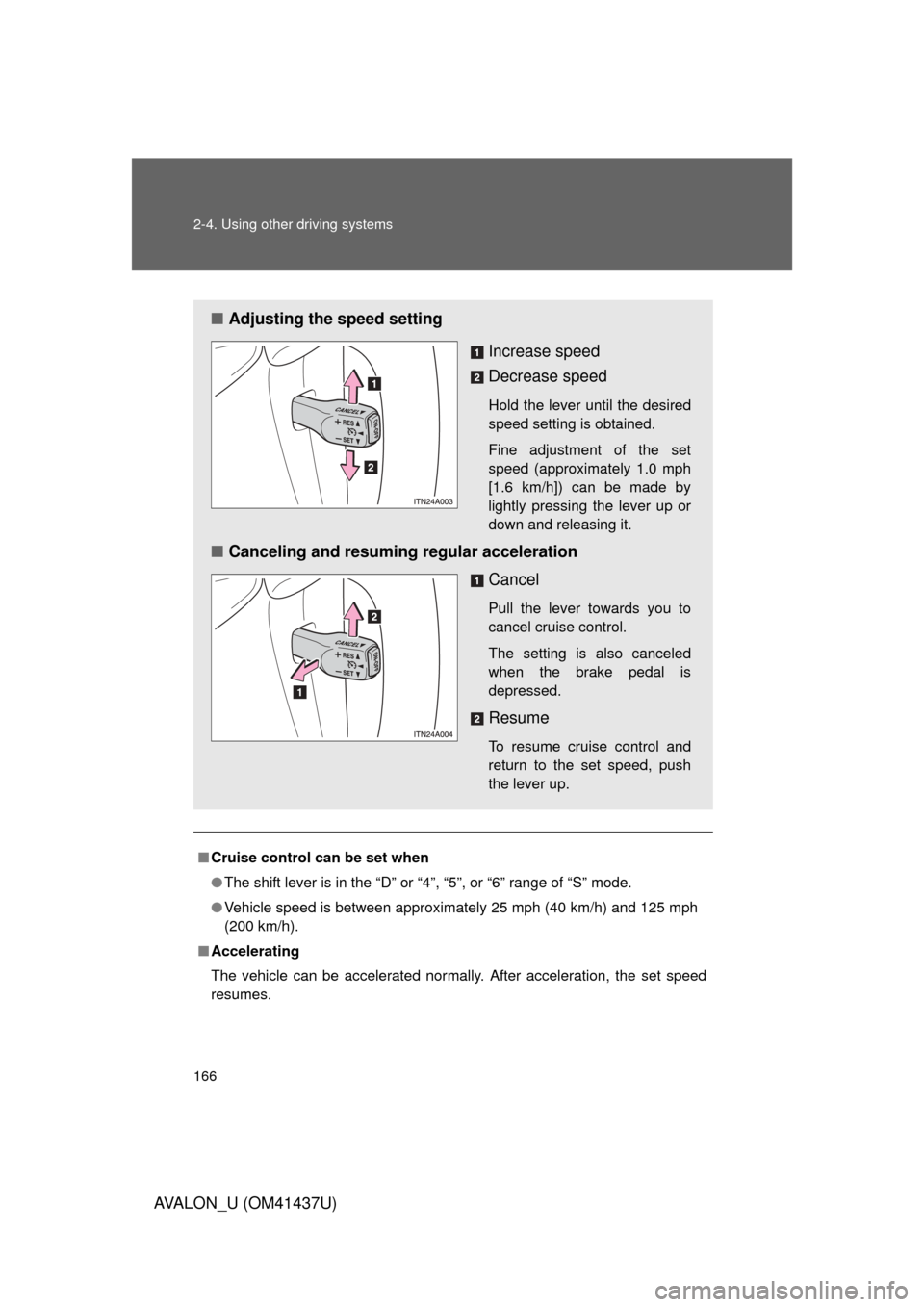
■ Adjusting the speed setting
Increase speed
Decrease speed
Hold the lever until the desired
speed setting is obtained.
Fine adjustment of the set
speed (approximately 1.0 mph
[1.6 km/h]) can be made by
lightly pressing the lever up or
down and releasing it.
■Canceling and resuming regular acceleration
Cancel
Pull the lever towards you to
cancel cruise control.
The setting is also canceled
when the brake pedal is
depressed.
Resume
To resume cruise control and
return to the set speed, push
the lever up.
Page 171 of 476
171
2-4. Using other
driving systems
2
When driving
AVALON_U (OM41437U)
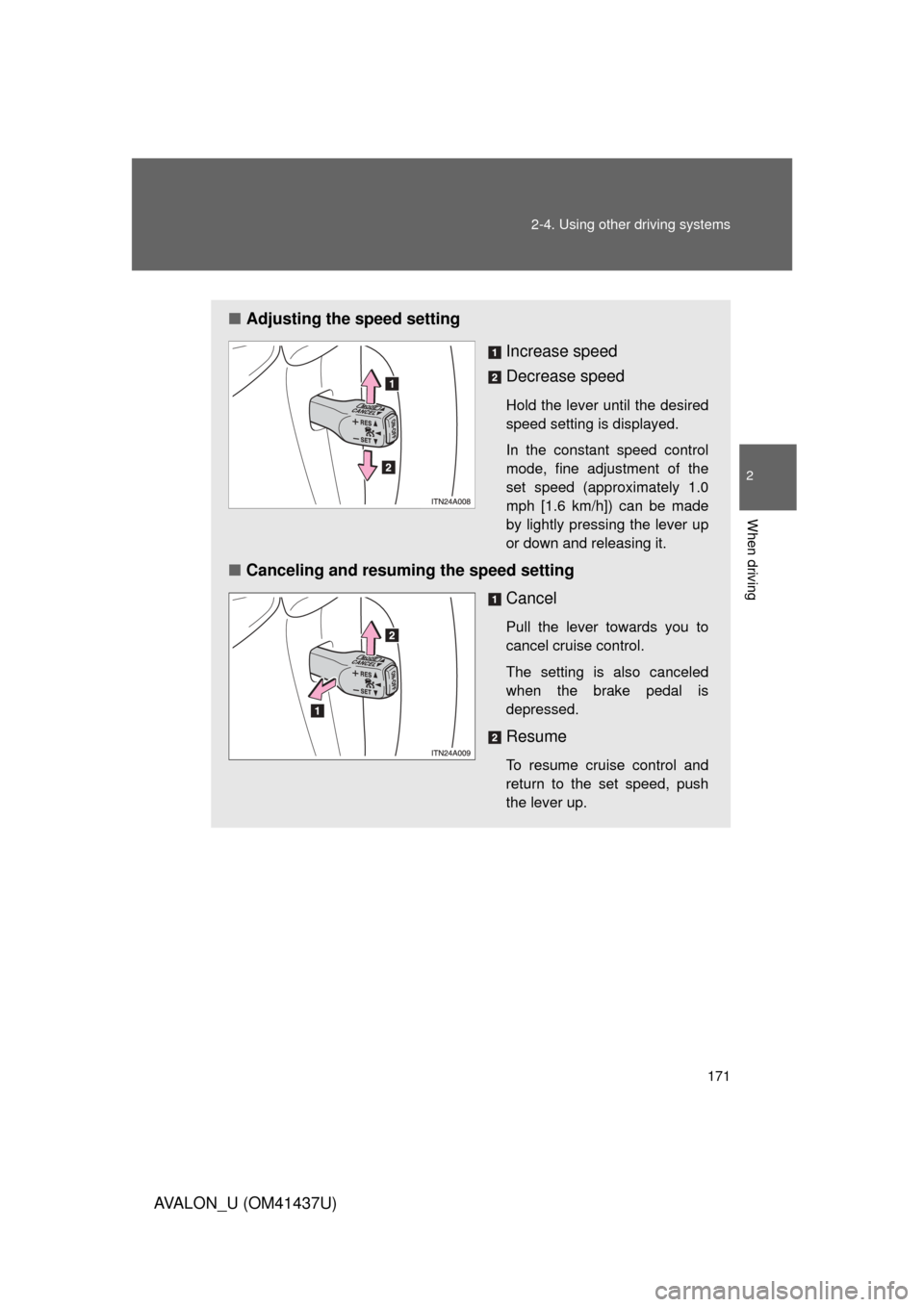
■Adjusting the speed setting
Increase speed
Decrease speed
Hold the lever until the desired
speed setting is displayed.
In the constant speed control
mode, fine adjustment of the
set speed (approximately 1.0
mph [1.6 km/h]) can be made
by lightly pressing the lever up
or down and releasing it.
■Canceling and resuming the speed setting
Cancel
Pull the lever towards you to
cancel cruise control.
The setting is also canceled
when the brake pedal is
depressed.
Resume
To resume cruise control and
return to the set speed, push
the lever up.
Page 184 of 476
184
AVALON_U (OM41437U)
2-5. Driving information
Cargo and luggage
Capacity and distributionCargo capacity depends on the total weight of the occupants.
(Cargo capacity) = (Total load capacity) – (Total weight of occupants)
Steps for Determining Correct Load Limit—
(1) Locate the statement “The co mbined weight of occupants and
cargo should never exceed XXX kg or XXX lbs.” on your vehi-
cle’s placard.
(2) Determine the combined weight of the driver and passengers that will be riding in your vehicle.
(3) Subtract the combined weight of the driver and passengers from
XXX kg or XXX lbs.
(4) The resulting figure equals the available amount of cargo and luggage load capacity.
For example, if the “XXX” amount equals 1400 lbs. and there will
be five 150 lb passengers in your vehicle, the amount of avail-
able cargo and luggage load capacity is 650 lbs. (1400 – 750 (5
150) = 650 lbs.)
Take notice of the following information about storage precau-
tions, cargo capacity and load.
● Stow cargo and luggage in the trunk whenever possible. Be
sure all items are secured in place.
● Be careful to keep the vehicle le vel. Placing the weight as far
forward as possible helps maintain vehicle balance.
● For better fuel economy, do no t carry unnecessary weight.
Page 185 of 476
185
2-5. Driving information
2
When driving
AVALON_U (OM41437U)
(5) Determine the combined weight of luggage and cargo being
loaded on the vehicle.
That weight may not safely ex ceed the available cargo and lug-
gage load capacity calculated in Step 4.
(6) If your vehicle will be towing a tr ailer, load from your trailer will
be transferred to your vehicle. Consult this manual to determine
how this reduces the available cargo and luggage load capacity
of your vehicle. ( P. 188)
Toyota does not recommend towing a trailer with your vehicle. Your
vehicle is not designed for trailer towing.
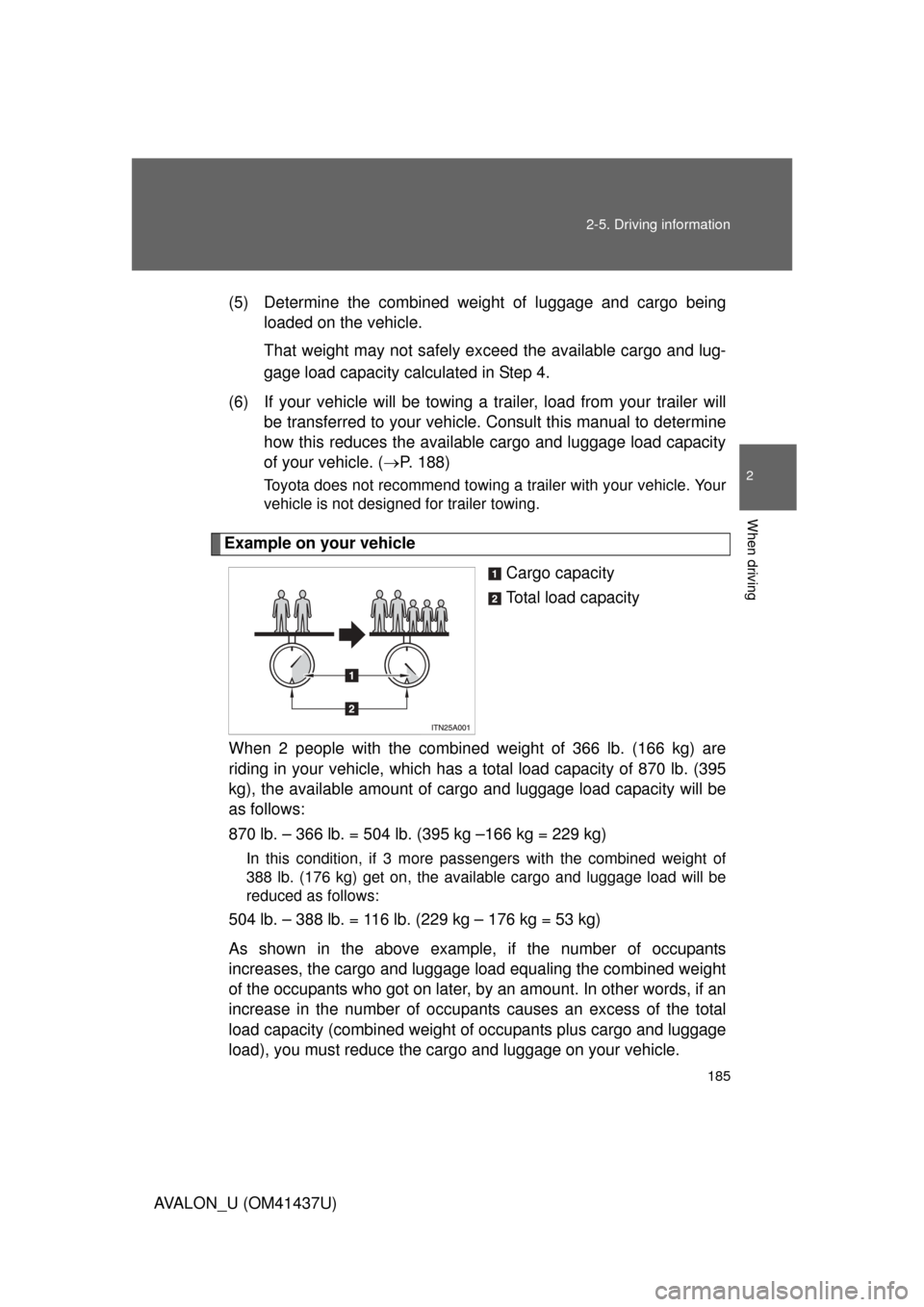
Example on your vehicle
Cargo capacity
Total load capacity
When 2 people with the combined weight of 366 lb. (166 kg) are
riding in your vehicle, which has a total load capacity of 870 lb. (395
kg), the available amount of cargo and luggage load capacity will be
as follows:
870 lb. – 366 lb. = 504 lb. (395 kg –166 kg = 229 kg)
In this condition, if 3 more pa ssengers with the combined weight of
388 lb. (176 kg) get on , the available cargo and luggage load will be
reduced as follows:
504 lb. – 388 lb. = 116 lb. (229 kg – 176 kg = 53 kg)
As shown in the above example, if the number of occupants
increases, the cargo and luggage load equaling the combined weight
of the occupants who got on later, by an amount. In other words, if an
increase in the number of occupants causes an excess of the total
load capacity (combined weight of occupants plus cargo and luggage
load), you must reduce the carg o and luggage on your vehicle.