2010 SUZUKI SX4 time
[x] Cancel search: timePage 238 of 297
7-33INSPECTION AND MAINTENANCE
80J23-03E
Vehicle Capacity Weight – the rated
cargo and luggage load plus 68 kilo-
grams (150 lbs) times the vehicle’s
designated seating capacity.
Vehicle Maximum Load on the Tire –
the load on an individual tire that is
determined by distributing to each axle
its share of the maximum loaded vehi-
cle weight and dividing by two.
Vehicle Normal Load on the Tire – the
load on an individual tire that is deter-
mined by distributing to each axle its
share of the curb weight, accessory
weight, and normal occupant weight
(distributed in accordance with Table 1
shown below) and dividing by 2.
TABLE 1 – Occupant Loading and
Distribution For Vehicle Normal
Load For Various Designated Seat-
ing CapacitiesVehicle Loading
Your vehicle was designed for specific
load capacities. The load capacities of
your vehicle are indicated by the
Gross Vehicle Weight Rating (GVWR),
the Gross Axle Weight Rating (GAWR,
front and rear), and the total load
capacity, the seating capacity, and the
cargo load capacity. The GVWR and
GAWR (front and rear) are listed on
the Safety Certification Label which is
located below the driver’s side door
latch striker. The total load capacity
and seating capacity are listed on the
Tire and Loading Information Label
which is located below the Safety Cer-
tification Label. The cargo load capac-
ity can be determined as described
below.
Cargo Load Capacity – Maximum
weight of cargo and luggage that the
vehicle can safely carry. Cargo load
capacity is the difference between the
total load capacity of the vehicle and
the total combined weight of all vehicle
occupants. Refer to “Steps for Deter-
mining Correct Load Limit” for details
on how to determine cargo load
capacity.GVWR – Maximum permissible overall
weight of the fully loaded vehicle
(including all the occupants, accesso-
ries and cargo plus the trailer tongue
weight if towing a trailer).
GAWR – (Front and Rear) Maximum
permissible weight on an individual
axle.
Seating Capacity – Maximum number
of occupants the vehicle is designed to
carry.
NOTE:
Even though the number of occupants
is within the seating capacity, you still
must make sure that you do not
exceed the total load capacity of the
vehicle.
Total Load Capacity – Maximum per-
missible weight a vehicle can carry
including the weight of all the occu-
pants, accessories, cargo, plus trailer
tongue weight (if towing a trailer).
The weight of any accessories already
installed on your vehicle at the time of
purchase, or that you or the dealer
install after purchase, must be sub-
tracted from the total load capacity to
determine how much capacity remains
available for occupants, cargo, and
trailer tongue weight (if towing a Designated
seating
capacity,
number of
occupantsVehicle nor-
mal load,
number of
occupants
Occupant
distribution
in a nor-
mally loaded
vehicle
2 through 4 2 2 in front5 through 10
32 in front,
1 in second
seat
Page 240 of 297
7-35INSPECTION AND MAINTENANCE
80J23-03E
Vehicle Loading Example
As an example, suppose that the Tire
and Loading Information label on your
vehicle indicates that your vehicle’s
total load capacity is 950 lbs. If you
were to drive your vehicle with one
passenger, and the total combined
weight of you and your passenger was
350 lbs, then the cargo and luggage
capacity of your vehicle would be 600
lbs (950 – 350 = 600 lbs).
If you later added 2 more passengers,
having a combined weight of 325 lbs,
the cargo and luggage capacity of
your vehicle would be reduced from
600 lbs to 275 lbs (600 – 325 = 275
lbs). As you can see, as the number
and combined weight of vehicle occu-
pants increase, the vehicle’s cargo
and luggage capacity decreases.
Suppose again, that you were to take
a trip in your vehicle with the same
three passengers described above,
and you decided to tow a trailer having
a trailer tongue weight of 75 lbs. The
cargo and luggage capacity would be
reduced again, to 200 lbs (275 – 75 =
200 lbs).Determining Compatibility of Tire
and Vehicle Load Limits
The tires on your vehicle, when they
are inflated to the recommended tire
inflation pressure, have a load-carry-
ing capacity that is greater than the
load that will be on the tires when the
vehicle is at its GVWR or GAWR limit.
Never use replacement tires that have
a load-carrying capacity less than the
original tires on your vehicle. Tire load-
carrying capacity information is
molded into the tire sidewall typically
shown as “Max. Load”. Use of replace-
ment tires with a lower load-carrying
capacity than the original tires, or fail-
ure to keep the tires inflated to recom-
mended tire pressure, may reduce the
GVWR or GAWR limit of your vehicle.
NOTE:
Use of replacement tires with a higher
load-carrying capacity than the origi-
nal tires, or using a tire inflation pres-
sure higher than the recommended
tire inflation pressure, will not increase
the GVWR or GAWR limit of your vehi-
cle.
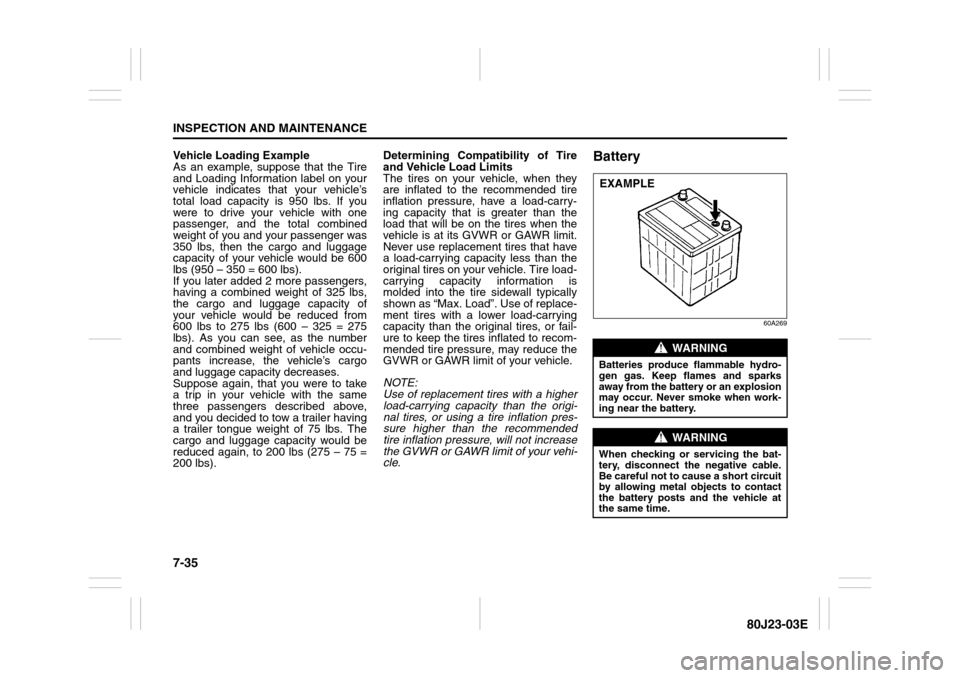
Battery
60A269
WARNING
Batteries produce flammable hydro-
gen gas. Keep flames and sparks
away from the battery or an explosion
may occur. Never smoke when work-
ing near the battery.
WARNING
When checking or servicing the bat-
tery, disconnect the negative cable.
Be careful not to cause a short circuit
by allowing metal objects to contact
the battery posts and the vehicle at
the same time.EXAMPLE
Page 244 of 297

7-39INSPECTION AND MAINTENANCE
80J23-03E
The fuses are also located under the
driver’s side of the dashboard. Remove the
fuse box cover by pulling it off. The amper-
age of each fuse is shown on the top of the
fuse box cover.
65D046
Headlight AimingSince special procedures are required, we
recommend you take your vehicle to your
SUZUKI dealer for headlight alignment. (8) 30A Wiper
(9) 10A IG1 SIG
(10) 15A Air bag
(11) 10A Anti-lock brake system
(12) – Blank
(13) 10A Stop light
(14) 20A Door lock
(15) 10A Rear fog light
(16) 10A ST SIG
(17) 15A Seat heater
(18) 10A IG 2 SIG
(19) 10A Tail light
(20) 15A Dome
(21) 30A Rear defogger
(22) 15A Horn / Hazard
(23) – Blank
(24) 30A Rear defogger
WARNING
Always be sure to replace a blown
fuse with a fuse of the correct amper-
age. Never use a substitute such as
aluminum foil or wire to replace a
blown fuse. If you replace a fuse and
the new one blows in a short period
of time, you may have a major electri-
cal problem. Have your vehicle
inspected immediately by your
SUZUKI dealer.
BLOWN OK
Page 268 of 297
9-1APPEARANCE CARE
80J23-03E
Corrosion PreventionIt is important to take good care of your
vehicle to protect it from corrosion.
Listed below are instructions for how to
maintain your vehicle to prevent corrosion.
Please read and follow these instructions
carefully.Important Information About
CorrosionCommon causes of corrosion
1) Accumulation of road salt, dirt, moisture
or chemicals in hard-to-reach areas of
the vehicle underbody or frame.
2) Chipping, scratches and any damage to
treated or painted metal surfaces
resulting from minor accidents or
impact from stones and gravel.
Environmental conditions which accel-
erate corrosion
1) Road salt, dust control chemicals, sea
air or industrial pollution will all acceler-
ate the corrosion of metal.
2) High humidity will increase the rate of
corrosion particularly when the temper-
ature range is just above the freezing
point.
3) Moisture in certain areas of a vehicle
for an extended period of time may pro-
mote corrosion even though other body
sections may be completely dry.
4) High temperatures will cause an accel-
erated rate of corrosion to parts of thevehicle which are not well ventilated to
permit quick drying.
52D151
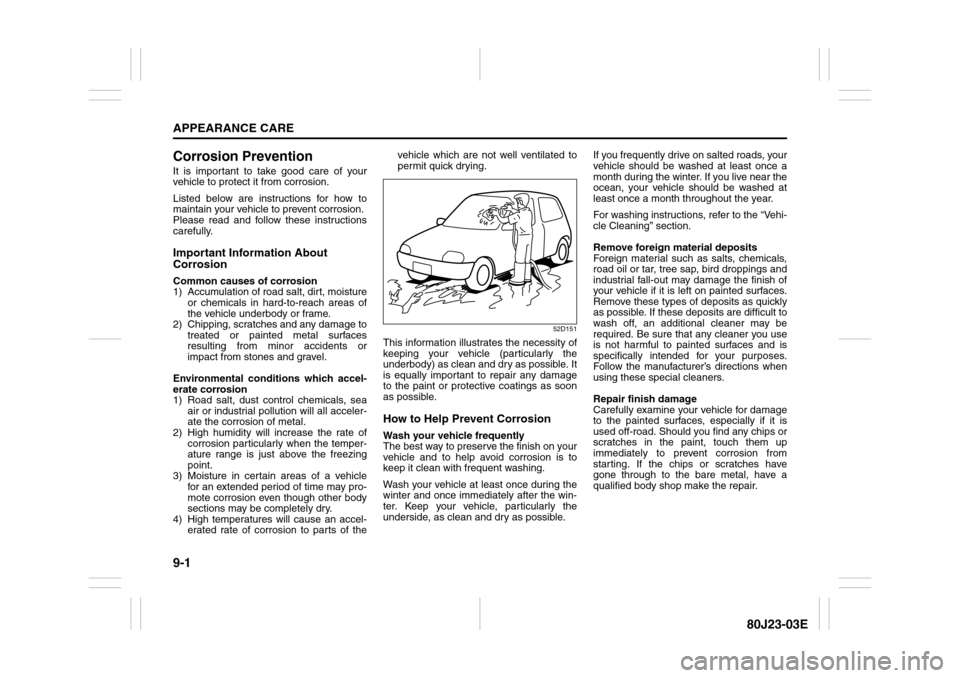
This information illustrates the necessity of
keeping your vehicle (particularly the
underbody) as clean and dry as possible. It
is equally important to repair any damage
to the paint or protective coatings as soon
as possible.How to Help Prevent CorrosionWash your vehicle frequently
The best way to preserve the finish on your
vehicle and to help avoid corrosion is to
keep it clean with frequent washing.
Wash your vehicle at least once during the
winter and once immediately after the win-
ter. Keep your vehicle, particularly the
underside, as clean and dry as possible.If you frequently drive on salted roads, your
vehicle should be washed at least once a
month during the winter. If you live near the
ocean, your vehicle should be washed at
least once a month throughout the year.
For washing instructions, refer to the “Vehi-
cle Cleaning” section.
Remove foreign material deposits
Foreign material such as salts, chemicals,
road oil or tar, tree sap, bird droppings and
industrial fall-out may damage the finish of
your vehicle if it is left on painted surfaces.
Remove these types of deposits as quickly
as possible. If these deposits are difficult to
wash off, an additional cleaner may be
required. Be sure that any cleaner you use
is not harmful to painted surfaces and is
specifically intended for your purposes.
Follow the manufacturer’s directions when
using these special cleaners.
Repair finish damage
Carefully examine your vehicle for damage
to the painted surfaces, especially if it is
used off-road. Should you find any chips or
scratches in the paint, touch them up
immediately to prevent corrosion from
starting. If the chips or scratches have
gone through to the bare metal, have a
qualified body shop make the repair.
Page 275 of 297
10-2
GENERAL INFORMATION
80J23-03E
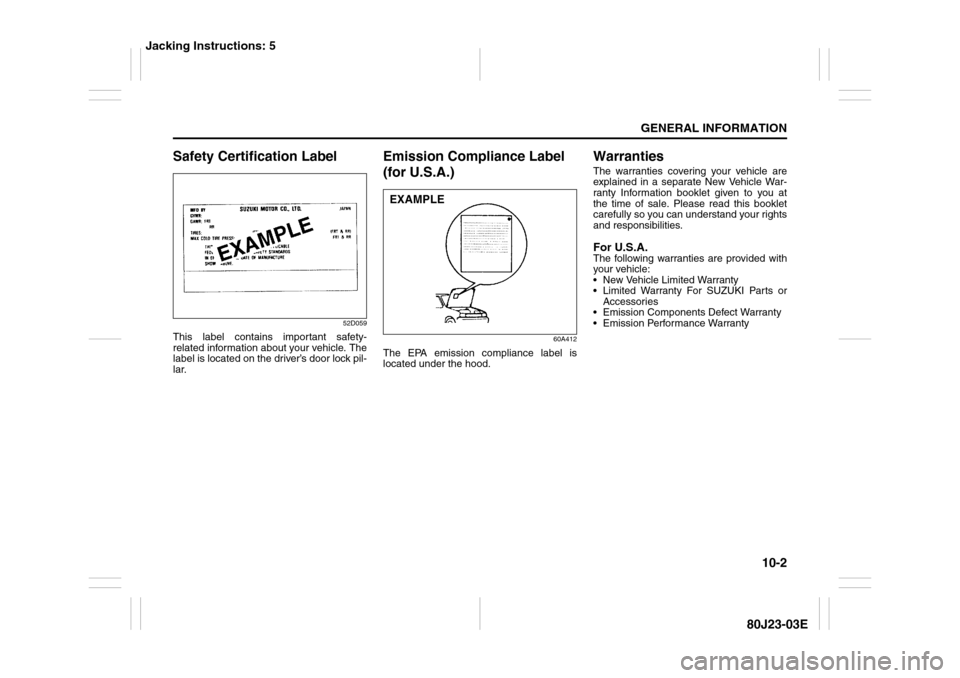
Safety Certification Label
52D059
This label contains important safety-
related information about your vehicle. The
label is located on the driver’s door lock pil-
lar.
Emission Compliance Label
(for U.S.A.)
60A412
The EPA emission compliance label is
located under the hood.
WarrantiesThe warranties covering your vehicle are
explained in a separate New Vehicle War-
ranty Information booklet given to you at
the time of sale. Please read this booklet
carefully so you can understand your rights
and responsibilities.For U.S.A.The following warranties are provided with
your vehicle:
New Vehicle Limited Warranty
Limited Warranty For SUZUKI Parts or
Accessories
Emission Components Defect Warranty
Emission Performance Warranty
EXAMPLE
Jacking Instructions: 5
Page 291 of 297
13-1
INDEX
13
80J23-03E
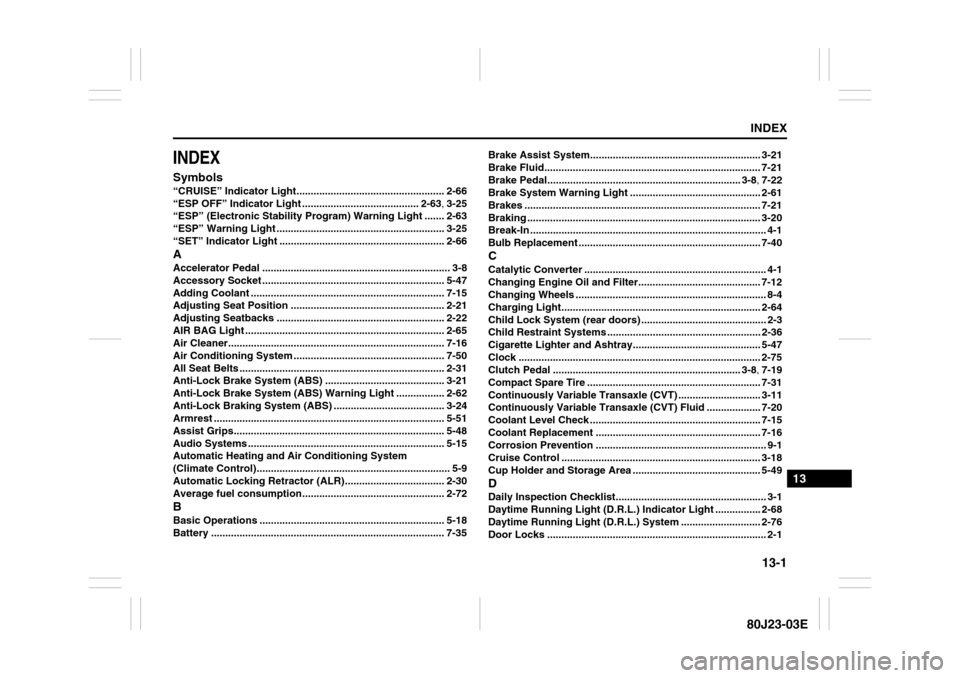
INDEXSymbols“CRUISE” Indicator Light.................................................... 2-66
“ESP OFF” Indicator Light ......................................... 2-63, 3-25
“ESP” (Electronic Stability Program) Warning Light ....... 2-63
“ESP” Warning Light ........................................................... 3-25
“SET” Indicator Light .......................................................... 2-66AAccelerator Pedal .................................................................. 3-8
Accessory Socket ................................................................ 5-47
Adding Coolant .................................................................... 7-15
Adjusting Seat Position ...................................................... 2-21
Adjusting Seatbacks ........................................................... 2-22
AIR BAG Light ...................................................................... 2-65
Air Cleaner............................................................................ 7-16
Air Conditioning System ..................................................... 7-50
All Seat Belts ........................................................................ 2-31
Anti-Lock Brake System (ABS) .......................................... 3-21
Anti-Lock Brake System (ABS) Warning Light ................. 2-62
Anti-Lock Braking System (ABS) ....................................... 3-24
Armrest ................................................................................. 5-51
Assist Grips.......................................................................... 5-48
Audio Systems ..................................................................... 5-15
Automatic Heating and Air Conditioning System
(Climate Control).................................................................... 5-9
Automatic Locking Retractor (ALR)................................... 2-30
Average fuel consumption.................................................. 2-72BBasic Operations ................................................................. 5-18
Battery .................................................................................. 7-35Brake Assist System............................................................ 3-21
Brake Fluid............................................................................ 7-21
Brake Pedal.................................................................... 3-8, 7-22
Brake System Warning Light .............................................. 2-61
Brakes ................................................................................... 7-21
Braking .................................................................................. 3-20
Break-In ................................................................................... 4-1
Bulb Replacement ................................................................ 7-40
CCatalytic Converter ................................................................ 4-1
Changing Engine Oil and Filter........................................... 7-12
Changing Wheels ................................................................... 8-4
Charging Light...................................................................... 2-64
Child Lock System (rear doors) ............................................ 2-3
Child Restraint Systems ...................................................... 2-36
Cigarette Lighter and Ashtray............................................. 5-47
Clock ..................................................................................... 2-75
Clutch Pedal .................................................................. 3-8, 7-19
Compact Spare Tire ............................................................. 7-31
Continuously Variable Transaxle (CVT) ............................. 3-11
Continuously Variable Transaxle (CVT) Fluid ................... 7-20
Coolant Level Check ............................................................ 7-15
Coolant Replacement .......................................................... 7-16
Corrosion Prevention ............................................................ 9-1
Cruise Control ...................................................................... 3-18
Cup Holder and Storage Area ............................................. 5-49DDaily Inspection Checklist..................................................... 3-1
Daytime Running Light (D.R.L.) Indicator Light ................ 2-68
Daytime Running Light (D.R.L.) System ............................ 2-76
Door Locks ............................................................................. 2-1