2010 SKODA ROOMSTER engine
[x] Cancel search: enginePage 167 of 231

Inspecting and replenishing
166
Inspecting the coolant levelThe coolant expansion bottle is located in the engine compartment on the right.
– Switch the engine off.
– Open the bonnet in “Working in the engine compartment” on page 162.
– Check the level of coolant in the coolant expansion bottle fig. 138 . The coolant
level when the engine is cold must lie between the “MIN” and “MAX” mark-
ings. The level may also rise slightly above the “MAX” marking when the engine is
warm.
If the coolant level in the reservoir is too lo w, this is indicated by the warning light in
the instrument cluster
page 28. We nevertheless recommend inspecting the
coolant level directly at the reservoir from time to time.
Loss of coolant
A loss of coolant is first and foremost an indication of a leak in the system. You should
not merely top up the coolant in the reservoir. It is also important to have the cooling
system inspected without delay by a specialist garage.
Losses can only occur through the pressure relief in the cap of the coolant expansion
bottle which is completely free of leaks if the coolant boils as a result of overheating
and is forced out of the cooling system.
WARNING
Read and observe the warning notes page 162, “Working in the engine
compartment” before working in the engine compartment.
Caution
One should contact a specialist garage as s oon as possible if the source of overheating
itself cannot be determined and removed, since there may be grave damage to the
engine.Replenishing the coolant– Switch the engine off.
– Allow the engine to cool down.
– Place a cloth over the cap of the coolant expansion reservoir fig. 138 and
unscrew the cap carefully by turning it to the left .
–Top up the coolant.
– Screw the cap tight until it is heard to lock.
The coolant which you use for replenishing the system, must comply with one specific
specification page 165, “Coolant”. Do not use an al ternative additive if the coolant
additive G12 PLUS - PLUS is not available in exceptional cases. Just top up the system
with water and as soon as possible arrange adjustment to correct the mixing ratio of
water and coolant additive again by a specialist garage.
Only use fresh coolant for topping up the system.
Do not fill up over the “MAX” marking! Excess coolant which is heated up is forced out
of the cooling system through the pressure relief valve in the cap of the coolant
compensation bottle.
Wait until the engine has cooled down for a system which has suffered a major loss of
coolant before pouring in coolant. This is necessary to avoid engine damage.
WARNING
The cooling system is pressurized! Do not open the cap of the coolant
expansion bottle if the engine is still hot - risk of scalding!
The coolant additive and thus all of the coolant is harmful to your health.
Avoid contact with the coolant. Coolant vapours are also harmful to the health.
It is important, therefore, to always safely store any coolant additive in its orig-
inal container out of the reach of children - risk of poisoning!
Fig. 138 Engine compartment: Coolant
expansion bottle
AB
AA
s16g.4.book Page 166 Wednesda y, February 10, 2010 3:53 PM
Page 168 of 231

Inspecting and replenishing167
Using the system
Safety
Driving Tips
General Maintenance
Breakdown assistance
Praktik
Technical Data
If any splashes of coolant get into yo ur eyes, rinse out your eyes immedi-
ately with clear water and contact a doctor as soon as possible.
You should also consult a doctor without delay if you have inadvertently
swallowed coolant.Caution
Do not continue your journey if for some reason it is not possible under the
conditions prevailing to top up with coolant. Switch the engine off and obtain
professional assistance from a specialist garage, otherwise it could lead to severe
engine damage.
For the sake of the environment
Do not re-use coolant if it is necessary to drain the coolant in the system. It should be
collected and disposed of in compliance with environmental protection regulations.Radiator fan
The radiator fan may switch on suddenly.The radiator fan is driven by an electric motor and controlled by a thermostat
according to the coolant temperature.
The radiator fan may continue running for up to 10 minutes after the engine has been
switched off - even if the igni tion is also off. It may also switch on suddenly after a
certain time, if
the coolant temperature has risen beca use of an accumulation of heat or
the warm engine compartment is heated up additionally by strong sunlight.
WARNING
You must therefore be aware when workin g in the engine compartment that the
fan may switch on suddenly - risk of injury!
Brake fluidInspecting the brake fluid levelThe brake fluid reservoir is located on the left of the engine compartment. The brake
fluid reservoir on right-hand steering models is positioned on the other side of the
engine compartment.
– Switch the engine off.
– Open the bonnet in “Working in the engine compartment” on page 162.
– Inspect the brake fluid level in the reservoir fig. 139 . The level must be between
the “MIN” and “MAX” markings.
A slight drop in the fluid level results when driving due to normal wear-and-tear and
automatic adjustment of the brak e pads, and is perfectly normal.
There may be an indication of a leak in the brake system, however, if the fluid level
drops significantly within a short time or if it drops below the “MIN” marking. If the
brake fluid level is too low, this is indicated by the warning light
lighting up in the
instrument cluster page 31. In this case stop immediately and do not drive any
further! Obtain professional assistance.
WARNING
Read and observe the warning notes page 162, “Working in the engine
compartment” before working in the engine compartment.
WARNING (continued)
Fig. 139 Engine compartment: Brake
fluid reservoir
s16g.4.book Page 167 Wednesda y, February 10, 2010 3:53 PM
Page 169 of 231
Inspecting and replenishing
168
If the fluid level has dropped below the MIN marking, do not drive any
further - risk of accident! Obtain professional assistance.
Replacing brake fluidBrake fluid absorbs moisture. This causes the fluid to absorb moisture from the
surrounding air over a period of time. Excessive water in the brake fluid may be the
cause of corrosion in the brake system. The water content also lowers the boiling point
of the brake fluid. This is why brake fluid must be replaced every two years.
One may only use new brake fluid approved by Škoda Auto. The brake fluid must
comply with one of the following standards or specifications:
VW 501 14,
FMVSS 116 DOT4,
DIN ISO 4925 CLASS 4.
We recommend that you have the brake fluid replaced by an authorised Škoda
Service Partner as part of an Inspection Service.
WARNING
Using old brake fluid can result in severe stress on the brakes because of the
formation of vapour bubbles in the br ake system. This greatly impairs the
braking efficiency and thus also the safety of your vehicle.
Brake fluid is toxic! It must therefor e be kept safely in closed original
containers and well away from children and unauthorized persons.Caution
Brake fluid damages the paintwork of the vehicle.
For the sake of the environment
In view of the problems involved with proper disposal of brake fluid, the special tools
and the professional knowledge required, we recommend you have the brake fluid
replaced by a specialist garage.
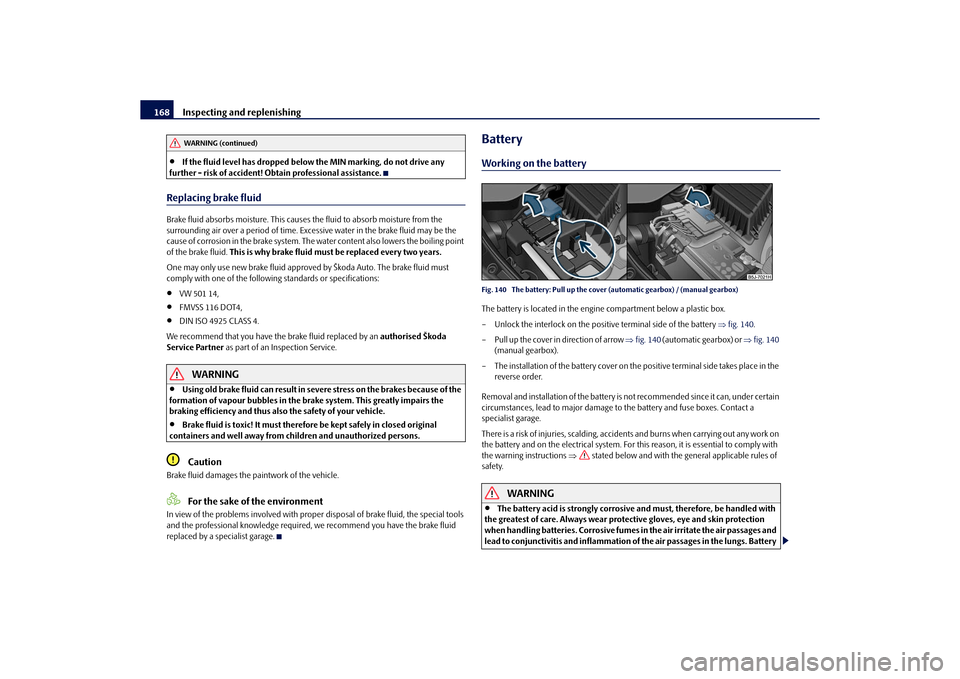
BatteryWorking on the batteryFig. 140 The battery: Pull up the cove r (automatic gearbox) / (manual gearbox)The battery is located in the engine compartment below a plastic box.
– Unlock the interlock on the positive terminal side of the battery fig. 140 .
– Pull up the cover in direction of arrow fig. 140 (automatic gearbox) or fig. 140
(manual gearbox).
– The installation of the battery cover on th e positive terminal side takes place in the
reverse order.
Removal and installation of the battery is not recommended since it can, under certain
circumstances, lead to ma jor damage to the battery and fuse boxes. Contact a
specialist garage.
There is a risk of injuries, scalding, accidents and burns when carrying out any work on
the battery and on the electrical system. For th is reason, it is essential to comply with
the warning instructions stated below and with the general applicable rules of
safety.
WARNING
The battery acid is strongly corrosive and must, therefore, be handled with
the greatest of care. Always wear prot ective gloves, eye and skin protection
when handling batteries. Corrosive fumes in the air irritate the air passages and
lead to conjunctivitis and inflammation of the air passages in the lungs. Battery
WARNING (continued)
s16g.4.book Page 168 Wednesday, February 10, 2010 3:53 PM
Page 170 of 231

Inspecting and replenishing169
Using the system
Safety
Driving Tips
General Maintenance
Breakdown assistance
Praktik
Technical Data
acid corrodes dental enamel and create
s deep wounds after contact with the
skin which take a long time to heal. Repeated contact with diluted acids causes
skin diseases (inflammations, ulcers, slin cracks). Acids coming into contact
with water are diluted accompanied by significant development of heat.
Do not tilt the battery otherwise battery electrolyte may flow out of the
battery vent openings. Protect the eyes with safety glas ses or a shield! There is
the danger of suffering blindness! If an y battery electrolyte gets into your eye,
rinse out your eye immediately with cl ear water for several minutes. Contact a
doctor without delay.
Splashes of acid on your skin or clothes should be neutralised as soon as
possible using soap suds and then rinsed with plenty of water. Contact a doctor
immediately if you swal low battery electrolyte.
Keep batteries out of the reach of children.
Hydrogen is released when you charge a battery and a highly explosive gas
mixture is produced. An explosion can be caused through sparkling over during
unclamping or loosening of the cabl e plug while the ignition is on.
Bridging of the poles will create a short circuit (e.g. through metal objects,
cables). Possible consequences of a short circuit: Melting of lead struts, explo-
sion and burning of the battery, jets of acid spurting out.
It is prohibited to work with a naked flame and light, to smoke or to carry out
any activities which produce sparks. Avoi d creating sparks when working with
cables and electrical devices. Strong sparking represents a risk of injury.
Before carrying out any work on the el ectrical system, switch off the engine,
the ignition as well as all electrical components and disconnect the negative
cable (-) on the battery. If you wish to replace a bulb it is sufficient to switch off
the appropriate light.
Never charge a frozen or thawed battery - risk of explosion and caustic
burns! Replace a frozen battery.
Never use a battery which is damaged - risk of explosion! Immediately
replace a damaged battery.
Caution
You must only disconnect the battery if th e ignition is switched off, otherwise the
electrical system (electronic components ) of the vehicle may be damaged. When
disconnecting the battery from the electrical system of the vehicle, first disconnect the
negative terminal (-) of the battery. Then disconnect the positive terminal (+).
When reconnecting the battery, first connect the positive terminal (+) and only
then the negative terminal (-) of the battery. You must on no account connect the
cables wrongly - risk of a cable fire.
Ensure that battery acid does not come into contact with the vehicle body other-
wise damage could occur to the paintwork.
Do not place the battery in direct daylight in order to protect the battery housing
from the effects of ultra-violet light.For the sake of the environment
A removed battery is a special type of wa ste which is harmful to the environment -
contact your specialist garage regarding disposing of the battery.
Note
Please also refer to the guidelines page 171, “Disconnectin g and reconnecting
the battery”, also after connecting the battery.
Battery with a two-tone indicator
WARNING (continued)
Fig. 141 The battery: Show
s16g.4.book Page 169 Wednesda y, February 10, 2010 3:53 PM
Page 172 of 231

Inspecting and replenishing171
Using the system
Safety
Driving Tips
General Maintenance
Breakdown assistance
Praktik
Technical Data
Operation in winterThe battery has to provide greater amounts of electricity during the winter. It also has
only part of the initial power output at low temperatures that it has at normal temper-
atures.
A discharged battery may already freez e at temperatures just below 0°C.
We therefore recommend that you have the battery checked by a specialist garage
before the start of the winter, and recharged if necessary.Charging the battery
A properly charged battery is essentia l for reliably starting the engine.– Read the warning notes in “Working on the battery” on page 168 and .
– Switch the ignition and all electrical components off.
– Only for “quick-charging”: Disconnect both battery cables (first of all “negative”,
then “positive”).
– Carefully attach the terminal clamps of the charger to the battery terminals (red = “positive”, black = “negative”).
– You can now plug the mains cable of the charger into the power socket and switch
on the charger.
– When charging is completed: switch th e charger off and unplug the mains cable
from the power socket.
– Only then should you disconnect the terminal clamps of the charger.
– Reconnect the cables to the battery (first of all “positive”, then “negative”).
It is not normally necessary to disconnect th e cables of the battery if you recharge the
battery using low amperages (as for example from a mini-charger ). Please also refer
to the instructions from the charger manufacturer.
A charging current of 0.1 of the total battery capacity (or lower) is that which should be
used until full charging is achieved.
It is, however, necessary to disconnect both cables before charging the battery with
high amperages, so-called “ quick-charging”. “Quick-charging” a battery is
dangerous in “Working on the battery” on
page 168. It requires a special charger an d appropriate knowledge. We therefore
recommend that you have your battery quick- charged only by your specialist garage.
A discharged battery may already freeze at temperatures just below 0°C . We
recommend that you no longer use a battery which has thawed out because the casing
of the battery may be cracked through the formation of ice and this would allow
battery electrolyte to flow out.
The vent plugs of the battery should not be opened for charging.
WARNING
Never charge a frozen or thawed battery - risk of explosion and caustic burns!
Replace a frozen battery.Disconnecting and reconnecting the batteryOn disconnecting and reconnecting the battery the following functions are initially
deactivated or are no longer able to operate fault-free.
We recommend having the vehicle checked by a specialist garage to ensure full func-
tionality of all electrical systems.Replacing the batteryYou should only replace a battery with a ne w battery of the same capacity, voltage (12
V), amperage and of the same size. Specialist garages have a range of suitable batteries
available.Operation
Operating measure
Electrical power window (operational faults)
page 44
Enter radio code number
see Radio Operating Instructions
Set hours
page 18
Data in the multi-functional indicator* are
deleted.
page 18
s16g.4.book Page 171 Wednesda y, February 10, 2010 3:53 PM
Page 173 of 231
Inspecting and replenishing
172
We recommend that you only have an old ba ttery disposed of by a specialist garage
since it does require special disposal.
For the sake of the environment
Batteries contain poisonous substances such as sulphuric acid and lead. They must be
disposed of in accordance with local environmental protection regulations and on no
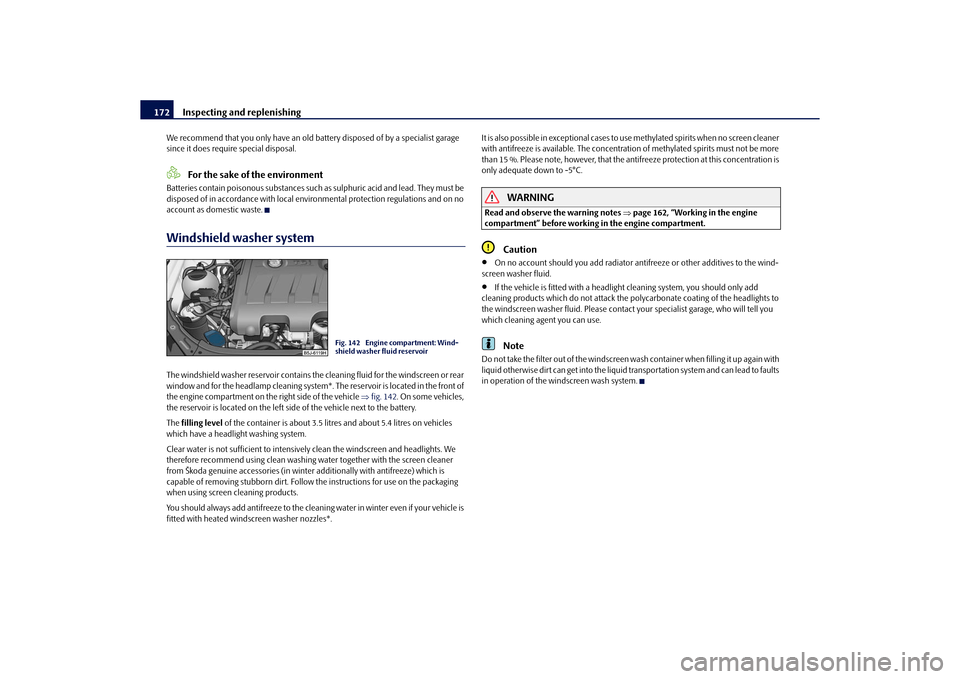
account as domestic waste.Windshield washer systemThe windshield washer reservoir contains the cleaning fluid for the windscreen or rear
window and for the headlamp cl eaning system*. The reservoir is located in the front of
the engine compartment on the right side of the vehicle fig. 142 . On some vehicles,
the reservoir is located on the left side of the vehicle next to the battery.
The filling level of the container is about 3.5 litres and about 5.4 litres on vehicles
which have a headlight washing system.
Clear water is not sufficient to intensively clean the windscreen and headlights. We
therefore recommend using clean washing water together with the screen cleaner
from Škoda genuine accessories (in winter additionally with antifreeze) which is
capable of removing stubborn dirt. Follow the instructions for use on the packaging
when using screen cleaning products.
You should always add antifreeze to the cleani ng water in winter even if your vehicle is
fitted with heated wind screen washer nozzles*. It is also possible in exceptional cases to use methylated spirits when no screen cleaner
with antifreeze is available. The concentration of methylated spirits must not be more
than 15 %. Please note, however, that the anti
freeze protection at this concentration is
only adequate down to -5°C.
WARNING
Read and observe the warning notes page 162, “Working in the engine
compartment” before working in the engine compartment.
Caution
On no account should you add radiator an tifreeze or other additives to the wind-
screen washer fluid.
If the vehicle is fitted wi th a headlight cleaning system, you should only add
cleaning products which do not attack the polycarbonate coating of the headlights to
the windscreen washer fluid. Please contac t your specialist garage, who will tell you
which cleaning agent you can use.Note
Do not take the filter out of the windscreen wash container when filling it up again with
liquid otherwise dirt can get into the liquid transportation system and can lead to faults
in operation of the windscreen wash system.
Fig. 142 Engine compartment: Wind-
shield washer fluid reservoir
s16g.4.book Page 172 Wednesda y, February 10, 2010 3:53 PM
Page 175 of 231

Wheels and Tyres
174
The tyre pressure should be at the highest pressure specified for your vehicle at all
times.
Always check the inflation pressure of tyres when cold. Do not reduce the higher pres-
sure of warm tyres. Adapt the inflation pressure of the tyres accordingly if your vehicle
is carrying a significantly higher payload.
Tyre inflation pressure - Tyre size 185/55 R15
The same inflation pressure values apply to ty res of the tyre size 195/55 R15 as to tyres
of the tyre size 185/55 R15 which are intended to be used with snow chains, see the
inside of the fuel filler flap.
The tyres of the tyre size 185/55 R15, which are intended to be used with snow chains
and are fitted on models Roomster Scout, have the following inflation pressure values
in kPa.
Driving style
Fast cornering, sharp acceleration and brak ing (squealing tyres) increase wear-and-
tear on your tyres.
Balancing wheels
The wheels of a new vehicle are balanced. There are a wide range of influences when
driving which may result in an imbalance and which makes themselves felt through
vibration in the steering. You should have the wheels rebalanced si
nce any imbalance increases wear-and-tear
on the steering, the suspension and tyres. A wheel must also be rebalanced when a
new tyre is fitted and each time a tyre is repaired.
Wheel alignment errors
Incorrect wheel alignment at the front and rear will not only increase wear-and-tear on
the tyres but will also has an adverse effect on vehicle safety. Contact your specialist
garage if you notice any unusual tyre wear.
WARNING
If the inflation pressure is too low, the tyre must perform a greater flexing
work. At higher speeds the tyre will warm up as a result of this. This can result
in tread separation and even a tyre blowout.
Immediately replace the damaged rims or tyres.
Tyres which are 6 years old or more should only be fitted in exceptional
cases and when adopting an appropriately cautious style of driving.For the sake of the environment
Tyres which are insufficiently inflated increase your fuel consumption.Wear indicatorsThe base of the tread of the original tyres has wear indicators 1.6 mm high, installed at
right angles to the direction of travel. These wear indicators are located at 6 - 8 points
depending on the make and are evenly spaced around the circumference of the tyre
Engine
Partial load
Full load
1.2/63 kW TSI
220/210
230/320
1,4/63 kW
220/210
1.2/77 kW TSI
220/210
1.6/77 kW
220/210
1,2/55 kW TDI CR
220/220
1.6/66 kW TDI CR
220/220
1.6/77 kW TDI CR
220/210
Fig. 144 Tyre tread with wear indicators
s16g.4.book Page 174 Wednesda y, February 10, 2010 3:53 PM
Page 184 of 231

Breakdown assistance183
Using the system
Safety
Driving Tips
General Maintenance
Breakdown assistance
Praktik
Technical Data
Changing a wheelPreliminary workThe following steps should be carried ou t before actually changing the wheel.
– If it is necessary to change a wheel, park the vehicle as far away as possible from
the traffic flow. The place you choose should be level.
– Have all the occupants get out. While changing a wheel, the occupants of the
vehicle should not stand on the road (e.g. behind a crash barrier).
– Apply the handbrake firmly.
–Engage 1st gear or if your vehicle is fitted with an automatic gearbox, position the
selector lever into position P .
– If a trailer is coupled, uncouple it.
– Take the vehicle tool kit and the spare wheel page 181 out of the luggage
compartment.
WARNING
If you find yourself in flowing traffic switch on the hazard warning lights
system and place the warning triangle on the side of the road at the prescribed
distance from your vehicle while observing all national legal provisions. In this
way you are protecting not only yourself but also other road users.
Never start the engine with the vehicle si tting on the raised jack - danger of
suffering injury.Caution
If you have to change a wheel on a slope first block the opposite wheel with a stone or
similar object in order to secure the vehicle from unexpectedly rolling away.
Note
Comply with the national legal regulations.
Always change a wheel on a level surface as far as possible.
– Take off the full wheel trim* page 184 or the caps page 184.
– Slacken the wheel bolts page 185.
– Jack up the vehicle until the wheel to be changed is clear of the ground
page 185.
– Unscrew the wheel bolts and place them on a clean surface (cloth, paper etc.).
– Take off the wheel.
– Fit on the spare wheel* and tighten the wheel bolts slightly.
– Lower the car.
– Tighten the wheel bolts firmly, alternatel y and diagonally using the wrench (cross-
wise) page 185.
– Mount the full wheel trim/wheel trim cap or the caps.
Note
All bolts must be clean and must turn easily.
You must never grease or oil the wheel bolts!
When fitting on unidirectiona l tyres, ensure that the tyres rotate in the correct
direction page 173.
Subsequent stepsAfter changing the wheel, you mu st perform the following steps.
– Stow the vehicle tool kit in the space provided.
– Stow the replaced wheel in the luggage compartment.
– Check the tyre pressure on the spare wheel just mounted as soon as possible.
– Have the tightening torque of the wheel bolts checked with a torque wrench as
soon as possible. Steel and light alloy wheels must be tightened to a tightening
torque of 120 Nm.
s16g.4.book Page 183 Wednesda y, February 10, 2010 3:53 PM