2010 PONTIAC VIBE tow
[x] Cancel search: towPage 48 of 318

How Does an Airbag
Restrain?
In moderate to severe frontal or
near frontal collisions, even belted
occupants can contact the steering
wheel or the instrument panel.
In moderate to severe side collisions,
even belted occupants can contact
the inside of the vehicle.
Airbags supplement the protection
provided by safety belts. Frontal
airbags distribute the force of the
impact more evenly over the
occupant’s upper body, stopping
the occupant more gradually.
Seat-mounted side impact and
roof-rail airbags distribute the force
of the impact more evenly over the
occupant’s upper body.
But airbags would not help in many
types of collisions, primarily because
the occupant’s motion is not toward
those airbags. SeeWhen Should an
Airbag Inate? on page 2-26 for
more information.
Airbags should never be regarded
as anything more than a supplement
to safety belts.
What Will You See After
an Airbag Inates?
After the frontal airbags and
seat-mounted side impact airbags
inflate, they quickly deflate, so
quickly that some people may not
even realize an airbag inflated.
Roof-rail airbags may still be at least
partially inflated for some time after
they deploy. Some components of
the airbag module may be hot for
several minutes. For location of the
airbag modules, see What Makes
an Airbag Inate? on page 2-27 .
The parts of the airbag that come
into contact with you may be warm,
but not too hot to touch. There may
be some smoke and dust coming
from the vents in the deflated
airbags. Airbag inflation does not
prevent the driver from seeing out
of the windshield or being able to
steer the vehicle, nor does it prevent
people from leaving the vehicle.
{CAUTION
When an airbag inflates, there
may be dust in the air. This dust
could cause breathing problems
for people with a history of asthma
or other breathing trouble.
To avoid this, everyone in the
vehicle should get out as soon
as it is safe to do so. If you have
breathing problems but cannot get
out of the vehicle after an airbag
inflates, then get fresh air by
opening a window or a door. If you
experience breathing problems
following an airbag deployment,
you should seek medical attention.
The vehicle has a feature that may
automatically unlock the doors, turn
the interior lamps on, and turn the
hazard warning flashers on when
the airbags inflate. You can lock
the doors, turn the interior lamps off,
and turn the hazard warning flashers
off by using the controls for those
features.
2-28 Seats and Restraints
Page 54 of 318

The passenger sensing system may
suppress the airbag deployment
when liquid soaks into the seat.
If this happens, the off indicator
in the passenger airbag status
indicator and the airbag readiness
light will be lit. Have your
dealer/retailer check the system.
An object, person or child in the
rear seat contacting or pressing
the right front passenger seatback,
or objects stowed under the right
front passenger seat, may affect the
proper functioning of the passenger
sensing system.
When a safety belt extender is
used in the right front passenger
seat, make sure the passenger
airbag status indicator shows
ON. If the indicator shows OFF,
disconnect the extender’s latch fromthe buckle then reconnect the safety
belt. The passenger airbag status
indicator light should be ON and
then the safety belt extender can
be reconnected. If the safety belt
extender is used while the passenger
airbag status indicator light is OFF,
the right front passenger frontal and
seat-mounted side impact airbags (if
equipped) may not activate correctly.
{CAUTION
Stowing of articles under the
passenger seat or between the
passenger seat cushion and
seatback may interfere with the
proper operation of the passenger
sensing system.
Servicing the
Airbag-Equipped Vehicle
Airbags affect how the vehicle
should be serviced. There are
parts of the airbag system in
several places around the vehicle.
Your dealer/retailer and the service
manual have information about
servicing the vehicle and the airbag
system. To purchase a service
manual, see
Service Publications
Ordering Information on page 12-12 .
{CAUTION
For up to 10 seconds after the
ignition is turned off and the
battery is disconnected, an airbag
can still inflate during improper
service. You can be injured if you
are close to an airbag when it
inflates. Avoid yellow connectors.
They are probably part of the
airbag system. Be sure to follow
proper service procedures, and
make sure the person performing
work for you is qualified to do so.
2-34 Seats and Restraints
Page 69 of 318

Do not fold the empty rear
seat with a safety belt buckled.
This could damage the safety belt
or the seat. Unbuckle and return
the safety belt to its stowed
position, before folding the seat.
1. Attach and tighten the lowerattachments to the lower anchors.
If the child restraint does not have
lower attachments or the desired
seating position does not have
lower anchors, secure the child
restraint with the top tether and
the safety belts. Refer to the
child restraint manufacturer
instructions and the instructions
in this manual.
1.1. Find the lower anchors for the desired seating position.
1.2. Put the child restraint on the seat.
1.3. Attach and tighten the lower attachments on the child
restraint to the lower
anchors. 2. If the child restraint manufacturer
recommends that the top tether
be attached, attach and tighten
the top tether to the top tether
anchor, if equipped. Refer to the
child restraint instructions and the
following steps:
2.1. Find the top tether anchor.
2.2. If the vehicle has a cargo mat, you may need to fold
it back to access the
top tether anchors.
2.3. Open the top tether anchor cover to expose the anchor. 2.4. Route, attach, and tighten
the top tether according
to the child restraint
instructions and the
following instructions:
If the position you are using
does not have a headrest or
head restraint and you are
using a single tether, route
the tether over the seatback.
Seats and Restraints 2-49
Page 73 of 318

5. To tighten the belt, push downon the child restraint, pull the
shoulder portion of the belt to
tighten the lap portion of the belt,
and feed the shoulder belt back
into the retractor. When installing
a forward-facing child restraint, it
may be helpful to use your knee
to push down on the child
restraint as you tighten the belt. 6. If the child restraint has a top
tether, follow the child restraint
manufacturer’s instructions
regarding the use of the top
tether. See Lower Anchors and
Tethers for Children (LATCH
System) on page 2-45 for more
information.
7. Push and pull the child restraint in different directions to be sure
it is secure.
To remove the child restraint,
unbuckle the vehicle safety belt and
let it return to the stowed position.
If the top tether is attached to a top
tether anchor, disconnect it.
Securing Child Restraints
(Right Front Seat
Position)
This vehicle has airbags. A rear
seat is a safer place to secure
a forward-facing child restraint.
See Where to Put the Restraint
on page 2-43.
In addition, the vehicle has a
passenger sensing system which is
designed to turn off the right front
passenger frontal and seat-mounted
side impact airbag under certain
conditions. See Passenger Sensing
System on page 2-29 andPassenger
Airbag Status Indicator on page 4-13
for more information, including
important safety information.
Seats and Restraints 2-53
Page 76 of 318

6. To tighten the belt, push downon the child restraint, pull the
shoulder portion of the belt to
tighten the lap portion of the belt
and feed the shoulder belt back
into the retractor. When installing
a forward-facing child restraint,
it may be helpful to use your
knee to push down on the child
restraint as you tighten the belt.
7. Push and pull the child restraint in different directions to be sure
it is secure. If the airbags are off, the off
indicator in the passenger airbag
status indicator will come on
and stay on when the vehicle
is started.
If a child restraint has been
installed and the on indicator is lit,
see “If the On Indicator is Lit for a
Child Restraint” under
Passenger
Sensing System on page 2-29 for
more information.
To remove the child restraint,
unbuckle the vehicle safety belt and
let it return to the stowed position.
2-56 Seats and Restraints
Page 79 of 318
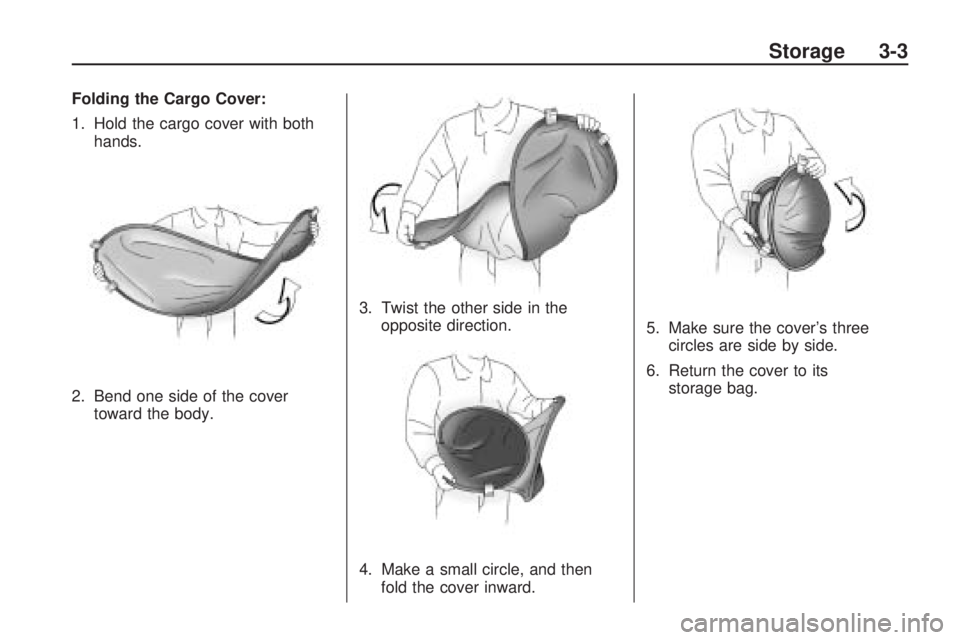
Folding the Cargo Cover:
1. Hold the cargo cover with bothhands.
2. Bend one side of the cover toward the body. 3. Twist the other side in the
opposite direction.
4. Make a small circle, and then fold the cover inward. 5. Make sure the cover’s three
circles are side by side.
6. Return the cover to its storage bag.
Storage 3-3
Page 87 of 318

Horn
Press near or on the horn symbols
on the steering wheel pad to sound
the horn.
Windshield Wiper/Washer
The windshield wiper/washer lever
is located on the right side of the
steering column.Move the lever to one of the
following positions:
z(Mist):
Move the lever to mist,
for a single wiping cycle and then
release. The wipers stop after
one wipe.
((Off): Turns the wipers off.
&(Intermittent): Move the lever
to choose a delayed wiping cycle.
For vehicles with the variable
intermittent feature, the time
between wipes can be adjusted.
Turn the
&band for a longer
or shorter delay interval.
q(Low): Slow wipes.
l(High): Fast wipes.
Clear snow and ice from the wiper
blades before using them. If the
blades are frozen to the windshield,
loosen or thaw them. If they become damaged, get new blades or
blade inserts. See
Wiper Blade
Replacement on page 9-30 .
Heavy snow or ice can overload
the wipers. A circuit breaker stops
them until the motor cools.
Windshield Washer
Pull the lever toward you to spray
washer fluid on the windshield.
The spray continues until the lever
is released. The wipers will run a
few times. See Washer Fluid on
page 9-24 for information on filling
the windshield washer fluid reservoir.
{CAUTION
In freezing weather, do not use
your washer until the windshield
is warmed. Otherwise the washer
fluid can form ice on the
windshield, blocking your vision.
Instruments and Controls 4-5
Page 97 of 318

Notice:Modications made
to the engine, transmission,
exhaust, intake, or fuel system
of the vehicle or the replacement
of the original tires with other
than those of the same Tire
Performance Criteria (TPC) can
affect the vehicle’s emission
controls and can cause this light
to come on. Modications to these
systems could lead to costly
repairs not covered by the vehicle
warranty. This could also result
in a failure to pass a required
Emission Inspection/Maintenance
test. See Accessories and
Modifications on page 9-3 .
This light comes on during a
malfunction in one of two ways:
Light Flashing: A misfire condition
has been detected. A misfire
increases vehicle emissions and
could damage the emission control
system on the vehicle. Diagnosis
and service might be required. The following can prevent more
serious damage to the vehicle:
•Reduce vehicle speed.
•Avoid hard accelerations.
•Avoid steep uphill grades.
•If towing a trailer, reduce the
amount of cargo being hauled
as soon as it is possible.
If the light continues to flash, when
it is safe to do so, stop the vehicle.
Find a safe place to park the vehicle.
Turn the key off, wait at least
10 seconds, and restart the engine.
If the light is still flashing, follow the
previous steps and see your dealer/
retailer for service as soon as
possible.
Light On Steady: An emission
control system malfunction has been
detected on the vehicle. Diagnosis
and service might be required. An emission system malfunction
might be corrected by doing
the following:
•Make sure the fuel cap is fully
installed. See
Filling the Tank on
page 8-41. The diagnostic system
can determine if the fuel cap
has been left off or improperly
installed. A loose or missing fuel
cap allows fuel to evaporate into
the atmosphere. A few driving
trips with the cap properly
installed should turn the light off.
•If the vehicle has been driven
through a deep puddle of water,
the vehicle’s electrical system
might be wet. The condition is
usually corrected when the
electrical system dries out.
A few driving trips should turn
the light off.
Instruments and Controls 4-15