2010 PEUGEOT 5008 light
[x] Cancel search: lightPage 172 of 331

138
Particular situations Emergency braking
In the event of a failure of the main ser-
vice brake or in an exceptional situation
(e.g. driver taken ill, under instruction,
etc) a continuous pull on control A will
stop the vehicle.
The electronic stability programme
(ESP) provides stability during emer-
gency braking.
If the emergency braking malfunctions,
one of the following messages will be
displayed:
- "Parking brake faulty".
- "Parking brake control faulty".
In certain situations (e.g. start-
ing the engine), the parking brake
can automatically alter its force. This
is normal operation.
To advance your vehicle a few cen-
timetres without starting the engine,
but with the ignition on, press on the
brake pedal and release the parking
brake by pulling then releasing con-
trol A . The full release of the parking
brake is confi rmed by the extinction
of warning lamp on control A and of
the warning lamp on the instrument
panel and the displaying of the mes-
sage "Handbrake off".
If the parking brake malfunctions
while applied or if the battery runs
fl at, an emergency release is always
possible. If a failure of the ESP system
is signalled by the lighting of
this warning lamp, then bra-
king stability is not guaranteed.
In this event, stability must be assured
by the driver by repeating alternate "pull
release" actions on control A .
The emergency braking must
only be used in exceptional
circumstances.
Page 190 of 331

158
Stopping the vehicle
Before switching off the engine, you
can engage position P or N to place the
gearbox in neutral.
In both cases, apply the parking brake
to immobilise the vehicle, unless it is
programmed to automatic mode.
Operating fault
When the ignition is on, the
lighting of this warning lamp,
accompanied by an audible
signal and a message on the
multifunction screen, indicates
a gearbox malfunction.
In this case, the gearbox switches to
back-up mode and is locked in 3rd gear.
You may feel a substantial knock when
changing from P to R and from N to R .
This will not cause any damage to the
gearbox.
Do not exceed 60 mph (100 km/h), local
speed restrictions permitting.
Have it checked by a PEUGEOT dealer.
This warning lamp may also come on if
a door is opened.
You risk damaging the gearbox:
- if you press the accelera-tor and brake pedals at the
same time,
- if you force the lever from posi- tion P to another position when
the battery is fl at.
To reduce fuel consumption when
stationary for long periods with the
engine running (traffi c jam...), posi-
tion the gear lever at N and apply
the parking brake, unless it is pro-
grammed in automatic mode.
Manual operation
Select position M for sequential
changing of the six gears.
Push the lever towards the + sign to
change up a gear.
Pull the lever towards the - sign to
change down a gear.
D disappears and the gears
engaged appear in succes-
sion on the instrument panel.
If the lever is not in posi-
tion P , when the driver's
door is opened or approxi-
mately 45 seconds after the ignition
is switched off, an audible signal is
heard and a message appears.
Return the lever to position P ; the
audible signal stops and the mes-
sage disappears.
It is only possible to change from one
gear to another if the vehicle speed and
engine speed permit; otherwise, the
gearbox will operate temporarily in au-
tomatic mode.
Invalid value during manual
operation
This symbol is displayed if a
gear is not engaged correctly
(selector between two posi-
tions).
It is possible to change from position D
(automatic) to position M (manual) at
any time.
When the vehicle is stationary or moving
very slowly, the gearbox selects gear M1
automatically.
The sport and snow programmes do not
operate in manual mode.
If the engine speed is too low or too
high, the gear selected fl ashes for a few
seconds, then the actual gear engaged
is displayed.
Page 200 of 331

CHECKS
169
Avoid prolonged contact of
used oil or fl uids with the skin.
Most of these fl uids are harmful to
health or indeed very corrosive.
Do not discard used oil or fl u-
ids into sewers or onto the
ground.
Take used oil to a PEUGEOT dealer
(France) or an authorised waste dis-
posal site.
Diesel additive level (Diesel
engine with particle emission
filter)
A low additive level is indicated by light-
ing of the service warning lamp, accom-
panied by an audible warning and a
message on the multifunction screen.
Used products
CHECKS
Battery
The battery does not require
any maintenance.
However, check that the ter-
minals are clean and correctly
tightened, particularly in sum-
mer and winter.
When carrying out work on the battery, refer to
the "Practical information" section for details of
the precautions to be taken before disconnect-
ing the battery and following its reconnection.
Air filter Refer to the Warranty and
Maintenance Record for de-
tails of the replacement inter-
vals for these components.
Depending on the environment
(e.g. dusty atmosphere) and the use of
the vehicle (e.g. city driving), replace
them twice as often if necessary
(refer to the "Engines" paragraph). Particle emission filter (Diesel)
It is imperative that the maintenance of
the particle emission fi lter is carried out
by a PEUGEOT dealer.
Oil filter Replace the oil fi lter each time
the engine oil is changed.
Refer to the Warranty and
Maintenance Record for details
of the replacement interval for
this component. Following prolonged opera-
tion of the vehicle at very low
speed or at idle, you may, in
exceptional circumstances, notice
the emission of water vapour at the
exhaust on acceleration. This does
not affect the behaviour of the vehicle
or the environment.
Topping up
This additive must be topped up by a
PEUGEOT dealer without delay.
Dust filter/Anti-odour filter
(activated carbon)
Your vehicle is fi tted with a fi lter which
traps certain dust and limits odours in
the ventilation and air conditioning.
Refer to the Warranty and Maintenance
Record for its replacement interval.
Do not hesitate to change it if you notice
unpleasant odours, contact a PEUGEOT
dealer.
A clogged passenger compartment fi lter
may reduce the performance of the air
conditioning system and produce un-
pleasant odours.
Unless otherwise indicated, check
these components in accordance with
the Warranty and Maintenance Record
and according to your engine.
Otherwise, have them checked by a
PEUGEOT dealer.
Page 201 of 331
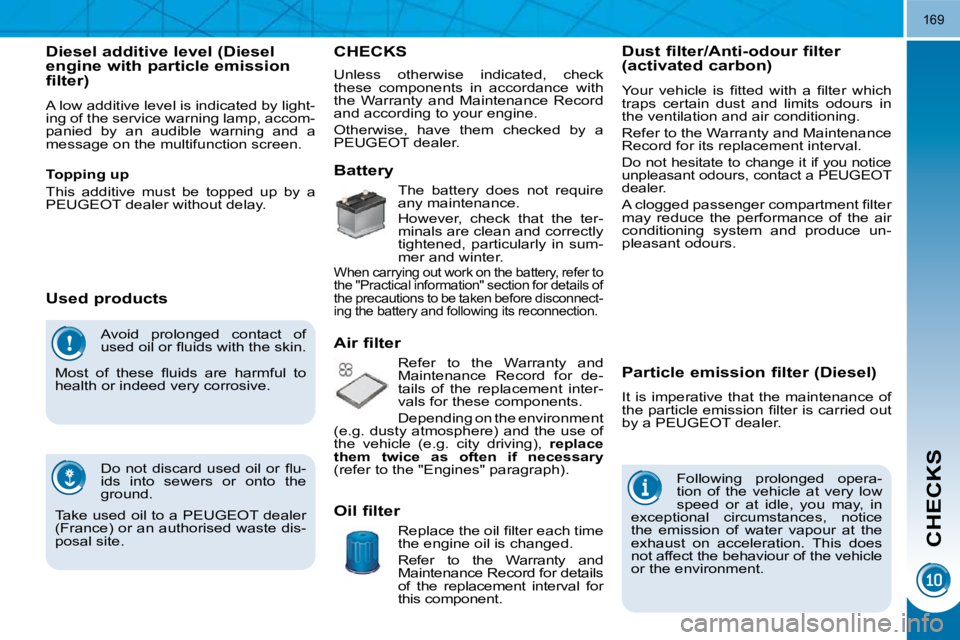
CHECKS
169
Avoid prolonged contact of
used oil or fl uids with the skin.
Most of these fl uids are harmful to
health or indeed very corrosive.
Do not discard used oil or fl u-
ids into sewers or onto the
ground.
Take used oil to a PEUGEOT dealer
(France) or an authorised waste dis-
posal site.
Diesel additive level (Diesel
engine with particle emission
filter)
A low additive level is indicated by light-
ing of the service warning lamp, accom-
panied by an audible warning and a
message on the multifunction screen.
Used products
CHECKS
Battery
The battery does not require
any maintenance.
However, check that the ter-
minals are clean and correctly
tightened, particularly in sum-
mer and winter.
When carrying out work on the battery, refer to
the "Practical information" section for details of
the precautions to be taken before disconnect-
ing the battery and following its reconnection.
Air filter Refer to the Warranty and
Maintenance Record for de-
tails of the replacement inter-
vals for these components.
Depending on the environment
(e.g. dusty atmosphere) and the use of
the vehicle (e.g. city driving), replace
them twice as often if necessary
(refer to the "Engines" paragraph). Particle emission filter (Diesel)
It is imperative that the maintenance of
the particle emission fi lter is carried out
by a PEUGEOT dealer.
Oil filter Replace the oil fi lter each time
the engine oil is changed.
Refer to the Warranty and
Maintenance Record for details
of the replacement interval for
this component. Following prolonged opera-
tion of the vehicle at very low
speed or at idle, you may, in
exceptional circumstances, notice
the emission of water vapour at the
exhaust on acceleration. This does
not affect the behaviour of the vehicle
or the environment.
Topping up
This additive must be topped up by a
PEUGEOT dealer without delay.
Dust filter/Anti-odour filter
(activated carbon)
Your vehicle is fi tted with a fi lter which
traps certain dust and limits odours in
the ventilation and air conditioning.
Refer to the Warranty and Maintenance
Record for its replacement interval.
Do not hesitate to change it if you notice
unpleasant odours, contact a PEUGEOT
dealer.
A clogged passenger compartment fi lter
may reduce the performance of the air
conditioning system and produce un-
pleasant odours.
Unless otherwise indicated, check
these components in accordance with
the Warranty and Maintenance Record
and according to your engine.
Otherwise, have them checked by a
PEUGEOT dealer.
Page 219 of 331
PRACTICAL INFORMATION
187
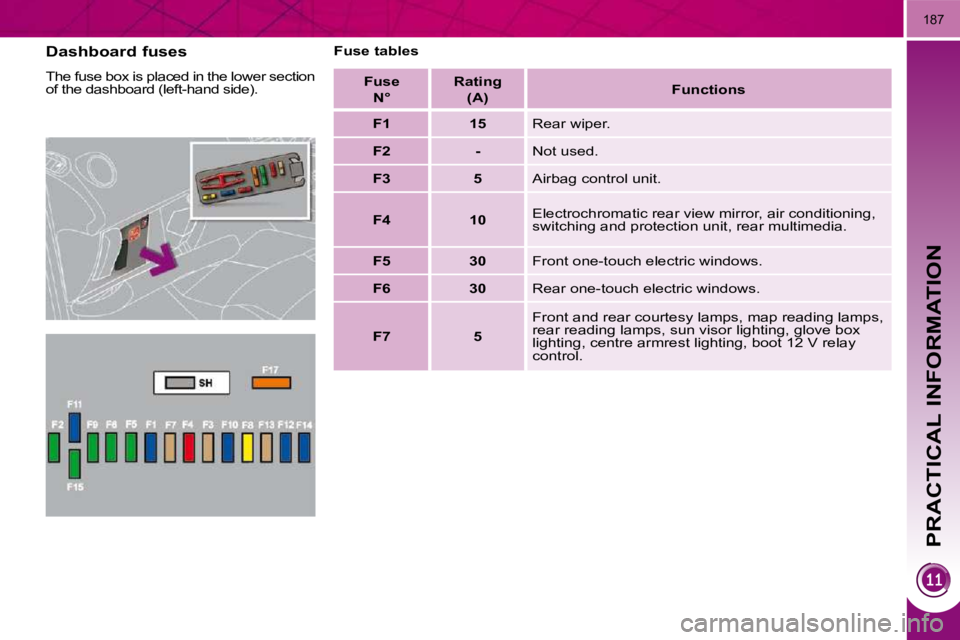
Dashboard fuses
The fuse box is placed in the lower section
of the dashboard (left-hand side). Fuse tables
F us e N° Ratin g
(A) Functions
F1 15 Rear wiper.
F2 - Not used.
F3 5 Airbag control unit.
F4 10 Electrochromatic rear view mirror, air conditioning,
switching and protection unit, rear multimedia.
F5 30 Front one-touch electric windows.
F6 30 Rear one-touch electric windows.
F7 5 Front and rear courtesy lamps, map reading lamps,
rear reading lamps, sun visor lighting, glove box
lighting, centre armrest lighting, boot 12 V relay
control.
Page 220 of 331

PRACTICAL INFORMATION
188
Access to the fuses
refer to the paragraph "Access to
the tools". Fuse
N° Rating
(A) Functions
F8 20 Audio equipment, audio/telephone, CD changer,
multifunction screen, tyre under-infl ation detection,
alarm siren, alarm control unit, telematic unit,
service module (with Peugeot Connect Media).
F9 30 Front 12 V socket, cigar lighter, rear 12 V socket.
F10 15 Steering mounted controls.
F11 15 Low current ignition switch.
F12 15 Trailer presence, rain/brightness sensor, supply for
fuses F32, F34, F35.
F13 5 Engine fusebox, airbag control unit.
F14 15 Instrument panel, instrument panel screen, supply
for fuse F33.
F15 30 Locking and deadlocking.
F17 40 Rear screen demist/defrost, supply for fuse F30.
SH - PARC shunt.
Page 229 of 331
PRACTICAL INFORMATION
197
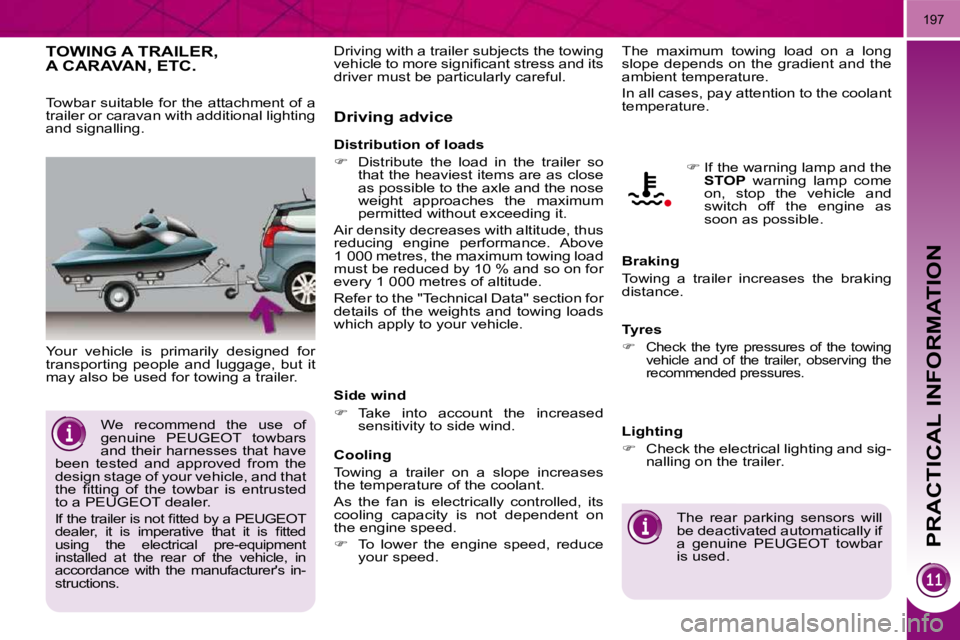
TOWING A TRAILER, A CARAVAN, ETC.
Your vehicle is primarily designed for
transporting people and luggage, but it
may also be used for towing a trailer. Driving advice
The maximum towing load on a long
slope depends on the gradient and the
ambient temperature.
In all cases, pay attention to the coolant
temperature.
Side wind
Take into account the increased
sensitivity to side wind.
Cooling
Towing a trailer on a slope increases
the temperature of the coolant.
As the fan is electrically controlled, its
cooling capacity is not dependent on
the engine speed.
To lower the engine speed, reduce
your speed. Braking
Towing a trailer increases the braking
distance.
Tyres
Check the tyre pressures of the towing
vehicle and of the trailer, observing the
recommended pressures.
Lighting
Check the electrical lighting and sig-
nalling on the trailer.
The rear parking sensors will
be deactivated automatically if
a genuine PEUGEOT towbar
is used.
If the warning lamp and the
STOP warning lamp come
on, stop the vehicle and
switch off the engine as
soon as possible.
Towbar suitable for the attachment of a
trailer or caravan with additional lighting
and signalling.
Distribution of loads
Distribute the load in the trailer so
that the heaviest items are as close
as possible to the axle and the nose
weight approaches the maximum
permitted without exceeding it.
Air density decreases with altitude, thus
reducing engine performance. Above
1 000 metres, the maximum towing load
must be reduced by 10 % and so on for
every 1 000 metres of altitude.
Refer to the "Technical Data" section for
details of the weights and towing loads
which apply to your vehicle.
Driving with a trailer subjects the towing
vehicle to more signifi cant stress and its
driver must be particularly careful.
We recommend the use of
genuine PEUGEOT towbars
and their harnesses that have
been tested and approved from the
design stage of your vehicle, and that
the fi tting of the towbar is entrusted
to a PEUGEOT dealer.
If the trailer is not fi tted by a PEUGEOT
dealer, it is imperative that it is fi tted
using the electrical pre-equipment
installed at the rear of the vehicle, in
accordance with the manufacturer's in-
structions.
Page 237 of 331

TECHNICAL DATA
202
* The kerb weight is equal to the unladen weight + driver (75 kg).
** The weight of the braked trailer can be increased, within the GTW limit, if the GVW of the towing vehicle is reduced by an
equal amount; warning, towing using a lightly loaded to wing vehicle may have an adverse effect on its road holding.
WEIGHTS AND TOWED LOADS (in kg)
Petrol engines 1.6 litre 16V VTi 120 hp 1.6 litre 16V THP 156 hp
Gearbox Manual
(5-speed)
Manual (6-speed)/
Automatic (6 speed)
Seats 5 7 5 7
- Unladen weight 1 427 1 454 1 460 1 490
- Kerb weight * 1 502 1 532 1 535 1 5 65
- Payload 573 736 590 735
- Gross vehicle weight (GVW) 2 000 2 190 2 050 2 225
- Gross train weight (GTW)
on a 12 % gradient 3 200 3 290 3 400 3 425
- Braked trailer (within GTW limit)
on a 10 % or 12 % gradient 1 200 1 100 1 350 1 200
- Braked trailer ** (with load transfer within the GTW limit) 1 400 1 550 1 500
- Unbraked trailer 750 750
- Recommended nose weight 70 70
The GTW and towed load values indicated are valid up to a maximum altitude of 1 000 metres; the towed load mention ed
must be reduced by 10 % for each additional 1 000 metres of a ltitude.
The speed of a towing vehicle must not exceed 60 mph (100 k m/h) (comply with the legislation in force in your country).
High ambient temperatures may result in a reduction in the pe rformance of the vehicle to protect the engine; if the ambient
temperature is above 37 °C, limit the towed load.
476.14