Page 102 of 212
96 Climate control
Picture no: 16489s.tif
Demisting and defrosting the windows
Misted or icy windows, e. g. due to damp
weather, damp clothing or low outside
temperatures:zTurn the temperature switch clockwise as
far as it will go (warm).
zSet fan to 3 or 4.
zSet air distribution switch to V.
zActivate heated rear window Ü.
zOpen side air vents as required and
direct them towards side windows.
zFor simultaneous warming of the foot
well, set air distribution switch to J.
Air conditioning system
3
In addition to the effects of the heating
and ventilation system, the air conditioning
system cools and dehumidified (dries) the
inflowing air.
If no cooling or dehumidification is
required, switch off cooling to save fuel.
Cooling switches off automatically at low
outside temperatures.
9 Warning
Failure to follow the description could
lead to misting or icing of the windows,
which in turn could lead an accident
stemming from lack of visibility.
Page 103 of 212

97
Climate control
Picture no: 13203s.tif
Cooling n
Only operate with the engine and fan
running. Activate and deactivate with
then button.
When cooling (air-conditioning
compressor) is on, the air is cooled and
dried. If no cooling or drying is required,
switch off cooling to save fuel.
Cooling switches off automatically at low
outside temperatures.
When cooling operates, condensation
forms and drips from the underside of the
vehicle.
Picture no: 13202s.tif
Air recirculation system 4
The air recirculation mode of the
ventilation system is activated and
deactivated by pressing the 4 button.
If fumes or unpleasant odours penetrate
from outside: temporarily switch on air
recirculation system 4.
To increase cooling at high outside
temperatures, switch on the air
recirculation system briefly.Air distribution to V: the air recirculation
system is automatically switched off to
speed up window demisting and prevent
fogging.
9 Warning
The air recirculation system minimises
the entry of outside air. The humidity
increases, and the windows can mist up.
The quality of the passenger
compartment air deteriorates which
may cause vehicle occupants to feel
drowsy.
Page 104 of 212

98 Climate control
Picture no: 11624s.tif
Comfort setting
zSet cooling n as desired.
zAir recirculation system 4 off.
zSet temperature switch as desired.
zSwitch on fan at desired speed.
zSet air distribution switch to M or L.
zOpen vents as required.
Temperature switch in centre of
adjustment range: warmer air will flow into
the foot well and cooler air into the upper
zone, with warmer air coming from the side
air vents and cooler air from the centre
vents.
Picture no: 11622s.tif
Maximum cooling
(Maximum Air Conditioning)
Open windows for a short time so that the
heated air can dissipate quickly.
zCooling n on.
zAir circulation system 4 on.
zTurn the temperature switch
anticlockwise as far as it will go (cold).
zSet fan to 4.
zSet air distribution switch to M.
zOpen all vents.
Picture no: 16490s.tif
Demisting and defrosting windows
Misting or icing of the windows, such as
from damp weather conditions, wet clothes
or low outside temperatures:
9 Warning
Failure to follow the description could
lead to misting or icing of the windows,
which in turn could lead an accident
stemming from lack of visibility.
Page 105 of 212

99
Climate control
zCooling n on, the air conditioning
compressor automatically switches off in
low outdoor temperatures (ice
formation),
zTurn the temperature switch clockwise.
zSet fan to 3 or 4.
zAir distribution switch to V, air
recirculation system 4 switches off
automatically.
– or –
If there is still moisture in the system after
previous air conditioning operation, the
windows may mist up. To prevent this,
set air distribution to K before starting
engine and set to V approx. 5 seconds
after starting.
zActivate heated rear window Ü.
zOpen side air vents as required and
direct them towards side windows.
Picture no: 11615s.tif
Air intake The air intakes in front of the windscreen on
the far left and right-hand sides of the
engine compartment must be kept free of
leaves, dirt and snow so as not to obstruct
the air supply. Air outletDo not cover the air outlets when stowing
objects in the luggage compartment. Pollen filter The pollen filter cleans dust, soot, pollen
and spores from the air entering from
outside. The active carbon layer 3
eliminates most odours and noxious
environmental gases from the air.
Regular operationTo make sure that the AC compressor
is constantly working well, the cooling
system3 must be switched on several
minutes once a month regardless of the
weather or season. It is not possible to
activate cooling when outside
temperatures are low. Service For optimal cooling performance, we
recommend that the climate control
system be checked annually, starting
three years after initial vehicle registration.
zFunctionality and pressure test
zHeating functionality
zLeakage check
zCheck of drive belts
zCleaning of condenser and
evaporator drainage
zPerformance check
Page 122 of 212

116 Driving and operation
Picture no: 11718s.tif
Control indicator
A
for engine electronics
Illuminates for a few seconds when ignition
is switched on.
If it comes on when the engine is running,
there is a fault in the engine or transmission
electronics. The electronics switch to the
emergency running programme, fuel
consumption may increase and the
driveability of the vehicle may be affected.
In some cases the fault can be remedied by
switching the engine off and starting it
again. If the control indicator continues to
illuminate whilst the engine is running,
contact a workshop for assistance in
remedying the cause of the fault. If it illuminates briefly, but does not recur, it
is of no significance.
If A illuminates, there may be water in the
diesel fuel filter 3. Have the fuel filter
checked for water residue by a workshop
3177.
I f i t f l a s h e s a f t e r t h e i g n i t i o n i s s w i t c h e d o n ,
there is a fault in the immobiliser system.
The engine cannot be started 321.
Engine exhaust Diesel particle filter 3
The diesel particle filter system filters
harmful soot particles out of the exhaust
gases. The system includes a self-cleaning
function that run automatically during
driving. The filter is cleaned by burning off
the soot particles at high temperature. This
process takes place automatically under
set driving conditions and may take up to
25 minutes. Fuel consumption may be
higher during this period. The emission of
smells and smoke during this process is
normal.
9 Warning
Engine exhaust gases contain poisonous
carbon monoxide, which is colourless
and odourless and could be fatal if
inhaled.
If exhaust gases penetrate the vehicle,
open windows and contact a workshop
for assistance.
Avoid driving with an open tailgate.
Otherwise, exhaust gases could get into
the interior.
Page 138 of 212
132 Self-help, vehicle care
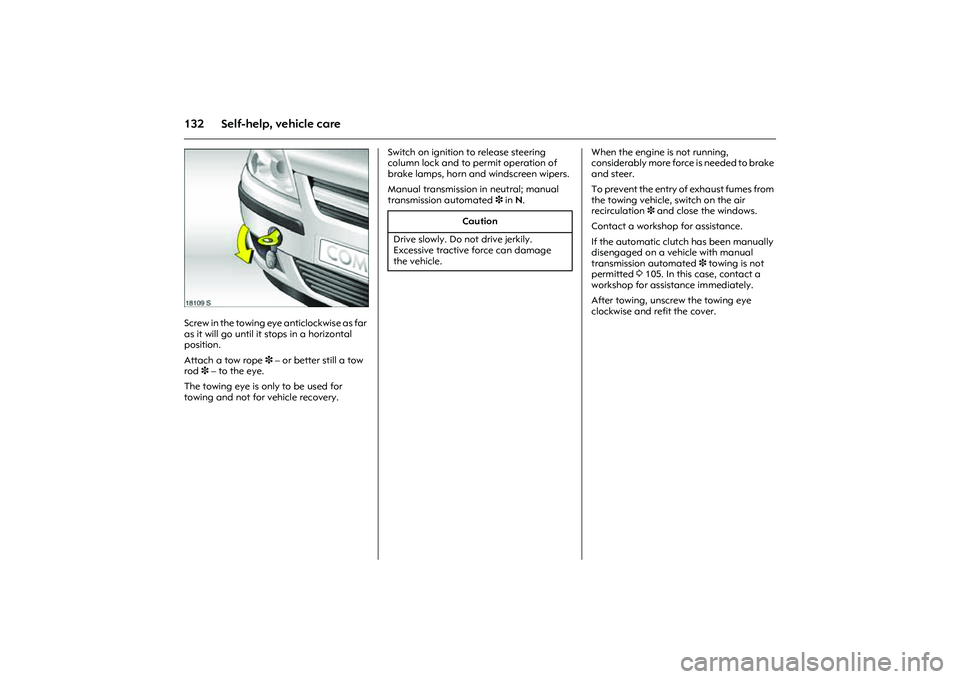
Picture no: 18109s.tif
Screw in the towing eye anticlockwise as far
as it will go until it stops in a horizontal
position.
Attach a tow rope 3 – or better still a tow
rod3 – to the eye.
The towing eye is only to be used for
towing and not for vehicle recovery. Switch on ignition to release steering
column lock and to permit operation of
brake lamps, horn and windscreen wipers.
Manual transmission in neutral; manual
transmission automated 3 in N. When the engine is not running,
considerably more force is needed to brake
and steer.
To prevent the entry of exhaust fumes from
the towing vehicle, switch on the air
recirculation 3 and close the windows.
Contact a workshop for assistance.
If the automatic clutch has been manually
disengaged on a vehicle with manual
transmission automated 3 towing is not
permitted 3105. In this case, contact a
workshop for assistance immediately.
After towing, unscrew the towing eye
clockwise and refit the cover.
Caution
Drive slowly. Do not drive jerkily.
Excessive tractive force can damage
the vehicle.
Page 155 of 212
149
Self-help, vehicle care
Picture no: 11743s.tif Picture no:
No. Circuit
27
Seat heater (left)
No. Circuit
28
ABS
29
Rear window wiperNo. Circuit
30
Engine control unit
31
Air conditioning system
32
ABS, manual transmission
automated, airbag
33
Engine control
34
Diesel filter heater
35
Power windows, Infotainment
system
36
Dipped beam (left)
37
Dipped beam (right)
Page 167 of 212

161
Self-help, vehicle care
Washing
The paintwork of your vehicle is exposed to
environmental influences. Wash and wax
your vehicle regularly. When using
automatic car washes, select a programme
that includes waxing.
Bird droppings, dead insects, resin, pollen
and the like should be cleaned off
immediately, as they contain aggressive
constituents which can cause paint
damage.
When using a car wash, follow the car-
wash manufacturer’s instructions. Switch
off the windscreen wipers 3. Unscrew the
antenna 3 and remove the roof rack 3.
If you wash your vehicle by hand, make
sure that the insides of the wings are also
thoroughly rinsed out.
Clean edges and folds on opened doors
and flaps as well as the areas they cover. Thoroughly rinse off and leather-off the
vehicle. Rinse leather frequently. Use
separate leathers for paint and window
surfaces: remnants of wax on the windows
will impair vision.
Do not use hard objects to remove spots of
tar. Use tar removal spray on painted
surfaces.
Polishing and waxing
Wax the vehicle regularly (at the latest
when water no longer beads). Otherwise,
the paintwork will dry out.
Polishing is necessary only if the paint has
become dull or if solid deposits have
become attached to it.
Paintwork polish with silicone forms a
protective film, making waxing
unnecessary.
Plastic body parts should not be treated
with wax and polish. Wheels and tyres
Do not use high-pressure jet cleaners.
Clean wheels with a pH-neutral wheel
cleaner.
Wheels are painted and can be treated
with the same agents as the body.
Paintwork damage
Rectify minor paintwork damage with a
touch-up pen before rust forms. Have more
extensive damage or rust areas repaired
by a workshop.

