Page 109 of 212

103
Driving and operation
Picture no: 12479S.tif
Winter programme T
In the event of difficulties starting off on
slippery roads, press the T b u t t o n ( " A " a n d
T appear in the transmission display). The
manual transmission automated switches
to automatic mode and the vehicle sets off
in second gear.
The Winter programme is switched off by:
zpressing the T button again,
zturning off the ignition,
zswitching to Manual mode,
zwhen clutch temperature is too high.
Picture no: 13322a.tif
Kickdown
If the accelerator pedal is pressed past the
pressure point, the transmission shifts to a
lower gear depending on engine speed.
During kickdown no manual gear shifting is
possible.
When the engine speed approaches its
upper limit, the transmission shifts to a
higher gear during kickdown even in
Manual mode.
Without kickdown this automatic shift is
not effected in Manual mode. Engine braking
Automatic mode
When driving downhill, the manual
transmission automated does not shift into
higher gears until a fairly high engine
speed has been reached. When braking,
the transmission shifts down in good time.
Manual modeTo utilise the engine braking effect, select a
lower gear in good time when driving
downhill.
"Rocking the car"
T o r o c k a v e h i c l e t h a t i s s t u c k i n s a n d , m u d ,
snow or a rut only, alternate the selector
lever between o (centre position) and R
positions and depress the accelerator
pedal slightly. Keep the engine speed as
low as possible and avoid rapid
acceleration.
Page 110 of 212

104 Driving and operation
Picture no: 14083j.tif
Manoeuvring the vehicle
To manoeuvre the vehicle back and forth
during attempts to park or in garage
entrances the creeping movement can be
utilised by releasing the foot brake.
Never actuate accelerator and brake
pedals simultaneously.
To prevent damage, the manual
transmission automated disengages the
"creep function" at extremely high
automatic clutch temperatures. Vehicle storage
Apply the handbrake and remove the key
from the ignition. The previously selected
gear (shown on the transmission display)
remains selected. No gear is selected in
selector lever position N.
When the ignition is switched off, the
manual transmission automated no longer
responds to movement of the selector
lever.
If the ignition key is not removed, the
battery may be discharged if the vehicle is
then left to stand for a lengthy period of
time.
If the hand brake has not been applied, the
control indicator R flashes for a few
seconds after the ignition is switched off.
Picture no: 12480s.tif
Fault
To prevent damage to the automated
manual transmission, the clutch is closed
automatically at high clutch temperatures.
Control indicator A illuminates in the
event of a fault. Continued driving is
possible. Manual mode cannot be used for
shifting.
If an "F" is also shown in the transmission
display, it is not possible to continue
driving.
Have cause of fault remedied by a
workshop. The system’s integrated self
diagnostics allow faults to be quickly
remedied.
Page 113 of 212

107
Driving and operation
Save energy – more kilometres
Please observe the running-in hints on the
previous page and the tips for saving
energy on the following pages.
Good, technically correct and economical
driving ensures maximum durability and
performance for your vehicle.
Overrun cut-off
The fuel supply is automatically cut off
during overrun, e.g. when the vehicle is
driven with a gear engaged but no throttle
application. Overrun cut-off is deactivated
if catalytic converter temperature is high.
Vehicles with turbocharged engine
Flow-generated noises may be audible if
the accelerator is released quickly on
account of air flow in the turbocharger.
Engine speed
Drive in a low engine speed range for each
gear as much as possible. Warming up
Allow the engine to warm up while driving.
Do not warm it up by letting it run at idling
speed. Do not apply full throttle until the
engine has reached operating
temperature.
In automatic mode, the manual
transmission automated 3 does not shift to
the higher gears after a cold start until
higher engine speeds are reached. This
allows the catalytic converter to quickly
reach the temperature that is required for
optimum pollutant reduction.
Correct gear selection
Do not race your engine whilst in neutral or
with a low gear selected. Driving too fast in
individual gears as well as stop-and-go
traffic increases engine wear and fuel
consumption.
Change down
When decreasing speed, shift down into
the next lowest gear. Do not slip the clutch
with a high-revving engine. This is
especially important when hill climbing. Cooling fan
The cooling fan is controlled via a
thermoswitch and therefore only runs if
necessary.
The cooling fan automatically switches on
when the diesel particle filter is being
cleaned 3 depending on the engine.
Pedals
Do not place any objects in the foot well
which could slip under the pedals and
inhibit the pedal travel.
To ensure the pedal travel is uninhibited,
there must be no mats in the area of the
pedals.
Battery care
When driving slowly or when the vehicle is
stationary, e.g. in slow urban traffic, stop-
and-go traffic or traffic jams, turn off all
unnecessary electrical loads where
possible (e.g. heated rear window, heated
front seats, etc.).
Declutch when starting in order to relieve
the strain on the starter and the battery.
Page 122 of 212

116 Driving and operation
Picture no: 11718s.tif
Control indicator
A
for engine electronics
Illuminates for a few seconds when ignition
is switched on.
If it comes on when the engine is running,
there is a fault in the engine or transmission
electronics. The electronics switch to the
emergency running programme, fuel
consumption may increase and the
driveability of the vehicle may be affected.
In some cases the fault can be remedied by
switching the engine off and starting it
again. If the control indicator continues to
illuminate whilst the engine is running,
contact a workshop for assistance in
remedying the cause of the fault. If it illuminates briefly, but does not recur, it
is of no significance.
If A illuminates, there may be water in the
diesel fuel filter 3. Have the fuel filter
checked for water residue by a workshop
3177.
I f i t f l a s h e s a f t e r t h e i g n i t i o n i s s w i t c h e d o n ,
there is a fault in the immobiliser system.
The engine cannot be started 321.
Engine exhaust Diesel particle filter 3
The diesel particle filter system filters
harmful soot particles out of the exhaust
gases. The system includes a self-cleaning
function that run automatically during
driving. The filter is cleaned by burning off
the soot particles at high temperature. This
process takes place automatically under
set driving conditions and may take up to
25 minutes. Fuel consumption may be
higher during this period. The emission of
smells and smoke during this process is
normal.
9 Warning
Engine exhaust gases contain poisonous
carbon monoxide, which is colourless
and odourless and could be fatal if
inhaled.
If exhaust gases penetrate the vehicle,
open windows and contact a workshop
for assistance.
Avoid driving with an open tailgate.
Otherwise, exhaust gases could get into
the interior.
Page 138 of 212
132 Self-help, vehicle care
Picture no: 18109s.tif
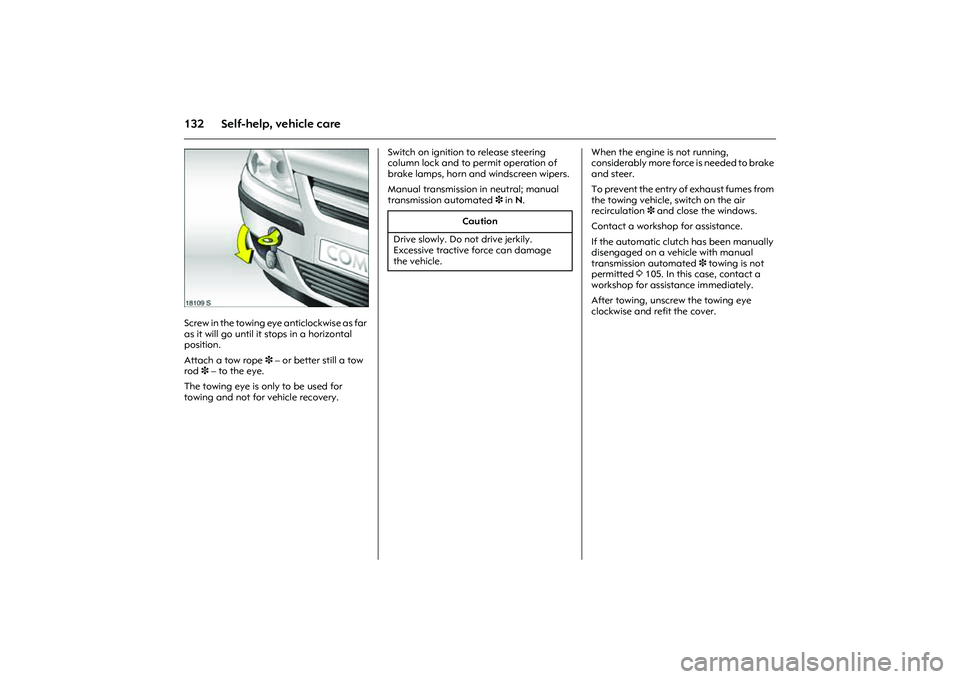
Screw in the towing eye anticlockwise as far
as it will go until it stops in a horizontal
position.
Attach a tow rope 3 – or better still a tow
rod3 – to the eye.
The towing eye is only to be used for
towing and not for vehicle recovery. Switch on ignition to release steering
column lock and to permit operation of
brake lamps, horn and windscreen wipers.
Manual transmission in neutral; manual
transmission automated 3 in N. When the engine is not running,
considerably more force is needed to brake
and steer.
To prevent the entry of exhaust fumes from
the towing vehicle, switch on the air
recirculation 3 and close the windows.
Contact a workshop for assistance.
If the automatic clutch has been manually
disengaged on a vehicle with manual
transmission automated 3 towing is not
permitted 3105. In this case, contact a
workshop for assistance immediately.
After towing, unscrew the towing eye
clockwise and refit the cover.
Caution
Drive slowly. Do not drive jerkily.
Excessive tractive force can damage
the vehicle.