Page 184 of 658
Features and controls
3-89
3
�
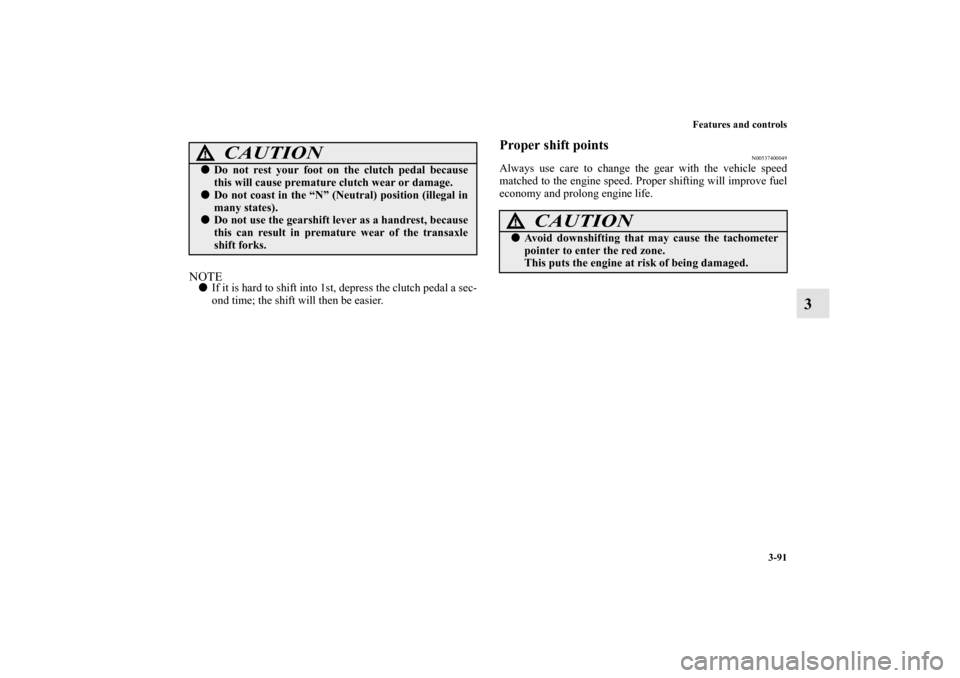
For vehicles equipped with Twin Clutch SST, if the tem-
perature inside the engine compartment is high, the cool-
ing fans (A) will continue to operate for some time even if
the engine is stopped.
Therefore, the operation sound of the cooling fans may be
heard even after the engine is stopped. This sound is nor-
mal and does not indicate a malfunction.
After operating for a period of time, the cooling fans will
stop automatically.
Turbocharger operation
(if so equipped)
N00537300064
*: Front of the vehicle
CAUTION
!�
Do not run the engine at high speeds (for example,
by revving it or by accelerating rapidly) immedi-
ately after starting it.
�
Do not stop the engine immediately after high-speed
or uphill driving. First allow the engine to idle to
give the turbocharger a chance to cool down.
�
Engine oil must be properly maintained to avoid
engine and/or turbocharger damage. To better pro-
tect your engine and turbocharger, use fully syn-
thetic engine oil.
BK0103001US.book 89 ページ 2009年8月20日 木曜日 午前10時45分
Page 185 of 658
3-90 Features and controls
3
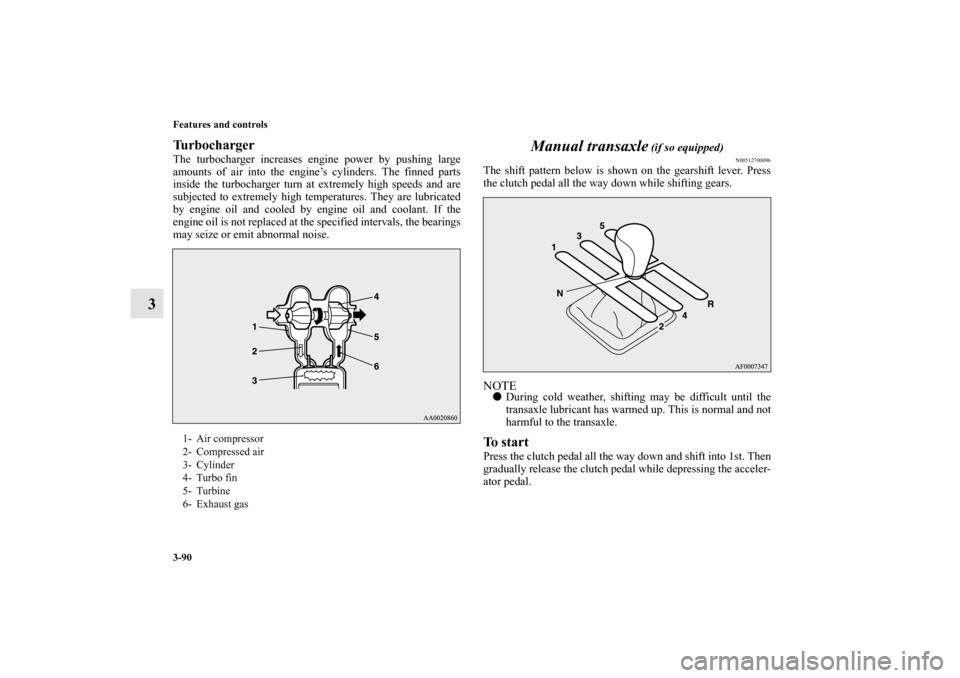
TurbochargerThe turbocharger increases engine power by pushing large
amounts of air into the engine’s cylinders. The finned parts
inside the turbocharger turn at extremely high speeds and are
subjected to extremely high temperatures. They are lubricated
by engine oil and cooled by engine oil and coolant. If the
engine oil is not replaced at the specified intervals, the bearings
may seize or emit abnormal noise.
Manual transaxle
(if so equipped)
N00512700096
The shift pattern below is shown on the gearshift lever. Press
the clutch pedal all the way down while shifting gears.NOTE�
During cold weather, shifting may be difficult until the
transaxle lubricant has warmed up. This is normal and not
harmful to the transaxle.
To startPress the clutch pedal all the way down and shift into 1st. Then
gradually release the clutch pedal while depressing the acceler-
ator pedal.
1- Air compressor
2- Compressed air
3- Cylinder
4- Turbo fin
5- Turbine
6- Exhaust gas
BK0103001US.book 90 ページ 2009年8月20日 木曜日 午前10時45分
Page 186 of 658
Features and controls
3-91
3
NOTE�
If it is hard to shift into 1st, depress the clutch pedal a sec-
ond time; the shift will then be easier.
Proper shift points
N00537400049
Always use care to change the gear with the vehicle speed
matched to the engine speed. Proper shifting will improve fuel
economy and prolong engine life.
CAUTION
!�
Do not rest your foot on the clutch pedal because
this will cause premature clutch wear or damage.
�
Do not coast in the “N” (Neutral) position (illegal in
many states).
�
Do not use the gearshift lever as a handrest, because
this can result in premature wear of the transaxle
shift forks.
CAUTION
!�
Avoid downshifting that may cause the tachometer
pointer to enter the red zone.
This puts the engine at risk of being damaged.
BK0103001US.book 91 ページ 2009年8月20日 木曜日 午前10時45分
Page 187 of 658
3-92 Features and controls
3
Upshifting
N00512900131
For the best fuel economy and performance in using your man-
ual transaxle, upshift as listed below.
At low altitude locations, shift at the vehicle speeds listed.
Upshifting earlier during cruise conditions (relatively steady
speeds) will improve your fuel economy.
At high altitude locations, upshift as listed below.
Downshifting
N00513000096
It is recommended that you downshift to a lower gear when
needed to maintain the desired speed, according to the table.
Avoid downshifting at too high a speed. The engine may suffer
damage.
To maintain a safe speed and prolong brake life, shift down to
2nd or 1st when descending a steep hill.
Downshifting is also important to avoid “lugging” the engine
at too low a speed, such as when turning a corner or when driv-
ing up a steep hill.Recommended downshifting speed
Shift point
Upshift speeds
Acceleration
Cruise
1st gear to 2nd gear 15 mph (24 km/h) 15 mph (24 km/h)2nd gear to 3rd gear 28 mph (45 km/h) 19 mph (31 km/h)3rd gear to 4th gear 36 mph (58 km/h) 33 mph (53 km/h)4th gear to 5th gear 45 mph (72 km/h) 45 mph (72 km/h)
Shift point
Upshift speeds
1st gear to 2nd gear 15 mph (24 km/h)2nd gear to 3rd gear 25 mph (40 km/h)3rd gear to 4th gear 40 mph (64 km/h)4th gear to 5th gear 45 mph (72 km/h)
Downshifting speed
Shift point
Under 20 mph (32 km/h)Shift down from current gear to
2nd gear.20 to 30 mph (32 to 48 km/h)Shift down from current gear to
3rd gear.
BK0103001US.book 92 ページ 2009年8月20日 木曜日 午前10時45分
Page 188 of 658
Features and controls
3-93
3
Driving precautions
N00513100185
�
Do not use the gearshift lever as a handrest. This can
result in premature wear of the transaxle shift forks.
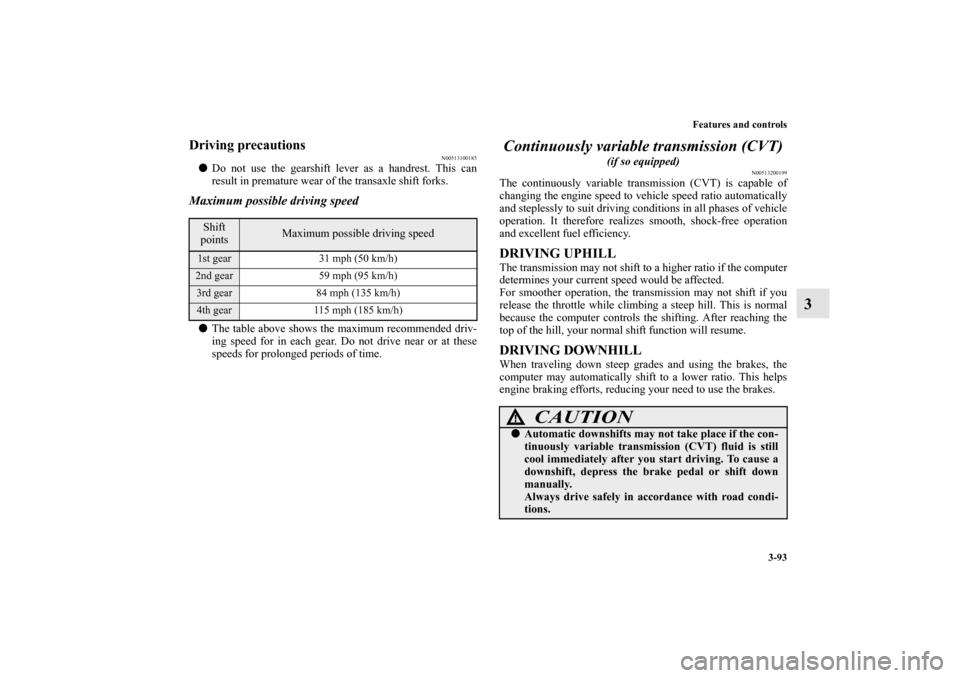
Maximum possible driving speed�
The table above shows the maximum recommended driv-
ing speed for in each gear. Do not drive near or at these
speeds for prolonged periods of time.
Continuously variable transmission (CVT)
(if so equipped)
N00513200199
The continuously variable transmission (CVT) is capable of
changing the engine speed to vehicle speed ratio automatically
and steplessly to suit driving conditions in all phases of vehicle
operation. It therefore realizes smooth, shock-free operation
and excellent fuel efficiency.DRIVING UPHILLThe transmission may not shift to a higher ratio if the computer
determines your current speed would be affected.
For smoother operation, the transmission may not shift if you
release the throttle while climbing a steep hill. This is normal
because the computer controls the shifting. After reaching the
top of the hill, your normal shift function will resume.DRIVING DOWNHILLWhen traveling down steep grades and using the brakes, the
computer may automatically shift to a lower ratio. This helps
engine braking efforts, reducing your need to use the brakes.
Shift
points
Maximum possible driving speed
1st gear 31 mph (50 km/h)2nd gear 59 mph (95 km/h)3rd gear 84 mph (135 km/h)4th gear 115 mph (185 km/h)
CAUTION
!�
Automatic downshifts may not take place if the con-
tinuously variable transmission (CVT) fluid is still
cool immediately after you start driving. To cause a
downshift, depress the brake pedal or shift down
manually.
Always drive safely in accordance with road condi-
tions.
BK0103001US.book 93 ページ 2009年8月20日 木曜日 午前10時45分
Page 191 of 658
3-96 Features and controls
3
When the selector lever cannot be shifted from the “P”
(PARK) position
N00563100021
When the selector lever cannot be shifted from the “P” (PARK)
position to another position while the brake pedal is pressed
and held down with the ignition switch at the “ON” position,
the battery may be flat or the shift-lock mechanism may be
malfunctioning.
Immediately have your vehicle checked by an authorized Mit-
subishi Motors dealer or a repair facility of your choice.
If you need to move the vehicle, shift the selector lever as fol-
lows.
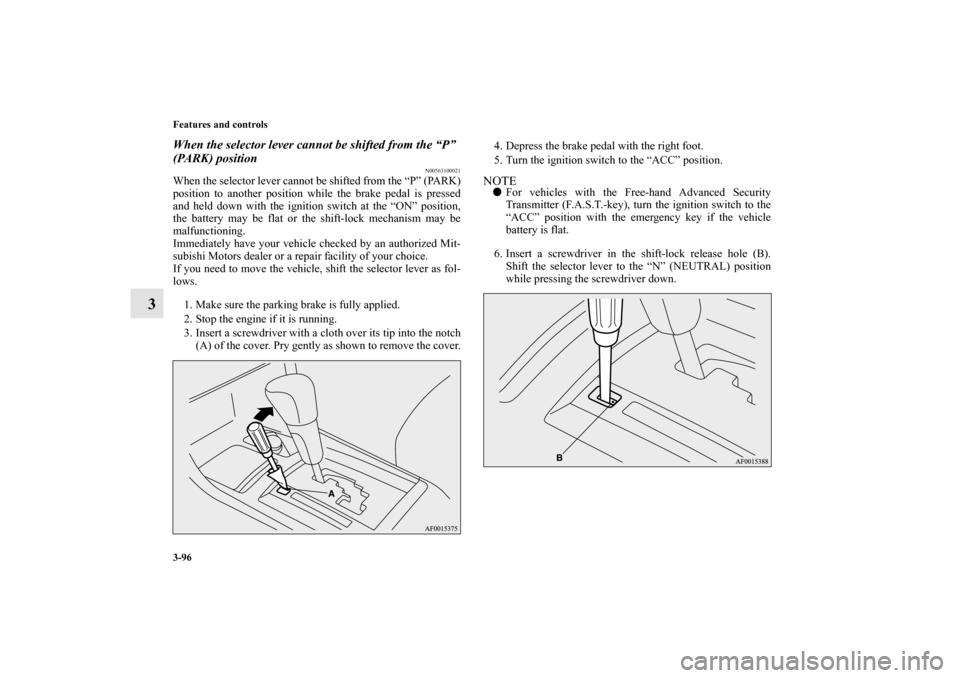
1. Make sure the parking brake is fully applied.
2. Stop the engine if it is running.
3. Insert a screwdriver with a cloth over its tip into the notch
(A) of the cover. Pry gently as shown to remove the cover.4. Depress the brake pedal with the right foot.
5. Turn the ignition switch to the “ACC” position.
NOTE�
For vehicles with the Free-hand Advanced Security
Transmitter (F.A.S.T.-key), turn the ignition switch to the
“ACC” position with the emergency key if the vehicle
battery is flat.
6. Insert a screwdriver in the shift-lock release hole (B).
Shift the selector lever to the “N” (NEUTRAL) position
while pressing the screwdriver down.
BK0103001US.book 96 ページ 2009年8月20日 木曜日 午前10時45分
Page 193 of 658

3-98 Features and controls
3
Selector lever positions
N00514200327
“P” PARKThis position locks the transmission to prevent the vehicle
from moving. The engine can be started from the “PARK”
position.“R” REVERSEMove the lever to this position only after the vehicle has come
to a complete stop.
CAUTION
!�
If a malfunction occurs in the CVT while driving,
the warning display or the warning display
will appear on the information screen in the multi-
information display.
In this case, immediately park your vehicle in a safe
place and follow these procedures:
[When warning display is showing]
The continuously variable transmission (CVT) fluid
is overheating. The engine control may activate to
lower the CVT fluid temperature, causing the
engine revolutions and vehicle speed to decrease. In
this case, take one of the following procedures: Slow down your vehicle.
Stop your vehicle in a safe place, put the selector
lever in the “P” (PARK) position, and open the
engine hood with the engine running to allow the
engine to cool down.After a while, confirm that the warning display is
no longer showing. It is safe to continue driving if
the display is no longer showing. If the warning dis-
play remains or flashes frequently, have your vehicle
inspected by an authorized Mitsubishi Motors
dealer or a repair facility of your choice.
[When warning display is showing]
It may be that there is something unusual happening
in the CVT, causing a safety device to activate. Have
your vehicle inspected by an authorized Mitsubishi
Motors dealer or a repair facility of your choice as
soon as possible. CAUTION
!�
Never shift into the “P” (PARK) or “R”
(REVERSE) position while the vehicle is in motion.
If the lever is shifted into the “P” (PARK) or “R”
(REVERSE) position while the vehicle is in motion,
the transmission may be damaged. CAUTION
!
BK0103001US.book 98 ページ 2009年8月20日 木曜日 午前10時45分
Page 194 of 658
Features and controls
3-99
3
“N” NEUTRALAt this position, the transmission is disengaged. It is the same
as the neutral position on a manual transaxle and should be
used when the vehicle is not moving for an extended length of
time during driving, such as in a traffic jam.
“D” DRIVEThis position is used for most city and highway driving. Engine
shifting and braking are done automatically as needed, depend-
ing on road conditions.NOTE�
For information on manual gate operation, please refer to
“Sports mode” on page 3-100.
WA R N I N G
!�
Never move the selector lever to the “N” (NEU-
TRAL) position while driving since you could acci-
dentally slip it into the “P” (PARK) or
“R”(REVERSE) position, damaging the transmis-
sion.
�
To prevent the vehicle from rolling when stopped on
a slope, the engine should be started in the “P”
(PARK) position, not in “N” (NEUTRAL) position.
�
Always keep your foot on the brake pedal when the
vehicle is in “N” (NEUTRAL) position, or when
shifting into or out of “N” (NEUTRAL) position, to
prevent rolling.
CAUTION
!�
Never shift into the “D” (DRIVE) position from the
“R” (REVERSE) position while the vehicle is in
motion. Transmission damage will result.
BK0103001US.book 99 ページ 2009年8月20日 木曜日 午前10時45分