Page 543 of 658
7-12 Vehicle care and maintenance
7
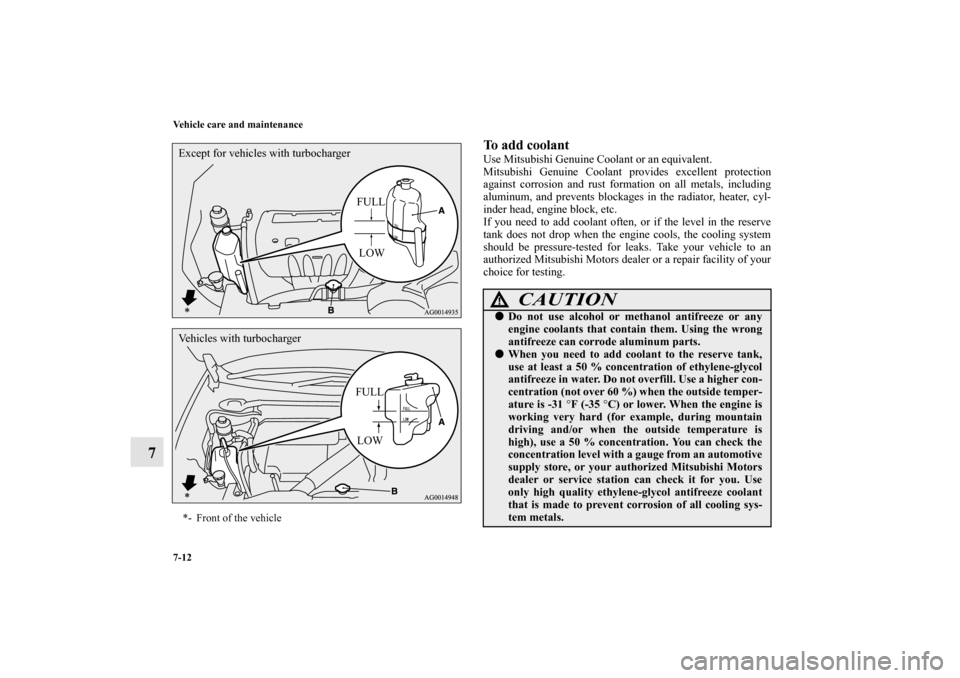
To add coolant Use Mitsubishi Genuine Coolant or an equivalent.
Mitsubishi Genuine Coolant provides excellent protection
against corrosion and rust formation on all metals, including
aluminum, and prevents blockages in the radiator, heater, cyl-
inder head, engine block, etc.
If you need to add coolant often, or if the level in the reserve
tank does not drop when the engine cools, the cooling system
should be pressure-tested for leaks. Take your vehicle to an
authorized Mitsubishi Motors dealer or a repair facility of your
choice for testing.
*- Front of the vehicle
FULL
LOW Except for vehicles with turbocharger
Vehicles with turbocharger
FULL
LOW
CAUTION
!�
Do not use alcohol or methanol antifreeze or any
engine coolants that contain them. Using the wrong
antifreeze can corrode aluminum parts.
�
When you need to add coolant to the reserve tank,
use at least a 50 % concentration of ethylene-glycol
antifreeze in water. Do not overfill. Use a higher con-
centration (not over 60 %) when the outside temper-
ature is -31 °F (-35 °C) or lower. When the engine is
working very hard (for example, during mountain
driving and/or when the outside temperature is
high), use a 50 % concentration. You can check the
concentration level with a gauge from an automotive
supply store, or your authorized Mitsubishi Motors
dealer or service station can check it for you. Use
only high quality ethylene-glycol antifreeze coolant
that is made to prevent corrosion of all cooling sys-
tem metals.
BK0103001US.book 12 ページ 2009年8月20日 木曜日 午前10時45分
Page 544 of 658
Vehicle care and maintenance
7-13
7
Radiator capThe radiator cap must be tight sealed to prevent losing coolant
which may result in engine damage. Only use a Genuine Mit-
subishi Parts radiator cap, or an approved equivalent.
Points to remember �
Do not overfill the reserve tank.
�
Your vehicle uses a special radiator cap that stays sealed
and lets the coolant flow from the reserve tank back to the
radiator when the engine cools down. If you need to
change the cap, use the exact same kind.
�
Check the coolant freeze point in the radiator with the
proper gauge, and only when it is safe. If you add anti-
freeze, the contents of the reserve tank must be protected
against freezing.
�
Keep the front of the radiator and condenser clean.
�
If the temperature of the engine coolant does not rise after
the engine is warmed-up, take your vehicle to an autho-
rized Mitsubishi Motors dealer or a repair facility of your
choice to have the thermostat checked, and replaced if
necessary.
�
Do not top off the tank with plain water only. Water
by itself boils at a lower temperature and does not
stop rust or freezing. If the water freezes, it will
damage your cooling system. Do not use tapwater. It
can cause corrosion and rust. WA R N I N G
!�
Wait for the engine to cool down before opening the
radiator cap. Otherwise hot steam or boiling coolant
could spray up from the radiator and scald you. CAUTION
!
BK0103001US.book 13 ページ 2009年8月20日 木曜日 午前10時45分
Page 552 of 658
Vehicle care and maintenance
7-21
7 Wa s h e r f l u i d
N00938600273
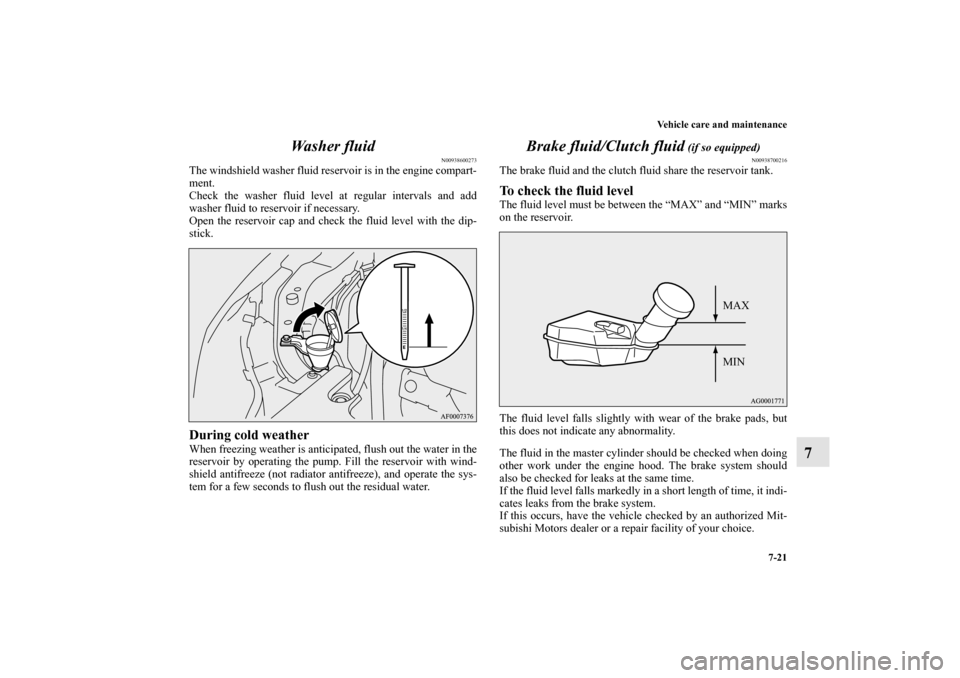
The windshield washer fluid reservoir is in the engine compart-
ment.
Check the washer fluid level at regular intervals and add
washer fluid to reservoir if necessary.
Open the reservoir cap and check the fluid level with the dip-
stick.During cold weatherWhen freezing weather is anticipated, flush out the water in the
reservoir by operating the pump. Fill the reservoir with wind-
shield antifreeze (not radiator antifreeze), and operate the sys-
tem for a few seconds to flush out the residual water.
Brake fluid/Clutch fluid
(if so equipped)
N00938700216
The brake fluid and the clutch fluid share the reservoir tank.To check the fluid levelThe fluid level must be between the “MAX” and “MIN” marks
on the reservoir.
The fluid level falls slightly with wear of the brake pads, but
this does not indicate any abnormality.
The fluid in the master cylinder should be checked when doing
other work under the engine hood. The brake system should
also be checked for leaks at the same time.
If the fluid level falls markedly in a short length of time, it indi-
cates leaks from the brake system.
If this occurs, have the vehicle checked by an authorized Mit-
subishi Motors dealer or a repair facility of your choice.
MAX
MIN
BK0103001US.book 21 ページ 2009年8月20日 木曜日 午前10時45分
Page 553 of 658
7-22 Vehicle care and maintenance
7
Fluid typeUse brake fluid conforming to DOT 3 or DOT 4. The reservoir
cap must be tightly sealed to keep dirt and water out.
Power steering fluid
N00939000287
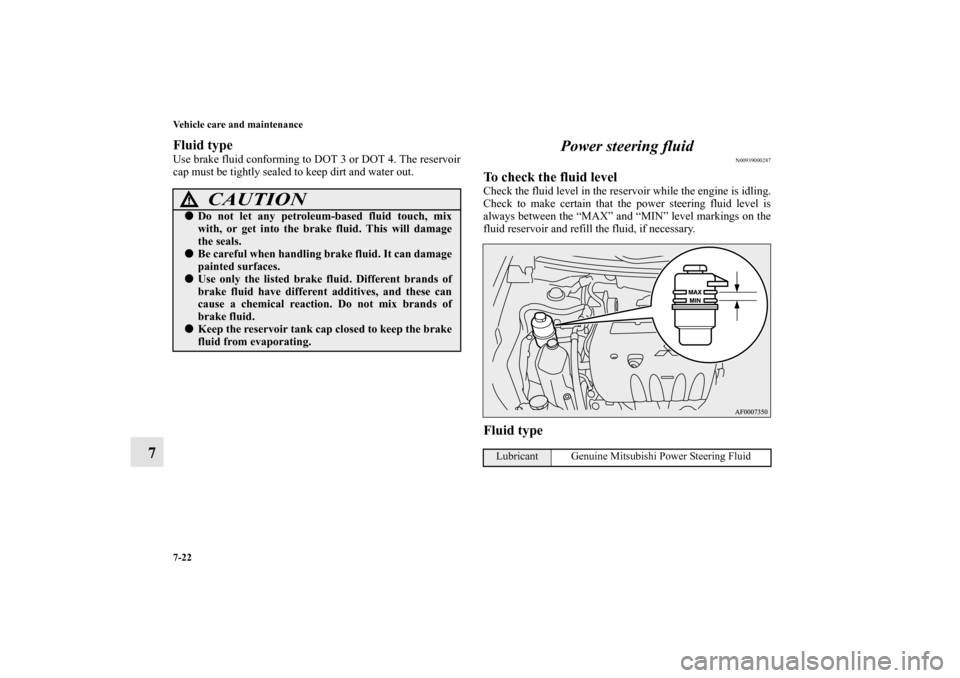
To check the fluid levelCheck the fluid level in the reservoir while the engine is idling.
Check to make certain that the power steering fluid level is
always between the “MAX” and “MIN” level markings on the
fluid reservoir and refill the fluid, if necessary.Fluid type
CAUTION
!�
Do not let any petroleum-based fluid touch, mix
with, or get into the brake fluid. This will damage
the seals.
�
Be careful when handling brake fluid. It can damage
painted surfaces.
�
Use only the listed brake fluid. Different brands of
brake fluid have different additives, and these can
cause a chemical reaction. Do not mix brands of
brake fluid.
�
Keep the reservoir tank cap closed to keep the brake
fluid from evaporating.
Lubricant Genuine Mitsubishi Power Steering Fluid
BK0103001US.book 22 ページ 2009年8月20日 木曜日 午前10時45分
Page 554 of 658
Vehicle care and maintenance
7-23
7 Battery
N00939100826
The condition of the battery is very important for quick starting
and to keep the vehicle’s electrical system working properly.
Check the battery regularly. Removing and installing the battery upper cover
(vehicles equipped with turbocharger)
N00901300025
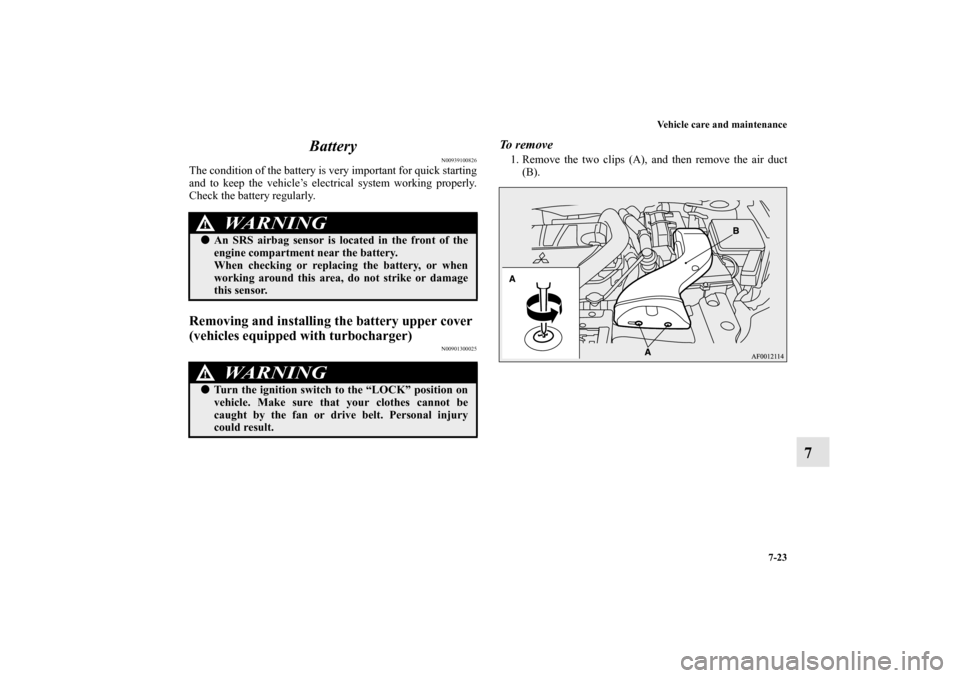
To r e m o v e1. Remove the two clips (A), and then remove the air duct
(B).
WA R N I N G
!�
An SRS airbag sensor is located in the front of the
engine compartment near the battery.
When checking or replacing the battery, or when
working around this area, do not strike or damage
this sensor.WA R N I N G
!�
Turn the ignition switch to the “LOCK” position on
vehicle. Make sure that your clothes cannot be
caught by the fan or drive belt. Personal injury
could result.
BK0103001US.book 23 ページ 2009年8月20日 木曜日 午前10時45分
Page 556 of 658
Vehicle care and maintenance
7-25
7
To check the battery indicator
N00901400042
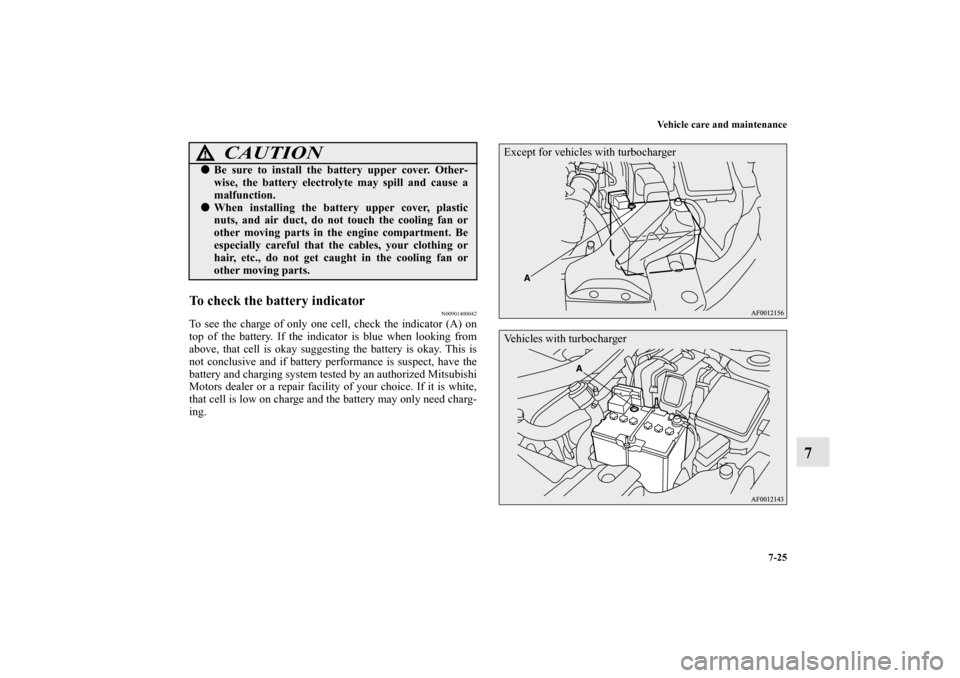
To see the charge of only one cell, check the indicator (A) on
top of the battery. If the indicator is blue when looking from
above, that cell is okay suggesting the battery is okay. This is
not conclusive and if battery performance is suspect, have the
battery and charging system tested by an authorized Mitsubishi
Motors dealer or a repair facility of your choice. If it is white,
that cell is low on charge and the battery may only need charg-
ing.
CAUTION
!�
Be sure to install the battery upper cover. Other-
wise, the battery electrolyte may spill and cause a
malfunction.
�
When installing the battery upper cover, plastic
nuts, and air duct, do not touch the cooling fan or
other moving parts in the engine compartment. Be
especially careful that the cables, your clothing or
hair, etc., do not get caught in the cooling fan or
other moving parts.
Except for vehicles with turbochargerVehicles with turbocharger
BK0103001US.book 25 ページ 2009年8月20日 木曜日 午前10時45分
Page 558 of 658
Vehicle care and maintenance
7-27
7
During cold weather
N00901600028
The battery is weaker in cold temperatures. This has to do with
its chemical and physical properties and is why a very cold bat-
tery, especially one with a low charge, will have a hard time
starting your vehicle.
It is recommended that you have your battery and charging sys-
tem checked by an authorized Mitsubishi Motors dealer or a
repair facility of your choice before the start of cold weather. If
necessary, have it charged. This will guarantee more reliable
starting, and longer battery life.
Disconnection and connection
N00901700029
To disconnect the battery cable, stop the engine. Disconnect the
negative (-) terminal first, then the positive (+) terminal. To
reconnect the battery, first connect the positive (+) terminal and
then the negative (-) terminal, before starting the vehicle. NOTE�
For vehicles equipped with turbocharger, remove the bat-
tery upper cover before disconnecting the terminal of bat-
tery. Refer to “Removing and installing the battery upper
cover” on page 7-23.
BK0103001US.book 27 ページ 2009年8月20日 木曜日 午前10時45分
Page 559 of 658
7-28 Vehicle care and maintenance
7
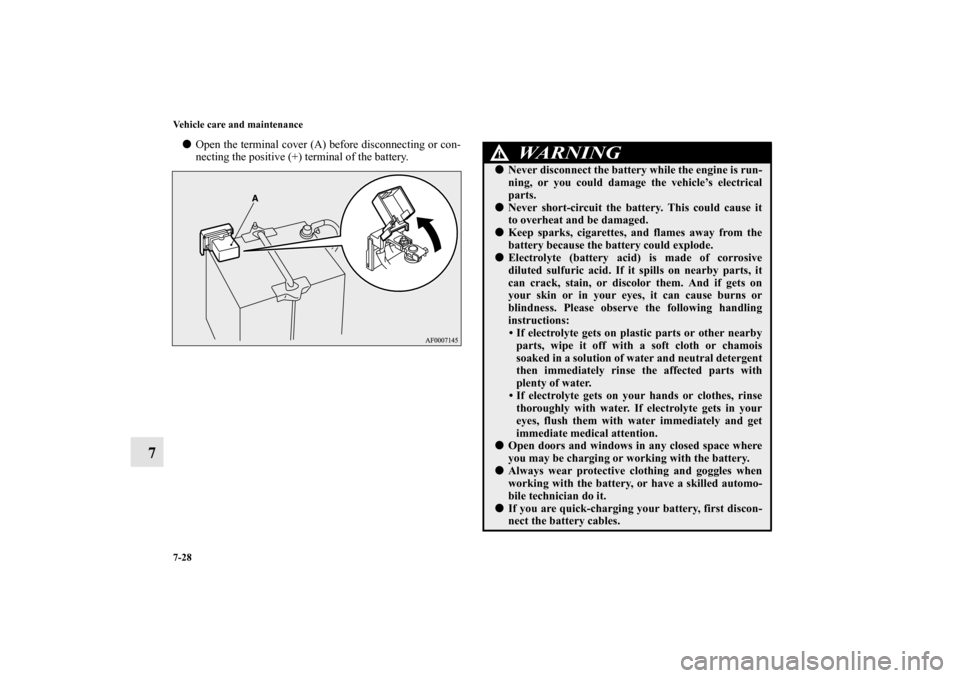
�
Open the terminal cover (A) before disconnecting or con-
necting the positive (+) terminal of the battery.
WA R N I N G
!�
Never disconnect the battery while the engine is run-
ning, or you could damage the vehicle’s electrical
parts.
�
Never short-circuit the battery. This could cause it
to overheat and be damaged.
�
Keep sparks, cigarettes, and flames away from the
battery because the battery could explode.
�
Electrolyte (battery acid) is made of corrosive
diluted sulfuric acid. If it spills on nearby parts, it
can crack, stain, or discolor them. And if gets on
your skin or in your eyes, it can cause burns or
blindness. Please observe the following handling
instructions: If electrolyte gets on plastic parts or other nearby
parts, wipe it off with a soft cloth or chamois
soaked in a solution of water and neutral detergent
then immediately rinse the affected parts with
plenty of water.
If electrolyte gets on your hands or clothes, rinse
thoroughly with water. If electrolyte gets in your
eyes, flush them with water immediately and get
immediate medical attention.
�
Open doors and windows in any closed space where
you may be charging or working with the battery.
�
Always wear protective clothing and goggles when
working with the battery, or have a skilled automo-
bile technician do it.
�
If you are quick-charging your battery, first discon-
nect the battery cables.
BK0103001US.book 28 ページ 2009年8月20日 木曜日 午前10時45分