Page 581 of 658
7-50 Vehicle care and maintenance
7
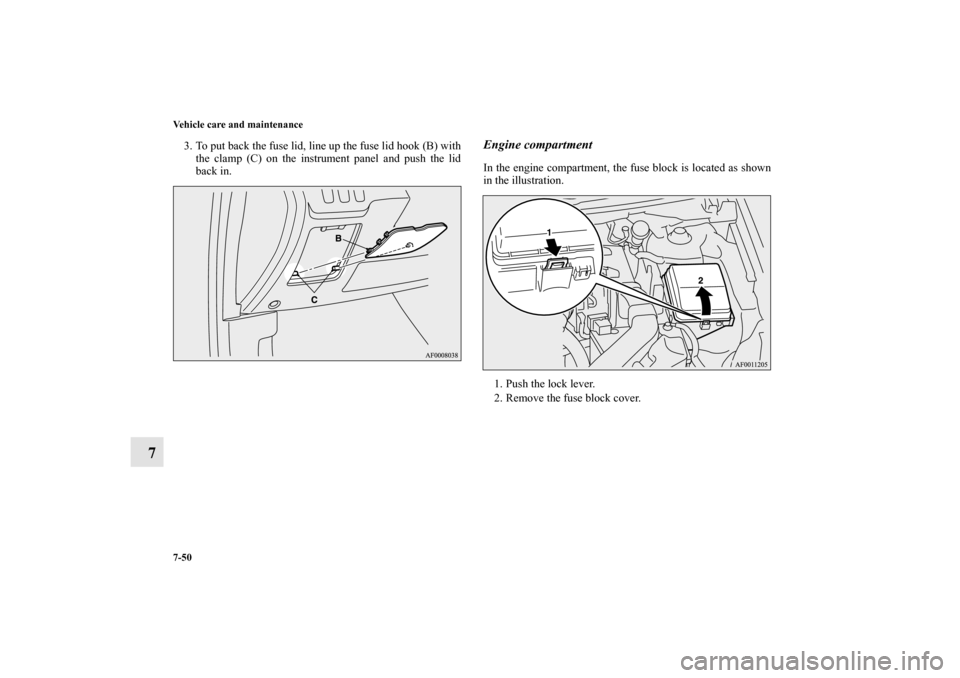
3. To put back the fuse lid, line up the fuse lid hook (B) with
the clamp (C) on the instrument panel and push the lid
back in.
Engine compartmentIn the engine compartment, the fuse block is located as shown
in the illustration.
1. Push the lock lever.
2. Remove the fuse block cover.
BK0103001US.book 50 ページ 2009年8月20日 木曜日 午前10時45分
Page 582 of 658
Vehicle care and maintenance
7-51
7
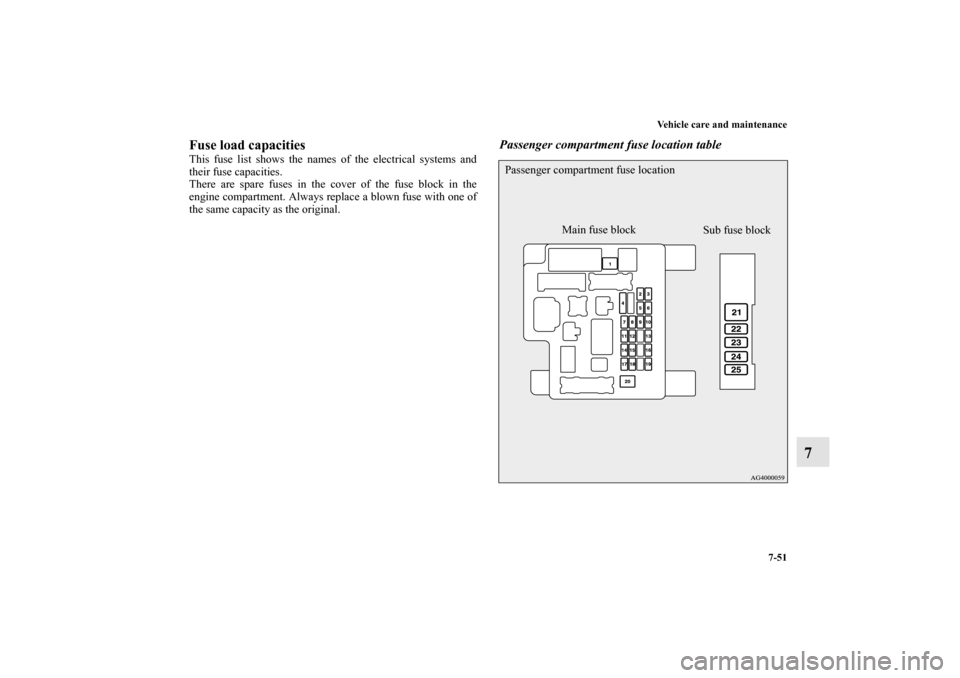
Fuse load capacities This fuse list shows the names of the electrical systems and
their fuse capacities.
There are spare fuses in the cover of the fuse block in the
engine compartment. Always replace a blown fuse with one of
the same capacity as the original.
Passenger compartment fuse location tablePassenger compartment fuse location
Sub fuse block Main fuse block
BK0103001US.book 51 ページ 2009年8月20日 木曜日 午前10時45分
Page 584 of 658
Vehicle care and maintenance
7-53
7
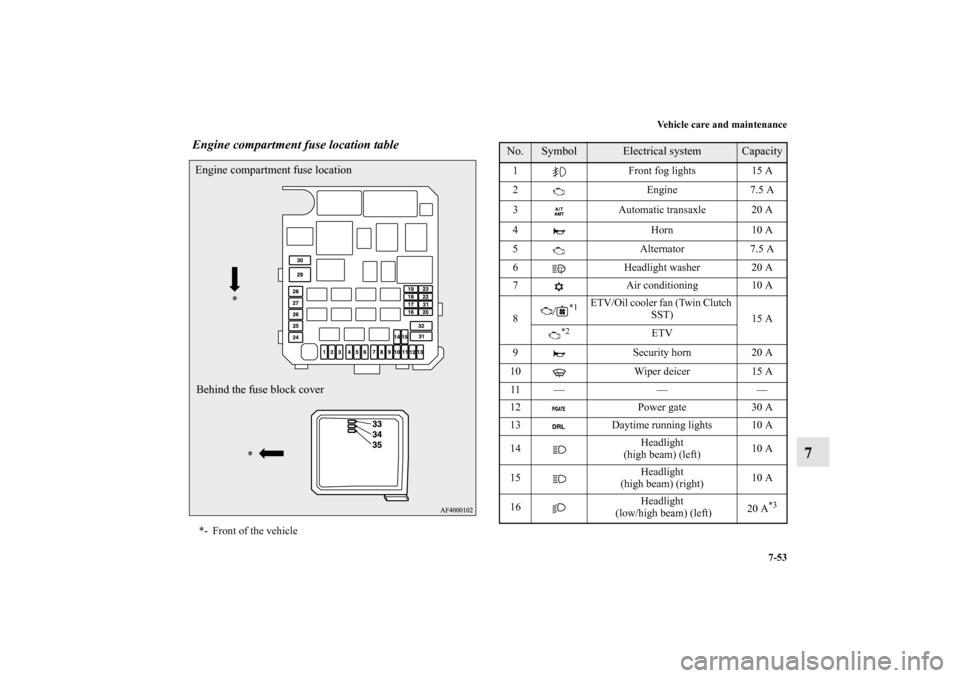
Engine compartment fuse location table*- Front of the vehicleEngine compartment fuse location
Behind the fuse block cover*
*
No.
Symbol
Electrical system
Capacity
1 Front fog lights 15 A
2 Engine 7.5 A
3 Automatic transaxle 20 A
4 Horn 10 A
5 Alternator 7.5 A
6 Headlight washer 20 A
7 Air conditioning 10 A
8
*1
ETV/Oil cooler fan (Twin Clutch
SST)
15 A
*2
ETV
9 Security horn 20 A
10 Wiper deicer 15 A
11 — — —
12 Power gate 30 A
13 Daytime running lights 10 A
14Headlight
(high beam) (left)10 A
15Headlight
(high beam) (right)10 A
16Headlight
(low/high beam) (left)20 A
*3
BK0103001US.book 53 ページ 2009年8月20日 木曜日 午前10時45分
Page 586 of 658
Vehicle care and maintenance
7-55
7
Identification of fuse
Fuse replacement
N00954900085
1. Before replacing a fuse, always turn off the electrical item
connected to the fuse and turn the ignition switch to the
“LOCK” position.
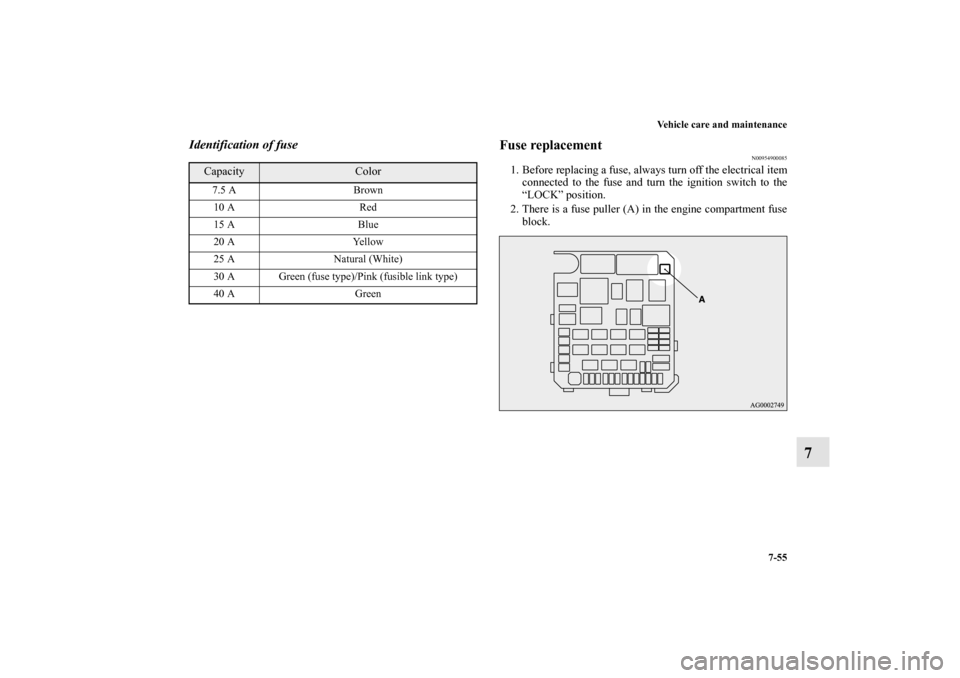
2. There is a fuse puller (A) in the engine compartment fuse
block.
Capacity
Color
7.5 A Brown
10 A Red
15 A Blue
20 A Yellow
25 A Natural (White)
30 A Green (fuse type)/Pink (fusible link type)
40 A Green
BK0103001US.book 55 ページ 2009年8月20日 木曜日 午前10時45分
Page 593 of 658
7-62 Vehicle care and maintenance
7
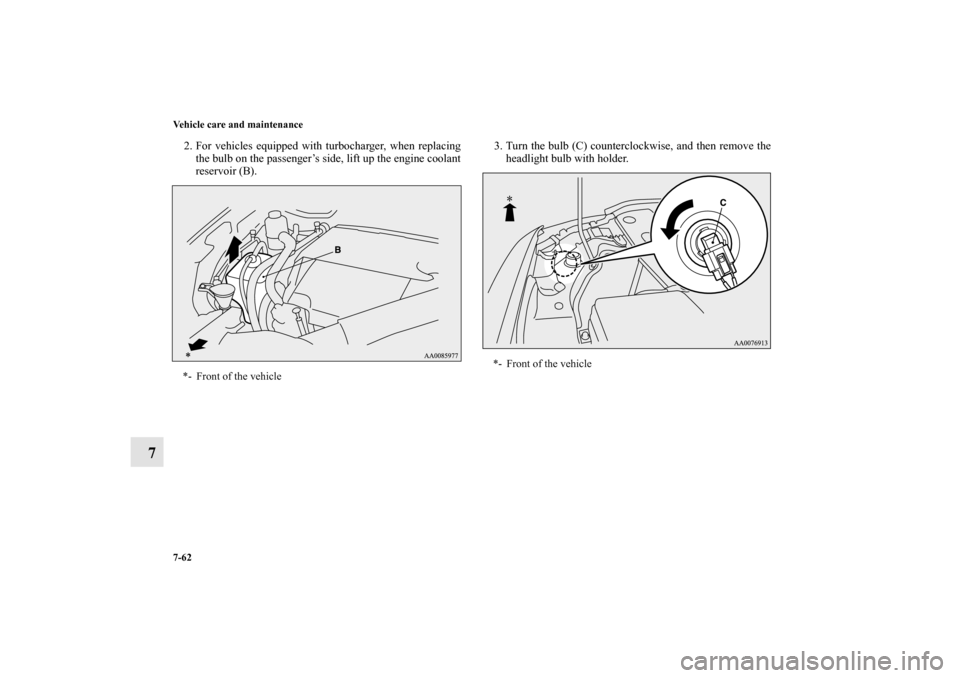
2. For vehicles equipped with turbocharger, when replacing
the bulb on the passenger’s side, lift up the engine coolant
reservoir (B).3. Turn the bulb (C) counterclockwise, and then remove the
headlight bulb with holder.*- Front of the vehicle
*- Front of the vehicle
BK0103001US.book 62 ページ 2009年8月20日 木曜日 午前10時45分
Page 600 of 658
Vehicle care and maintenance
7-69
7
Front side-marker and parking lights (except for
vehicles equipped with high intensity discharge
headlights)
N00917300440
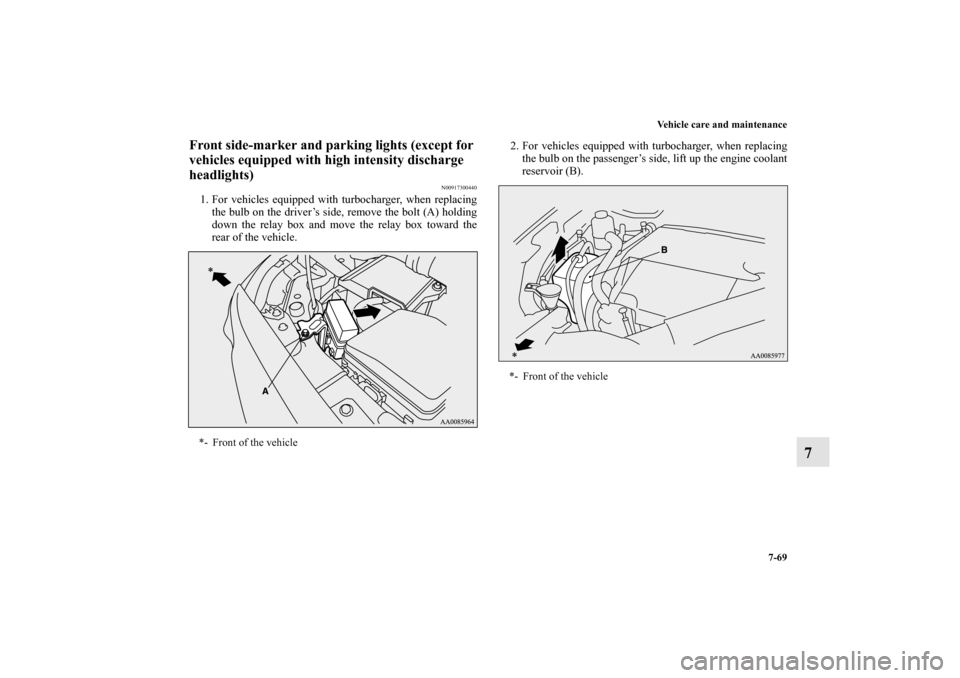
1. For vehicles equipped with turbocharger, when replacing
the bulb on the driver’s side, remove the bolt (A) holding
down the relay box and move the relay box toward the
rear of the vehicle.2. For vehicles equipped with turbocharger, when replacing
the bulb on the passenger’s side, lift up the engine coolant
reservoir (B).*- Front of the vehicle
*- Front of the vehicle
BK0103001US.book 69 ページ 2009年8月20日 木曜日 午前10時45分
Page 626 of 658
Vehicle care and maintenance
7-95
7
During cold weather Salt and other chemicals spread on winter roads in some geo-
graphical areas can have a detrimental effect on the vehicle
underbody. You should flush the underbody with a high pres-
sure hose every time you wash the outside of your vehicle.
Take special care to remove mud or other debris which could
trap and hold salt and moisture.
After washing your vehicle, wipe off all waterdrops from the
rubber parts around the doors to prevent the doors from freez-
ing.
CAUTION
!�
When washing the underside of your vehicle or the
wheels, wear a pair of gloves to protect your hands.
�
If your vehicle has rain sensor wipers, place the
wiper switch lever in the “OFF” position to deacti-
vate the rain sensor before washing the vehicle. Oth-
erwise, the wipers will operate in the presence of
water spray on the windshield and may get damaged
as a result.
�
Never spray or splash water on the electrical parts
in the engine compartment. This may damage them.
Be careful also when washing the underbody. Do not
spray water into the engine compartment.
�
Avoid automatic car washers that use rotating
brushes. These brushes may scratch the paint sur-
face and make it dull.
Scratches are more noticeable on darker colored
vehicles.
�
Some hot water washing equipment uses high pres-
sure and heat to clean your vehicle. This heated
water may damage your vehicle’s resin parts. It can
flood the interior of the vehicle. Therefore, be sure
of the following: Keep the washing nozzle at least 20 inches (50 cm)
away from the vehicle body.
When washing around the door glass, hold the
nozzle at a distance of more than 20 inches (50 cm)
and at right angles to the glass surface.
�
When using high-pressure water to wash a vehicle
equipped with the F.A.S.T.-key system, keep the
water from spraying on the open button on the rear
hatch. This could cause the rear hatch to open and
flood the inside of the rear hatch.
�
Make sure to do the following when using an auto-
matic car wash, with help from either this manual or
the car wash operator, to avoid damaging your vehi-
cle: Fold the outside rear-view mirrors.
Put down (except for vehicles equipped with SIR-
IUS satellite radio antenna only) or remove the
antenna.
If your vehicle is equipped with rear spoiler, check
with the car wash operator before using the car
wash.
If your vehicle has rain sensor wipers, place the
wiper switch lever in the “OFF” position to deacti-
vate the rain sensor.CAUTION
!
BK0103001US.book 95 ページ 2009年8月20日 木曜日 午前10時45分
Page 627 of 658
7-96 Vehicle care and maintenance
7
NOTE�
When the door is frozen, opening it by force may tear off
or crack the rubber gasket installed around the door. Pour
warm water to melt the ice. Be sure to thoroughly wipe off
the water after opening the door. To prevent freezing of
the weatherstripping on the doors, hood, etc., treat with
silicone lubricant.
Waxing
N00946000218
Wax your vehicle once or twice a year, or when water does not
bead up on the paint.
Use a soft cloth to put a small amount of wax on the painted
surfaces. After the wax has dried, polish with a dry soft cloth.
Do not wax your vehicle in direct sunlight.
You should wax when the painted surfaces are cool.
Polishing
N00946100059
If painted surfaces have been severely damaged and lost their
original luster and color tone, polish the surface lightly with a
fine polishing compound. Avoid limiting your polishing to the
damaged surface only; polish a somewhat wider area, moving
the polishing cloth in one direction. After polishing, flush the
compound from the surface and apply a coat of wax to regain a
beautiful luster.Damaged paint
N00946200063
Small cracks and scratches in the paint coat should be touched
up as soon as possible with touch-up paint to prevent corrosion.
Check body areas facing the road or the tires carefully for dam-
age to the paint caused by flying stones, etc. The paint code
number for your vehicle can be found on the vehicle informa-
tion code plate in the engine compartment.
CAUTION
!�
Waxes containing high abrasive compounds should
not be used. These waxes remove rust and stain
effectively from the paintwork, but are harmful to
the finish on the paint and the plate, because they
also remove clearcoat.
They are also harmful to other glossy surfaces such
as the grille, trim, moldings, etc.
�
Do not use gasoline, kerosene, benzine or paint thin-
ners to remove road tar or other dirt from the vehi-
cle surface.
�
Do not put wax on the areas having black matte
coating because it can cause uneven discoloration,
patches, blurs, etc. If these get wax on them, wipe
the wax off right away with a soft cloth and warm
water.
�
On vehicles equipped with sunroof, be careful not to
apply any wax on the weatherstrip (black rubber)
when waxing the area around the sunroof opening.
If stained with wax, the weatherstrip cannot main-
tain a weatherproof seal with the sunroof.CAUTION
!
BK0103001US.book 96 ページ 2009年8月20日 木曜日 午前10時45分